Helpex® effect
Ukraine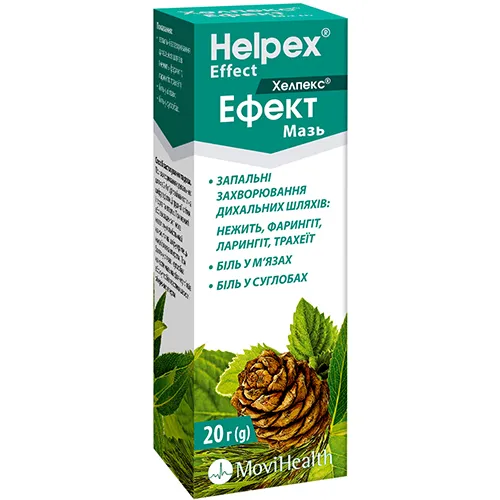
Table of Contents
INSTRUCTIONS FOR MEDICAL USE OF THE MEDICINAL PRODUCT HELPEX® EFFECT
Composition:
Active substances: menthol, camphor, thymol, methyl salicylate, eucalyptus oil, turpentine oil;
1 g of ointment contains: menthol 50 mg, camphor 100 mg, thymol 00 mg, methyl salicylate 50 mg, eucalyptus oil 10 mg, turpentine oil 30 mg;
Excipients: white wax, white soft paraffin, microcrystalline wax, paraffin.
Pharmaceutical form. Ointment.
Main physicochemical properties: soft, homogeneous mass of almost white color.
Pharmacotherapeutic group.
Agents acting on the respiratory system.
ATC Code: R07A.
Pharmacological Properties
Pharmacodynamics
Menthol exerts local irritant, analgesic, counterirritant, antipruritic, antiseptic, and soothing effects. The effect is mainly due to reflex reactions associated with stimulation of sensory nerve endings: stimulation of skin receptors promotes the formation and release of endogenous biologically active substances (enkephalins, endorphins, peptides, kinins) involved in regulation of pain perception, vascular permeability, and other processes providing analgesic, counterirritant, and antipruritic actions. The irritant (counterirritant) effect helps reduce pain sensations. Local action is accompanied by vasoconstriction, a sensation of coldness, which subsequently changes into a feeling of mild burning and tingling. Dermo-visceral reflexes improve tissue trophism (according to innervation zones). Menthol reflexively alters vascular tone both in superficial and deep tissues as well as in internal organs.
Camphor exerts antiseptic, local irritant, analeptic, and antiaggregatory effects. It reflexively stimulates vasomotor and respiratory centers, demonstrating analeptic activity. It exhibits peripheral pressor activity. It inhibits platelet aggregation. When excreted through the respiratory tract, it promotes expectoration. When applied locally, it demonstrates counterirritant properties.
Thymol acts as an antiseptic and disinfectant. By destroying enzymes essential for microbial viability, it prevents the spread of putrefaction and halts the process if it has already begun.
Methyl salicylate exerts anti-inflammatory and analgesic effects. It non-selectively inhibits cyclooxygenase, thereby reducing prostaglandin synthesis. It normalizes increased capillary permeability, improves microcirculation, and reduces swelling and infiltration of inflamed tissues.
Eucalyptus oil exerts antiseptic and anti-inflammatory effects and, when applied locally, reduces sensitivity. Eucalyptus oil also stimulates cardiac activity.
Turpentine oil is used topically in the treatment of colds as a counterirritant and warming agent.
Clinical characteristics.
Indications.
- Inflammatory diseases of the respiratory tract (rhinitis, pharyngitis, laryngitis, tracheitis);
- muscle pain;
- joint pain.
Contraindications.
Hypersensitivity to the components of the medicinal product, acetylsalicylic acid, and other nonsteroidal anti-inflammatory agents; skin diseases and skin injuries at the site intended for application of the medicinal product, including burns, eczema, dermatitis, skin infections; bronchial asthma, cough, pseudocroup; epilepsy, predisposition to seizures.
Interaction with other medicinal products and other types of interactions.
Patients should exercise caution when using the medicinal product concomitantly with oral anticoagulants (coumarin anticoagulants, antiplatelet medicinal products, including acetylsalicylic acid), since excessive use of topical salicylates may enhance the effect of anticoagulants.
Special precautions for use.
For external use only.
Apply only to intact healthy skin. Do not apply to damaged or inflamed areas of skin.
If local skin irritation occurs, discontinue use of the medicinal product. Do not apply the medicinal product to large areas of skin.
Do not use under tight or heating bandages or simultaneously with devices intended for local heating.
Avoid contact with eyes and mucous membranes. In case of accidental contact of the ointment with eyes, rinse thoroughly with water. Hands should always be washed after application of the product.
Do not use the medicinal product for prolonged or chronic cough resulting from smoking, asthma, emphysema, or if cough is accompanied by heavy mucus production. Persistent cough may be a sign of a serious disease. If cough persists for more than 1 week, tends to recur, or is accompanied by fever, rash, or persistent headache, the patient should consult a physician to reassess the treatment strategy.
Do not apply to facial skin, due to the possibility of reflex bronchospasm.
Should not be used in combination with anticoagulants due to increased risk of bleeding. Salicylates have been associated with Reye's syndrome.
Note that the product may leave stains on fabrics it contacts.
Use during pregnancy or breastfeeding.
Do not use during pregnancy or breastfeeding.
Ability to affect reaction rate when driving or operating machinery.
Has no effect.
Method of Administration and Dosage
For respiratory tract diseases, apply 2–4 g of ointment to the skin over the chest and throat area and rub in gently. If desired, the application area may be covered with a warm, dry cloth; however, it should not be applied tightly, to allow vapors to reach the nose and throat. For nasal congestion or stuffy nose, apply a small amount of ointment to the skin of the nasal wings and rub in gently. For muscle and joint pain, apply a thick layer of ointment to the affected muscles or joints and rub in carefully. For optimal results, cover the area with a warm compress.
Apply the medicinal product up to 3 times daily for adults and children.
The duration of treatment is determined individually, depending on the severity of the condition and clinical response.
Children.
This medicinal product is intended for use in children aged 3 years and older.
Overdose.
Symptoms of adverse effects may intensify, including a strong sensation of heat and burning.
Prolonged application of the ointment over large areas of skin may lead to systemic adverse reactions typical of methyl salicylate (including tinnitus, visual disturbances, nausea, vomiting, diarrhea, epigastric pain), and toxic effects such as nephrotoxicity and central nervous system disturbances.
Accidental exposure of the medicinal product into the nose or onto the face of infants and children may cause apnea due to laryngospasm—a condition requiring immediate medical intervention.
Improper use, particularly accidental ingestion of a significant amount of ointment, may result in nausea, vomiting, abdominal pain, headache, dizziness, flushing (sensation of warmth or facial redness), excitement, hallucinations, seizures, respiratory depression, reflex respiratory arrest, and coma (symptoms of camphor intoxication); diarrhea, symptoms of central nervous system depression, ataxia, and somnolence may also occur. In such cases, hospitalization and medical supervision are indicated.
Treatment is symptomatic.
In case of local irritation from use, wash off the ointment with soap and water.
In case of accidental ingestion, seek immediate medical attention; do not induce vomiting.
Adverse reactions.
Immune system disorders: hypersensitivity reactions.
Skin and subcutaneous tissue disorders: hyperemia, mild local irritation, erythema, rash, urticaria, peeling, pruritus, dermatitis, burns, transient mild skin discoloration.
Respiratory system disorders: bronchospasm.
Nervous system disorders: headache, dizziness, excitation, seizures.
Prolonged use may increase sensitivity to the drug and reduce its clinical effect.
Reporting suspected adverse reactions
Reporting suspected adverse reactions after marketing authorization is important. It allows continued monitoring of the benefit-risk balance of the medicinal product. Healthcare professionals and patients, as well as their legal representatives, are encouraged to report any suspected adverse reactions and lack of drug efficacy via the Automated Pharmacovigilance Information System at the following link: https://aisf.dec.gov.ua.
Shelf life:
3 years.
Storage conditions:
Store in the original packaging, out of reach of children, at a temperature not exceeding 25 °C.
Packaging:
20 g or 40 g in a tube; 1 tube per cardboard box.
Availability category:
Over-the-counter (without prescription).
Manufacturer:
Sava Helskea Ltd.
Manufacturer's address:
India, GIDC Estate, 507-B-512, Vadodwan City - 363 035, Surendranagar.
Marketing Authorization Holder:
LLC "Movi Health"
Address of the Marketing Authorization Holder:
08140, Ukraine, Kyiv Oblast, Kyiv-Sviatoshynskyi district, Shevchenkove village, Shevchenka St., 162 A