Ketotifen sofarma
Ukraine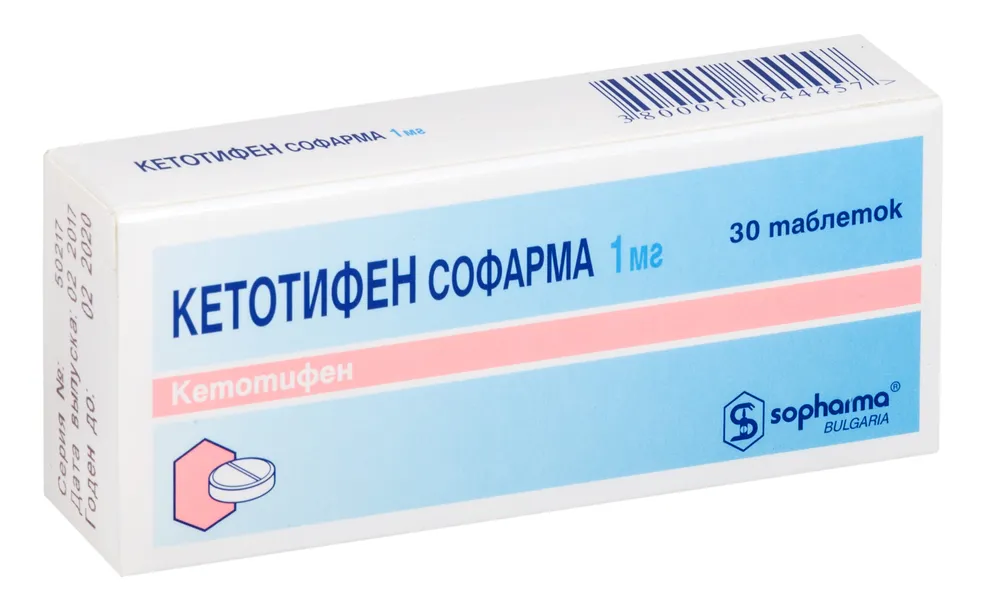
Table of Contents
INSTRUCTIONS FOR MEDICAL USE OF THE MEDICINAL PRODUCT KETOTIFEN SOPHARMA (KETOTIFEN SOPHARMA)
Composition:
Active substance: ketotifen hydrofumarate;
1 tablet contains ketotifen hydrofumarate 1.38 mg, equivalent to ketotifen 1 mg;
Excipients: calcium hydrogen phosphate anhydrous, microcrystalline cellulose, wheat starch, magnesium stearate.
Pharmaceutical form. Tablets.
Main physicochemical properties: round, flat tablets with beveled edges, with a score line on one side, 7 mm in diameter, white to white with a greyish hue; odorless.
Pharmacotherapeutic group.
Antihistamines for systemic use.
ATC code: R06AX17.
Pharmacological Properties.
Pharmacodynamics.
Ketotifen belongs to the cycloheptothiophene group and has a pronounced antihistaminic effect. It belongs to the group of non-bronchodilating antiasthmatic agents. Its mechanism of action is related to inhibition of histamine and other mediator release from mast cells, blockade of histamine H1-receptors, and inhibition of phosphodiesterase enzyme activity, resulting in increased cAMP levels in mast cells. It inhibits the effects of PAF (platelet-activating factor). When used alone, it does not abort asthma attacks but prevents their occurrence and reduces their duration and intensity; in some cases, attacks may disappear completely. It has a favorable effect on sputum secretion.
Pharmacokinetics.
Absorption: characterized by almost complete absorption from the gastrointestinal tract. Maximum plasma levels are reached within 2–4 hours. Steady-state levels are achieved after administration of the minimum daily dose of 2 mg.
Distribution: approximately 75% bound to plasma proteins. Volume of distribution is 2.7 L/kg.
Metabolism: about 60% of the administered dose is metabolized in the liver via three pathways: demethylation, N-oxidation, and N-glucuronidation, producing the following metabolites: ketotifen-N-glucuronide (pharmacologically inactive), nor-ketotifen (pharmacologically active, with activity similar to that of unchanged ketotifen), ketotifen N-oxide, and 10-hydroxy-ketotifen (pharmacological activity unknown).
Metabolism in children does not differ from that in adults, except for a faster clearance rate.
Elimination: excreted in a biphasic manner, with a short half-life of 3 to 5 hours and a longer one of 21 hours. Approximately 1% of the substance is excreted unchanged in urine within 48 hours, and 60–70% is excreted as metabolites.
Clinical characteristics.
Indications.
- Prophylactic treatment of bronchial asthma, especially atopic asthma.
- Symptomatic treatment of allergic conditions, including allergic rhinitis and conjunctivitis.
Contraindications.
Hypersensitivity to the active substance or to any of the excipients of the medicinal product.
Avoid concomitant use of ketotifen and oral antidiabetic agents (risk of reversible thrombocytopenia) until this phenomenon is sufficiently studied.
Interaction with other medicinal products and other forms of interaction.
Concomitant use of ketotifen and oral antidiabetic agents may result in a risk of developing reversible thrombocytopenia. Patients should be advised to monitor platelet counts.
Concomitant use of atropine, atropine-like drugs, and ketotifen increases the risk of adverse reactions such as urinary retention, constipation, and dry mouth.
Ketotifen may potentiate the effects of other medicinal products that depress the central nervous system (e.g., sedatives, hypnotics).
Concomitant use of ketotifen with other antihistamines may lead to mutual potentiation of their effects.
Alcohol consumption should be avoided during ketotifen therapy, as ethanol enhances the depressant effect of ketotifen on the central nervous system.
Special precautions for use.
The drug is ineffective in the treatment of acute allergic reactions and is not used to control acute asthmatic attacks (asthma attacks).
The maximum therapeutic effect of the drug develops after several weeks of regular use.
Normalization of the hypothalamic-pituitary-adrenal system function may take up to one year; therefore, during the first weeks of ketotifen treatment, previous therapy should be continued and discontinued gradually and over a prolonged period.
At the beginning of long-term ketotifen therapy, other anti-asthmatic drugs, especially corticosteroids, must not be abruptly discontinued. In patients dependent on steroids, adrenal cortical insufficiency may develop.
In case of intercurrent infection, specific anti-infective therapy should be administered.
Very rarely, seizures have been reported during ketotifen treatment. Since ketotifen may lower the seizure threshold, it should be used with particular caution in patients with a history of seizures. Patients receiving ketotifen should be under medical supervision due to the potential risk of seizures.
Ketotifen should be administered cautiously to patients with a history of epilepsy due to the possibility of lowering the seizure threshold during treatment.
Alcohol consumption should be avoided during ketotifen therapy, as alcohol enhances the depressant effect of ketotifen on the central nervous system.
The drug should be discontinued 10–14 days prior to performing skin tests for allergy diagnosis.
If discontinuation of ketotifen therapy is necessary, the dose should be gradually reduced over 2–4 weeks to prevent recurrence of asthma symptoms.
Caution is advised when administering ketotifen to patients with impaired liver function.
Since concomitant use with oral hypoglycemic agents may cause thrombocytopenia, such combination should be avoided or platelet levels should be closely monitored if such treatment is indicated.
The wheat starch contained in the tablet may contain only trace amounts of gluten and is considered safe for patients with celiac disease.
Use during pregnancy or breastfeeding.
Animal studies have not shown embryotoxic or teratogenic effects of ketotifen. Controlled clinical studies in pregnant women have not been conducted. Ketotifen is contraindicated during the first trimester of pregnancy. During the second and third trimesters, it should be prescribed only after strict evaluation of direct indications, when the expected benefit of treatment outweighs the potential risk to the fetus.
Ketotifen passes into breast milk; therefore, breastfeeding should be discontinued if use of the drug is necessary.
Ability to influence reaction rate while driving or operating machinery.
At the beginning of treatment, Ketotifen Sofarma may slow reaction times; therefore, patients should exercise increased caution when driving vehicles or operating automated machinery.
Method of Administration and Dosage
Tablets should be taken orally during meals with water.
Dosage
Adults: 1 tablet (1 mg) twice daily, in the morning and evening, during meals. For patients experiencing significant sedative effects, a gradual dose escalation is recommended over the first week, starting with 0.5 mg twice daily and slowly increasing to the therapeutic dose. If necessary, the daily dose may be increased up to 4 mg (4 tablets), given as 2 tablets twice daily. When higher doses are used, a faster onset of therapeutic effect may be expected.
Children:
Children aged 6 months to under 3 years: ketotifen should be administered in another pharmaceutical form (syrup).
Children aged 3 years and older: 1 tablet (1 mg) twice daily, in the morning and evening, during meals.
Duration of Treatment
Treatment is long-term, with therapeutic effect usually achieved after several weeks of therapy. Treatment should last at least 2–3 months, especially in patients who do not experience symptom improvement during the first weeks.
Concomitant bronchodilator therapy: co-administration of ketotifen with bronchodilators may reduce the frequency of bronchodilator use.
Discontinuation of Therapy
Ketotifen treatment should be discontinued gradually over a period of 2–4 weeks to avoid the risk of relapse of asthmatic symptoms.
Elderly Patients
There are no special requirements for elderly patients.
Children
To be used in children aged 3 years and older.
Clinical observations confirm pharmacokinetic characteristics and indicate that children may require a higher dose in mg/kg than adults to achieve optimal results. Higher doses are tolerated as well as lower ones.
Overdose
Symptoms: possible marked impairment of psychomotor reactions, drowsiness progressing to pronounced sedation, confusion, headache, disorientation, tachycardia, decreased blood pressure; in children – hyperexcitability or seizures, reversible coma. Bradycardia, arrhythmia, respiratory center depression, and nystagmus may also occur.
In case of the above-mentioned symptoms, the patient should be thoroughly examined.
Treatment: general measures to remove unabsorbed drug from the gastrointestinal tract: induction of vomiting, gastric lavage. Administration of activated charcoal may be beneficial. If necessary, symptomatic treatment and monitoring of cardiovascular and respiratory systems are recommended. In cases of agitation, short-acting barbiturates or benzodiazepines may be used.
Side effects
The adverse reactions described below are classified by system organ class and frequency. Adverse reactions are classified by frequency as follows: very common (≥ 1/10), common (≥ 1/100 to <1/10), uncommon (≥ 1/1,000 to <1/100), rare (≥ 1/10,000 to <1/1,000), very rare (<1/10,000), frequency not known (cannot be estimated from the available data).
Infections and infestations:
uncommon – cystitis.
Immune system disorders:
very rare – severe skin reactions, erythema multiforme, Stevens-Johnson syndrome; frequency not known – skin rashes.
Metabolism and nutrition disorders:
rare – weight gain due to increased appetite.
Psychiatric disorders:
common – psychomotor agitation, irritability, insomnia, restlessness, nervousness; frequency not known – disorientation, somnolence.
Nervous system disorders:
uncommon – dizziness; rare – sedative effect; very rare – seizures.
Gastrointestinal disorders:
uncommon – dry mouth; frequency not known – stomach pain, constipation, nausea, vomiting, dyspeptic disorders.
Hepatobiliary disorders:
very rare – increased levels of liver enzymes, hepatitis.
Renal and urinary disorders:
frequency not known – dysuria.
Dry mouth and dizziness may occur at the beginning of treatment, but usually resolve spontaneously during continued therapy. Symptoms of CNS stimulation such as agitation, irritability, insomnia, and anxiety are rarely observed, especially in children.
Shelf life. 3 years.
Storage conditions.
Keep out of the reach of children.
Store in the original packaging at a temperature not exceeding 25 °C.
Packaging.
10 tablets in a blister pack made of PVC film/aluminum foil, 3 blisters per cardboard box.
Prescription status. Prescription only.
Manufacturers.
JSC "Sofarma".
JSC "VITAMINS".
Manufacturers' addresses and locations of business activities.
JSC "Sofarma"
16 Iliensko Shose Str., Sofia, 1220, Bulgaria.
JSC "VITAMINS"
31 Uspenska Street, Uman, Cherkasy Region, 20300, Ukraine.