Ketotifen
Ukraine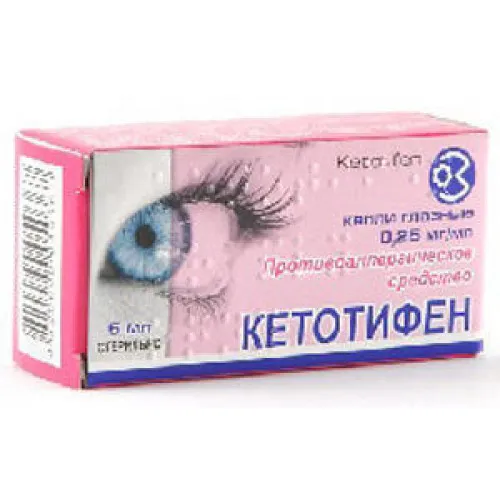
Table of Contents
INSTRUCTIONS FOR MEDICAL USE OF THE MEDICINAL PRODUCT Ketotifen
Composition:
Active substance: ketotifen;
1 ml of solution contains ketotifen fumarate equivalent to ketotifen 0.25 mg;
Excipients: benzalkonium chloride; sodium chloride; dextran; disodium edetate (Trilon B); sodium hydroxide; citric acid monohydrate; water for injections.
Pharmaceutical form. Eye drops.
Main physicochemical properties: clear or slightly opalescent, colorless or slightly yellowish liquid.
Pharmacotherapeutic group. Ophthalmological agents. Anti-edematous and antiallergic agents. ATC code S01GX08.
Pharmacological properties.
Pharmacodynamics. Ketotifen has pronounced anti-allergic and antihistaminic activity and is an H1-histamine receptor blocker. The mechanism of action is due to its ability to inhibit the release of histamine and other mediators (leukotrienes, prostaglandins, and slow-reacting substance of anaphylaxis) from mast cells. Ketotifen also reduces chemotaxis, activation, and degranulation of eosinophils and inhibits phosphodiesterase, thereby increasing cAMP levels, which stabilizes mast cell membranes.
Pharmacokinetics. Plasma levels of ketotifen after repeated administration of drops over 14 days were in most cases below the quantitative detection limit (20 pg/mL).
Clinical characteristics.
Indications. Treatment and prevention of allergic conjunctivitis.
Contraindications. Hypersensitivity to ketotifen or to any of the other components of the drug.
Interaction with other medicinal products and other forms of interaction. If the drug is used simultaneously with other ophthalmic agents, an interval of at least 5 minutes should be maintained between their applications.
The use of oral formulations of ketotifen may potentiate the effects of central nervous system (CNS) depressants, antihistamines, and alcohol. Although this has not been observed with the use of ketotifen eye drops, the possibility of such effects cannot be excluded.
Special precautions for use.
The product contains benzalkonium chloride, which may cause irritation. Contact with soft contact lenses should be avoided (remove contact lenses before using the product and reinsert them 15 minutes after use). May discolor soft contact lenses.
Use during pregnancy or breastfeeding.
Pregnancy
There are no reliable data on the use of the product in pregnant women. Animal studies using maternally toxic oral doses showed increased pre- and postnatal mortality, but no teratogenicity. Systemic exposure after ocular administration is considerably lower than after oral administration. Caution should be exercised when prescribing to pregnant women.
Breastfeeding
Although animal data after oral administration show excretion into breast milk, topical use in humans is unlikely to result in detectable quantities in breast milk. The product may be used during breastfeeding.
Fertility
There are no data on the effect of ketotifen fumarate on human fertility.
Ability to influence the speed of reactions when driving or operating machinery. If blurred vision or drowsiness occurs, patients should not drive or operate machinery.
Method of Administration and Dosage
For adults and children aged 3 years and older: it is recommended to instill 1 drop twice daily into the lower conjunctival sac.
The contents and dispenser of the bottle remain sterile until the primary packaging is opened. Patients should be instructed to avoid contact between the tip of the dispenser and the eye or adjacent tissues, as this may contaminate the solution.
Children. The efficacy and safety of the drug in children from birth to 3 years of age have not been established; therefore, it should not be prescribed to patients in this age group.
Overdose. Cases of overdose have not been reported.
Oral ingestion of an entire 5 ml bottle would be equivalent to 1.25 mg of ketotifen, which is 60% of the recommended daily oral dose for a 3-year-old child. Clinical findings have shown no serious signs or symptoms following oral administration of up to 20 mg of ketotifen.
Side effects
Side effects are classified by frequency as follows: very common (≥ 1/10); common (≥ 1/100 to < 1/10); uncommon (≥ 1/1000 to < 1/100); rare (≥ 1/10000 to < 1/1000); very rare (< 1/10000); not known (cannot be estimated from the available data).
Immune system disorders: uncommon – hypersensitivity.
Eye disorders: common – eye irritation, eye pain, punctate keratitis, punctate epithelial erosions; uncommon – blurred vision (during instillation), dry eyes, eyelid injury, conjunctivitis, photophobia, subconjunctival haemorrhage.
Nervous system disorders: uncommon – headache.
Skin and subcutaneous tissue disorders: uncommon – skin rash, eczema, urticaria.
Gastrointestinal disorders: uncommon – dry mouth.
General disorders: uncommon – somnolence.
Post-marketing experience (frequency not known)
Additional post-marketing observations include: hypersensitivity reactions, including local allergic reactions (e.g. contact dermatitis, eye swelling, itching and eyelid swelling) and systemic allergic reactions, including facial swelling/angioedema (in some cases associated with contact dermatitis), exacerbation of pre-existing allergic conditions such as bronchial asthma or eczema.
Reporting of side effects. Reporting of side effects after marketing authorization of the medicinal product is important. It allows continuous monitoring of the benefit-risk balance of the medicinal product. Medical and pharmaceutical professionals, as well as patients or their legal representatives, are encouraged to report all suspected side effects and lack of efficacy through the Automated Pharmacovigilance Information System at the following link: https://aisf.dec.gov.ua.
Shelf life. 2 years. The shelf life of the solution after opening the bottle is 14 days.
Storage conditions. Store at a temperature not exceeding 25 °C in the original packaging. Keep out of reach and sight of children.
Packaging. 5 ml in a bottle, 1 bottle in a box with a dropper cap.
Prescription status. Prescription only.
Manufacturer.
LLC "Experimental Plant "GNCLS".
LLC "FARMEKS GROUP".
Manufacturer's address and place of business.
8 Vorobiova Street, Kharkiv, Kharkiv Oblast, Ukraine.
(LLC "Experimental Plant "GNCLS")
100 Shevchenka Street, Boryspil, Kyiv Oblast, 08301, Ukraine.
(LLC "FARMEKS GROUP")