Ketamine
Ukraine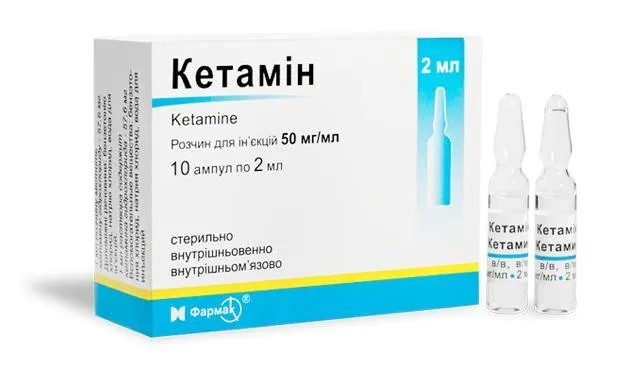
Table of Contents
INSTRUCTION FOR MEDICAL USE OF THE MEDICINAL PRODUCT KETAMINE (KETAMINE)
Composition:
active substance: ketamine;
1 ml of solution contains ketamine hydrochloride 57.6 mg (equivalent to 50 mg of ketamine);
excipients: benzethonium chloride, sodium chloride, water for injections.
Pharmaceutical form. Injection solution.
Main physicochemical properties: clear, colorless or slightly colored liquid.
Pharmacotherapeutic group. General anesthetics. ATC code N01AX03.
Pharmacological Properties.
Pharmacodynamics.
Ketamine is an anesthetic agent with pronounced analgesic properties. The drug induces so-called dissociative anesthesia, which is described as a functional dissociation between thalamo-neocortical and limbic systems. Analgesic action of the drug manifests even at subdissociative doses and lasts longer than anesthesia. Sedative and hypnotic effects are less pronounced. In the spinal cord and peripheral nerves, the drug exhibits local anesthetic activity.
When ketamine is administered, muscle tone remains unchanged or may even increase. Therefore, protective reflexes are generally preserved. The seizure threshold is not reduced. During spontaneous respiration, intracranial pressure may rise; however, this can be avoided with controlled ventilation.
Since ketamine induces sympathicotonia, arterial pressure and heart rate may increase. Simultaneously, with increased coronary blood flow in the myocardium, oxygen demand also rises. Ketamine has a negative inotropic effect and antiarrhythmic activity (direct cardiac effect).
Due to its antagonistic action, peripheral vascular resistance remains unchanged.
After administration of ketamine, marked hyperventilation is observed without significant deviations in blood gas parameters. Ketamine relaxes bronchial smooth muscle.
Pharmacokinetics.
Ketamine is lipid-soluble. Maximum plasma concentration is achieved within 20 (5–30) minutes after intravenous administration of the initial dose.
Following intramuscular administration, the bioavailability of the drug is 93%. Approximately 47% of ketamine is protein-bound in the blood. The first phase of action (alpha-phase) lasts approximately 45 minutes; T1/2 = 10–15 min. Clinically, the first phase is characterized by the anesthetic effect of the drug. Ketamine rapidly distributes into tissues with good blood supply (e.g., brain). Ketamine concentration in tissues follows a two-compartment open model. Termination of the anesthetic effect occurs due to redistribution from the CNS to peripheral tissues with lower blood flow and due to hepatic biotransformation into active metabolites. Among ketamine metabolites, there is one that exerts a hypnotic effect. The elimination half-life of the second phase (beta-phase) is approximately 2.5 hours. About 90% of metabolites are excreted by the kidneys. Ketamine crosses the placenta.
Clinical characteristics.
Indications.
To be used as an anesthetic agent (monotherapy) for short-term diagnostic procedures and surgical interventions in children and in certain special cases in adults: induction and maintenance of anesthesia.
For general anesthesia in combination with other agents (especially benzodiazepines), the drug should be administered in a lower dose.
Specific indications for ketamine use (alone or in combination with another agent):
- Painful procedures (e.g., dressing changes in burn patients);
- Neurodiagnostic procedures (pneumoencephalography, ventriculography, myelography);
- Endoscopy;
- Certain ophthalmological procedures;
- Diagnostic and surgical interventions in the area of the neck or oral cavity; dental procedures;
- Otolaryngological interventions;
- Gynecological extraperitoneal interventions;
- Obstetric procedures, induction of anesthesia for cesarean section;
- Orthopedic and traumatological interventions;
- Anesthesia in patients in shock or with hypotension, due to ketamine's unique effects on the heart and circulation;
- Anesthesia in patients for whom intramuscular administration is preferred (e.g., children).
Contraindications.
- Hypersensitivity to the active substance or to any of the excipients.
- Eclampsia, pre-eclampsia.
- Ketamine is contraindicated in patients in whom an increase in arterial pressure may pose a serious threat to life; in patients with head trauma, intracranial hemorrhage, stroke, severe cardiovascular diseases, or impaired cerebral circulation.
Interaction with other medicinal products and other forms of interaction.
Concomitant use of barbiturates and/or other anesthetic agents with ketamine prolongs the awakening time after anesthesia.
Concomitant administration with diazepam may prolong the elimination half-life of ketamine and enhance its pharmacodynamic effects; therefore, the two should not be mixed in the same infusion system.
Ketamine in combination with atracurium or tubocurarine may potentiate neuromuscular blockade, including respiratory depression and apnea.
Concomitant use of halogenated anesthetics with ketamine may prolong the elimination half-life of ketamine and prolong awakening time after anesthesia. Combined use of ketamine (especially at high doses or with rapid administration) with halogenated anesthetics increases the risk of bradycardia, hypotension, or reduced cardiac output.
Use of ketamine with other medicinal products that depress the central nervous system (e.g., ethanol, phenothiazines, antihistamines, or muscle relaxants) may enhance CNS depression and/or increase the risk of respiratory insufficiency. Dose reduction of ketamine may be necessary when used concomitantly with hypnotics, sedatives, and tranquilizers. Ketamine has been reported to act as an antagonist to the hypnotic effect of thiopental.
In patients receiving thyroid hormone therapy, there is an increased risk of elevated arterial pressure and tachycardia when ketamine is administered.
Concomitant use of antihypertensive agents and ketamine increases the risk of hypotension.
Combination with aminophylline (theophylline) may lower the seizure threshold. There are reports of unpredictable extensor muscle seizures occurring with concomitant use of these agents.
Medicinal products that inhibit CYP3A4 reduce hepatic clearance and increase plasma concentrations of CYP3A4 substrates such as ketamine. Concomitant use of ketamine and CYP3A4 inhibitors requires a reduction in ketamine dose to achieve optimal clinical effect.
Medicinal products that induce CYP3A4 increase hepatic clearance and reduce plasma concentrations of CYP3A4 substrates such as ketamine. Concomitant use of ketamine and CYP3A4 inducers requires an increase in ketamine dose to achieve optimal clinical effect.
Sympathomimetics (direct or indirect-acting) and vasopressin may enhance the sympathomimetic effects of ketamine. Concomitant use with ergometrine may lead to increased arterial pressure.
Special precautions for use.
Ketamine may be combined with any type of local anesthesia.
The drug must be administered by a specialist—anesthesiologist.
As with other general anesthetics, instruments and equipment for resuscitation should be prepared prior to ketamine administration.
Since respiratory depression may occur during administration of the drug, a mechanical ventilator must be available. Use of the ventilator should be combined with analeptics.
Intravenous ketamine must be administered slowly (over 1 minute). Rapid injection may cause respiratory depression or apnea, as well as a sharp increase in arterial pressure.
Since pharyngeal reflexes are generally preserved during ketamine therapy, mechanical stimulation of the pharynx should be avoided. For procedures involving the larynx, pharynx, or trachea, ketamine must be combined with muscle relaxants and careful monitoring of respiration.
During surgical procedures involving visceral pain pathways, administration of additional analgesics may be required.
When ketamine is used in outpatient settings, the patient may be discharged only after full recovery of consciousness and under the supervision of an adult.
Ketamine should be used with special caution in the following conditions:
- Chronic alcoholism and acute alcohol intoxication.
Ketamine is metabolized in the liver, and complete hepatic elimination leads to termination of clinical effects. Prolonged duration of action may occur in patients with liver cirrhosis or other forms of hepatic insufficiency. Therefore, the dose of ketamine should be reduced in such patients. Abnormal liver function tests have also been reported, associated with prolonged use of the drug, particularly in patients receiving it for more than 3 days or in individuals with a history of substance dependence.
- Increased intracranial pressure;
- Penetrating eye injury and/or elevated intraocular pressure (e.g., glaucoma), as pressure may significantly increase even after a single dose of ketamine;
- History of seizures or psychiatric disorders (e.g., schizophrenia, acute psychosis);
- Acute intermittent porphyria;
- Hyperthyroidism or replacement therapy with thyroid hormones (increased risk of elevated arterial pressure and tachycardia);
- Upper respiratory tract or lung infections (since ketamine increases sensitivity of the pharyngeal reflex, which may lead to laryngospasm);
- Brain tumors, head trauma, or hydrocephalus.
Reactions that may occur during emergence from anesthesia.
Psychological disturbances may range from mild to severe, including dream-like experiences, vivid imagery, hallucinations, nightmares, post-anesthetic delirium (often manifesting as dissociative sensations and feelings of "free-floating"), and in some cases, confusion, psychomotor agitation, and irrational behavior. These manifestations have been observed in only a few patients.
Acute delirium may occur during emergence from anesthesia. This reaction can be prevented by administering benzodiazepines or by minimizing verbal, tactile, and visual stimuli. However, vital sign monitoring must still be maintained.
Since ketamine increases myocardial oxygen consumption, it should be used cautiously in patients with hypovolemia, dehydration, or cardiac disease, especially ischemic heart disease (e.g., congestive heart failure, myocardial ischemia, or myocardial infarction). Ketamine should also be used cautiously in patients with mild to moderate pulmonary arterial hypertension and tachyarrhythmias.
Patients with arterial hypertension or cardiac insufficiency require cardiac function monitoring during anesthesia. Premedication with diazepam reduces the hypertensive response. Maximum increase in arterial pressure (20–25%) occurs several minutes after intravenous administration, but blood pressure returns to baseline within 15 minutes. Depending on the patient's condition, this rise in blood pressure may be considered either a beneficial effect or an adverse reaction. The cardiostimulatory effect of ketamine can be prevented by prior intravenous administration of diazepam at a dose of 0.2–0.25 mg/kg body weight.
Ketamine is not recommended for prolonged use. Cases of cystitis, including hemorrhagic cystitis, have been reported in patients receiving long-term ketamine (from 1 month to several years).
Hepatotoxicity may develop with prolonged use (more than 3 days).
Cases of ketamine abuse have also been reported. Data indicate that ketamine may cause dysphoria, hallucinations, "flashback" phenomena, fear, anxiety, insomnia, or disorientation, as well as cystitis or hemorrhagic cystitis. Daily use of ketamine over several weeks may lead to dependence, particularly in individuals with current or past substance dependence. Therefore, the drug should be used with caution and under close medical supervision in such patients.
This medicinal product contains less than 1 mmol of sodium per dose (23 mg sodium per dose), i.e., it is practically sodium-free.
Use during pregnancy or breastfeeding.
Ketamine crosses the placental barrier. This should be considered during obstetric procedures in pregnancy, except for administration during cesarean section or vaginal delivery. Safety of use during pregnancy and lactation has not been established, and such use is not recommended.
Ketamine enters the neonate’s body when administered intravenously to a pregnant woman at doses ≥1.5 mg/kg during delivery, which may cause respiratory depression and low Apgar scores in the newborn.
Intravenous administration of ≥2 mg/kg to a pregnant woman during delivery increases arterial pressure and uterine tone.
Use during lactation is not recommended. Animal studies have shown reproductive toxicity.
Ability to affect reaction speed when driving or operating machinery.
Patients should be advised not to drive or operate machinery or engage in any other potentially hazardous activities for at least 24 hours after anesthesia.
Ketamine may impair cognitive function, which could affect the ability to drive a vehicle.
Administration and Dosage
Administer intramuscularly, intravenously, or by intravenous infusion.
Individual response to Ketamine, as with other systemic anesthetics, depends on the dose, route of administration, and patient's age. Therefore, dosage must be individually adjusted.
When used in combination, the dose of Ketamine should be reduced.
The following dosages apply to adults, elderly patients (aged 65 years and older), and children.
Intravenous administration. Must be administered slowly over 1 minute.
Initial dose: 0.7–2 mg/kg body weight, providing surgical anesthesia within approximately 30 seconds after administration, lasting 5–10 minutes (in high-risk patients, elderly patients, or patients in shock, the recommended dose is 0.5 mg/kg body weight).
Intramuscular administration. Initial dose: 4–8 mg/kg body weight, providing surgical anesthesia within several minutes after administration, lasting 12–25 minutes.
Intravenous infusion. Add 500 mg of Ketamine to 500 mL of 0.9% sodium chloride solution or 5% glucose solution.
Initial dose: 80–100 drops per minute.
Maintenance dose: 20–60 drops per minute (2–6 mg/kg body weight per hour).
Dosage for adults: 2–6 mg/kg body weight per hour.
Maintenance anesthesia. If necessary, half the initial dose or the full initial dose may be repeated intramuscularly or intravenously.
The appearance of nystagmus or motor response to stimulation indicates inadequate depth of anesthesia, and therefore, a repeat dose may be required. However, involuntary limb movements may occur independently of the depth of anesthesia!
Children.
The medicinal product is used in pediatric practice.
Overdose.
Ketamine has a wide therapeutic index. When large doses are administered or when rapid intravenous injection is performed, respiratory depression may occur. In such cases, artificial ventilation of the lungs should be maintained until adequate spontaneous respiration is restored, and analeptics may be administered if necessary.
Adverse reactions.
Immune system disorders.
Rare: anaphylactic reactions.
Metabolism and nutrition disorders.
Uncommon: anorexia.
Psychiatric disorders.
Frequent: hallucinations, abnormal or disturbing dreams, confusion, psychomotor agitation, inappropriate behavior.
Uncommon: anxiety.
Rare: delirium, flashback phenomenon, dysphoria, insomnia, disorientation.
Nervous system disorders.
Frequent: nystagmus, increased skeletal muscle tone, and tonic-clonic seizures.
Eye disorders.
Frequent: diplopia.
Frequency not known: increased intraocular pressure.
Cardiac disorders.
Frequent: increased blood pressure and heart rate.
Uncommon: bradycardia, arrhythmia.
Vascular disorders.
Uncommon: hypotension.
Respiratory system disorders.
Frequent: increased respiratory rate.
Uncommon: respiratory depression, laryngospasm.
Rare: airway obstruction or respiratory arrest.
Hepatobiliary disorders.
Frequency not known: changes in liver function laboratory tests, drug-induced liver injury.
Gastrointestinal disorders.
Frequent: nausea, vomiting.
Rare: salivation.
Skin and subcutaneous tissue disorders.
Frequent: urticaria, erythema, and/or morbilliform rash.
Renal and urinary disorders.
Rare: cystitis, hemorrhagic cystitis.
General disorders and administration site conditions.
Uncommon: reactions at the injection site, including pain and/or rash at the site of drug administration.
Shelf life. 3 years.
Do not use the medicinal product after the expiry date stated on the packaging.
Storage conditions.
Store in the original packaging at a temperature not exceeding 25 °C.
Keep out of reach and sight of children.
Incompatibilities.
Barbiturates are contraindicated for mixing with Ketamine in the same syringe due to chemical incompatibility. If concomitant administration of Ketamine with diazepam is required, the drugs should be administered separately; do not mix in the same syringe or infusion.
Do not use solvents not specified in the section "Instructions for use and dosage".
Packaging.
2 ml in a vial; 10 vials in a pack; 5 vials in a blister, 2 blisters in a pack.
10 ml in a vial; 5 vials in a pack; 5 vials in a blister, 1 blister in a pack.
Prescription category. Prescription only.
Manufacturer.
JSC "Farmak".
Manufacturer's name and address of the place of business.
74, Kyrylivska Street, Kyiv, 04080, Ukraine.