Keravort
Ukraine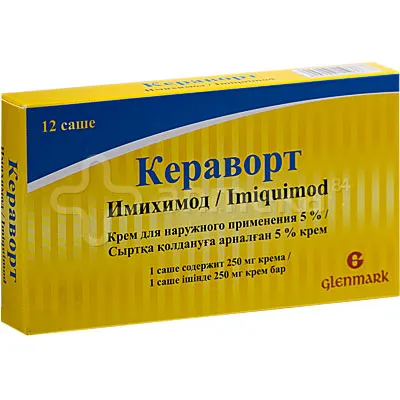
Table of Contents
INSTRUCTIONS FOR MEDICAL USE OF THE MEDICINAL PRODUCT KERAWORT (KERAWORT)
Composition:
active substance: imiquimod;
1 sachet (250 mg cream) contains imiquimod 12.5 mg;
excipients: sorbitan stearate, isostearic acid, cetyl alcohol, stearyl alcohol, white soft paraffin, polysorbate 60, methylparaben (E 218), propylparaben (E 216), glycerol, xanthan gum, benzyl alcohol, purified water.
Pharmaceutical form. Cream.
Main physicochemical properties: white or almost white soft cream.
Pharmacotherapeutic group.
Chemotherapeutic agents for topical use. Imiquimod.
ATC code D06B B10.
Pharmacological Properties
Pharmacodynamics
Imiquimod is an immune response modifier. Imiquimod does not exhibit direct antiviral activity; its effect is mediated through the induction of interferon-alpha (IFNα) and other cytokines.
Pharmacokinetics
Less than 0.9% of radiolabeled imiquimod is absorbed through the skin following a single dose application.
A small amount of the drug that reaches the systemic circulation is rapidly eliminated via the kidneys and through the gastrointestinal tract in a ratio of approximately 3:1. The plasma concentration of the drug after single or repeated topical application does not reach quantifiable levels (> 5 ng/ml).
Clinical Characteristics.
Indications.
The drug is indicated for local treatment of:
- external genital and perianal genital warts (condylomata acuminata);
- small superficial basal cell carcinomas (sBCC);
- clinically typical actinic keratoses (AK) without signs of hyperkeratosis or hypertrophy, located on the skin of the face or scalp in patients with normally functioning immune systems, in cases where efficacy and/or acceptability of cryotherapy is limited due to the size or number of lesions, and when other local treatment methods are contraindicated or less appropriate.
Contraindications.
Hypersensitivity to imiquimod or to any of the other components of the drug.
Interaction with other medicinal products and other forms of interaction.
Interaction of imiquimod with other medicinal products has not been studied. Since imiquimod stimulates the immune system, the cream should be administered with caution to patients receiving immunosuppressants.
Minimal skin absorption should limit interaction with systemically acting drugs.
Special precautions for use.
Avoid contact with the mucous membranes of the eyes, lips, and nose.
Imiquimod may exacerbate inflammatory processes in the skin.
The cream should be used with caution in patients with autoimmune diseases and in patients who have undergone organ transplantation.
The benefit-risk ratio of imiquimod treatment should be carefully considered in these patients due to the potential risk of organ rejection or graft-versus-host reaction.
Treatment with the cream is not recommended if the skin has not healed after previous medical or surgical treatment. Application of the cream to damaged skin may increase systemic absorption of imiquimod, thereby increasing the risk of adverse reactions.
Use of occlusive dressings is not recommended.
In isolated cases, an acute inflammatory reaction may occur, including oozing or erosion, after several applications of imiquimod cream. Local acute inflammatory reactions may accompany or even precede systemic flu-like symptoms, including malaise, fever, nausea, muscle pain, and chills.
Imiquimod should be used with caution in patients with anemia.
External genital warts.
Treatment of men with warts located on the foreskin is possible only if daily hygiene procedures are performed. In the absence of such procedures, phimosis or stricture may develop, leading to difficulty in retracting the foreskin.
Treatment of urethral, intra-vaginal, cervical, rectal, or intra-anal warts is not recommended. Treatment of tissues with open ulcers or wounds should not be initiated until complete healing has occurred.
Skin reactions are common during treatment. Therefore, if skin reactions become intolerable, the application site should be washed with warm water and soap. Treatment with the cream may be resumed after skin reactions have subsided.
There are no clinical data on immediate application of the cream following treatment of genital and perianal warts with other medicinal products.
Imiquimod cream must be washed off before sexual intercourse. It may reduce the effectiveness of condoms and vaginal diaphragms. Alternative contraceptive methods should be used.
Repeat treatment with the cream is not recommended in immunocompromised patients.
In HIV-positive patients, treatment of condylomas with the cream has not always been effective.
Superficial basal cell carcinoma.
When treating basal cell carcinoma, the cream should not be applied within 1 cm of the hairline, eyelid margins, or the borders of the mouth or nose.
During treatment and until full recovery, the affected skin will significantly differ from healthy skin. Local skin reactions are normal, but their intensity usually decreases during treatment and resolves after discontinuation of therapy.
There is a correlation between the rate of healing and the appearance of local skin reactions (e.g., erythema). These local skin reactions may be associated with stimulation of a local immune response. A treatment break of several days may be considered due to patient discomfort or severe local skin reactions. Treatment may be resumed after skin reactions have subsided.
The clinical outcome of treatment can be assessed approximately 12 weeks after completion of therapy, once the skin has fully recovered.
There are no clinical data on the use of the cream in immunocompromised patients.
There are no clinical data on the use of the cream in patients with recurrent or previously treated basal cell carcinomas; therefore, therapy in these patient groups is not recommended.
Large tumors (>7.25 cm²) are less responsive to imiquimod treatment.
The area of skin undergoing treatment should be protected from exposure to ultraviolet radiation.
Actinic keratosis.
If lesions are clinically atypical for actinic keratosis or if there is suspicion of a malignant neoplasm, a biopsy should be performed.
When treating actinic keratosis, the cream should not be applied to the eyelids, the inner surface of the nose or ears, or the vermilion border of the lips.
Data on the use of the cream on areas other than the face or scalp are limited. Data on treatment of keratosis in the axillae or on the hands do not confirm the efficacy of the product.
Imiquimod is not recommended for the treatment of actinic lesions with marked hyperkeratosis or hypertrophy, as seen in cutaneous horn.
During treatment and until full recovery, the affected skin will significantly differ from healthy skin. Local skin reactions are a normal phenomenon, but their intensity usually decreases during treatment and resolves after discontinuation of cream therapy. There is a correlation between the rate of healing and the appearance of local skin reactions (e.g., erythema). These local reactions may be associated with stimulation of a local immune response. A treatment break of several days may be considered due to patient discomfort or severe local skin reactions. Treatment may be resumed after skin reactions have subsided.
Each treatment period should not exceed 4 weeks, regardless of missed doses or rest periods.
The clinical outcome of treatment can be assessed approximately 4–8 weeks after completion of therapy, once the skin has fully recovered.
There are no clinical data on the use of the cream in immunocompromised patients.
Areas of skin undergoing treatment must be protected from ultraviolet radiation.
Excipients methylparaben (E 218) and propylparaben (E 216) may cause allergic reactions (possibly delayed). Cetyl alcohol and stearyl alcohol may cause local skin reactions (e.g., contact dermatitis).
Use during pregnancy or breastfeeding.
Use during pregnancy or breastfeeding is not recommended.
If use of the product is necessary, breastfeeding should be discontinued.
Ability to affect reaction speed when driving or operating machinery.
During treatment, caution should be exercised when driving vehicles or operating machinery, as well as when performing tasks requiring high concentration, due to the possible occurrence of weakness or dizziness.
Administration and Dosage.
The frequency and duration of administration should be determined individually by a physician for each patient.
External genital warts in adults.
Imiquimod cream should be applied three times a week (e.g., on Monday, Wednesday, and Friday, or on Tuesday, Thursday, and Saturday) before bedtime and left on the skin for 6–10 hours. Treatment with imiquimod cream should continue until complete clearance of genital and perianal warts, but not longer than 16 weeks for each episode of warts.
The cream should be applied in a thin layer and rubbed into the clean surface of the affected areas until completely absorbed. The cream should be applied only to affected areas. For 6–10 hours after application, avoid showering or bathing. After the specified time period, the cream should be washed off with warm water and soap. Application of excessive amounts of cream or prolonged contact with the skin may cause local site reactions. One sachet of cream is sufficient for application to a skin area of 20 cm². Do not reuse cream from a previously opened sachet. Hands must be washed with warm water and soap before and after applying the cream.
Uncircumcised men undergoing treatment for warts located under the foreskin should retract the foreskin and wash the area beneath it daily.
Superficial basal cell carcinoma in adults.
Apply imiquimod cream five consecutive days per week for 6 weeks (e.g., Monday through Friday) before bedtime and leave on the skin for approximately 8 hours.
Before applying imiquimod cream, wash the affected areas with soap and allow them to dry. Apply a sufficient amount of cream to the entire affected area, including a 1 cm margin of healthy skin surrounding the lesion. Rub the cream into the affected area until completely absorbed. The cream should be applied before bedtime and left on the skin for 8 hours. During this time, avoid showering or bathing. After the specified time, wash off the cream with warm water and soap.
Do not reuse cream from a previously opened sachet. Hands must be washed with warm water and soap before and after applying the cream.
The response of the treated tumor should be evaluated 12 weeks after completion of treatment. If the treated lesion does not show an adequate response, alternative treatment should be considered.
If local skin reactions cause significant discomfort to the patient or if the treated area becomes infected, treatment should be interrupted for several days.
Actinic keratosis in adults.
Treatment should be prescribed and monitored by a physician. Imiquimod cream should be applied three times a week (e.g., on Monday, Wednesday, and Friday, or on Tuesday, Thursday, and Saturday) before bedtime for 4 weeks and left on the skin for 8 hours. Apply a sufficient amount of cream to the entire affected area. Four weeks after discontinuation of treatment, the presence of actinic keratosis should be evaluated. If any lesions remain, treatment should be continued for an additional 4 weeks.
Maximum recommended dose: one sachet. Maximum recommended treatment duration: 8 weeks.
If a severe local inflammatory reaction occurs or if the treated area becomes infected, treatment should be discontinued. In the latter case, appropriate measures should be taken. Each treatment period, including dose omissions or breaks, should not exceed 4 weeks.
If lesions do not show an adequate response to treatment upon follow-up examination 4–8 weeks after the second treatment period, alternative treatment should be considered.
Before application, wash the affected areas with soap and allow them to dry. Apply a sufficient amount of cream to the entire affected area. Rub the cream into the affected area until completely absorbed. The cream should be applied before bedtime and left on the skin for approximately 8 hours. During this time, avoid showering or bathing. After the specified time, wash off the cream with warm water and soap.
Do not reuse cream from a previously opened sachet. Hands must be washed with warm water and soap before and after applying the cream.
If a dose is missed, the patient should apply the cream as soon as remembered, then continue treatment according to the regular schedule. However, note that the cream should not be applied more than once per day.
Children.
Contraindicated in children under 18 years of age.
Overdose.
Overdose is unlikely due to the low systemic absorption of the drug. Chronic overdose with topical application of the cream may cause severe local skin reactions.
Following accidental oral ingestion of a 200 mg dose of imiquimod (equivalent to the contents of approximately 16 sachets), symptoms such as nausea, vomiting, headache, myalgia, and fever may occur. The most clinically significant adverse effect observed after oral ingestion of several 200 mg doses is arterial hypotension, which resolved following oral or intravenous infusion therapy.
Adverse Reactions.
Adverse reactions are defined by frequency as follows: very common (≥1/10), common (from ≥1/100 to <1/10), and uncommon (from ≥1/1000 to <1/100).
External genital warts. When the cream was applied three times a week, the most frequently observed adverse reactions were local site reactions, namely erythema, erosion, desquamation, and edema. Some systemic adverse reactions were also observed, including headache, influenza-like symptoms, and myalgia.
Delayed skin reactions, primarily erythema, were observed on unaffected skin areas that may have come into contact with imiquimod cream. Most of these reactions resolved within 2 weeks after completion of treatment. However, in some cases, these reactions were severe and led to dysuria in women.
Infections and infestations.
Common: predisposition to bacterial infections.
Uncommon: herpes simplex, genital candidiasis, vaginitis, bacterial infection, mycosis, upper respiratory tract infections, vulvitis.
Blood and lymphatic system disorders.
Uncommon: lymphadenopathy.
Metabolism and nutrition disorders.
Uncommon: anorexia.
Psychiatric disorders.
Uncommon: insomnia, depression.
Nervous system disorders.
Common: headache.
Uncommon: paresthesia, dizziness, hemi-crania, somnolence.
Ear and labyrinth disorders.
Uncommon: tinnitus.
Vascular disorders.
Uncommon: hyperemia.
Respiratory system disorders.
Uncommon: pharyngitis, rhinitis.
Gastrointestinal disorders.
Common: nausea.
Uncommon: vomiting, abdominal pain, diarrhea, tenesmus, rectal disorders.
Skin and subcutaneous tissue disorders.
Uncommon: pruritus, dermatitis, folliculitis, erythematous rash, eczema, increased sweating, urticaria.
Musculoskeletal and connective tissue disorders.
Common: myalgia.
Uncommon: arthralgia, back pain.
Renal and urinary disorders.
Uncommon: dysuria.
Reproductive system and breast disorders.
Uncommon: genital pain in males, penile disorders, dyspareunia, erectile dysfunction, uterine and vaginal prolapse, vaginal pain, atrophic vaginitis, vulvar disorders.
General disorders.
Very common: pruritus and pain at the application site.
Common: burning and irritation at the application site, fatigue.
Uncommon: hyperthermia, influenza-like symptoms, pain, asthenia, discomfort, chills.
Superficial basal cell carcinoma. When the cream was applied five times a week, local reactions at the application site were observed, namely erythema, erosion, severe crusting, and desquamation. Systemic adverse reactions were also observed in patients, including back pain and influenza-like symptoms.
Infections and infestations.
Common: predisposition to bacterial infections, acne.
Lymphatic system disorders.
Common: lymphadenopathy.
Psychiatric disorders.
Uncommon: irritability.
Gastrointestinal disorders.
Uncommon: nausea, dry mouth.
Skin and subcutaneous tissue disorders.
Uncommon: dermatitis.
Musculoskeletal and connective tissue disorders.
Common: back pain.
General disorders.
Very common: pruritus at the application site.
Common: burning, irritation, and pain at the application site, erythema, bleeding at the application site, papule formation at the application site, paresthesia at the application site, rash at the application site.
Uncommon: influenza-like symptoms, discharge at the application site, inflammation, edema at the application site, crusting, breakdown at the application site, vesicle formation, lethargy.
Actinic keratosis. When the cream was applied three times a week in two courses of 4 weeks each, local reactions at the application site were observed, namely pruritus and burning. Severe erythema and severe crusting and desquamation were frequently observed. Some systemic adverse reactions were also observed, particularly myalgia.
Infections and infestations.
Uncommon: predisposition to bacterial infections, acne, influenza, rhinitis.
Blood and lymphatic system disorders.
Uncommon: lymphadenopathy.
Metabolism and nutrition disorders.
Common: anorexia.
Psychiatric disorders.
Uncommon: depression.
Nervous system disorders.
Common: headache.
Eye disorders.
Uncommon: eyelid edema, conjunctivitis.
Respiratory system disorders.
Uncommon: sore throat, nasal congestion.
Gastrointestinal disorders.
Common: nausea.
Uncommon: diarrhea.
Skin and subcutaneous tissue disorders.
Uncommon: erythema, actinic keratosis, facial edema, skin ulcers.
Musculoskeletal and connective tissue disorders.
Common: myalgia, arthralgia.
Uncommon: limb pain.
General disorders.
Very common: pruritus at the application site.
Common: fatigue, burning, irritation, and pain at the application site, erythema, reaction at the application site.
Uncommon: bleeding at the application site, papule formation, paresthesia, hyperthermia, asthenia, chills, dermatitis, discharge at the application site, hyperesthesia at the application site, edema, crusting and scarring, swelling and ulceration at the application site, vesicle formation, sensation of heat at the application site, discomfort, inflammation.
Regarding adverse reactions observed across all indications, these included hypo- and hyperpigmentation after cream application, and alopecia at or around the application site. In isolated cases, decreased levels of hemoglobin, blood leukocyte count, absolute neutrophil count, and platelets were observed, although these did not require intervention. In individual reports, elevated liver enzymes and exacerbation of autoimmune conditions were noted. Severe skin reactions reported in clinical trials include erythema multiforme, Stevens-Johnson syndrome, and cutaneous lupus erythematosus.
Shelf life.
2 years.
Storage conditions.
Store at a temperature not exceeding 25 °C. Do not freeze.
Keep out of reach of children.
Packaging.
250 mg of cream in sachets. 12 or 24 sachets per cardboard box.
Prescription status.
Prescription only.
Manufacturer.
Glenmark Pharmaceuticals Ltd. / Glenmark Pharmaceuticals Ltd.
Manufacturer's address and place of business.
Plot No. S-7, Colvale Industrial Estate, Colvale, Bardez, Goa – 403 513, India / Plot No. S-7, Colvale Industrial Estate, Colvale, Bardez, Goa – 403 513, India.