Catedgel with lidocaine
Ukraine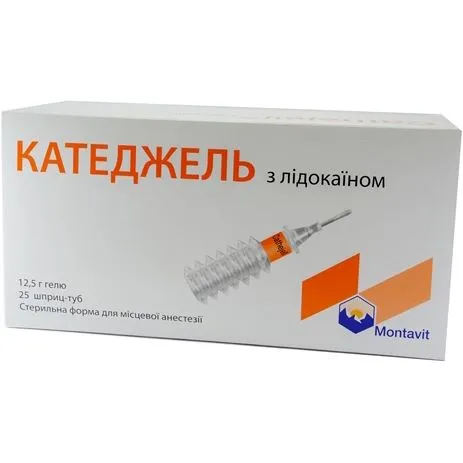
Table of Contents
INSTRUCTIONS FOR MEDICAL USE OF THE MEDICINAL PRODUCT CATHJELL WITH LIDOCAINE (CATHJELL LIDOCAIN®)
Composition:
Active substances: 1 g of gel contains 20 mg of lidocaine hydrochloride and 0.5 mg of chlorhexidine dihydrochloride;
Excipients: hydroxyethylcellulose, glycerin, sodium lactate solution, water for injections.
Pharmaceutical form. Gel.
Main physicochemical properties: sterile, water-soluble, transparent, colorless gel.
Pharmacotherapeutic group. Local anesthetics. Lidocaine, combinations. ATC code N01B B52.
Pharmacological Properties
Pharmacodynamics
Cathedjel with lidocaine is a sterile antiseptic gel with local anesthetic action. By means of local surface anesthesia, Cathedjel with lidocaine provides anesthesia of mucous membranes, resulting in rapid symptomatic reduction of pain sensations. The onset of action occurs within 5–10 minutes after application and lasts 20–30 minutes. In addition to analgesic effect, Cathedjel with lidocaine significantly helps prevent urinary tract infections following catheterization.
Lidocaine is a clinically proven amide-type local anesthetic. Lidocaine reversibly and locally inhibits conduction in sensory nerve fibers. Sensitivity decreases in the following sequence: cold/hot, touch, and pressure. With local anesthesia, onset of action typically occurs within 3–5 minutes. Its effect is reduced in inflamed tissues due to the acidic pH prevailing in such areas. In addition to its anesthetic action, lidocaine also has antiarrhythmic effects. Unlike most other local anesthetics, lidocaine does not exert a vasodilatory effect.
Pronounce
Lidocaine is clinically proven amide-type local anesthetic. Lidocaine reversibly and locally inhibits conduction in sensory nerve fibers. Sensitivity sequentially decreases: cold / heat, touch and pressure. With local anesthesia, onset of action typically occurs within 3–5 min. Effect is reduced in inflamed tissues due to acidic pH prevailing there. In addition to use as an anesthetic agent, lidocaine also has antiarrhythmic effect. Unlike most other local anesthetics, lidocaine does not have vasodilatory effect.
Dictionary - Open dictionary entry
Chlorhexidine is an antimicrobial agent active against most Gram-positive and Gram-negative bacteria, as well as against a number of fungi and viruses. In the formulation, it acts as a prophylactic agent to prevent iatrogenic infections with local application.
Pharmacokinetics
Absorption
Lidocaine is rapidly absorbed into the bloodstream through mucous membranes. The amount of lidocaine absorbed after local application on mucous membranes depends on the concentration and total applied dose, the specific site of application, and the duration of exposure. Local anesthetics are generally absorbed most rapidly after intratracheal and bronchial administration, which may lead to a rapid increase or very high plasma concentrations of lidocaine, increasing the risk of intoxication. Lidocaine is rapidly absorbed in the gastrointestinal tract, although only a small portion of the active substance reaches systemic circulation due to hepatic metabolism (first-pass effect).
Forty-five to sixty minutes after intraurethral instillation of 10–40 mL of 2% gel (200–800 mg lidocaine), maximum plasma lidocaine concentration ranged from 0.06 to 0.2 µg/mL. These values are 7.5–27.5 times lower than plasma concentrations (1.5–5.5 µg/mL) considered therapeutically relevant for antiarrhythmic effects and 30 times lower than toxic plasma concentrations (5–8 µg/mL).
It should be noted that pronounced inflammation of the urethral mucosa and increased surface area due to urethral dilation may lead to increased absorption of lidocaine.
Absorption of chlorhexidine following local application is extremely low.
Distribution
The volume of distribution of lidocaine is 1.3–1.6 L/kg; it rapidly distributes into all tissues, particularly highly vascularized organs such as lungs, kidneys, and skeletal muscles. Approximately 65% of lidocaine binds to plasma proteins and alpha-1 acid glycoproteins (AAGs).
Biotransformation, elimination
Lidocaine is rapidly metabolized in the liver via CYP1A2 and CYP3A4. Approximately 90% of the lidocaine dose is rapidly dealkylated and metabolized in the liver to monoethylglycinexylidide (MEGX) or glycinexylidide (GX), both of which are pharmacologically active. Only 2% of lidocaine is excreted unchanged in urine. Hepatic clearance of lidocaine largely depends on blood flow. MEGX and GX are less active sodium channel blockers than lidocaine. Other metabolites include 2,6-xylidine and 4-hydroxy-2,6-xylidine.
The terminal elimination half-life of 1.8 hours primarily reflects hepatic metabolism, but it may be prolonged to <2.3 hours in elderly patients. The elimination half-life of active metabolites is 0.9 hours.
Total plasma clearance of 0.95 L/min may be reduced in patients with cardiac or hepatic impairment. In renal insufficiency, accumulation of metabolites may occur.
Kinetics in hepatic, renal, and cardiac insufficiency
Due to the rapid biotransformation of lidocaine in the liver, its elimination half-life may be prolonged by two or more times in patients with impaired liver function—for example, up to 4.5–6 hours in chronic liver disease caused by alcohol abuse. In patients with severe heart failure, the elimination half-life may be prolonged to 4–10 hours. Renal insufficiency may lead to accumulation of metabolites.
Clinical characteristics.
Indications.
For local anesthesia of mucous membranes and as a lubricant in:
- urethral catheterization;
- sounding;
- endoscopic examinations;
- endotracheal intubation.
Contraindications.
Hypersensitivity to the components of the drug, as well as hypersensitivity to other amide-type local anesthetics; bulbocavernous (urethrocavernous) reflux; severe heart failure (NYHA class IV); pronounced bradycardia (< 33 beats per minute); severe atrioventricular block (third degree); cardiogenic shock; hypovolemic shock.
Interaction with other medicinal products and other types of interactions.
Concomitant use with strong CYP1A2 inhibitors, such as fluvoxamine, should be avoided, as they may lead to increased plasma concentration of lidocaine.
Moderate effects on lidocaine pharmacokinetics are caused by CYP3A4 inhibitors, such as erythromycin and itraconazole, which increase plasma lidocaine concentration. Plasma clearance of lidocaine is thus reduced by 9–18%, and by 53% when erythromycin is used concomitantly with fluvoxamine. Cathjel with lidocaine should not be used concurrently with products containing lidocaine hydrochloride or with other amide-type local anesthetics, as this may result in unpredictable interactions between the drugs.
Class I antiarrhythmic agents (including mexiletine, tocainide, disopyramide, ajmaline, etc.) should be used with caution, as toxic effects may occur. Cardiodepressive action is enhanced (QT interval prolongation; in isolated cases, AV block or ventricular fibrillation may develop);
Class III antiarrhythmic agents – concomitant use with amiodarone may lead to seizures. Close monitoring and ECG control are required in such patients.
Procaine, procainamide, and procainamide. Excitement of the central nervous system, delirium, and hallucinations are possible.
Caution should be exercised when using Cathjel with lidocaine concomitantly with cimetidine, an H2-receptor antagonist. Plasma lidocaine concentration may increase due to reduced hepatic perfusion and inhibition of microsomal enzymes, and a synergistic effect may also occur.
Beta-adrenergic blockers (e.g., propranolol, metoprolol) slow hepatic metabolism of lidocaine, enhance lidocaine effects (including toxic effects), and increase the risk of bradycardia and arterial hypotension. When beta-blockers are used concomitantly with lidocaine, the dose of lidocaine should be reduced. Beta-blockers also exhibit a synergistic effect when interacting with lidocaine; an inhibitory effect on cardiac conduction is observed, which may lead to increased myocardial contractility.
Cathjel with lidocaine should not be used simultaneously with calcium channel antagonists (e.g., diltiazem, verapamil), as they cause a significant prolongation of the elimination half-life due to decreased lidocaine clearance. Medicinal products that reduce lidocaine clearance may lead to potentially toxic plasma concentrations if lidocaine is administered repeatedly in high doses over a prolonged period. Therefore, during short-term treatment with Cathjel containing lidocaine at recommended doses, such interactions are not clinically significant.
Rifampicin. Possible decrease in its blood concentration.
No interactions with herbal medicinal products have been observed.
Special precautions for use.
Caution should be exercised when administering high doses or when dosing intervals are short. This may lead to high plasma levels of the drug and the development of severe adverse effects. The degree of absorption by mucous membranes varies, but is particularly high in the bronchial tree. Therefore, administration of the drug into the bronchial tree may result in rapid absorption or elevated plasma levels, associated with an increased risk of developing toxic symptoms such as seizures.
The drug should be used with caution in patients with hemorrhage, sepsis, or damaged mucous membranes, taking into account the patient's age, body weight, and physical condition. Particular attention should be paid to dosing in children, which also depends on age, body weight, and patient status.
It is recommended to use the lowest dose that provides effective anesthesia in order to avoid high plasma levels and serious adverse reactions. Tolerance to increased drug concentration in blood depends on the patient's condition.
Cathjelly with lidocaine should not be administered to children under 2 years of age.
Higher plasma concentrations may be observed in patients under general anesthesia who are paralyzed, compared to patients with spontaneous respiration. Healthy patients often swallow a significant portion of the administered dose, which then undergoes hepatic metabolism following intestinal absorption.
Cathjelly with lidocaine should be avoided in contact with the eyes.
Hyperthermia cannot be ruled out as a possible effect during the use of Cathjelly with lidocaine.
Particular caution is recommended during endotracheal intubation, as the gel may enter the lumen of the endotracheal tube. When performing oral intubation or instrumentation, the anesthetic effect may impair swallowing and lead to aspiration. Mucosal damage increases systemic absorption following oropharyngeal administration. As a result, dysphagia may develop and the risk of aspiration may increase. Numbness of the tongue or oral cavity may increase the risk of trauma due to biting.
Cathjelly with lidocaine may potentially affect the course of porphyria and therefore should not be used in patients with acute porphyria unless there are compelling indications for its use.
Cathjelly with lidocaine should be used with caution in:
- patients with cardiovascular disorders (e.g., bradycardia or heart failure), as this may worsen A-V conduction disturbances caused by amide-type local anesthetics;
- patients with severe hepatic impairment (Stage III and IV);
- patients with severe renal impairment (creatinine clearance < 30 mL/min), as metabolites of lidocaine may accumulate;
- elderly, debilitated, and critically ill patients, as well as patients prone to seizures, due to the potential for increased blood levels of lidocaine;
- patients with epilepsy.
When using the contents of more than one syringe tube, or when a significant amount of gel enters the bladder, or when the urethra is inflamed/ulcerated, absorption of lidocaine may be enhanced—especially in children and elderly patients—leading to drug overdose and adverse effects on the central nervous and cardiovascular systems.
Patients with myasthenia gravis are particularly sensitive to local anesthesia.
Use during pregnancy or breastfeeding.
Pregnancy.
There are no available data from studies on use in pregnant women. Approximately 50–60% of the maternal plasma concentration of lidocaine crosses the placenta. In cases of systemic effects, fetal depression may occur. The potential risk in humans is unknown. Adverse reactions were observed in animal studies with high doses.
Chlorhexidine, an ingredient of the product, does not pose risks, as only a minimal amount is absorbed into the mother's body.
Cathjelly with lidocaine should be used during pregnancy only if clearly needed, after careful assessment of risks and benefits, and doses should be individually adjusted. Repeated use of the drug during pregnancy is not recommended.
Breastfeeding.
Only a small amount of lidocaine passes into breast milk. If Cathjelly with lidocaine is used correctly, safety for the infant during breastfeeding is maintained.
There is no available information on the passage of chlorhexidine into breast milk. Since systemic absorption of chlorhexidine following urethral instillation is very low, the expected amount of chlorhexidine that may pass into breast milk is clinically insignificant.
Cathjelly with lidocaine should be used during breastfeeding only if necessary; doses should be individually adjusted. The interval between instillation of Cathjelly with lidocaine and the next breastfeeding should be 12 hours. Repeated use of the drug during breastfeeding is not recommended.
Ability to influence the speed of reactions when driving or operating machinery.
Cathjelly with lidocaine has practically no influence on the ability to drive or operate machinery. However, its effect cannot be completely excluded, and it should be remembered that reaction times may be reduced after administration of the drug.
Method of Administration and Dosage
Catedgel with lidocaine must be administered exclusively by a physician or specially trained medical personnel. The dose is determined individually by the physician.
Use of the drug for catheter, endoscope, or other medical instruments insertion into the urethra.
The collapsible tube-syringe contains 12.5 g of gel, approximately 10 g of which enters the urethra during instillation.
Recommended doses for adult males: To adequately fill the urethra, use 12.5 g of the drug. The contents of one collapsible tube-syringe are sufficient to fill the urethra. For one procedure, no more than one tube should be used. The onset of action occurs within 5–10 minutes.
Women, children (aged 2–12 years), and adolescents (aged 12 years and older): Specific dosage recommendations for these patient categories are not available. No more than 4 doses should be used within 24 hours.
Method of Administration
- Clean and disinfect the external urethral orifice.
- Remove the paper covering the transparent blister up to the conical edge.
- Break off the tip of the tube; if possible, leaving the tube inside the blister.
- Completely remove the broken tip of the tube to avoid accidental entry into the urethra.
- Squeeze out a drop of gel to facilitate insertion of the tip.
- Gently press on the tube and slowly introduce the gel into the urethra.
Any remaining gel should be discarded.
Anesthesia for general and tracheal intubation
Adults and children aged 15 years and older: Evenly distribute approximately 5 mL of gel over the lower third of the tube. To prevent drying, the gel should be applied directly before use. The gel must not enter the lumen of the tube. For adults with average body weight, the maximum dose of Catedgel with lidocaine is 16 g.
Dosage for children aged 2 to 15 years: In children under 15 years of age, the dose of the drug should not exceed 6 mg of lidocaine (= 0.3 mL of gel/kg body weight). No more than 4 doses should be used within 24 hours.
Dosage recommendations for patients in risk groups.
For elderly, weakened, or severely ill patients, as well as in cases of impaired liver function or severe renal insufficiency, the dose should be individually adjusted.
The maximum single dose is calculated in milligrams of lidocaine hydrochloride per kilogram of body weight (2.9 mg lidocaine hydrochloride/kg body weight).
Children.
Catedgel with lidocaine should not be administered to children under 2 years of age.
Overdose.
When professionally administered, Catedgel with lidocaine does not achieve toxic plasma concentrations (>5 µg/mL). However, concomitant use of other local anesthetics may cause an additive effect, potentially leading to overdose and systemic toxic reactions.
If symptoms of systemic intoxication do occur, they will resemble those seen with other methods of local anesthetic administration (e.g., infiltration or conduction anesthesia), particularly lidocaine (see symptoms of lidocaine intoxication).
Symptoms:
Lidocaine intoxication occurs in two phases:
Stimulation: At low toxic concentrations, lidocaine acts as a central nervous system (CNS) stimulant, resulting in CNS excitation accompanied by anxiety, dizziness, tremor, and stimulation of the cardiovascular system—namely, increased heart rate, elevated arterial blood pressure, and skin flushing.
Depression: At high toxic doses, depression of CNS and cardiovascular system function may occur (drowsiness, sedative effect, pallor, coma).
Reactions due to the toxic effects of lidocaine on the CNS usually precede cardiovascular reactions, as they occur at lower plasma concentrations.
The first symptom of lidocaine overdose is excitation; patients become restless, complain of dizziness, pre-syncope, hearing and vision disturbances, circumoral paresthesia, tingling in the tongue and lips, or nystagmus. Subconvulsive plasma levels of lidocaine often result in drowsiness and sedation. Tremors and muscle twitching are precursors to inevitable generalized seizures. As the toxic effect on the CNS increases, brainstem function is severely impaired, leading to symptoms of respiratory depression or arrest and even coma.
Acidosis, hyperkalemia, hypocalcemia, and hypoxia increase and worsen the toxic effects of local anesthetics.
Decreased arterial blood pressure, bradycardia, arrhythmia, and cardiac collapse are the first signs of lidocaine toxicity on the cardiovascular system, ultimately leading to myocardial depression and prolonged ventricular activity. Cardiovascular side effects are usually observed at very high plasma lidocaine concentrations and are of minimal clinical significance.
Treatment: Oxygen therapy, anticonvulsants, muscle relaxants. At the first signs of changes, ensure access to fresh air, oxygen supply, and/or artificial ventilation. If seizures occur and persist for more than 15–20 seconds, administer sodium thiopental at a dose of 1–3 mg/kg. As an alternative, diazepam may be administered at a dose of 0.1 mg/kg body weight. Prolonged seizures threaten respiration and may require administration of a muscle relaxant (e.g., succinylcholine 1 mg/kg body weight).
If cardiovascular depression (hypotension, bradycardia) occurs, administer 5–10 mg of ephedrine, which may be repeated if necessary after 2–3 minutes.
In case of cardiac arrest, immediate resuscitation is indicated. Administer adrenaline (epinephrine) (0.1–0.2 mg as intracardiac or intravenous injection), and repeat administration if necessary.
Side effects.
Side effects after the use of Cathedjel with lidocaine are rare (< 1/10000), if the product is used according to the recommended dosage and administration instructions.
Rarely, cases of local and/or systemic hypersensitivity reactions, idiosyncrasy, or tolerance to lidocaine and/or chlorhexidine may occur. Systemic side effects may be caused by high plasma levels of the active substance, which may result from rapid absorption, overdose, hypersensitivity, individual intolerance, or reduced tolerance, possibly leading to the following symptoms:
Central nervous system (CNS) effects: CNS excitation or depression may occur, manifesting as restlessness, blurred vision, tremor, drowsiness, loss or confusion of consciousness, circumoral paresthesia, delirium, fear, euphoria, dizziness, hyperacusis, tinnitus, nausea, vomiting, sensation of warmth, cold or numbness, twitching, seizures, respiratory depression and/or respiratory arrest. Excitatory symptoms (e.g., twitching, tremor, seizures) may be very brief or may not occur at all. The first sign of toxicity may be drowsiness, confusion progressing to loss of consciousness and respiratory arrest.
Cardiovascular system effects: arterial hypotension, arrhythmia, bradycardia, asystole, cardiac collapse, cardiac arrest;
Respiratory system effects: bronchospasm, respiratory distress syndrome;
Hypersensitivity reactions: skin reactions, urticaria, angioneurotic edema or anaphylactic shock;
Local application site reactions: burning and itching sensations; hoarseness and sore throat (during endotracheal intubation).
Shelf life. 3 years.
Storage conditions. Store in a light-protected place, out of reach of children.
Packaging. 12.5 g of gel in laminated syringe-tubes in blisters. 1, 5, or 25 blisters per cardboard box.
Prescription category. Prescription only.
Manufacturer.
Pharmazeutische Fabrik Montavit GmbH.
Manufacturer's address.
Salzbergstrasse 96, 6067 Absam, Austria.