Karizon
Ukraine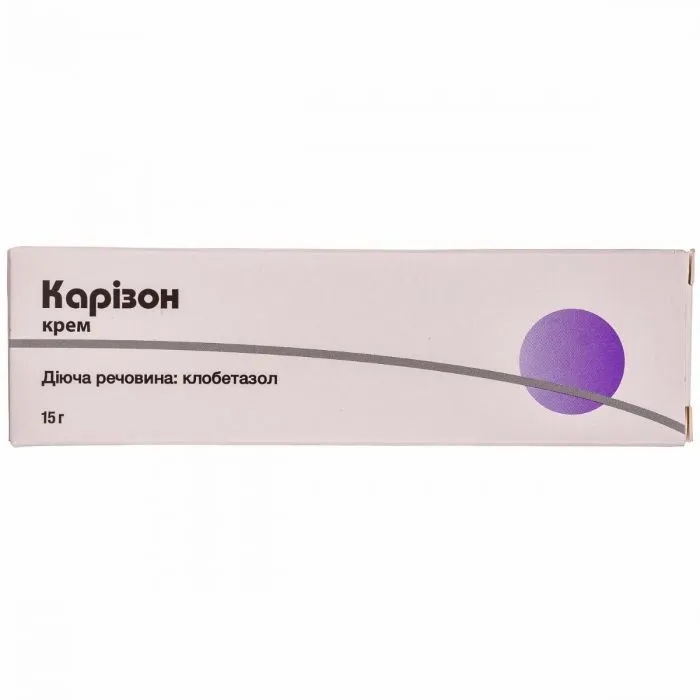
Table of Contents
INSTRUCTION FOR MEDICAL USE OF THE MEDICINAL PRODUCT KARIZON®
Composition:
Active substance: clobetasol;
1 g of cream contains 0.5 mg of clobetasol propionate;
Excipients:
methyl parahydroxybenzoate (E 218), disodium edetate, stearyl alcohol, soft white paraffin, paraffin, sorbitan sesquioleate, polysorbate 80, glycerin, purified water.
Pharmaceutical form. Cream.
Main physicochemical characteristics: white homogeneous cream with a slight specific odor.
Pharmacotherapeutic group. Corticosteroids for topical use. Simple corticosteroids. Very potent corticosteroids (group IV).
ATC code: D07AD01.
Pharmacological properties.
Pharmacodynamics.
Efficacy
Topical corticosteroids possess anti-inflammatory, antipruritic, and vasoconstrictive properties.
Based on its efficacy confirmed in animal studies and pharmacological trials in humans, clobetasol propionate 0.05% belongs to the class of very high potency topical corticosteroids, intensity class IV.
Mechanism of action
Qualitatively, the mechanism of anti-inflammatory, antiproliferative, and immunomodulatory action of all glucocorticoids—according to generally accepted, partially incomplete, and hypothetical concepts—can schematically and in simplified form be represented as follows: glucocorticoid molecules form complexes in plasma with cellular corticoid receptors—binding to specific genes GRE (hormone-responsive elements).
This induces transcription of specific m-RNA molecules, leading to the synthesis of lipocortin-proteins on ribosomes.
Lipocortins slow down reactions occurring in response to physical, chemical, toxic, or immunogenic influences, or the action of microbiological pathogenic factors, which take place between phospholipase A2 and membrane phospholipids and mediate the release of arachidonic acid.
Inhibition or slowing of arachidonic acid release normalizes, reduces, or blocks the synthesis regulated by arachidonic acid metabolism via cyclooxygenase and lipoxygenase, thereby suppressing the release of prostaglandins, prostacyclin, leukotrienes, PAF (platelet-activating factor), and thromboxane. As inflammatory mediators, these substances affect, for example, blood vessels, cell membranes, leukocytes, and macrophages—including their chemotaxis and migration—and regulate cell growth.
In addition, glucocorticoids exert antimitotic effects and slow down nucleic acid and protein synthesis. Important factors in their immunomodulatory and anti-allergic effects are glucocorticoid interactions with B-cells, T-cells, and Langerhans cells, which slow antigen progression and antagonize the synthesis and functions of interleukin-1, interleukin-2, and other cytokines.
Pharmacokinetics.
Studies on skin penetration of clobetasol from a cream formulation containing clobetasol propionate have not been conducted.
Clinical Characteristics
Indications
For the treatment of localized therapy-resistant plaques of inflammatory skin diseases where symptomatic treatment with potent topical glucocorticoids is indicated, such as psoriasis.
Contraindications
Carison® cream is contraindicated in the following cases:
- Hypersensitivity to the active substance, methylparahydroxybenzoate, or to any other excipient of the medicinal product;
- Rosacea, rosacea-like (perioral) dermatitis, generalized forms of chronic plaque psoriasis, common acne, pruritus without inflammation, Pruritus anogenitalis, viral skin infections (e.g., herpes simplex, varicella), specific skin conditions (e.g., cutaneous tuberculosis, cutaneous manifestations of syphilis), vaccination reactions, and untreated skin infections (caused by bacteria, fungi, or parasites);
- In infants and children under 3 years of age (including treatment of dermatoses);
- In the eye area, eyelids, and around the eyes, since under certain conditions this may lead to the development of glaucoma or cataract; this product is not intended for ophthalmic use.
Carison® cream should not be applied to the face (see section "Special Warnings and Precautions for Use").
Interaction with Other Medicinal Products and Other Forms of Interaction
When used concomitantly with drugs that may inhibit the CYP3A4 enzyme system (e.g., ritonavir, itraconazole), inhibition of corticosteroid metabolism has been observed, which may lead to increased systemic bioavailability. The clinical significance of such an interaction depends on the dose of the drug, the route of administration of the corticosteroid, and the potency of the CYP3A4 inhibitor.
Interactions between clobetasol propionate and other medicinal products have not been fully documented; however, potential interactions may occur, for example with diuretics and anticoagulants, particularly under unfavorable therapeutic and absorptive conditions, such as on severely damaged skin.
Special precautions for use.
Increased systemic absorption of topical corticosteroids may lead in some individuals to manifestations of hypercorticism (Cushing's syndrome) and reversible suppression of the hypothalamic-pituitary-adrenal (HPA) axis with adrenal insufficiency. If any of the above symptoms occur, the frequency of application should be gradually reduced or the drug should be replaced with a less potent corticosteroid. Sudden discontinuation of treatment may lead to adrenal insufficiency (see section "Side effects").
Factors that increase the risk of systemic effects include:
- Potency and formulation of the topical corticosteroid;
- Duration of treatment;
- Application over a large skin surface area;
- Application to areas of skin in close contact, such as intertriginous areas or under occlusive dressings (in infants, diapers may act as occlusive dressings);
- Increased hydration of the stratum corneum;
- Application to areas with thin skin, such as the face;
- Application to damaged skin or in the presence of other skin barrier impairments;
- In infants and children compared to adults, a proportionally greater amount of topical corticosteroid may be absorbed due to their underdeveloped skin barrier and larger skin surface area relative to body mass. Therefore, systemic adverse effects are more likely in infants and children.
Children aged 3 to 12 years should not use Karizon® cream. The use of this product in this age group should be limited to exceptional cases and only for a few days. Prolonged treatment with topical corticosteroids should be avoided in this age group due to the risk of adrenal suppression.
The risk of bacterial infections increases in warm and moist conditions, such as skin folds, or due to the use of occlusive dressings. When using occlusive dressings, the skin should be thoroughly cleaned each time the dressing is changed.
Topical steroids should be used with caution in the treatment of psoriasis, as recurrences, development of tolerance, risk of generalized pustular psoriasis, and symptoms of local or systemic toxicity due to impaired skin barrier function have been reported. When treating psoriasis with this product, the patient should remain under close medical supervision.
For inflammatory skin conditions complicated by infection, appropriate antimicrobial therapy should be administered. Any sign of infection spreading requires immediate discontinuation of topical glucocorticoid therapy and initiation of appropriate antimicrobial treatment.
Topical corticosteroids are sometimes used to treat dermatitis around chronic leg ulcers. However, such use is associated with an increased incidence of local hypersensitivity reactions and a higher risk of local infections.
Serious necrotizing infections (including necrotizing fasciitis) and systemic immunosuppression (sometimes leading to Kaposi's sarcoma) have been reported following prolonged use of clobetasol propionate at doses exceeding recommendations (see section "Dosage and administration"). In some cases, patients were concurrently using other potent oral/topical corticosteroids or immunosuppressants (e.g., methotrexate, mycophenolate mofetil). If treatment with topical corticosteroids is clinically justified for longer than 2 weeks, consideration should be given to switching to a less potent corticosteroid.
Karizon® cream should not be applied to the face, as facial skin is particularly susceptible to atrophic skin changes.
If application to the facial skin is necessary, treatment duration should be limited to a few days.
Vision disorders:
Visual disturbances may occur with systemic or topical use of corticosteroids. If a patient reports symptoms such as blurred vision or other visual disturbances, they should be referred to an ophthalmologist to evaluate possible causes, including cataract, glaucoma, or rare conditions such as central serous chorioretinopathy, which has been reported after systemic or topical corticosteroid use.
Additionally, Karizon® cream should not be applied to the skin of the neck, intertriginous areas (axillary and genital folds), except in cases of genital lichen sclerosus, or to eroded, weeping, abraded, or ulcerated skin surfaces. The product should also be avoided in patients with hepatic impairment or those developing diabetes-like metabolic disturbances.
Elderly patients should not apply Karizon® cream over large areas of skin.
Careful monitoring of patients is required during prolonged and/or repeated use of clobetasol propionate, similar to monitoring required with oral or parenteral corticosteroid administration.
When applying the product to the genital area or perianal region, the presence of excipients such as soft white paraffin and paraffin may reduce the strength and reliability of latex condoms if used simultaneously.
Stearyl alcohol may cause localized skin reactions (e.g., contact dermatitis).
Use during pregnancy or breastfeeding.
During pregnancy, use of Karizon® cream should be avoided. If use is necessary, the duration should be as short as possible and the application area as small as possible. Clobetasol should be used during pregnancy only if the expected benefit to the mother outweighs the potential risk to the fetus.
Prolonged glucocorticoid treatment during pregnancy may impair fetal development. Animal studies have shown that glucocorticoid use can lead to cleft palate. There is an increased risk of cleft palate in human fetuses following glucocorticoid use during the first trimester of pregnancy. Furthermore, epidemiological and animal studies suggest that intrauterine exposure to glucocorticoids may predispose individuals to metabolic and cardiovascular disorders in adulthood. Synthetic glucocorticoids such as clobetasol are generally less readily inactivated than endogenous cortisol (hydrocortisone), thus posing a risk to the fetus. Use of glucocorticoids late in pregnancy may lead to adrenal atrophy in the fetus, which may require gradual replacement therapy in newborns.
Breastfeeding period.
Glucocorticoids are excreted in breast milk. To date, no adverse effects have been observed in newborns. However, indications for use during breastfeeding should be clearly defined. Clobetasol should be used during breastfeeding only if the expected benefit to the mother outweighs the potential risk to the infant. Contact between the infant and areas of skin treated with the product should be avoided. If higher doses are required due to illness, breastfeeding should be discontinued.
Karizon® cream should not be applied to the breast area during breastfeeding to prevent accidental oral exposure of the infant.
Ability to affect reaction speed when driving or operating machinery.
No negative effect on reaction speed when driving or operating machinery is expected with the use of Karizon® cream.
Method of Administration and Dosage.
Clobetasol propionate belongs to the class of the most potent topical corticosteroids (Group IV), and prolonged use may lead to serious adverse effects (see section "Special Warnings and Precautions for Use"). If treatment with a topical corticosteroid is clinically justified beyond 2 weeks, consideration should be given to switching to a less potent corticosteroid. Repeated, but short-term, courses of clobetasol propionate may be used to control flare-ups (see details below).
Dosage
The cream should be applied once daily in a thin layer.
The treated area should not exceed 10% of the body surface. For safety reasons, patients should not use more than 50 g of Karizon® cream per week.
Repeated short-term treatment with Karizon® cream may be used to control disease flare-ups. If long-term steroid therapy is recommended, a formulation with less frequent application should be selected.
Geriatric Patients
Clinical studies have not revealed differences in efficacy between elderly patients and younger patients. However, the increased incidence of renal and hepatic impairment in elderly patients may reduce elimination in the event of systemic absorption. Therefore, treatment should be limited to the minimum amount and shortest duration providing the desired clinical benefit. During treatment, patients should be monitored regularly at short intervals for adverse effects.
Patients with Renal or Hepatic Impairment
In the event of systemic absorption (possible with prolonged use over large areas), patients with renal or hepatic impairment may experience delayed metabolism and elimination, thereby increasing the risk of systemic toxicity. Therefore, treatment should be limited to the minimum amount and shortest duration providing the desired clinical benefit. During treatment, patients should be monitored regularly at short intervals for adverse effects.
Patients with Impaired Glucose Metabolism
Karizon® cream should not be used in patients with impaired glucose metabolism over large skin areas. During treatment, patients should be monitored regularly at short intervals for adverse effects.
Method of Administration
Patients should wash their hands after applying Karizon® cream, unless the hands are the area being treated.
Duration of Treatment
The maximum duration of treatment is 2 weeks. If improvement does not occur, the patient should consult again with the physician who prescribed the medication.
Once disease control is achieved, corticosteroid therapy should be gradually discontinued, and skin care should continue as the main treatment.
Sudden withdrawal of clobetasol may lead to rebound flare-up of the dermatosis that existed prior to treatment initiation (rebound phenomenon).
Children.
Karizon® cream should be used in children for the shortest possible duration and at the lowest effective doses.
The product is contraindicated for use in infants and children under 3 years of age (see section "Contraindications").
Karizon® cream should not be used in children aged 3 to 12 years. Treatment in this age group should only be considered in exceptional cases and for a few days (see section "Special Warnings and Precautions for Use").
Overdose.
Symptoms.
The likelihood of acute overdose is very low; however, with chronic overdose or incorrect use, signs of hypercorticism may occur (see section "Adverse Reactions").
Treatment.
In case of overdose, due to the risk of adrenal insufficiency, the dosage should be gradually reduced by decreasing the frequency of application or by switching to a less potent corticosteroid under medical supervision.
Further management in case of overdose should be based on the patient's clinical condition.
Adverse reactions.
The adverse effects listed below are classified by organs and systems and by their frequency of occurrence.
The following classification was used to determine the frequency of adverse reactions:
| Very common |
(≥ 1/10) |
| Common |
(≥ 1/100 to < 1/10) |
| Uncommon |
(≥ 1/1 000 to < 1/100) |
| Rare |
(≥ 1/10 000 to < 1/1000) |
| Very rare |
(< 1/10 000) |
| Frequency not known |
(frequency cannot be estimated from the available data) |
| System Organ Class |
Adverse Reaction |
Frequency |
| Infections and parasitic disorders |
Opportunistic infections |
very rare |
| Immune system disorders |
Local hypersensitivity reactions* |
very rare |
| Endocrine disorders |
Suppression of hypothalamic-pituitary-adrenal (HPA) axis: Cushingoid signs (e.g., moon face, central obesity), growth/weight gain delay in children, osteoporosis, hyperglycemia/glucosuria, arterial hypertension, weight gain/obesity, decreased endogenous cortisol levels, alopecia, hair fragility |
very rare |
| Eye disorders |
Glaucoma, cataract |
very rare |
| Central serous chorioretinopathy (CSC), Blurred vision (see also section "Special precautions") |
frequency not known |
|
| Skin and subcutaneous tissue disorders |
Itching, local burning sensation/pain on the skin. |
common |
| Skin atrophy**, striae**, telangiectasia** |
uncommon |
|
| Skin thinning**, skin wrinkling**, dry skin**, pigment changes**, hypertrichosis, exacerbation of underlying symptoms, allergic contact dermatitis/dermatitis (including rosacea-like [perioral] dermatitis), pustular psoriasis, erythema, rash, urticaria |
very rare |
|
| Steroid acne, folliculitis, bruising, whiteheads |
frequency not known |
|
| General disorders and administration site conditions |
Irritation/pain at application site |
very rare |
* If signs of hypersensitivity reactions occur, the drug must be discontinued immediately.
Local hypersensitivity reactions similar to symptoms caused by the disease may occur during drug use.
* Skin disorders secondary to local and/or systemic suppression of the hypothalamic-pituitary-adrenal axis.
After prolonged use of the drug, skin atrophy occurs more frequently when applied to the face than to other areas of the body.
Exacerbation of symptoms requiring treatment is possible.
Methylparahydroxybenzoate may cause hypersensitivity reactions and delayed-type allergic reactions.
Reporting suspected adverse reactions
Reporting of suspected adverse reactions during the post-marketing period is very important. It allows ongoing monitoring of the benefit-risk balance of the medicinal product. Healthcare professionals should report any suspected adverse reactions.
Shelf life. 3 years.
After opening the tube – 3 months.
Storage conditions.
Store out of reach of children at a temperature not exceeding 25 °C.
Packaging. Tube of 15 g, 30 g or 50 g in a cardboard box with instructions for medical use.
Prescription status. Prescription only.
Manufacturer.
mibe GmbH Arzneimittel.
Manufacturer's address and place of business.
Muenchener Strasse 15, Brehna, Saxony-Anhalt, 06796, Germany.