Cardonat
Ukraine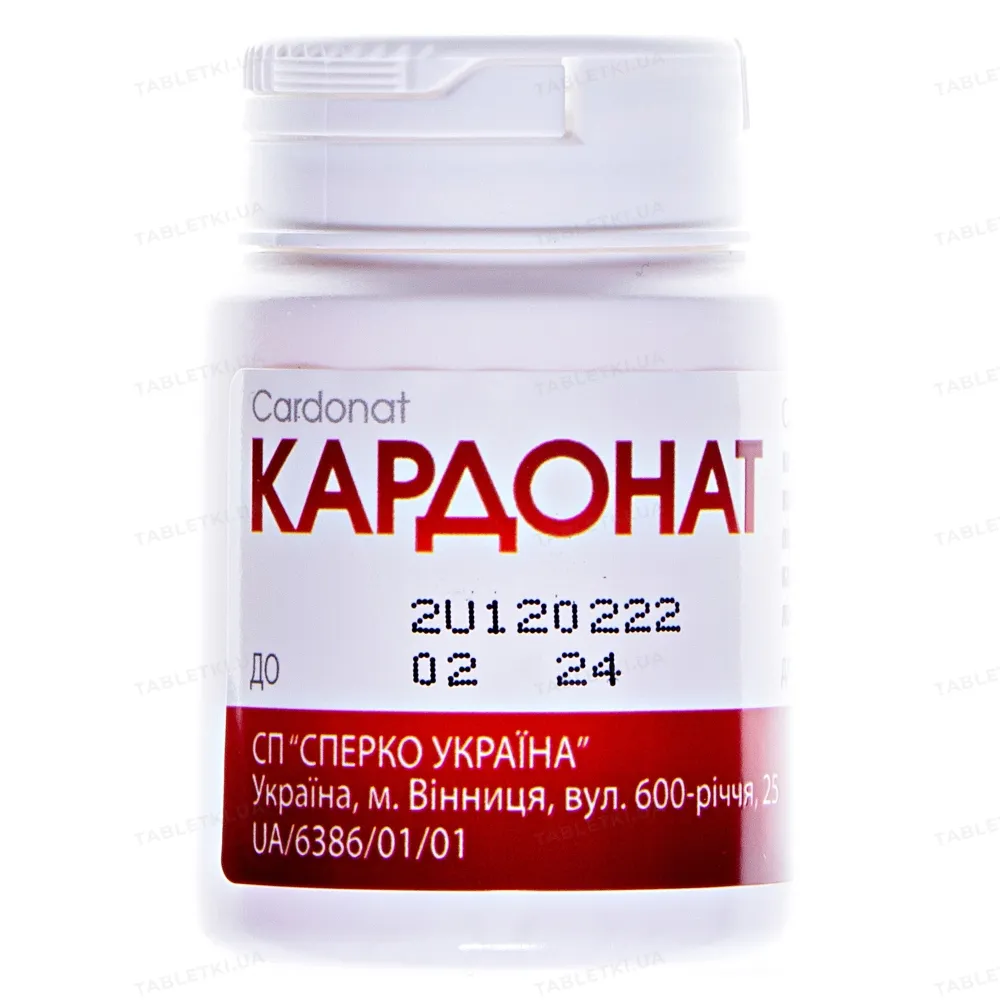
Table of Contents
INSTRUCTIONS FOR MEDICAL USE OF THE MEDICINAL PRODUCT KARDONAT (CARDONAT)
Composition:
Active substances: cobamamide (dibencoside, coenzyme B12), cocarboxylase (chloride) (coenzyme B1), pyridoxal-5-phosphate (coenzyme B6), carnitine chloride, lysine hydrochloride;
1 capsule contains cobamamide (dibencoside, coenzyme B12) – 1 mg, cocarboxylase (chloride) (coenzyme B1) – 50 mg, pyridoxal-5-phosphate (coenzyme B6) – 50 mg; carnitine chloride – 100 mg, lysine hydrochloride – 50 mg;
Excipients: talc, colloidal anhydrous silicon dioxide;
Capsule composition:
Cap: gelatin, titanium dioxide (E 171), Ponceau 4R (E 124), Yellow FCF (E 110);
Body: gelatin, titanium dioxide (E 171).
Pharmaceutical form. Capsules.
Main physicochemical properties: hard gelatin capsules size № 1 or № 2 with a white or orange body and an orange or red cap. The capsule contents are a powder ranging from whitish-yellow to light orange in color, with dark and/or white specks.
Pharmacotherapeutic group. Vitamins in combination with other substances.
ATC code A11JC.
Pharmacological properties.
Pharmacodynamics.
Cardonat is a combination drug whose action is determined by the synergistic effects of its components. L-carnitine, a trimethylammonium (betaine) derivative of γ-amino-β-hydroxybutyric acid, belongs to agents with anabolic activity. It is synthesized in the liver, kidneys, and central nervous system from the amino acids lysine and methionine with the participation of iron and ascorbic acid; in blood plasma, it is present in free form and as acylcarnitine esters. Carnitine is the main cofactor and regulator of fatty acid metabolism in myocardium, liver, and skeletal muscles, and is the only transporter of long-chain fatty acids into mitochondria, where their beta-oxidation to acetyl-CoA occurs. Acetyl-CoA serves as a substrate for ATP production in the Krebs cycle. Carnitine promotes the removal of metabolites and toxic substances from the cytoplasm and improves metabolic processes. Under normal oxygen supply, it shifts cellular metabolism toward oxidation of fatty acids—the most energy-rich substrate; under hypoxic conditions, L-carnitine removes toxic fatty acid metabolites from mitochondria and shifts cellular metabolism toward glucose oxidation, thereby exerting an anti-hypoxic effect. It enhances physical performance, accelerates growth, increases muscle mass, and reduces fat mass due to its lipolytic action. It decreases peripheral effects of thyroid hormones and helps normalize basal metabolism in hyperthyroidism. It reduces symptoms of physical and mental fatigue, exhibits neuroprotective, hepatoprotective, and cardioprotective effects, demonstrates anti-ischemic activity, helps limit the infarct zone, improves nerve impulse transmission in synapses and axons by increasing the synthesis of choline and acetylcholine, and glutamic acid. It reduces ammonia concentration in nervous tissue, stimulates cellular immunity, eliminates functional disorders of the nervous system in patients with chronic intoxications, including those of alcoholic origin, alleviates withdrawal syndrome, and inhibits dystrophic changes in the retina. Carnitine exerts an anti-ketogenic effect by reducing the production of ketone bodies from higher fatty acids.
Lysine is an essential amino acid involved in all processes of assimilation and growth. It promotes ossification and bone tissue growth, stimulates cell mitosis, improves oogenesis and spermatogenesis, and exhibits direct antiviral activity against herpes simplex viruses.
Cobamamide, the coenzyme form of vitamin B12, has anabolic activity and activates the metabolism of carbohydrates, proteins, and lipids. It participates in the synthesis of labile methyl groups, and in the formation of choline, methionine, nucleic acids, and creatine. It promotes the accumulation of sulfhydryl group-containing compounds in erythrocytes. As a growth factor, it stimulates bone marrow function, which is essential for normoblastic erythropoiesis. Cobamamide helps normalize impaired liver and nervous system functions, exerts an anti-ketogenic effect, activates the blood coagulation system, and at high doses increases thromboplastin and prothrombin activity.
Thiamine coenzyme (cocarboxylase), the coenzyme form of vitamin B1, regulates metabolic processes in the body. It plays a particularly important role in carbohydrate and lipid metabolism, primarily in the oxidative decarboxylation of keto acids (pyruvic acid, α-ketoglutaric acid), as well as in the pentose phosphate pathway of glucose breakdown. It reduces levels of lactic and pyruvic acids in the body, improves glucose utilization and neural tissue trophism, and exhibits cardioprotective effects.
Pyridoxal-5-phosphate, the coenzyme form of vitamin B6, plays a crucial role in metabolic processes and is necessary for the normal functioning of the central and peripheral nervous systems. It acts as a coenzyme for numerous enzymes involved in non-oxidative amino acid metabolism (decarboxylation and transamination processes). It participates in the metabolism of tryptophan, methionine, cysteine, glutamic acid, and other amino acids. It is important for histamine metabolism as a coenzyme of histaminase, promotes normalization of lipid metabolism, increases glycogen content in the liver, and enhances its detoxifying properties. It regulates neuromuscular processes, which are particularly important in children with delayed mental and physical development, as well as in cases of chronic fatigue and asthenia.
Pharmacokinetics.
Not studied.
Clinical characteristics.
Indications.
In adults and children: physical and mental overstrain, including in athletes, decreased work capacity, asthenic syndrome, vegetative-vascular dystonia, during the convalescence period after somatic and infectious diseases, as well as after surgical interventions, acetonemic syndromes of various etiologies, liver diseases (hepatitis, cirrhosis), metabolic cardiomyopathies, chronic heart failure (as part of complex therapy), to improve ossification in the complex treatment of osteoporosis and bone fractures.
In children: delayed mental and physical development (hypotrophy, anorexia, growth retardation).
In adults: peripheral neuritis, neuralgias, radiculopathies, as part of complex therapy for acute and chronic cerebral circulation disorders (cerebral strokes and chronic cerebral ischemia), as part of complex therapy for ischemic heart disease (angina pectoris, myocardial infarction), hyperhomocysteinemia, as part of complex therapy for alcohol dependence syndrome, including during withdrawal, hyperthyroidism.
In obstetrics and gynecology: gestosis in pregnant women, fetoplacental insufficiency, and intrauterine growth retardation of the fetus.
Contraindications.
Hypersensitivity to the components of the drug, malignant neoplasms, active phase of peptic ulcer of the stomach or duodenum.
Interaction with other medicinal products and other types of interactions.
When used concomitantly with levodopa, its therapeutic activity may be reduced due to interaction with pyridoxal. Cardonat may potentiate the effect of antihypertensive agents, cardiac glycosides, peripheral vasodilators, insulin, and other hypoglycemic agents.
Special precautions.
Do not exceed the recommended doses of the drug.
Use during pregnancy or breastfeeding.
The drug should be used during pregnancy only as prescribed and under strict medical supervision. It is unknown whether the active substances of the drug pass into breast milk; therefore, during breastfeeding, Cardonat may be used only when the benefit to the mother outweighs the potential risk of adverse effects in the infant.
Ability to affect reaction speed when driving or operating machinery.
Has no effect.
Dosage and Administration.
For adults and children aged 15 years and older, administer 1-2 capsules of Cardonat three times daily after meals. For children aged 5 to 15 years, administer 1 capsule twice daily. For children aged 1 to 5 years, it is recommended to take the contents of 1 capsule once daily. When administering to children aged 1 to 5 years, the capsule contents should be dissolved beforehand in 50-100 ml of any fruit juice or sweetened water.
Dose adjustment for treatment during pregnancy is not required.
In cases of anorexia, administer the drug 15-20 minutes before meals.
For patients experiencing difficulty swallowing capsules (children, postoperative patients, stroke survivors), it is permissible to dissolve the capsule contents in juice or sweetened water prior to administration.
The average duration of treatment course ranges from 3 weeks to 3 months.
Children.
Suitable for children aged 1 year and older.
Overdose.
Possible symptoms include tachycardia, dyspeptic disorders, excitation, increased or decreased arterial pressure. These symptoms resolve after discontinuation of the drug and do not require specific therapeutic interventions.
Adverse reactions.
The drug is usually well tolerated, but rarely, usually in cases of individual hypersensitivity, allergic reactions may occur, including various skin rashes, skin itching, urticaria, angioneurotic edema. In such cases, treatment should be discontinued and medical advice should be sought.
Gastrointestinal tract: possible bloating, epigastric pain, heartburn, nausea, vomiting, bowel disturbances.
Cardiovascular system: possible tachycardia, changes in blood pressure.
Central nervous system: very rarely excitement may occur.
The capsule shell contains Sunset Yellow FCF (E 110) and Ponceau 4R (E 124), which may cause allergic reactions.
Shelf life.
2 years.
Do not use the drug after the expiry date stated on the packaging.
Storage conditions.
Store at a temperature not exceeding 25 °C. Keep out of reach of children.
Packaging.
20 or 30 capsules in a plastic container and cardboard box.
Dispensing category.
Over-the-counter.
Manufacturer.
Ukrainian-Spanish joint venture "Sperco Ukraine".
Manufacturer's location and address of business activity.
21027, Ukraine, Vinnytsia, 600-richchia St., 25.
Tel.: + 38 (0432) 52-30-36. E-mail: [email protected]
www.sperco.com.ua