Cardazin-zdorovya
Ukraine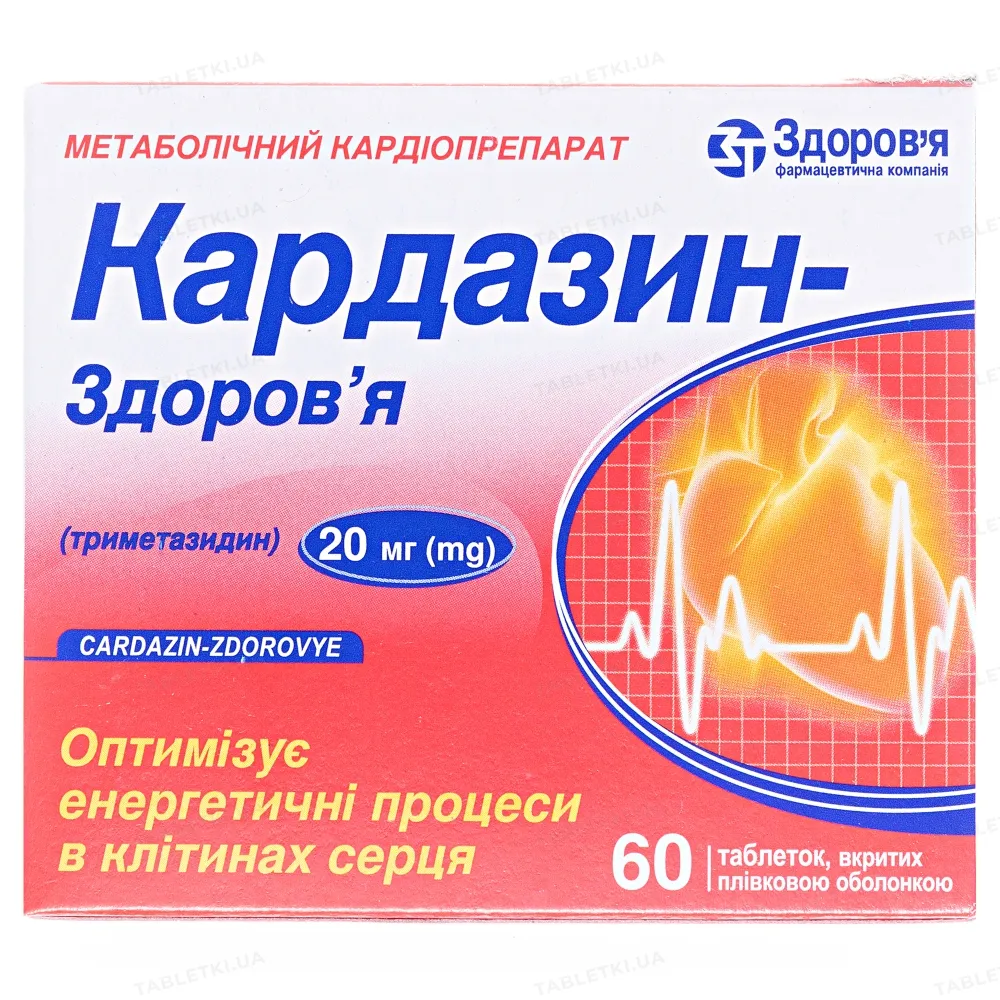
Table of Contents
INSTRUCTIONS FOR MEDICAL USE OF THE MEDICINAL PRODUCT KARDASIN-ZDOROVYA (CARDAZIN-ZDOROVYE)
Composition:
Active substance: trimetazidine;
One tablet contains 20 mg of trimetazidine dihydrochloride;
Excipients: lactose monohydrate; microcrystalline cellulose; potato starch; povidone; magnesium stearate; colloidal anhydrous silicon dioxide; talc; titanium dioxide (E 171); candurin (silver glitter) containing potassium aluminosilicate, titanium dioxide (E 171); hypromellose; colouring agent "Sepisperse DRY 5220 Red" containing hypromellose (hydroxypropylmethylcellulose) (E 464), microcrystalline cellulose (E 460), Ponceau 4R (E 129), titanium dioxide (E 171).
Pharmaceutical form. Film-coated tablets.
Main physicochemical characteristics: film-coated tablets, from reddish-pink to pink-red in colour with a pearly sheen.
Pharmacotherapeutic group. Cardiology drugs. Trimetazidine. ATC code C01EB15.
Pharmacological Properties.
Pharmacodynamics.
Mechanism of action. By preserving cellular energy metabolism in cells suffering from hypoxia or ischemia, trimetazidine prevents the decrease in intracellular ATP levels, thereby ensuring proper functioning of ion pumps and transmembrane sodium-potassium flux, maintaining cellular homeostasis.
Trimetazidine inhibits fatty acid β-oxidation by blocking long-chain 3-ketoacyl-CoA thiolase (3-KAT), which enhances glucose oxidation. In ischemic cells, energy production via glucose oxidation requires less oxygen compared to energy production via fatty acid β-oxidation. Enhanced glucose oxidation thus optimizes cellular energy processes and supports adequate energy metabolism under ischemic conditions.
Pharmacodynamic effects. In patients with ischemic heart disease, trimetazidine acts as a metabolic agent, preserving intracellular levels of high-energy phosphates in the myocardium. Anti-ischemic effects are achieved without concomitant hemodynamic effects.
Clinical efficacy and safety. Clinical studies have demonstrated the efficacy and safety of trimetazidine for the treatment of patients with stable angina, both as monotherapy and as an add-on to other antianginal medications when their efficacy is insufficient.
A randomized, double-blind, placebo-controlled study (TRIMPOL-II) involving 426 patients showed that adding trimetazidine 60 mg daily to metoprolol 100 mg (50 mg twice daily) for 12 weeks led to significant improvements in exercise test parameters and clinical symptoms compared to placebo: total exercise duration − +20.1 sec, p=0.023; total work performed − +0.54 MET, p=0.001; time to ST-segment depression of 1 mm − +33.4 sec, p=0.003; time to onset of angina − +33.9 sec, p<0.001; number of angina attacks/week − -0.73, p=0.014; short-acting nitrate use/week − -0.63, p=0.032, without changes in hemodynamic parameters.
A randomized, double-blind, placebo-controlled study (Sellier) involving 223 patients demonstrated that in the subgroup (n=173) receiving add-on therapy with trimetazidine modified-release tablets 35 mg twice daily to atenolol 50 mg once daily for 8 weeks, there was a significant increase (+34.4 sec, p=0.03) in time to ST-segment depression of 1 mm during exercise testing compared to placebo, measured 12 hours after dosing. A significant difference was also confirmed for time to onset of angina (p=0.049). No significant differences between the two patient groups were observed for other secondary endpoints (total exercise duration, total work performed, and clinical endpoints).
In a randomized, double-blind study (Vasco study) involving 1962 patients over 3 months, trimetazidine 70 mg/day, 140 mg/day, or placebo was added to atenolol 50 mg/day. In the overall population, including symptomatic and asymptomatic patients, trimetazidine showed no advantage over placebo regarding either ergometric parameters (total exercise time, time to ST-segment depression of 1 mm, time to onset of angina) or clinical endpoints. However, in the subgroup of symptomatic patients (n=1574), treatment with trimetazidine 140 mg/day significantly improved total exercise time (+23.8 sec vs. +13.1 sec with placebo; p=0.001) and time to onset of angina (+46.3 sec vs. +32.5 sec with placebo; p=0.005).
Pharmacokinetics.
Absorption. After oral administration, trimetazidine is rapidly and completely absorbed, with maximum plasma concentration reached in less than 2 hours. The maximum plasma concentration after a single 20 mg oral dose of trimetazidine is approximately 55 ng/mL. At steady state, equilibrium is reached within 24–36 hours with repeated dosing.
Distribution. The volume of distribution is 4.8 L/kg; protein binding is low, measured in vitro at 16%.
Elimination. Trimetazidine is primarily excreted in urine, mainly in unchanged form. The elimination half-life averages 6 hours.
Linearity. The pharmacokinetics of trimetazidine are linear after single doses up to 100 mg. Repeated dosing shows time-linear pharmacokinetic response.
Special patient populations.
Elderly patients. In elderly patients, increased trimetazidine concentrations may occur due to age-related decline in renal function. A dedicated pharmacokinetic study in patients aged 75–84 years or ≥85 years showed that in patients with moderate renal impairment (creatinine clearance 30–60 mL/min), trimetazidine concentration increased by a factor of 1 and 1.3, respectively, compared to younger patients (aged 30–65 years) with moderate renal impairment (see section "Dosage and administration").
A specific clinical study in elderly patients (≥75 years) receiving trimetazidine modified-release tablets 35 mg (1 tablet) twice daily, analyzed using population pharmacokinetic methods, showed a mean 2-fold increase in plasma concentration in patients with severe renal impairment (creatinine clearance <30 mL/min) compared to patients with creatinine clearance >60 mL/min.
In this population, no safety concerns were observed compared to the general population.
Renal impairment. Trimetazidine exposure increases on average by a factor of 1.7 in patients with moderate renal impairment (creatinine clearance 30–60 mL/min) and by a factor of 3.1 in patients with severe renal impairment (creatinine clearance <30 mL/min), compared to healthy volunteers with normal renal function (see sections "Dosage and administration" and "Contraindications").
In this population, no safety concerns were observed compared to the general population.
Children. The pharmacokinetics of trimetazidine have not been studied in patients under 18 years of age.
Clinical characteristics.
Indications. In adults, trimetazidine is indicated as add-on therapy for the symptomatic treatment of stable angina pectoris, when first-line antianginal therapies are insufficiently effective or not tolerated.
Contraindications. Hypersensitivity to the active substance or to any of the excipients of the medicinal product. Parkinson's disease, symptoms of parkinsonism, tremor, restless legs syndrome, and other movement disorders related to the above. Severe renal impairment (creatinine clearance < 30 ml/min).
Interaction with other medicinal products and other forms of interaction. Not observed.
Special precautions for use.
The drug is not intended for the treatment of acute angina attacks. It should not be prescribed for unstable angina or myocardial infarction as initial therapy at the pre-hospital stage or during the first days of hospitalization.
If an episode of unstable angina occurs during ongoing treatment, the patient's condition must be reassessed and therapy adjusted accordingly (including medication review and consideration of revascularization options).
Trimetazidine may cause or worsen symptoms of parkinsonism (tremor, akinesia, muscle hypertonia), which should be regularly monitored, especially in elderly patients. In doubtful cases, patients should be referred to a neurologist for appropriate evaluation. If movement disorders occur, such as parkinsonism symptoms, restless legs syndrome, tremor, or gait instability, trimetazidine should be discontinued. These disorders are of low frequency and usually resolve after treatment cessation, in most patients within 4 months after stopping trimetazidine. If parkinsonism symptoms persist for more than 4 months after discontinuation of the drug, consultation with a neurologist is required.
Severe cutaneous adverse reactions (SCARs). Severe cutaneous adverse reactions (SCARs), including drug-induced eosinophilia with systemic symptoms (DRESS) and acute generalized exanthematous pustulosis (AGEP), have been reported in association with trimetazidine treatment. These reactions can be life-threatening or lead to fatal outcomes. Patients should be informed about the signs and symptoms of such reactions and carefully monitored for skin reactions during treatment. If signs or symptoms suggestive of these reactions occur, trimetazidine should be discontinued immediately and alternative therapy considered (if necessary).
Falls related to gait instability or arterial hypotension may occur, particularly in patients receiving antihypertensive therapy (see section "Adverse reactions").
Trimetazidine should be prescribed with caution in patients expected to have increased exposure:
- patients with moderate renal impairment (see section "Dosage and administration" and subsection "Pharmacokinetics");
- elderly patients aged 75 years and older (see section "Dosage and administration").
The medicinal product contains lactose. If the patient has known sugar intolerances, they should consult their physician before taking this medicinal product.
Sportsmen. This medicinal product contains an active substance that may result in a positive anti-doping test.
Use during pregnancy or breastfeeding.
Pregnancy. Data on the use of trimetazidine in pregnant women are lacking. Animal studies have not revealed any direct or indirect harmful toxic effects on the reproductive system. As a precautionary measure, it is advisable to avoid using trimetazidine during pregnancy.
Breastfeeding. It is unknown whether trimetazidine or its metabolites are excreted in human breast milk. Risk to the newborn/infant cannot be excluded. Trimetazidine should not be used during breastfeeding.
Fertility. Reproductive toxicity studies showed no effect on fertility in male or female rats.
Ability to influence reaction rate when driving or operating machinery. Clinical studies indicate that trimetazidine does not affect hemodynamics; however, during the post-marketing period, cases of dizziness and somnolence have been reported (see section "Adverse reactions"), which may impair the ability to drive or operate machinery.
Dosage and Administration.
For oral use.
Dosage. 1 tablet (20 mg of trimetazidine) 3 times daily during meals.
After 3 months of treatment, the therapeutic efficacy should be evaluated, and if no benefit is observed, trimetazidine should be discontinued.
Special patient populations.
Renal impairment. For patients with moderate renal impairment (creatinine clearance – 30–60 mL/min) (see section "Special precautions" and subsection "Pharmacokinetics"), the recommended dose is 1 tablet twice daily, i.e. in the morning and evening during meals.
Elderly patients. Increased exposure to trimetazidine may occur in elderly patients due to age-related decline in renal function (see subsection "Pharmacokinetics"). For elderly patients with moderate renal impairment (creatinine clearance – 30–60 mL/min), the recommended dose is 1 tablet twice daily, i.e. in the morning and evening during meals.
Dosage titration in elderly patients should be performed with caution (see section "Special precautions").
Children. Safety and efficacy of trimetazidine in children (under 18 years of age) have not been established. Data are lacking.
Overdose. Information on trimetazidine overdose is limited. Treatment is symptomatic.
Adverse reactions.
For adverse reactions related to the use of trimetazidine, see also section "Special precautions".
The table below contains adverse reactions from spontaneous reports and scientific literature.
Very common (≥ 1/10); common (≥ 1/100, < 1/10); uncommon (≥ 1/1000, < 1/100); rare (≥ 1/10000, < 1/1000); very rare (< 1/10000); frequency not known (cannot be estimated from the available data).
| Organ system classification |
Frequency |
Adverse reaction |
| Nervous system disorders |
Common |
Dizziness, headache |
| Uncommon |
Paraesthesia |
|
| Frequency unknown |
Parkinsonism symptoms (tremor, akinesia, muscle hypertonia), gait instability, restless legs syndrome and other movement disorders related to the above, which usually resolve after discontinuation of treatment, sleep disorders (insomnia, somnolence) |
|
| Ear and labyrinth disorders |
Frequency unknown |
Vertigo |
| Cardiac disorders |
Rare |
Palpitations, extrasystoles, tachycardia |
| Vascular disorders |
Rare |
Arterial hypotension, orthostatic hypotension which may be associated with malaise, dizziness or falls, particularly in patients taking antihypertensive agents, facial flushing |
| Gastrointestinal disorders |
Common |
Abdominal pain, diarrhoea, dyspepsia, nausea and vomiting |
| Frequency unknown |
Constipation |
|
| Skin and subcutaneous tissue disorders |
Common |
Rash, pruritus, urticaria |
| Frequency unknown |
Drug-induced eosinophilia with systemic symptoms (DRESS), acute generalised exanthematous pustulosis (AGEP) (see section "Special precautions"), angioedema |
|
| General disorders |
Common |
Asthenia |
| Blood and lymphatic system disorders |
Frequency unknown |
Agranulocytosis, thrombocytopenia, thrombocytopenic purpura |
| Hepatobiliary disorders |
Frequency unknown |
Hepatitis |
Shelf life. 3 years.
Storage conditions. Store in the original packaging at a temperature not exceeding 25 °C. Keep out of reach of children.
Packaging. Tablets № 10×3, № 30, № 30×2 in blisters in a carton.
Prescription status. Prescription only.
Manufacturer. LIMITED LIABILITY COMPANY "CORPORATION "ZDOROV'YA".
Limited Liability Company "FARMEKS GROUP".
Manufacturer's address and place of business. Ukraine, 61013, Kharkiv region, city of Kharkiv, Shevchenka Street, building 22.
(LIMITED LIABILITY COMPANY "CORPORATION "ZDOROV'YA")
Ukraine, 08301, Kyiv region, city of Boryspil, Shevchenka Street, building 100.
(Limited Liability Company "FARMEKS GROUP")