Capicor
Ukraine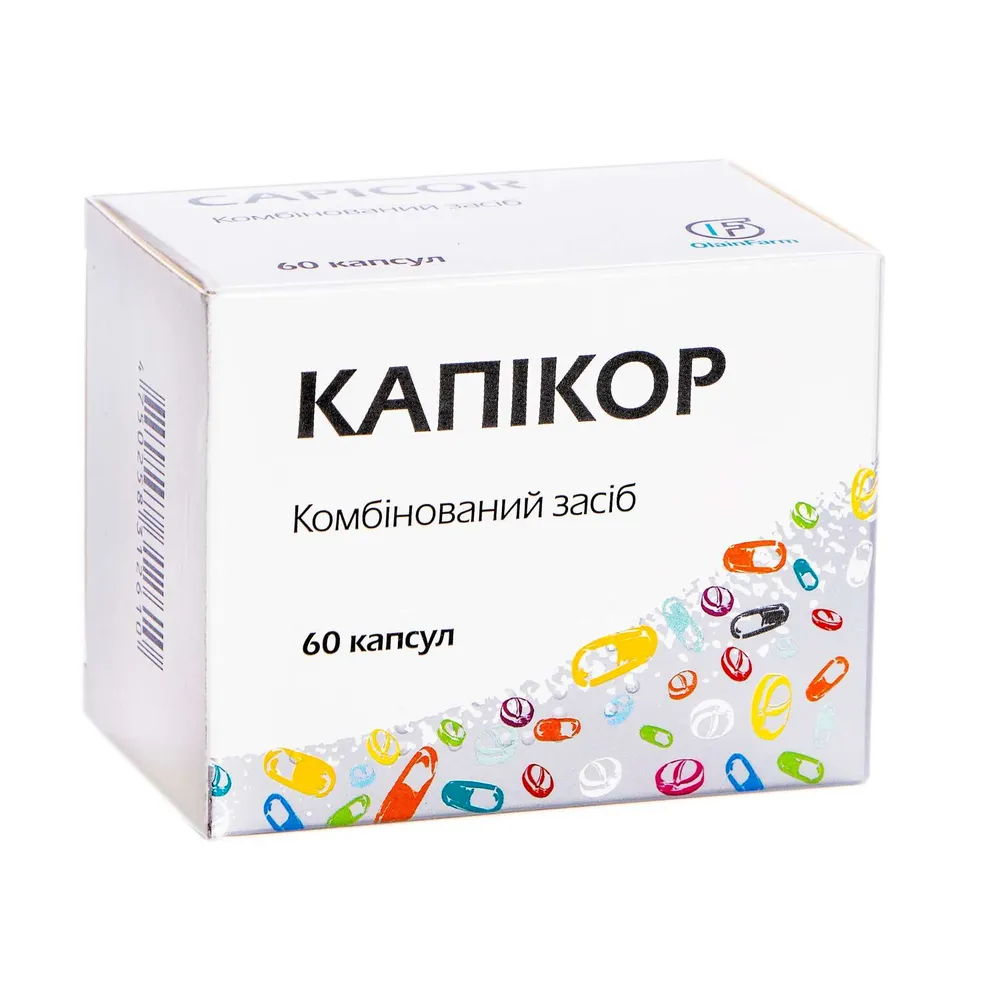
Table of Contents
INSTRUCTIONS FOR MEDICAL USE OF THE MEDICINAL PRODUCT KAPICOR® (CAPICOR®)
Composition:
Active substances: meldonium dihydrate (meldonium), gamma-butyrobetaine dihydrate;
1 capsule contains meldonium dihydrate ─ 180 mg, gamma-butyrobetaine dihydrate ─ 60 mg;
Excipients: low-substituted hydroxypropyl cellulose, potato starch, colloidal anhydrous silicon dioxide, sodium stearyl fumarate.
Pharmaceutical form. Capsules.
Main physicochemical properties: hard transparent/transparent or white/white capsules size 0 made of hydroxypropylmethylcellulose (HPMC), containing a white or almost white powder.
The presence of granules and particle aggregates is acceptable.
Pharmacotherapeutic group.
Combined cardiovascular preparations. ATC code C01EX.
Pharmacological Properties
Pharmacodynamics
Capicor® is a combination medication whose therapeutic effects are due to the combination of two active ingredients:
- Meldonium dihydrate;
- Gamma-butyrobetaine dihydrate.
This combination provides a stronger and faster cardioprotective and cerebroprotective action of Capicor®, eliminating the dependence of the onset rate of therapeutic effects on the body's exhaustion under conditions of ischemia and stress of various origins (including oxidative stress).
Gamma-butyrobetaine dihydrate enhances the action of Capicor® by promoting the induction of NO biosynthesis, protects cells from the toxic effects of free radicals, normalizes oxidative homeostasis at the cellular level, and positively influences endothelial function.
Meldonium dihydrate inhibits the transport of long-chain fatty acids and their metabolites into mitochondria by reducing carnitine biosynthesis. This preserves the aerobic metabolic pathway under conditions of tissue hypoxia, prevents depletion of ATP and creatine phosphate reserves in cells, accumulation of lactic acid, development of cellular acidosis, disruption of enzymatic processes, and dysfunction of ion channels. Additionally, meldonium dihydrate exerts a certain influence on increasing the concentration of gamma-butyrobetaine dihydrate in the body.
These combined mechanisms ensure an optimal level of gamma-butyrobetaine dihydrate, resulting in more pronounced and rapid NO-dependent effects: vasodilatory, anti-aggregatory, anticoagulant, antioxidant, and others. It also affects the regulation of apoptosis and proliferation, and supports vascular homeostasis.
The drug demonstrates anti-ischemic, cerebroprotective, cardioprotective, and immunomodulatory effects.
In heart failure, Capicor® improves myocardial contractile function and increases tolerance to physical exertion. In stable angina of functional classes II and III, it reduces the frequency of angina attacks. It provides a moderate hypotensive effect and normalizes heart rhythm.
In cerebral vascular disorders, Capicor® improves cerebral hemodynamics, normalizes metabolism in nerve cells, and optimizes oxygen consumption by brain tissue. As a result, cognitive functions improve, mental and physical performance increases, psychoemotional state normalizes, and feelings of fatigue decrease.
Pharmacokinetics
After oral administration, the drug is rapidly absorbed from the gastrointestinal tract. Its bioavailability is 78%. Maximum plasma concentration is reached within 1–2 hours after administration. The drug is metabolized in the body, forming two main metabolites, which are excreted by the kidneys. The elimination half-life is 3–6 hours.
Clinical characteristics.
Indications.
As part of complex therapy
Ischemic heart disease (angina pectoris, myocardial infarction, ischemic cardiomyopathy, post-infarction cardiosclerosis). Chronic heart failure.
Dyshormonal cardiomyopathy.
Acute and chronic cerebral circulation disorders (cerebral stroke, dyscirculatory encephalopathy, cerebrovascular insufficiency).
Neurocirculatory dystonia; vegetative-vascular dysfunction.
Contraindications.
Hypersensitivity to the drug and its components.
Increased intracranial pressure (due to impaired venous outflow, intracranial tumors).
Severe impairment of liver and/or kidney function, renal and hepatic insufficiency.
Interaction with other medicinal products and other types of interactions.
Capicor® can be used concomitantly with prolonged-action nitrates and other antianginal agents (stable exertional angina), cardiac glycosides, and diuretics (heart failure). It can also be combined with anticoagulants, antiplatelet agents, antiarrhythmic drugs, and other agents improving microcirculation.
The drug may enhance the effect of medications containing glyceryl trinitrate, nifedipine, beta-adrenergic blockers, and other antihypertensive agents and peripheral vasodilators.
As a result of simultaneous administration of iron-containing drugs and meldonium to patients with iron-deficiency anemia, an improvement in the fatty acid composition of erythrocytes was observed.
When meldonium is used in combination with orotic acid to eliminate ischemia/reperfusion-induced injuries, an additional pharmacological effect is observed.
Meldonium helps eliminate cardiac pathological changes caused by zidovudine (AZT) and indirectly affects oxidative stress reactions induced by AZT, which lead to mitochondrial dysfunction. The use of meldonium in combination with zidovudine or other drugs for the treatment of AIDS has a positive impact in managing acquired immunodeficiency syndrome (AIDS).
In the test of loss of righting reflex induced by a standard agent, meldonium reduced the duration of sleep. In seizures induced by pentetrazole, a pronounced anticonvulsant effect of meldonium was established. In turn, when alpha2-adrenergic blocker yohimbine at a dose of 2 mg/kg and a nitric oxide synthase (NOS) inhibitor N-(G)-nitro-L-arginine at a dose of 10 mg/kg were administered prior to meldonium therapy, the anticonvulsant effect of meldonium was completely blocked.
Overdose of meldonium may enhance cardiotoxicity caused by cyclophosphamide.
Carnitine deficiency induced by meldonium may enhance cardiotoxicity caused by ifosfamide.
Meldonium has a protective effect against cardiotoxicity caused by indinavir and neurotoxic effects caused by efavirenz.
Do not use together with other drugs containing meldonium, as this may increase the risk of adverse reactions.
Special precautions.
Patients with mild to moderate impairment of liver and/or kidney function should use the drug with caution (monitoring of liver and/or kidney function is recommended).
Long-term experience in the treatment of acute myocardial infarction and unstable angina in cardiology departments shows that meldonium is not a first-line drug for acute coronary syndrome.
Due to the possible development of a stimulating effect, the last dose should be taken no later than 3–4 hours before bedtime.
Use during pregnancy or breastfeeding .
The safety of Kapikor® during pregnancy has not been established. To prevent any potential adverse effect on the fetus, the drug should not be administered during pregnancy.
It is unknown whether Kapikor® is excreted in breast milk. If treatment with Kapikor® is necessary for the mother, breastfeeding should be discontinued.
Ability to influence reaction rate while driving or operating machinery .
There are no data on a negative effect of the drug on reaction speed while driving or operating machinery.
Dosage and Administration
For adults, take orally, regardless of food intake.
As part of combination therapy: 2 capsules 1–3 times daily. Treatment duration: 2 to 6 weeks.
Maximum daily dose: 6 capsules.
Repeated courses (usually 2–3 times per year) are possible after consultation with a physician.
Due to the possible stimulatory effect, the last dose should be taken no later than 3–4 hours before bedtime.
Children
The use of the drug in children is contraindicated.
Overdose
The drug is low-toxic and does not cause life-threatening adverse effects.
No cases of meldonium overdose have been reported.
Symptoms: Decreased blood pressure (manifested as headache and dizziness), tachycardia, central nervous system stimulation.
Treatment: Symptomatic therapy.
In severe overdose, monitor kidney and liver function.
Hemodialysis is not significantly effective in meldonium overdose due to extensive plasma protein binding.
Adverse Reactions
Adverse reactions are classified according to organ systems and frequency of occurrence according to MedDRA: common (≥1/100 to <1/10), rare (≥1/10,000 to <1/1,000).
Immune system disorders: common – allergic reactions; rare – hypersensitivity, including allergic dermatitis, urticaria, angioedema, anaphylactic reactions up to shock.
Psychiatric disorders: rare – excitement, fear, obsessive thoughts, sleep disturbances.
Nervous system disorders: common – headache; rare – paresthesia, tremor, hypesthesia, tinnitus, vertigo, dizziness, gait disturbance, pre-syncope, syncope.
Cardiac disorders: rare – change in heart rhythm, palpitations, tachycardia/sinus tachycardia, atrial fibrillation, arrhythmia, chest discomfort/chest pain.
Vascular disorders: rare – increased/decreased blood pressure, hypertensive crisis, hyperemia, pallor of the skin.
Respiratory, thoracic and mediastinal disorders: common – respiratory tract infections; rare – pharyngitis, cough, dyspnea, apnea.
Gastrointestinal disorders: common – dyspepsia; rare – dysgeusia (metallic taste in mouth), loss of appetite, nausea, vomiting, flatulence, diarrhea, abdominal pain, dry mouth or hypersalivation.
Skin and subcutaneous tissue disorders: rare – rash, generalized/maculopapular rash, pruritus.
Musculoskeletal and connective tissue disorders: rare – back pain, muscle weakness, muscle spasms.
Renal and urinary disorders: rare – pollakiuria.
General disorders: rare – general weakness, chills, asthenia, swelling, facial and leg edema, sensation of heat or cold, cold sweat.
Investigations: common – dyslipidemia, increased C-reactive protein level; rare – electrocardiogram (ECG) abnormalities, increased heart rate, eosinophilia.
Shelf life. 3 years.
Storage conditions.
Store in a dry, protected from light place at a temperature not exceeding 25°C.
Keep out of reach of children.
Packaging.
10 capsules per blister; 2 or 6 blisters per cardboard box.
Prescription status.
Prescription only.
Manufacturer: JSC "Olaipharm".
Manufacturer's name and address of place of business.
5 Rupnicu street, Olaine, LV-2114, Latvia / 5 Rupnicu street, Olaine, LV-2114, Latvia.