Canespor® set
Ukraine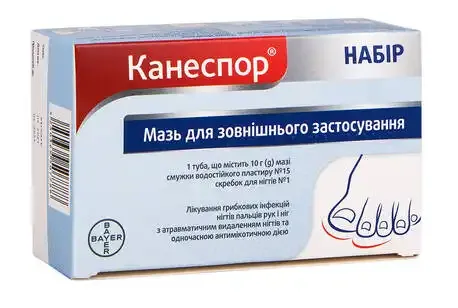
Table of Contents
INSTRUCTIONS FOR MEDICAL USE OF THE MEDICINAL PRODUCT CANESPOR® NAILSET
Composition:
Active substances: bifonazole and urea;
1 g of the ointment contains 10 mg of bifonazole and 400 mg of urea;
Excipients: white wax, white soft paraffin, lanolin.
Pharmaceutical form. Topical ointment.
Main physicochemical properties: homogeneous ointment of yellowish color.
Pharmacotherapeutic group. Antifungal agents for dermatological use. Bifonazole, combinations.
ATC code: D01AC60.
Pharmacological properties.
Pharmacodynamics.
The active ingredient of Canespor® set – bifonazole – is an imidazole derivative with a broad spectrum of antifungal activity. The drug is active against dermatophytes, yeasts, molds, and other fungi.
Bifonazole, unlike other azole derivatives and fungicidal agents, inhibits ergosterol biosynthesis at two different levels rather than one. Inhibition of ergosterol synthesis leads to structural and functional disturbances of the cytoplasmic membrane of fungal pathogens.
The minimal inhibitory concentration for the indicated fungal species is 0.062–16 mcg/mL of substrate or less. Bifonazole exerts a fungicidal effect on dermatophytes, particularly on Trichophyton species. A complete fungicidal effect is achieved at a concentration of approximately 5 mcg/mL with 6 hours of exposure. Against yeast fungi, such as Candida species, bifonazole acts predominantly fungistatically at concentrations of 1–4 mcg/mL and fungicidally at 20 mcg/mL.
Bifonazole remains effective even under conditions of pathogen resistance to other antifungal agents. Primary resistance of susceptible fungal species to bifonazole is very rare. During studies, no development of secondary resistance in initially susceptible strains has been observed.
Urea softens keratinized tissues. Urea is a naturally occurring substance found in the human body. In the ointment formulation, urea softens the keratin of the infected nail, enabling non-invasive, painless removal of the affected nail portion. In vitro studies have demonstrated that urea enhances the penetration depth of bifonazole into the infected nail. Thus, the combination of bifonazole and urea enhances the antifungal effect.
Pharmacokinetics.
During nail treatment with Canespor® set, the plasma concentration of bifonazole was below the detection limit in all cases (i.e., less than 1 ng/mL).
Clinical characteristics.
Indications.
Treatment of fungal infections of fingernails and toenails with non-traumatic nail removal and simultaneous antifungal action.
Contraindications.
Hypersensitivity to bifonazole or other components of the product.
Interaction with other medicinal products and other forms of interaction.
There is data indicating a possible interaction between topically applied bifonazole and warfarin, leading to an increased international normalized ratio (elevated risk of bleeding). If bifonazole is used in patients being treated with warfarin, appropriate monitoring should be performed.
Special precautions for use
Avoid contact of the medication with the eyes. Do not swallow. Keep out of reach of children.
A sustained therapeutic effect primarily depends on removal of the affected nail portion and continued treatment of the nail bed with Canespor® cream or another medicinal formulation containing bifonazole.
Allergic reactions to the patch are possible but very rare. In case of allergic reactions, consult a physician. An alternative waterproof dressing or surgical padding may be used.
Patients with known allergic reactions to other antifungal agents of the imidazole class (e.g. econazole, clotrimazole, miconazole) should use Canespor® kit with caution.
If symptoms persist, consult a physician.
This medicinal product may cause local skin reactions (contact dermatitis) due to the presence of lanolin.
Fertility. Previous clinical studies have not shown that bifonazole may impair male or female fertility.
Preclinical studies on urea have not revealed any evidence of adverse effects on spermatozoa or female fertility.
Use during pregnancy or breastfeeding.
Pregnancy. Preclinical safety data and human pharmacokinetic data do not indicate harmful effects of bifonazole on the mother or fetus when the Canespor® kit is used during pregnancy.
However, during the first trimester, the use of bifonazole should be avoided.
Breastfeeding. It is unknown whether bifonazole or urea passes into human breast milk. Pharmacodynamic and toxicological studies in animals indicate excretion of bifonazole and its metabolites into breast milk. Therefore, breastfeeding should be discontinued during treatment with bifonazole.
Ability to influence reaction rate when driving or operating machinery. This medicinal product has no effect or has a negligible effect on the ability to drive or operate machinery.
Method of Administration and Dosage
Apply the medication to the affected nail once daily in sufficient quantity to cover the entire surface with a thin layer. The treatment should be performed carefully every day and continued until the softened, fungus-infected nail tissue can be removed. This usually takes 7–14 days and depends on the extent of infection and nail thickness.
After application, cover the treated nail with an adhesive plaster for 24 hours. Replace the plaster once daily. After removing the plaster, wash the fingers with affected nails in warm water for approximately 10 minutes, then remove the softened infected nail tissue with a curette, and allow the nail area to dry thoroughly. Thereafter, continue using the Canespor® kit as described above.
There is no need to cover the skin around the nail. However, irritation may occasionally occur. Therefore, the skin adjacent to the nail should be protected by applying zinc paste or another topical anti-inflammatory agent before securing the plaster. The Canespor® kit, topical ointment, acts only on fungal-infected nails, leaving healthy areas unaffected.
After nail removal, antifungal treatment should not be continued until the physician confirms that onycholysis is completely resolved; if necessary, perform final debridement of the nail bed.
Following nail detachment resulting from antifungal therapy with the Canespor® kit, treat the nail bed with Canespor® cream once daily for approximately 4 weeks.
Instructions for Use:
| Fig. 1. |
Fig. 2. |
Fig. 3. |
|||
| Wash the foot or hand with warm water and then dry thoroughly (Fig. 1). |
Apply a dose of the ointment to the nail. Do not press or rub it in (Fig. 2). |
Place half of the patch under the toe or palm. The patch can be cut to fit the size of the nail (Fig. 3). |
|||
| Fig. 4. |
Fig. 5. |
Fig. 6. |
|||
| Fold the edges of the patch upwards and press them down firmly (Fig. 4). |
Then place the other half of the patch over the nail, folding the adhesive ends downwards. Press firmly (Fig. 5). |
The patch is now correctly positioned and acts as a protective covering over the affected nail. |
|||
| Fig. 7. |
Fig. 8. |
||||
| After 24 hours, remove the patch. Wash the foot or hand again with warm water and dry thoroughly (Fig. 7). |
Using a scraper, carefully remove the softened portion of the affected nail (Fig. 8). |
||||
Perform the above-described procedures daily and thoroughly. The procedure should be repeated until complete clearance of the nail bed. This usually takes 7–14 days. If after 7–14 days all infected parts of the nail have not been removed and the nail bed has not become smooth, consult a physician.
The Canespor® kit acts directly on the affected nail; healthy areas remain unaffected. After the nail has been removed, antifungal treatment with Canespor® cream should be continued for approximately four weeks.
Children. Based on available clinical data, there is no reason to expect toxic effects in children. However, the product should be used in children aged 1 to 3 years only under medical supervision.
Overdose.
There have been no reports of overdose with this medicinal product.
Side effects.
When treating fungal nail diseases, skin and subungual tissue disorders may occur at the edges or nail bed in the form of contact dermatitis, maceration, skin peeling, nail shedding, nail discoloration, erythema, skin irritation, limb pain, itching, or rashes. Pain and swelling of the skin at the application site, eczema, urticaria, blisters, dryness, and sensation of warmth on the skin are also possible. These adverse effects resolve after discontinuation of treatment.
Shelf life. 3 years.
After opening the tube, the shelf life is 3 months.
Do not use the medicinal product after the expiry date stated on the packaging.
Storage conditions.
Store in a place inaccessible to children, at a temperature not exceeding 30 °C.
Packaging.
10 g in a tube, with 15 waterproof adhesive strips, 1 nail scraper in a box.
Supply category. Over-the-counter.
Manufacturer.
Bayer AG.
Manufacturer's location and address of place of business.
Kaiser-Wilhelm-Allee 51368 Leverkusen, Germany.
Manufacturer.
GP Grenzach Produktions GmbH.
Manufacturer's location and address of place of business.
Emil-Barell-Strasse 7, 79639 Grenzach-Wyhlen, Germany.