Kanamycin
Ukraine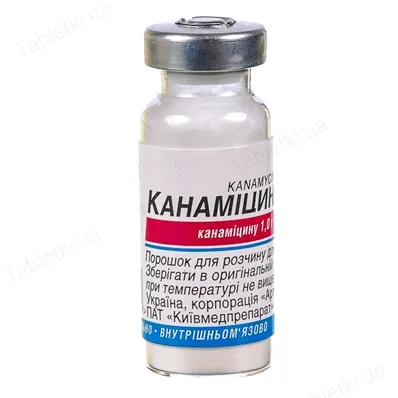
Table of Contents
INSTRUCTION FOR MEDICAL USE OF THE MEDICINAL PRODUCT KANAMYCIN (KANAMYCIN)
Composition:
Active substance: kanamycin;
1 vial contains 1 g of sterile kanamycin sulfate (acidic), calculated as kanamycin.
Pharmaceutical form. Powder for solution for injection.
Main physicochemical properties: white or almost white powder. Hygroscopic. Adhesion of the drug to the vial walls is permissible.
Pharmacotherapeutic group. Antimicrobial agents for systemic use. Aminoglycosides. ATC code J01GB04.
Pharmacological Properties
Pharmacodynamics
Kanamycin is a broad-spectrum antibiotic. It exerts bactericidal activity against most gram-positive and gram-negative microorganisms, as well as acid-resistant bacteria. It acts on strains of tuberculous mycobacteria, including those resistant to streptomycin, PAS, and isoniazid. By binding to the 30S subunit of the bacterial ribosomal membrane, it disrupts protein synthesis in microbial cells.
It is generally effective against microorganisms resistant to tetracycline, erythromycin, and chloramphen游戏副本
Clinical characteristics.
Indications.
- Severe purulent-septic diseases (sepsis, meningitis, peritonitis, septic endocarditis);
- respiratory tract infectious-inflammatory diseases (pneumonia, pleural empyema, lung abscess);
- infections of kidneys and urinary tract;
- purulent complications in the postoperative period;
- infected burns;
- pulmonary tuberculosis and tuberculosis lesions of other organs caused by microorganisms resistant to first- and second-line antituberculosis agents and sensitive to kanamycin.
Contraindications.
- Hypersensitivity to kanamycin and other aminoglycosides in medical history;
- auditory nerve neuritis;
- myasthenia gravis;
- parkinsonism;
- botulism;
- intestinal obstruction;
- severe renal function impairment (creatinine clearance less than 10 ml/min) (see section "Administration and dosage").
Interaction with other medicinal products and other types of interactions. Concomitant use with loop diuretics (furosemide, ethacrynic acid) should be avoided, as they may enhance the ototoxic and nephrotoxic effects of kanamycin.
Respiratory function disturbances (respiratory depression and respiratory arrest) due to neuromuscular blockade may occur in patients receiving non-depolarizing muscle relaxants (succinylcholine, tubocurarine, decamethonium), anesthetics, narcotic analgesics, magnesium sulfate, or receiving large-volume blood transfusions with citrate-containing anticoagulants, concurrently with kanamycin. Concomitant use should be avoided; if necessary, doses of muscle relaxants should be adjusted and strict monitoring of neuromuscular function should be performed.
Concomitant or sequential systemic or local use of kanamycin with other neurotoxic and/or nephrotoxic agents (such as cisplatin, other aminoglycoside antibiotics, polymyxin B, acyclovir, ganciclovir, amphotericin B, platinum and gold compounds, dextrans – polygeline, reopolygline, cyclosporine, first-generation cephalosporins, capreomycin, vancomycin) should be avoided.
Treatment with kanamycin may be initiated no earlier than 10 days after discontinuation of streptomycin, monomycin, or florimycin.
Mixing kanamycin with penicillins or cephalosporins leads to inactivation of kanamycin, whereas their separate administration results in synergism.
Indomethacin, phenylbutazone, and other NSAIDs that impair renal blood flow may slow down elimination of aminoglycosides from the body.
Concomitant administration of kanamycin with intravenous indomethacin solution in premature neonates leads to increased plasma concentration, prolonged effect, and enhanced toxicity of the aminoglycoside.
In tuberculosis, kanamycin may be used concomitantly with all basic and reserve antituberculosis agents (except streptomycin, florimycin, and capreomycin), and in non-tuberculosis infections – with penicillins.
Special precautions for use
Kanamycin should be used only when other antibiotics have proven ineffective. If the causative agent is resistant to neomycin-group antibiotics (e.g., gentamicin, neomycin), cross-resistance to kanamycin is usually observed.
Factors increasing the risk of developing ototoxicity and/or nephrotoxicity include: genetically determined predisposition to aminoglycoside ototoxicity (family history of aminoglycoside-induced ototoxicity should be investigated); advanced age; pre-existing hearing impairment (otitis, meningitis, birth trauma, perinatal hypoxia); high doses or prolonged treatment duration; concomitant use of other ototoxic or nephrotoxic drugs (see section "Interaction with other medicinal products and other forms of interaction"); renal or cardiovascular diseases leading to drug accumulation; dehydration; diabetes mellitus; HIV infection; renal insufficiency.
Therefore, prior to initiating treatment and during therapy with kanamycin, the following monitoring is required:
- careful monitoring of kidney function (repeated urine tests, serum creatinine measurement, and glomerular filtration rate calculation every 3 days; if this parameter decreases by 50%, the drug should be discontinued);
- assessment of auditory function (audiometry should be performed at least twice weekly);
- monitoring of kanamycin blood concentrations.
Kanamycin should be discontinued at the first signs of ototoxicity (even mild tinnitus) or nephrotoxicity.
In patients with vestibular disturbances, the interval between injections should be increased.
The possibility of neuromuscular blockade should be considered (injections should be administered only when all necessary conditions for artificial ventilation of the lungs are available). The risk of developing severe neuromuscular blockade increases in patients with Parkinson's disease, myasthenia gravis, or botulism, as well as when kanamycin is used concomitantly with muscle relaxants.
To manage neuromuscular blockade, intravenous calcium chloride or anticholinesterase agents may be used.
If signs of respiratory depression occur, kanamycin administration must be stopped immediately, and intravenous calcium chloride solution and subcutaneous proserin with atropine should be administered urgently. If necessary, the patient should be switched to mechanical ventilation.
In cases of hypokalemia, serum magnesium and calcium levels should be monitored.
Elderly patients. Kanamycin should be prescribed to elderly patients only when less toxic antibiotics cannot be used.
Slower drug metabolism in elderly patients leads to prolonged circulation in the bloodstream, even with normal renal function, thereby increasing the risk of ototoxic effects in this patient group.
Recommended doses should not be exceeded.
Patients with hepatic impairment. In patients with liver disease, blood levels of the drug are generally unchanged (except in severe alcoholic cirrhosis with ascites, which increases the volume of drug distribution).
Kanamycin administration in patients with severe liver disease is considered safe; however, particular caution is recommended, as rapid progression of hepatorenal syndrome may occur in some patients.
Use during pregnancy or breastfeeding. Kanamycin passes into breast milk in small amounts (up to 18 mcg/mL) and is poorly absorbed from the gastrointestinal tract; therefore, no adverse effects in infants have been reported. Nevertheless, breastfeeding should be discontinued during treatment.
Kanamycin is contraindicated during pregnancy. Cases of congenital deafness have been reported following kanamycin use during pregnancy. The drug may be used in exceptional cases only when strictly indicated, if antibiotics from other classes have proven ineffective or cannot be used.
Ability to affect reaction speed when driving or operating machinery. There are no data on the effect of kanamycin on the ability to drive or operate machinery. However, the possibility of vestibular disturbances (dizziness, impaired coordination) should be considered, and patients should avoid potentially hazardous activities.
Administration and Dosage
Kanamycin is administered intramuscularly.
The solution for intramuscular injection is prepared ex tempore by adding 4 mL of sterile water for injections or a 0.25–0.5% procaine solution to the contents of the vial (1 g). The solution should be injected deeply into the upper outer quadrant of the buttock no more frequently than 2–3 times daily. For children, only water for injections should be used as the solvent.
For adults, the single dose for the treatment of non-tuberculosis infections is 0.5 g every 8–12 hours; the daily dose is 1–1.5 g. The maximum single dose is 1 g, administered with a 12-hour interval between doses; the maximum daily dose is 2 g. The treatment duration is 5–7 days. Depending on the severity of the disease, treatment efficacy, and clinical course, the duration of therapy may be adjusted.
For children:
- Under 1 year of age for non-tuberculosis infections (in exceptional cases), the average daily dose is 0.1 g;
- From 1 to 5 years of age – 0.1–0.3 g;
- From 5 years of age – 0.3–0.5 g.
The maximum daily dose is 15 mg/kg body weight, administered 2–3 times daily. The treatment course lasts 5–7 days.
For the treatment of tuberculosis, kanamycin is administered to adults once daily at a dose of 1 g; for children – at a dose of 15 mg/kg body weight, administered 6 days per week with a break on the 7th day. The number of cycles and total treatment duration are determined based on the stage and clinical features of the disease.
In renal impairment, the kanamycin administration regimen should be adjusted by reducing the dose or increasing the intervals between doses.
To calculate the dosing intervals according to the degree of renal function impairment, the following formula may be used: dosing interval (in hours) = plasma creatinine concentration (in mg/100 mL) × 9.
For example: if the plasma creatinine concentration is 2 mg/100 mL, the patient should receive the recommended dose every 18 hours.
The initial dose of the drug is calculated based on body weight using the formula: dose (in mg) = body weight (in kg) × 7.
| Subsequent doses = = |
initial dose (in mg) |
| serum creatinine level (in mg/100 ml) for administration frequency 2–3 times a day |
On hemodialysis days, an additional single dose of the drug should be administered after the procedure.
Children. In premature infants and newborns, the elimination half-life is prolonged due to immature kidney function, which may lead to drug accumulation and potential toxic effects. Therefore, the use of kanamycin in these patient groups and in children during the first year of life is permitted only under life-threatening indications.
Overdose.
Symptoms of overdose—intensification of adverse reactions. With parenteral administration, neuromuscular blockade (curare-like effect) may occur.
Treatment: There is no specific antidote. In case of overdose symptoms, the drug must be discontinued immediately and symptomatic therapy initiated.
In the event of blockade or respiratory depression, administer proserin (neostigmine) together with atropine; artificial ventilation of the lungs may be required if necessary.
In case of toxic reactions—perform peritoneal dialysis or hemodialysis. Exchange blood transfusion should be performed in newborns.
Adverse Reactions
Central and peripheral nervous system disorders: Ototoxicity (damage to the 8th cranial nerve). With prolonged use, auditory nerve neuritis may develop, manifested by tinnitus, ringing or a sensation of fullness in the ears, and decreased hearing acuity. These symptoms may be irreversible. Initially, perception of high-frequency sounds is impaired (detected by audiometry); irreversible speech discrimination impairment, noticeable to the patient, develops later.
Damage to the vestibular apparatus manifests as dizziness or vertigo and impaired motor coordination. When the vestibular apparatus is symmetrically affected, these symptoms may be initially unapparent. Cases of irreversible ototoxicity have been reported.
Neurotoxicity (encephalopathy, confusion, lethargy, hallucinations, depression). Peripheral neuropathy.
Neuromuscular blockade may also occur, manifested by respiratory depression due to paralysis of respiratory muscles, headache, general weakness, somnolence, muscle twitching, paresthesia, and seizures.
Urinary system disorders: Nephrotoxicity. Kidney damage, usually presenting as reversible renal insufficiency of mild degree, rarely acute tubular necrosis, interstitial nephritis, decreased glomerular filtration rate (observed after several days of treatment or after discontinuation of therapy), elevated serum creatinine levels, microhematuria, albuminuria, and cylindruria.
In addition to high drug concentration in blood plasma, which particularly increases the risk of ototoxicity and nephrotoxicity, many other risk factors exist (see section "Special Warnings and Precautions for Use").
Electrolyte imbalance: Hypomagnesemia, hypocalcemia, hypokalemia.
Gastrointestinal disorders: Nausea, vomiting, diarrhea, dysbiosis.
Cardiovascular system disorders: Arterial hypotension.
Skin and mucous membranes: Stomatitis.
Allergic reactions: Rarely – rash, pruritus, swelling, skin hyperemia. In isolated cases, anaphylactoid reactions may occur.
Local reactions at the injection site: Irritation and pain at the injection site are possible. Also possible: hyperemia, bruising, hematoma, induration, subcutaneous fat atrophy, or necrosis.
Blood coagulation system disorders: Purpura.
Laboratory test abnormalities: Increased serum aminotransferase levels, increased bilirubin levels. Hematological changes (anemia, leukopenia, granulocytopenia, thrombocytopenia).
Shelf life. 3 years.
Storage conditions. Store in original packaging at a temperature not exceeding 25 °C. Keep out of reach of children.
Incompatibility. Do not use with solvents other than those specified (water for injections or 0.25–0.5% novocaine solution for intramuscular injection, isotonic sodium chloride solution or 5% glucose solution for intravenous injection). Kanamycin is pharmaceutically incompatible with streptomycin, gentamicin, monomycin, penicillins, heparin, cephalosporins, capreomycin, amphotericin B, erythromycin, nitrofurantoin, and viomycin. Mixing in the same container is not permitted.
Packaging. 1 g in vials; 10 vials per carton.
Prescription status. Prescription only.
Manufacturer. JSC "Kyivmedpreparat".
Manufacturer's address and location of business operations.
139 Saksaganskogo Street, Kyiv, 01032, Ukraine.