Calcium chloride-darnitsa
Ukraine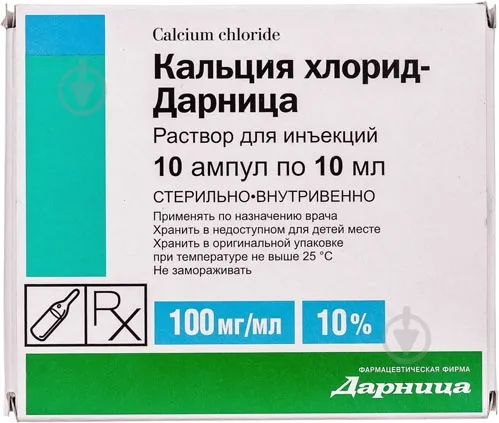
Table of Contents
INSTRUCTIONS FOR MEDICAL USE OF THE MEDICINAL PRODUCT CALCIUM CHLORide – DARNITSA (CALCIUM CHLORIDE – DARNITSA)
Composition:
Active substance: calcium chloride;
1 ml of solution contains calcium chloride dihydrate equivalent to calcium chloride 50.7 mg;
Excipients: diluted hydrochloric acid, water for injections.
Pharmaceutical form. Injection solution.
Main physico-chemical properties: clear colorless liquid.
Pharmacotherapeutic group. Plasma substitutes and perfusion solutions. Electrolyte solutions. ATC code B05XA07.
Pharmacological properties.
Pharmacodynamics.
The medicinal product Calcium Chloride-Darnitsa eliminates calcium ion deficiency. Calcium ions are involved in the transmission of nerve impulses, contraction of smooth and skeletal muscles, myocardial functional activity, and blood coagulation; they are necessary for bone tissue formation and functioning of other systems and organs. The concentration of calcium ions in blood decreases due to numerous pathological processes; pronounced hypocalcemia promotes the development of tetany. Calcium chloride, in addition to correcting hypocalcemia, reduces vascular permeability and exhibits hemostatic action.
Intravenous administration of calcium leads to stimulation of the sympathetic nervous system, resulting in enhanced release of norepinephrine.
Pharmacokinetics.
In blood, calcium exists in bound and ionized forms. Physiological activity is inherent to ionized calcium. It is deposited in bone tissue. Excreted by the kidneys (20%) and through the intestine (80%). 95% of calcium undergoing glomerular filtration is reabsorbed.
Clinical characteristics.
Indications.
Cases of hypocalcemia requiring rapid increase in plasma ionized calcium concentration (tetany due to parathyroid insufficiency, tetany due to vitamin D deficiency, hypocalcemia during blood exchange transfusion and infusion of citrated blood, alkalosis).
As part of complex therapy in acute lead colic.
Cases of magnesium intoxication occurring due to magnesium overdose.
Hyperkalemia registered on ECG as cardiac functional disturbances.
Contraindications.
Hypersensitivity to components of the medicinal product, hypercalcemia, marked hypercalciuria, nephrolithiasis (calcium type), severe renal failure, sarcoidosis, hypercoagulability, predisposition to thrombosis.
Pronounced atherosclerosis with signs of arterial occlusion. Ventricular fibrillation. Asystole and electromechanical dissociation. Concomitant use of cardiac glycosides.
Concomitant administration with ceftriaxone.
Interaction with other medicinal products and other types of interactions.
Currently, there are no reliable scientific data on the occurrence of intravascular precipitates in patients (except neonates) when ceftriaxone and calcium-containing medicinal products are administered simultaneously. However, calcium-containing solvents should not be used, and ceftriaxone and calcium-containing medicinal products should not be mixed or administered simultaneously to any patient population. Calcium-containing solutions should not be administered within 48 hours after the last dose of ceftriaxone.
Calcium-containing products may reduce the effectiveness of calcium channel blockers, diminish calcitonin effects in hypercalcemia, and reduce phenytoin bioavailability.
Calcium salts reduce the absorption of several medicinal products, such as bisphosphonates, fluorides, certain fluoroquinolones, and tetracyclines; administration should be separated by at least 3 hours.
Calcium chloride reduces the cardiotonic effects of dobutamine.
Concomitant use with quinidine may result in slowed intraventricular conduction and increased quinidine toxicity.
Concomitant use of the medicinal product with cardiac glycosides enhances the cardiotoxic effects of the latter.
Calcium salts must not be mixed with carbonates, phosphates, sulfates, or tartrates in parenteral mixtures.
Thiazide diuretics reduce calcium excretion in urine, thereby increasing the risk of hypercalcemia.
Concomitant use with vitamin D or its derivatives increases calcium absorption.
Concomitant intake with other calcium- or magnesium-containing medicinal products increases the risk of hyperkalemia or hypermagnesemia, respectively, especially in patients with chronic renal insufficiency.
Reduces the efficacy of non-depolarizing muscle relaxants. May prolong the action of tubocurarine chloride.
Special precautions for use.
Prolonged use at high doses may lead to hypercalcemia with deposition of calcium salts in the body.
The injection should be administered through a thin needle into a large vein to minimize the damaging effect of the drug on the vessel wall. The solution should be warmed to body temperature.
When the drug is administered intravenously, a typical reaction occurs—the sensation of warmth in the oral cavity, followed by a feeling of warmth throughout the body.
Calcium chloride - Darnitsia must not be administered subcutaneously or intramuscularly due to its irritant and necrotizing effects. In case of accidental leakage of the solution under the skin or into muscle tissue, attempt to aspirate the calcium chloride with a syringe if possible, and inject 10 ml of sodium sulfate, 25% injection solution, or 5–10 ml of magnesium sulfate, 25% injection solution, into the injection site. Dimedrol should be administered to counteract resorptive effects; EDTA should be used in cases of hypercalcemia.
Use with caution in patients with mild to moderate chronic renal insufficiency, dehydration, electrolyte imbalances (risk of hypercalcemia), heart diseases (risk of arrhythmia), kidney diseases, nephrolithiasis, or conditions associated with hypercalcemia (particularly malignancies and sarcoidosis), pulmonary heart disease, respiratory acidosis, or respiratory failure (risk of toxic reactions due to oxidation of calcium chloride). Careful monitoring of blood calcium levels is required during treatment.
Rapid intravenous administration may cause moderate decrease in arterial pressure due to vasodilation.
Calcium chloride for injections should not be administered orally to children due to severe irritation of the gastrointestinal tract.
Injections in children should not be administered through the skin of the head.
Use during pregnancy or breastfeeding.
Adequate and well-controlled studies on the safety and efficacy of the drug in pregnant women have not been conducted. Use during pregnancy is possible only if the potential benefit to the mother outweighs the potential risk to the fetus.
The drug may be used during breastfeeding.
Ability to influence reaction rate when driving or operating machinery.
During treatment with this drug, driving vehicles or operating machinery is contraindicated.
Administration and dosage.
Calcium chloride is administered intravenously as a bolus (very slowly) and intravenously by infusion (slowly).
Adults.
Intravenous bolus administration: 5 ml of 10% solution administered at a rate of 1 ml/min.
Intravenous infusion: 5–10 ml of 10% solution diluted in 100–200 ml of 0.9% sodium chloride solution or 5% glucose solution; administer at a rate of 6–8 drops/min.
Exchange transfusion and transfusion of citrated blood: for adults and children, 30 mg (0.3 ml) per 100 ml of blood.
Tetany: 10 ml of 10% solution (1 g) over 10–30 minutes; if necessary, repeat after 6 hours.
Hypocalcemia: 500 mg to 1 g (5–10 ml) at intervals of 1 to 3 days, depending on patient response or plasma calcium levels. If necessary, a repeat dose may be administered.
Magnesium intoxication: 500 mg (5 ml) administered rapidly. Administration must be under medical supervision and patient monitoring, before administering subsequent doses.
Hyperkalemia, as evidenced by ECG changes indicating cardiac dysfunction: dosage should be individually adjusted according to the patient's condition, with continuous monitoring via electrocardiography.
Dosages for elderly patients are the same as for adults.
Children.
Hypocalcemia: administer slowly, at a rate of up to 0.5 ml/min, at a dose of 10–20 mg/kg body weight (0.1–0.2 ml/kg body weight); if necessary, repeat every 4–6 hours.
Tetany: 10 mg/kg body weight (0.1 ml/kg body weight) over 5–10 minutes; if necessary, repeat after 6 hours or continue as an infusion. Maximum daily dose for children (regardless of age) – 10 ml (1000 mg).
Children.
Use in children is possible from the age of 1 year.
Overdose.
Symptoms of hypercalcemia: weakness, anorexia, abdominal pain, vomiting, nausea, constipation, polydipsia, polyuria, increased fatigue, irritability, malaise, depression, dehydration, possible cardiac rhythm disturbances, tachycardia, possible sharp drop in blood pressure and arterial hypertension, myalgia, arthralgia, coma.
Treatment: in cases of mild overdose (serum calcium concentration 2.6–2.9 mmol/L), discontinue administration and withdraw other calcium-containing medications. In cases of severe overdose (serum calcium concentration >2.9 mmol/L), administer calcitonin parenterally at a dose of 5–10 IU/kg body weight per day (diluted in 500 ml of 0.9% sodium chloride solution) by intravenous infusion over 6 hours. Slow intravenous bolus administration may be performed 2–4 times daily. Use non-thiazide diuretics; monitor serum potassium and magnesium concentrations, and if necessary, administer potassium and magnesium preparations; monitor cardiovascular function, and administer beta-adrenergic blockers to prevent arrhythmias. If necessary, perform hemodialysis.
Adverse reactions.
From the sensory organs: chalky taste in the mouth.
From metabolism and endocrine system: hypercalcaemia.
From the psyche: depression.
From the cardiovascular system: moderate and transient decrease in arterial pressure, bradycardia, arrhythmia, arterial hypertension, venous thrombosis. With excessively rapid administration – ventricular fibrillation.
From the immune system: sensation of warmth, tingling starting in the oral cavity and then spreading throughout the body, facial skin hyperaemia, allergic reactions, urticaria.
General disorders and administration site reactions: pain and hyperaemia along the vein. In case of extravasation: burning sensation, tissue necrosis and eschar formation, cellulitis, and soft tissue calcification.
Shelf life. 5 years.
Storage conditions.
Store in the original packaging at a temperature not exceeding 25 °C. Do not freeze.
Keep out of reach of children.
Incompatibility.
Pharmaceutically incompatible with tetracyclines, magnesium sulfate, ceftriaxone, and medicinal products containing phosphates, carbonates, or tartrates.
Calcium chloride should not be mixed in the same injection with ceftriaxone, as precipitation may occur.
Packaging.
5 ml or 10 ml in a vial; 5 vials in a blister pack; 2 blisters per carton.
Prescription status. Prescription only.
Manufacturer: JSC "Pharmaceutical Company "Darnytsia".
Manufacturer's address and place of business.
13, Boryspylska Street, Kyiv, 02093, Ukraine.