Calcium gluconate-darnitsa (stabilized)
Ukraine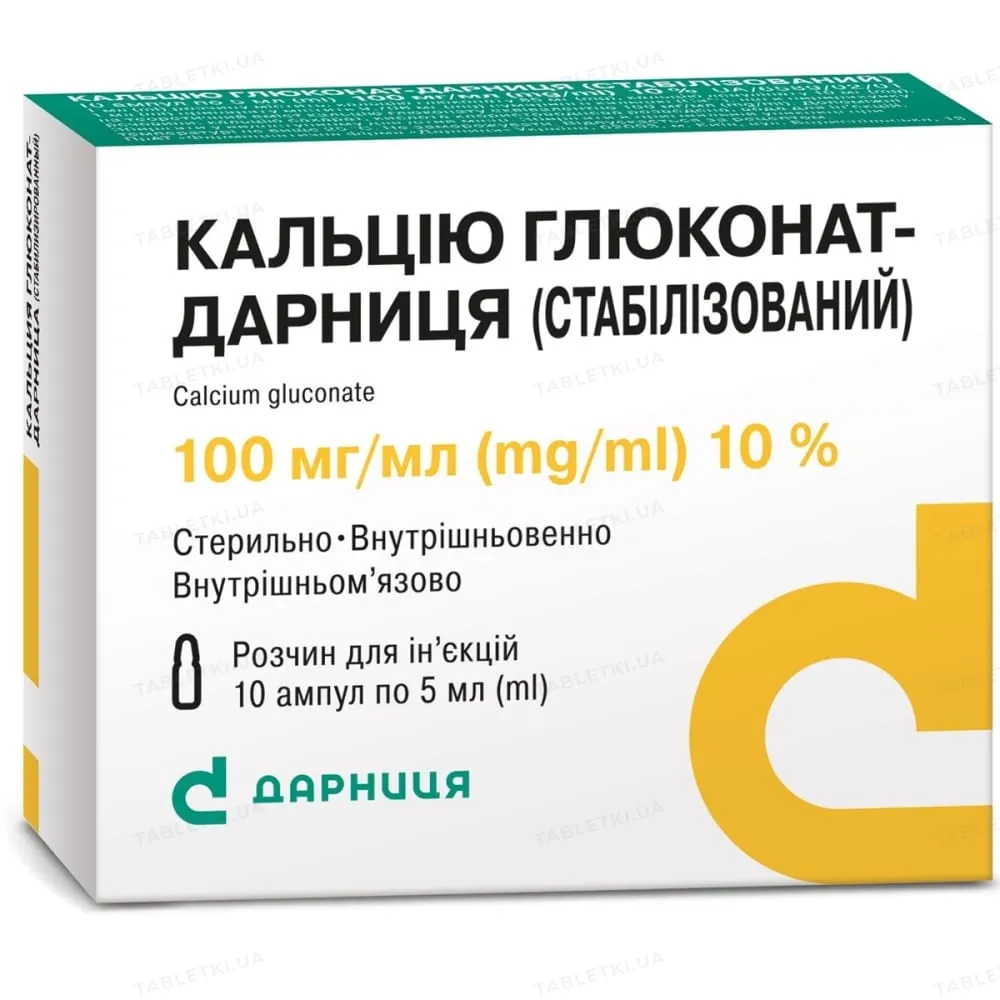
Instructions for Use
INSTRUCTIONS FOR MEDICAL USE OF THE MEDICINAL PRODUCT CALCIUM GLUCONATE-DARNITSA (STABILIZED)
Composition:
Active substance: calcium gluconate;
1 ml of solution contains: calcium gluconate 85 mg, calcium levulinate 10 mg;
Excipients: calcium saccharate, diluted hydrochloric acid, water for injections.
1 ml of the preparation contains 9.706 mg of total calcium (Ca2+), which, recalculated according to the theoretical content of calcium gluconate, is equivalent to 100 mg/ml.
Pharmaceutical form. Injection solution.
Main physicochemical properties: clear, colorless liquid.
Pharmacotherapeutic group. Calcium preparations. ATC code A12A A03.
Pharmacological Properties
Pharmacodynamics
Calcium gluconate (stabilized) is an agent that regulates metabolic processes, replenishes calcium deficiency in the body, and exerts hemostatic and antiallergic effects, as well as reduces capillary permeability.
Calcium ions are involved in the transmission of nerve impulses, contraction of smooth and striated muscles, myocardial function, and blood coagulation; they are essential for bone tissue formation and the proper functioning of other systems and organs. The concentration of calcium ions in the blood decreases in many pathological conditions; pronounced hypocalcemia may lead to tetany. In addition to correcting hypocalcemia, calcium compounds reduce vascular permeability and exert antiallergic, anti-inflammatory, and hemostatic effects.
Pharmacokinetics
After parenteral administration, the drug is evenly distributed throughout all tissues and organs. In blood plasma, calcium is present in ionized form. It crosses the placental barrier and is excreted into breast milk. The drug is mainly eliminated from the body via the kidneys.
Clinical characteristics.
Indications.
Parathyroid insufficiency; increased excretion of calcium from the body (particularly during prolonged dehydration); as an adjunct in allergic diseases (serum sickness, urticaria, angioneurotic edema) and allergic complications of drug therapy; to reduce vascular permeability in pathological processes of any origin (exudative phase of inflammation, hemorrhagic vasculitis, radiation sickness); parenchymal hepatitis; toxic liver damage; nephritis; eclampsia; hyperkalemia; hyperkalemic form of periodic paralysis; skin diseases (skin pruritus, eczema, psoriasis); as a hemostatic agent; as an antidote in poisoning with magnesium salts, oxalic acid or its soluble salts, and soluble salts of hydrofluoric acid.
Contraindications.
Hypersensitivity to components of the medicinal product; predisposition to thrombosis; hypercalcemia; severe hypercalciuria; pronounced atherosclerosis; increased blood coagulation; severe renal failure; sarcoidosis; concomitant use with cardiac glycosides, ceftriaxone.
Interaction with other medicinal products and other types of interactions.
When ethanol interacts with calcium gluconate, the latter precipitates.
It is not recommended to administer together with other calcium-containing drugs.
Intravenous administration of calcium gluconate before and after verapamil reduces its hypotensive effect, but does not affect its antiarrhythmic effect.
Combination with thiazide diuretics may lead to the development of hypercalcemia.
Concomitant use with quinidine may result in slowed intraventricular conduction and increased quinidine toxicity.
Parenteral administration of calcium gluconate is not recommended during treatment with cardiac glycosides due to enhanced cardiotoxic effects.
Calcium gluconate reverses neuromuscular blockade caused by aminoglycoside antibiotics.
When used concomitantly with phenygidine, calcium-containing drugs reduce its effectiveness.
Special precautions for use.
Calcium salts should be administered with caution to patients with impaired kidney function or heart disease.
When administering to patients receiving cardiac glycosides and/or diuretics, as well as during prolonged treatment, calcium and creatinine concentrations in blood should be monitored, especially in children. If their concentrations increase, the dose of the medicinal product should be reduced or its administration temporarily discontinued.
Patients with moderate hypercalciuria exceeding 300 mg/day (7.5 mmol/day), mild impairment of kidney function, or a history of nephrolithiasis should be treated with caution and with regular monitoring of urinary calcium excretion. If necessary, the dose of the medicinal product should be reduced or discontinued. Patients predisposed to formation of urinary calculi should increase their fluid intake during treatment.
Calcium levels in blood and calcium excretion should be monitored, especially in children, patients with chronic renal insufficiency, or nephrolithiasis. If plasma calcium levels exceed 2.75 mmol/L or daily urinary calcium excretion exceeds 5 mg/kg, treatment must be immediately discontinued due to the risk of developing cardiac arrhythmias.
Before filling the syringe with calcium gluconate solution, ensure that no residual ethanol is present, as calcium gluconate may precipitate upon interaction with alcohol.
Serious complications, including fatal outcomes, have occurred due to microcrystallization of insoluble calcium salts in the body following separate administration of physically incompatible solutions or total parenteral nutrition solutions containing calcium and phosphates.
Fatal reactions due to precipitation of ceftriaxone-calcium complexes in the lungs and kidneys have been reported in premature and full-term neonates up to 1 month of age.
Scientific publications report cases of intravascular precipitate formation in patients, other than neonates, who received ceftriaxone and intravenous solutions containing calcium, or any other calcium-containing products, regardless of age. In vitro studies have shown that neonates have an increased risk of ceftriaxone-calcium precipitation compared to other age groups.
Ceftriaxone must not be mixed or co-administered with intravenous solutions containing calcium.
However, in patients aged 28 days and older, ceftriaxone and calcium-containing solutions may be administered sequentially if infusion is performed at different sites or if the infusion system is replaced between administrations to prevent precipitate formation.
Use during pregnancy or breastfeeding.
The use of this medicinal product during pregnancy or breastfeeding is possible only when the benefit to the mother outweighs the potential risk to the fetus (or infant). Calcium passes into breast milk, which should be considered when administering the medicinal product to breastfeeding women.
Ability to affect reaction speed while driving or operating machinery.
There is no data indicating a negative effect of the medicinal product on reaction speed while driving or operating machinery.
Administration and Dosage
Administer intravenously or intramuscularly.
The ampoule with solution should be warmed to body temperature before administration. The solution should be injected slowly over 2–3 minutes.
For adults and children aged 14 years and older, administer 5–10 mL of the medicinal product "Calcium Gluconate-Darnitsia (stabilized)" daily or every 1–2 days, depending on the course of the disease and the patient's condition.
For children, administration is only intravenous. The 10% calcium gluconate solution is administered according to age as follows: under 6 months of age – 0.1–1 mL; 6–12 months – 1–1.5 mL; 1–3 years – 1.5–2 mL; 4–6 years – 2–2.5 mL; 7–14 years – 3–5 mL.
To administer a volume less than 1 mL, dilute the single dose of the medicinal product to the required volume (syringe volume) with 0.9% sodium chloride solution or 5% glucose solution.
Children
Intramuscular administration of the medicinal product is not recommended in children under 14 years of age due to the risk of necrosis development.
Overdose
Symptoms: Hypercalcemia may develop. Symptoms of hypercalcemia may include anorexia, nausea, vomiting, constipation, abdominal pain, muscle weakness, polydipsia, polyuria, mental disturbances, nephrocalcinosis, nephrolithiasis, and in severe cases, cardiac arrhythmias and coma.
Treatment: In cases of mild overdose (serum calcium concentration 2.6–2.9 mmol/L), discontinue administration and withdraw other calcium-containing medicinal products. In cases of severe overdose (serum calcium concentration >2.9 mmol/L), administer calcitonin parenterally at a dose of 5–10 IU/kg body weight per day (diluted in 500 mL of 0.9% sodium chloride solution) by intravenous infusion over 6 hours. Intermittent slow intravenous bolus injections may be administered 2–4 times daily. Use non-thiazide diuretics; monitor serum potassium and magnesium concentrations and, if necessary, administer potassium and magnesium preparations; monitor cardiovascular function and administer beta-adrenergic blockers to prevent arrhythmias. Hemodialysis may be required if necessary.
Side effects.
When administered rapidly, nausea, vomiting, sweating, feeling of heaviness in the head, syncope, general weakness, arterial hypotension, vasomotor collapse, and sometimes death may occur. Occasionally, diarrhea, bradycardia, sensation of warmth in the mouth, followed by warmth throughout the body, which quickly resolve spontaneously; soft tissue calcification due to extravasation of calcium solution. Intramuscular injections of calcium salts may cause local irritation.
Very rarely, allergic and anaphylactic reactions up to anaphylactic shock are possible.
Shelf life. 3 years.
Storage conditions.
Store in the original packaging at a temperature not exceeding 25 °C. Do not freeze.
Keep out of reach of children.
Incompatibility.
Pharmaceutically incompatible with ethyl alcohol, oxidizing agents, citric acid, carbonates, bicarbonates, phosphates, salicylates, sulfates, and tartrates.
Physical incompatibility with amphotericin, cephalothin solution, cefamandole, ceftriaxone, sodium novobiocin, dobutamine hydrochloride, prochlorperazine, tetracycline.
Packaging. 5 ml in a vial; 5 vials in a blister pack; 2 blister packs in a carton; 10 ml in a vial; 5 vials in a blister pack; 1 or 2 blister packs in a carton.
Prescription status. Prescription only.
Manufacturer. JSC "Pharmaceutical Company "Darnytsia".
Manufacturer's address and place of business.
13, Borispilska Street, Kyiv, 02093, Ukraine.
Frequently Asked Questions
What is Calcium gluconate-darnitsa (stabilized) prescribed for?
The drug is used to replenish calcium deficiency in the body, for parathyroid gland dysfunction, for allergic diseases (e.g., urticaria, edema), to reduce vascular permeability, for liver and kidney diseases, and as a hemostatic agent. It is also used as an antidote in certain poisonings.
How should Calcium gluconate-darnitsa (stabilized) be taken correctly?
The drug is administered intravenously or intramuscularly. Before administration, the ampoule should be warmed to body temperature, and the solution itself should be injected slowly over 2–3 minutes. Adults and adolescents aged 14 and older are usually administered 5–10 ml daily or every other day. Intramuscular administration is not recommended for children under 14 due to the risk of necrosis.
What are the possible side effects of Calcium gluconate-darnitsa (stabilized)?
Rapid administration may cause nausea, vomiting, weakness, dizziness, decreased blood pressure, or loss of consciousness. Diarrhea, bradycardia (slowed heart rate), and sensations of heat may also occur. Local irritation is possible with intramuscular injections.
Who should not use this drug?
Contraindications include hypersensitivity to the components, tendency toward thrombosis, excess calcium in the body (hypercalcemia), severe atherosclerosis, increased blood coagulation, severe renal failure, and sarcoidosis. It should also not be used simultaneously with certain drugs, specifically ceftriaxone and cardiac glycosides.
Can the drug be combined with other medicines or alcohol?
It is not recommended to take it together with other calcium preparations. It is important to note that the drug precipitates when mixed with ethyl alcohol. Interactions are also possible with diuretics, quinine, verapamil, and aminoglycoside antibiotics.
How should children take this medicine?
For children under 14 years of age, the drug should be administered intravenously only. Dosage depends on age: from 0.1–1 ml for infants to 3–5 ml for children aged 7–14 years.
Similar Medications
-
Calcium gluconate
Form: solution for injection
Active substance Dosage calcium gluconate 100 mg/ml Manufacturer: Yuria-Pharm LLC
-
Calcium gluconate - darnitsa (stabilized)
Form: solution for injection
Active substance Dosage calcium gluconate 95.5 mg/ml Manufacturer: PJSC «Pharmaceutical Company «Darnitsa»
-
Calcium gluconate-zdorovya (stabilized)
Form: solution for injection
Active substance Dosage calcium gluconate 100 mg/ml Manufacturer: LLC "Corporation "Zdorovya"
This page has been machine-translated and may contain inaccuracies. The original data is available in the manufacturing country's language.
Last data check: July 21, 2026 · Data source: Державний реєстр лікарських засобів України