Calceos
Ukraine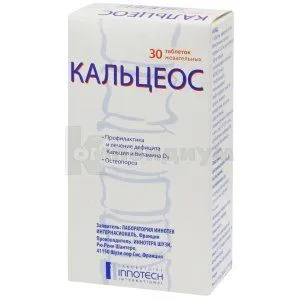
Table of Contents
INSTRUCTIONS FOR MEDICAL USE OF THE MEDICINAL PRODUCT KALCEOS (CALCEOS)
Composition:
Active substances: calcium carbonate, cholecalciferol (vitamin D3);
One chewable tablet contains: calcium carbonate 1250 mg, equivalent to 500 mg of calcium, cholecalciferol (vitamin D3*) 400 IU in the form of cholecalciferol concentrate (powdered form) 4 mg;
*vitamin D3 composition: cholecalciferol, alpha-tocopherol, gelatin, sucrose, corn starch, partially hydrogenated soybean oil;
Excipients: xylitol, sorbitol (E 420), povidone, magnesium stearate, lemon flavoring.
Pharmaceutical form. Chewable tablets.
Main physicochemical properties: white to grey-white square tablets.
Pharmacotherapeutic group. Calcium preparations. Calcium in combination with other agents. ATC code A12AX.
Pharmacological Properties
Pharmacodynamics
Calcios is a combination drug that actively influences calcium metabolism in the body and corrects deficiencies of calcium and vitamin D3 derived from food. Calcios reduces bone resorption and increases bone tissue density.
In elderly individuals, the daily requirement for calcium is 1500 mg, and for vitamin D3 it is 500–1000 IU.
Calcium participates in the formation of bone tissue and mineralization of teeth, blood coagulation processes, regulation of nerve conduction and muscle contractions, and maintenance of stable nervous system function; it is also a component of the blood coagulation system.
Cholecalciferol (vitamin D3) enhances intestinal absorption of calcium and its deposition in bone tissue, and regulates calcium and phosphorus metabolism in the body.
Pharmacokinetics
The pharmacokinetics are determined by the interaction of the drug's components.
Approximately 30% of the administered calcium dose is absorbed in the gastrointestinal tract. Calcium is absorbed in its ionized form in the proximal segment of the small intestine via an active, vitamin D-dependent transport mechanism. Nearly 99% of calcium is concentrated in dense body structures (bones, teeth), while 1% is located in extracellular and intracellular spaces.
Approximately 50% of calcium in the blood exists in the physiologically active ionized form. About 10% is bound to citrates, phosphates, and other anions. The remaining 40% is protein-bound, primarily to albumins.
Calcium is excreted in feces, urine, and sweat.
Vitamin D3 is readily absorbed in the small intestine. Cholecalciferol and its metabolites circulate in the blood bound to specific globulins. To become active, vitamin D3 undergoes two hydroxylation steps: first, in the liver, cholecalciferol is converted into the hydroxy-activated form 25-hydroxycholecalciferol; then, in the kidneys, it is converted into 1,25-dihydroxycholecalciferol, which is responsible for enhanced calcium absorption. Unmetabolized vitamin D3 is stored in muscle and adipose tissue. Vitamin D3 is excreted in feces and urine.
Clinical characteristics.
Indications.
- Correction of calcium and vitamin D deficiency in elderly patients.
- Adjunct to specific osteoporosis therapy in patients with established deficiency or at high risk of developing combined calcium and vitamin D deficiency.
CalcEOS is indicated for use in adults.
Contraindications.
-
Hypersensitivity to the active substances or to any of the excipients.
-
The product contains partially hydrogenated soybean oil. Patients with peanut or soy allergy should not take this medicinal product.
-
Hypercalcaemia (elevated blood calcium levels), hypercalciuria (increased urinary excretion of calcium), and diseases or conditions leading to hypercalcaemia and/or hypercalciuria (e.g. myeloma, bone metastases, primary hyperparathyroidism).
-
Nephrolithiasis (kidney stones, nephrocalcinosis).
-
Severe renal insufficiency (glomerular filtration rate < 30 mL/min). In patients with severe renal insufficiency, vitamin D3 in the form of cholecalciferol is not metabolized via the normal pathway; therefore, other forms of vitamin D3 should be used.
-
In cases of prolonged immobilization associated with hypercalciuria or hypercalcaemia, treatment with the product may be considered only after restoration of patient mobility.
-
Hypervitaminosis D.
Interaction with other medicinal products and other forms of interaction.
Combinations requiring caution in use
Digoxin
Risk of severe arrhythmia. Medical supervision is required; monitoring of electrocardiogram and serum calcium levels is recommended when necessary.
Bisphosphonates
Risk of reduced gastrointestinal absorption of bisphosphonates. It is recommended to take calcium-containing products and bisphosphonates at an interval of 30 minutes to 2 hours or more.
Strontium
Reduced gastrointestinal absorption of strontium when co-administered with calcium-containing products. It is recommended to take calcium separately, with an interval of more than two hours from strontium-containing products.
Oral tetracycline antibiotics
Possible reduction in tetracycline absorption. It is recommended to take calcium salt products separately, with an interval of at least two hours from tetracycline administration.
Rifampicin
Possible reduction in vitamin D levels. Vitamin D levels should be checked and supplementation considered if necessary.
Cyprofloxacin, norfloxacin
Due to the risk of reduced intestinal absorption of these fluoroquinolones, it is recommended to take calcium separately, with an interval of at least two hours from cyprofloxacin or norfloxacin.
Dolutegravir
Risk of reduced intestinal absorption of dolutegravir. It is recommended to take calcium at least 2 hours after or 6 hours before dolutegravir administration.
Ferrous salts
Risk of reduced gastrointestinal absorption of ferrous salts. It is recommended to take calcium and ferrous salts at an interval of more than 2 hours.
Zinc preparations
Risk of reduced gastrointestinal absorption of zinc preparations. It is recommended to take calcium and zinc preparations at an interval of more than 2 hours.
Estramustine
Risk of reduced gastrointestinal absorption of estramustine. It is recommended to take calcium and estramustine at an interval of more than 2 hours.
Thyroid hormones
Risk of reduced gastrointestinal absorption of thyroid hormones. It is recommended to take calcium and thyroid hormones at an interval of more than 2 hours.
Enzyme-inducing antiepileptic drugs (carbamazepine, fosphenytoin, phenobarbital, phenytoin, primidone)
Possible reduction in vitamin D concentration. Vitamin D levels should be monitored and supplementation considered if necessary.
Combinations with usage precautions
Orlistat
Orlistat treatment may impair vitamin D absorption.
Thiazide diuretics
Risk of hypercalcaemia due to reduced urinary calcium excretion.
Food products
Possible interactions with food products, such as those containing oxalic acid (spinach, rhubarb, sorrel, cocoa, tea, etc.), phosphates (pork, ham, sausages, processed cheese, dessert creams, cola-containing beverages, etc.), or phytic acid (cereals, dried vegetables, oilseed seeds, chocolate, etc.). Therefore, it is recommended to consume foods containing these products either some time before or after taking the medicinal product.
Special precautions for use
- The medicinal product should be used with caution in patients with sarcoidosis due to the risk of increased metabolism of vitamin D into its active form. In these patients, serum and urinary calcium levels should be monitored.
- The medicinal product should be used with caution in patients with renal insufficiency when glomerular filtration rate is ≥ 30 ml/min, with monitoring of calcium and phosphate levels in blood to maintain homeostasis. The risk of soft tissue calcification should be considered.
- When prescribing the medicinal product Calcios, intake of calcium and absorbable alkali from other sources (e.g., food, dietary supplements, or other medicinal products) should be taken into account. If very high doses of calcium are taken concomitantly with easily absorbable alkali (such as carbonates), there is a risk of developing milk-alkali syndrome (Burnett's syndrome), characterized by hypercalcemia, metabolic alkalosis, renal failure, and soft tissue calcification. In such cases, more careful monitoring of serum calcium levels and urinary calcium excretion may be required.
- In cases of prolonged immobilization, treatment with vitamin D and calcium should be resumed only after the patient has regained mobility (see section "Contraindications").
- During long-term treatment, serum and urinary calcium levels, as well as renal function (serum creatinine), should be monitored. It is recommended to temporarily reduce the dose or interrupt treatment if urinary calcium excretion exceeds 7.5 mmol/24 hours (300 mg/24 hours). Such monitoring is particularly important in elderly patients, during concomitant therapy with cardiac glycosides or diuretics (see section "Interaction with other medicinal products and other forms of interaction"), and in patients prone to kidney stone formation. If hypercalcemia or signs of impaired renal function occur, the dose should be reduced or treatment discontinued.
- Additional intake of vitamin D or calcium supplements should be carried out under strict medical supervision. In such cases, weekly monitoring of serum and urinary calcium levels is mandatory.
- The medicinal product Calcios contains sorbitol (E 420) and should not be used in patients with rare hereditary fructose intolerance.
- The medicinal product Calcios contains a small amount of sucrose (sugar) as part of the colecalciferol concentrate. It should not be used in patients with rare hereditary disorders associated with fructose intolerance, glucose-galactose malabsorption, or sucrase-isomaltase deficiency. Sucrose may have a harmful effect on teeth if this medicinal product is taken for a prolonged period, for example, for two weeks or longer.
Use during pregnancy or breastfeeding
Pregnancy
There are several clinical reports of administration of very high doses of vitamin D to pregnant women with hypoparathyroidism, resulting in healthy newborns.
Vitamin D overdose should be avoided during pregnancy:
- Vitamin D overdose has been shown to cause teratogenic effects in animals.
- Vitamin D overdose in pregnant women should be prevented, as prolonged hypercalcemia may lead to physical and/or mental retardation, supravalvular aortic stenosis, and retinopathy in the child.
Therefore, considering the approved indications, the medicinal product Calcios is not recommended during pregnancy.
Breastfeeding
Vitamin D and its metabolites pass into breast milk. Considering the approved indications, the medicinal product Calcios is not recommended during breastfeeding.
Effect on fertility
There are no data on the effect of the medicinal product Calcios on fertility. However, normal levels of endogenous calcium and vitamin D are not expected to have an adverse effect on fertility.
Ability to influence reaction speed when driving or operating machinery
The medicinal product has no effect or negligible effect on the ability to drive vehicles or operate machinery.
Method of Administration and Dosage
For oral use.
Tablets should be chewed or allowed to dissolve in the mouth.
Adults should take 1 tablet twice daily.
Children
The drug is not intended for use in children.
Overdose
Overdose of the drug may lead to hypervitaminosis and hypercalcemia.
Symptoms
Symptoms of hypercalcemia may include anorexia, thirst, nausea, vomiting, constipation, abdominal pain, muscle weakness, fatigue, arterial hypertension, mental disorders, polydipsia, polyuria, bone pain, renal calcinosis, kidney stones, and in severe cases, cardiac arrhythmias. Severe hypercalcemia may lead to coma and death. Prolonged high calcium levels may result in irreversible kidney damage and soft tissue calcification.
The risk of overdose increases if other calcium-containing drugs or alkaline substances are taken (milk-alkali syndrome) (see sections "Special Warnings" and "Adverse Reactions").
Treatment
Treatment of hypercalcemia: calcium and vitamin D3 therapy must be discontinued. The need for continued use of all other concomitant medications should be re-evaluated by a physician. Gastric lavage should be performed in patients with impaired consciousness. Rehydration should be initiated, and depending on the severity, monotherapy or combination therapy with loop diuretics, bisphosphonates, calcitonin, and corticosteroids may be administered. For patients with renal insufficiency, as well as for patients in whom other treatment methods have proven ineffective, peritoneal dialysis should be considered.
Serum electrolyte levels, kidney function, and diuresis should be monitored. In severe cases, ECG parameters and symptoms of hypercalcemia should also be monitored.
Adverse Reactions
Adverse reactions are listed below, classified by organ systems and frequency of occurrence. Frequency is defined as follows: very common (≥ 1/10), common (≥ 1/100 to < 1/10), uncommon (≥ 1/1000 to < 1/100), rare (≥ 1/10,000 to < 1/1,000), very rare (< 1/10,000), frequency not known (cannot be estimated based on available data).
Immune system disorders
Frequency not known: hypersensitivity reactions such as angioedema or laryngeal edema.
Metabolism and nutrition disorders
Uncommon: hypercalcaemia and hypercalciuria.
Frequency not known: milk-alkali syndrome (Burnett's syndrome: hypercalcaemia, alkalosis, and renal failure). This is usually observed only in cases of overdose (see sections "Special precautions" and "Overdose").
Gastrointestinal disorders
Rare: constipation, flatulence, nausea, abdominal pain, and diarrhoea.
Skin and subcutaneous tissue disorders
Rare: pruritus, rash, and urticaria.
Reporting of suspected adverse reactions
Reporting suspected adverse reactions after medicinal product authorization is important. It allows continued monitoring of the benefit-risk balance of the medicinal product. Healthcare professionals and patients, as well as their legal representatives, are encouraged to report any suspected adverse reactions and lack of efficacy via the automated pharmacovigilance information system at the following link: https://aisf.dec.gov.ua.
Shelf life. 3 years.
Do not use the medicinal product after the expiry date stated on the packaging.
Storage conditions.
Store in the original packaging at a temperature not exceeding 25 °C, in a place inaccessible to children.
The cap inside the tube contains small silica gel granules to protect the tablets from moisture. Keep the tube cap out of sight and reach of children. Do not swallow the silica gel granules.
Packaging.
15 tablets in a polypropylene tube with a polyethylene cap containing silica gel granules as a desiccant. 2 tubes in a cardboard box (30 tablets).
Prescription status. Over-the-counter.
Manufacturer.
Innothera Chouzy, France.
Manufacturer's address.
Rue René Chantereau, Chouzy-sur-Cisse, Valloire-sur-Cisse, 41150, France.
Marketing Authorization Holder.
Laboratoire Innotech International, France.
Address of the Marketing Authorization Holder.
22 avenue Aristide Briand, 94110 Arcueil, France.