Calcemin® silver
Ukraine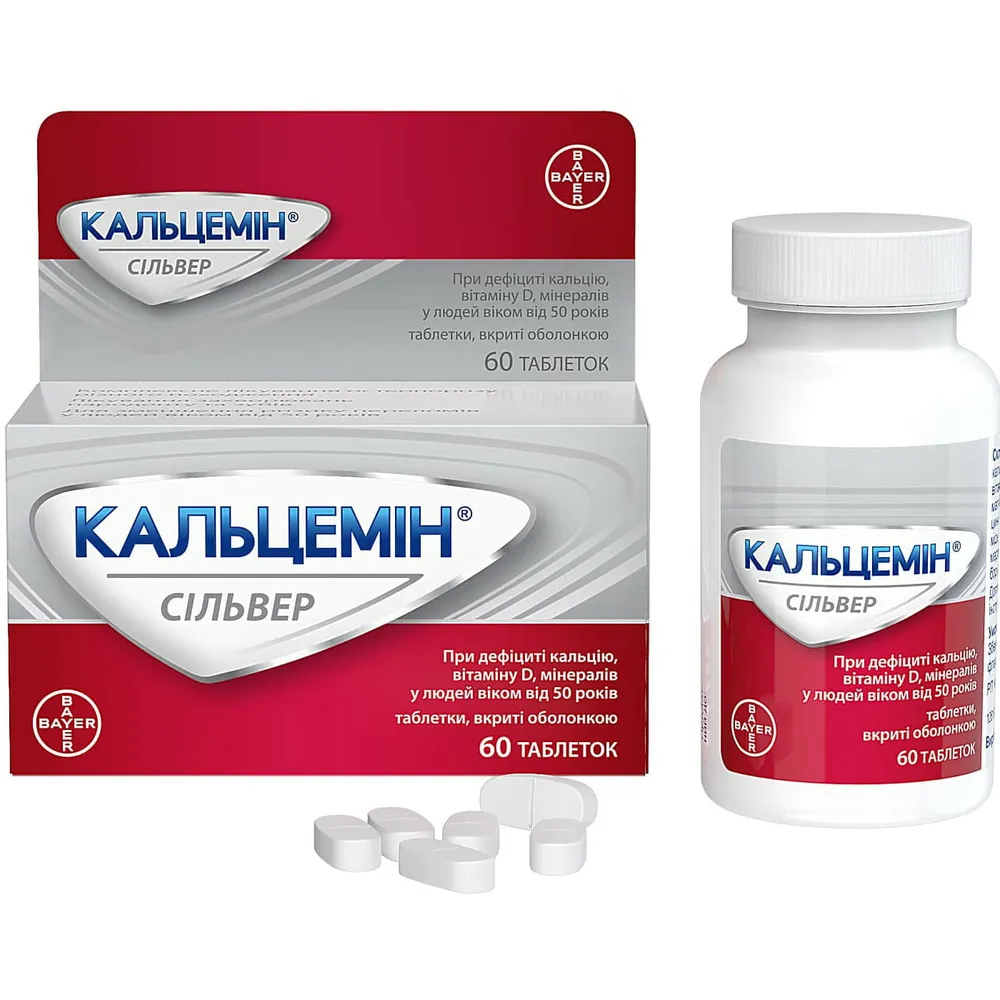
Table of Contents
INSTRUCTIONS FOR MEDICAL USE OF THE MEDICINAL PRODUCT KALTSIMIN® SILVER
Composition:
Active substances:
1 tablet contains: calcium (calcium carbonate, calcium citrate) 500 mg, vitamin D3 (cholecalciferol) 400 IU, magnesium (magnesium oxide) 40 mg, zinc (zinc oxide) 7.5 mg, copper (copper oxide) 1 mg, manganese (manganese sulfate) 1.8 mg, boron (sodium borate) 250 mcg;
Excipients: sodium croscarmellose, acacia, maltodextrin, microcrystalline cellulose, hypromellose, soy polysaccharide, stearic acid, titanium dioxide (E 171), sodium lauryl sulfate, magnesium silicate, triacetin, mineral oil, magnesium stearate, indigocarmine (E 132), tartrazine (E 110).
Pharmaceutical form. Coated tablets.
Main physicochemical properties: oval, film-coated tablets of light grey color, with a transverse groove on one side.
Pharmacotherapeutic group.
Calcium, combinations with vitamin D and/or other agents. ATC code A12AX.
Pharmacological properties.
Pharmacodynamics.
Calcium is an important structural component of bone tissue. Calcium supplementation corrects dietary calcium deficiency, especially in conditions of increased calcium demand or reduced calcium absorption.
Calcium carbonate is the salt containing the highest amount of elemental calcium. Calcium citrate enhances the bioavailability of the drug in patients with reduced gastric acidity, achlorhydria, or those taking histamine H2-receptor blockers; it reduces the risk of kidney stone formation during long-term use, and has a high anti-resorptive potential due to inhibition of parathyroid hormone.
Vitamin D is essential for the absorption of calcium, phosphates, and magnesium in the small intestine. It regulates the levels of these elements in body fluids and helps maintain normal blood calcium levels. It also participates in the synthesis of organic bone matrix components and in skeletal calcification.
Magnesium is involved in bone tissue metabolism, prevents bone demineralization, inhibits calcium deposition in the walls of blood vessels, heart valves, muscles, and urinary tract.
Zinc acts as a cofactor for more than 200 enzymes and influences the bone tissue remodeling process.
Copper participates in the formation of the most important connective tissue proteins—collagen and elastin—which constitute the matrix of bone and cartilage tissue.
Manganese normalizes the synthesis of glycosaminoglycans necessary for the formation of bone and cartilage tissue. It duplicates the calcium-conserving functions of vitamin D.
Boron regulates the activity of parathyroid hormone and thereby influences the metabolism of calcium, magnesium, phosphorus, and cholecalciferol.
Clinical characteristics.
Indications.
Complex treatment of osteoporosis of various etiologies: postmenopausal, senile, idiopathic, steroid-induced, caused by prolonged immobilization and its complications (fractures, etc.), as well as severe dental and periodontal diseases. Recommended as a baseline agent when using anti-resorptive drugs (hormone replacement therapy, calcitonin, bisphosphonates) and bone-forming stimulants. For reducing the risk of fractures in cases of calcium, vitamin D, and mineral deficiency in the diet in individuals aged 50 years and older.
Contraindications.
Hypersensitivity to any component of the drug (allergic reactions); hypercalcemia and/or conditions leading to hypercalcemia (sarcoidosis, malignant tumors, and primary hyperthyroidism), severe hypercalciuria, renal dysfunction, nephrolithiasis; hypervitaminosis D.
Interaction with other medicinal products and other types of interactions.
When using this drug concurrently with other medicinal products, consultation with a physician is required.
Interaction with other medicinal products.
Calcium may reduce the absorption of other medicinal substances by forming insoluble complexes in the gastrointestinal tract, including antibiotics (e.g., tetracyclines, quinolones) and antiviral agents, eltrombopag, sodium fluoride. In addition, calcium absorption itself may also be reduced. To avoid potential interactions, these drugs should be administered at least 2 hours before or 4–6 hours after calcium intake, unless otherwise specified.
Interaction with protease inhibitors. Concomitant use of drugs containing calcium or magnesium, including buffered medicinal products, leads to reduced plasma concentrations of these compounds. Therefore, it is recommended to administer protease inhibitors 2 hours before or 1 hour after drugs containing aluminum, calcium, or magnesium. Such effects have been observed with amprenavir, atazanavir, and tipranavir.
Levothyroxine should be taken at least 4 hours before or 4 hours after calcium intake, as calcium reduces its absorption, possibly due to formation of insoluble complexes.
Phosphates, bisphosphonates, and fluorides. Calcium preparations reduce the absorption of bisphosphonates; therefore, they should be taken at least 30 minutes before calcium administration, but preferably at another time or on another day. Concurrent use of the drug with antacids containing aluminum is not recommended due to reduced efficacy.
Eltrombopag. When taken with a high-fat breakfast and high calcium levels (427 mg), a 59% reduction in plasma eltrombopag levels was observed. No effect on plasma eltrombopag levels was observed when food with low calcium content (< 50 mg) was consumed. Food high in calcium and antacids containing aluminum, calcium, and magnesium significantly reduced systemic absorption.
Calcium and/or vitamin D. Thiazide diuretics reduce urinary calcium excretion. Due to the increased risk of hypercalcemia when thiazide diuretics are used concomitantly, serum calcium levels should be monitored regularly.
Concomitant use with furosemide and other loop diuretics increases renal calcium excretion.
Cardiac glycosides and calcium channel blockers. Hypercalcemia increases the risk of fatal arrhythmias when cardiac glycosides such as digoxin are used and reduces the effectiveness of calcium channel blockers such as verapamil in atrial fibrillation. Monitoring of serum calcium levels, ECG, and the patient's clinical condition is recommended. Glucocorticoids and hormonal contraceptives impair calcium ion absorption.
Vitamin D. Some medicinal products may reduce vitamin D absorption in the gastrointestinal tract. To minimize interactions, these drugs and vitamin D should be taken at least 2 hours before or 4–6 hours after vitamin D intake. Such medicinal products include: ion-exchange resins (e.g., cholestyramine), laxatives, orlistat. Carbamazepine, phenytoin, or barbiturates increase vitamin D metabolism to inactive metabolites and thus reduce its effect.
When Calciumin**®** Silver is used concomitantly with vitamin A, the toxicity of vitamin D3 is reduced.
Interaction of calcium with food and supplements. Oxalic acid found in spinach and rhubarb, and phytic acid present in whole grains, may inhibit calcium absorption. Therefore, it is not recommended to consume calcium-containing products within two hours after eating foods rich in oxalic and phytic acids.
Iron, zinc, magnesium. Calcium preparations may reduce the absorption of iron, zinc, and copper from food. For individuals at risk of iron, zinc, or magnesium deficiency, to prevent inhibition of mineral absorption from food, calcium supplements are recommended to be taken before bedtime rather than with meals.
Fiber. Some components of dietary fiber may reduce calcium absorption. Concurrent use of psyllium with calcium does not lead to a significant reduction in calcium absorption.
Special precautions for use
Do not exceed the recommended dose. Calciumemin® Silver should not be used simultaneously with other calcium or vitamin D supplements.
Overdose of calcium and vitamin D may lead to adverse effects, including hypercalcemia and hypercalciuria. Calcium and vitamin D should be used with caution to avoid exceeding the total daily intake of 2500 mg of calcium and 4000 IU of vitamin D, including dietary sources (see section "Overdose").
Patients receiving other medications containing vitamin D and/or calcium, or any other medicinal products, should consult a physician before starting this medication.
During prolonged treatment with calcium and vitamin D combination products, and also in cases of mild to moderate renal impairment (including elderly patients), serum levels of calcium, phosphate, and creatinine should be monitored, as well as urinary levels of calcium and phosphate. If signs of hypercalcemia or impaired renal function appear, or if calciuria exceeds 7.5 mmol/day (300 mg/day), the dose should be reduced or treatment discontinued. In cases of renal impairment and when concomitantly using cardiac glycosides, calcium channel blockers and/or thiazide diuretics, monitoring of renal function should be performed by measuring serum creatinine levels (see section "Interaction with other medicinal products and other forms of interaction").
Combined calcium and vitamin D preparations should be used with caution in immobilized patients due to an increased risk of hypercalcemia.
Dose adjustment is not required in patients with impaired liver function. This medicinal product should not be used in patients with renal impairment, nephrolithiasis, or predisposition to calcium deposition.
Use during pregnancy or breastfeeding
During pregnancy and lactation, the daily dose should not exceed 1 coated tablet of Calciumemin® Silver.
The medication should be used during pregnancy and breastfeeding only when clearly indicated and under medical supervision. Use of the medication at recommended doses is considered safe. Recommended doses should not be exceeded, as chronic overdose may be harmful to the fetus or newborn.
During pregnancy and lactation, the total daily intake of calcium and vitamin D from all sources, including diet and supplements, should not exceed 2500 mg of calcium and 4000 IU of vitamin D.
In animal studies, vitamin D overdose during pregnancy has been associated with teratogenic effects. There are no data indicating a potential teratogenic effect of vitamin D in humans when used at recommended doses.
Maternal hypercalcemia due to excessive vitamin D intake during pregnancy has been associated with fetal hypercalcemia, which may lead to adverse effects in the newborn, including suppression of parathyroid hormone, hypocalcemia, tetany, epileptic seizures, and supravalvular aortic stenosis syndrome, which may manifest as retinopathy, delayed psychomotor development, or growth disorders; it may also lead to neonatal hypercalcemia.
Vitamin D and calcium are excreted in breast milk. This should be taken into account if the infant is receiving any supplements containing vitamin D or calcium.
Fertility. Currently, there are no data indicating a potential adverse effect of vitamin D and/or calcium on human fertility.
Effect on ability to drive and operate machinery. No effects on the ability to drive or operate machinery have been observed.
Dosage and Administration
For adults and children aged 12 years and older: 1 tablet during a meal, 1–2 times daily. Swallow with sufficient amount of water (200 ml). The maximum daily dose should not exceed 3 coated tablets. The duration of use should be determined by a physician. If necessary, repeated treatment courses may be administered.
Children. Not intended for use in children under 12 years of age.
Overdose.
No cases of overdose have been observed when the product is used at recommended doses. Most reports of overdose are associated with concomitant use of high doses of single-component or multivitamin preparations. In case of accidental overdose, symptomatic treatment is recommended: gastric lavage, increased fluid intake, and a low-calcium diet.
Prolonged intake of calcium and vitamin D in excessive doses exceeding 2500 mg of calcium and 4000 IU/day of vitamin D may lead to toxic effects.
In patients with hypercalcemia or conditions associated with hypercalcemia, renal insufficiency, and/or predisposition to nephrolithiasis, toxic effects of calcium and vitamin D may occur even at lower doses.
Acute or chronic overdose of calcium and vitamin D may cause hypervitaminosis D, hypercalcemia, hypercalciuria, hyperphosphatemia, and increased calcium absorption. Consequences include renal failure, milk-alkali syndrome—particularly in patients with impaired kidney function—vascular and soft tissue calcification, including calcinosis leading to nephrocalcinosis and nephrolithiasis, especially in patients predisposed to nephrolithiasis.
Non-specific initial symptoms such as sudden onset of headache, muscle weakness, impaired consciousness, and gastrointestinal disturbances (abdominal pain, constipation, diarrhea, nausea, and vomiting) may indicate acute overdose.
If such symptoms occur, discontinue use of the product immediately and seek medical advice without delay.
Laboratory and clinical signs of poisoning and hypercalcemia may include: anorexia, weight loss, increased fatigue, thirst, polyuria, bone pain, cardiac arrhythmias, and impaired absorption of other minerals. Laboratory findings may show elevated plasma levels of aspartate aminotransferase (AST) and alanine aminotransferase (ALT). Chronic overdose may lead to vascular and organ calcification due to hypercalcemia. Extremely high hypercalcemia may result in coma and fatal outcomes.
Side effects.
Gastrointestinal system. Gastrointestinal pain and abdominal pain, dyspepsia (including abdominal discomfort), constipation, diarrhea, flatulence, nausea, and vomiting.
Immune system disorders (allergic reactions, anaphylactic reactions, anaphylactic shock). Rarely, hypersensitivity reactions have been reported, accompanied by corresponding laboratory and clinical manifestations, including asthma syndrome, and mild to moderate reactions affecting the skin and/or respiratory system, gastrointestinal tract, and/or cardiovascular system. Symptoms may include rash, urticaria, swelling, skin redness, itching, non-cardiogenic pulmonary edema. Very rarely, severe reactions have been reported, including anaphylactic shock.
Laboratory findings. With prolonged use at high doses, there is a possibility of developing hypercalcemia, hypercalciuria, and vitamin D hypervitaminosis.
Shelf life.
3 years. Do not use the medication after the expiry date stated on the package.
Storage conditions.
Store at a temperature not exceeding 25 °C in a tightly closed container.
Keep out of reach of children.
Packaging.
Primary: plastic bottle containing 30 or 60 film-coated tablets; with a screw cap and protective film. Secondary: cardboard box.
Supply category.
Over-the-counter.
Manufacturer.
Contract Pharmacal Corporation.
Manufacturer's address.
135 Adams Avenue, Hauppauge, New York 11788, USA.