Potassium iodide
Ukraine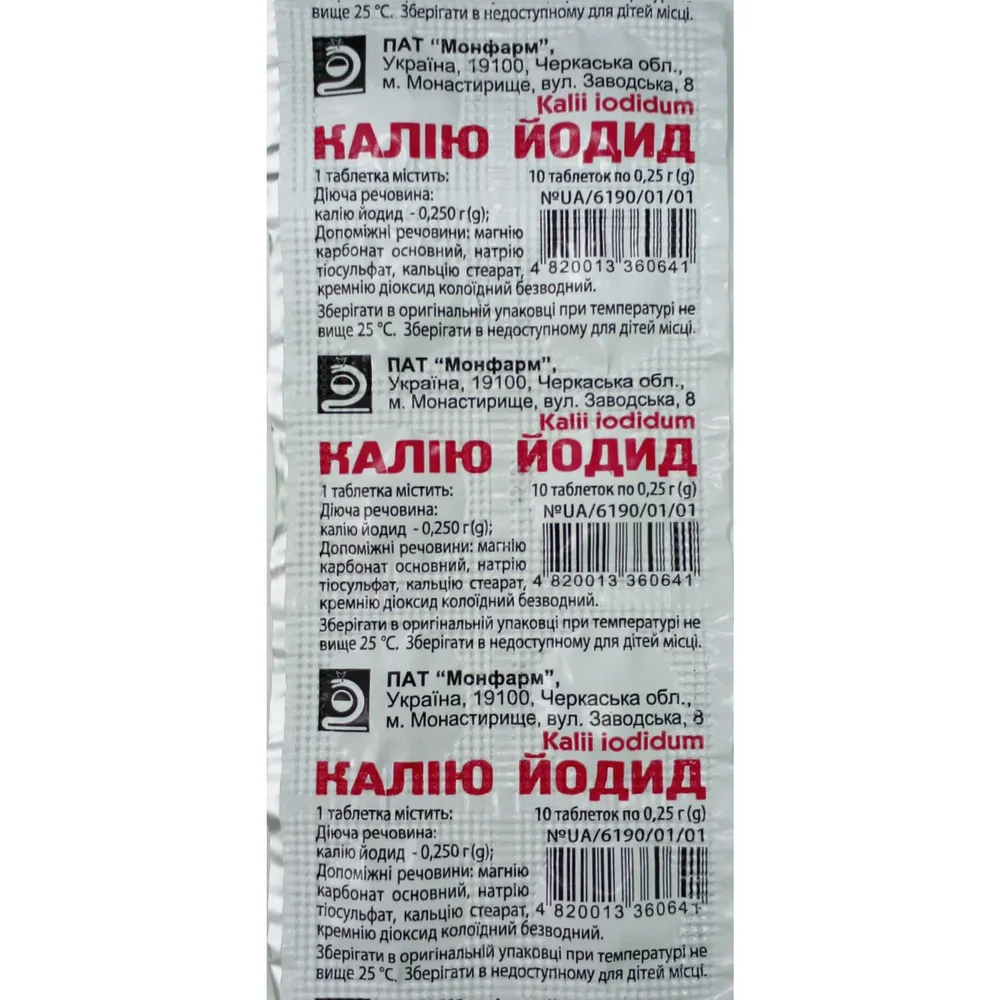
Table of Contents
I N S T R U C T I O N for medical use of the medicinal product POTASSIUM IODIDE (KALII IODIDUM)
Composition:
Active substance: Potassium iodide;
One tablet contains potassium iodide 250 mg (0.25 g);
Excipients: magnesium carbonate basic, sodium thiosulfate, calcium stearate, silicon dioxide anhydrous colloidal.
Pharmaceutical form. Tablets.
Main physicochemical properties: white tablets with a flat surface, beveled edges, and a score line; the presence of speckles and marbling is permissible.
Pharmacotherapeutic group. Antidotes. ATC code V03AB21.
Pharmacological properties.
Pharmacodynamics.
Upon entering the follicular epithelial cells of the thyroid gland, iodides are oxidized by the enzyme iodide-peroxidase to form elemental iodine, which is incorporated into the tyrosine molecule. As a result, some of the tyrosine radicals in thyroglobulin become iodinated. The iodinated tyrosine radicals condense into thyronines, the main ones being thyroxine (T4) and triiodothyronine (T3). The formed complex of thyronine and thyroglobulin is released as a stored form of thyroid hormone into the follicular colloid and remains stored in this state for several days or weeks. In iodine deficiency, this process is impaired. Potassium iodide compensates for this deficiency and promotes restoration of the impaired synthesis of thyroid hormones.
An important property of potassium iodide is its ability to prevent accumulation of radioactive iodine in the thyroid gland and to provide protection against radiation exposure.
Pharmacokinetics.
When administered orally, it is rapidly absorbed from the gastrointestinal tract. It is widely distributed throughout all tissues and body fluids. It is excreted predominantly by the kidneys.
Clinical characteristics.
Indications.
For iodine prophylaxis during nuclear-technical accidents to prevent radiation exposure.
Contraindications.
- individual hypersensitivity to the components of the medicinal product;
- hypocomplementemic urticarial vasculitis (McDuffie syndrome);
- pronounced hyperthyroidism;
- furunculosis;
- hypersensitivity to iodine;
- latent hyperthyroidism;
- hyperfunction of the thyroid gland;
- toxic adenoma, nodular or diffuse toxic goiter;
- dermatitis herpetiformis (Duhring's disease);
- hemorrhagic diathesis;
- urticaria, pulmonary tuberculosis, nephritis, nephrosis, pyoderma;
- children under 12 years of age.
Interaction with other medicinal products and other types of interactions.
Concomitant high-dose therapy with iodine and potassium-sparing diuretics may lead to the development of hyperkalemia; with lithium-containing drugs — development of goiter and hypothyroidism.
When the medicinal product "Potassium Iodide" is used concomitantly with angiotensin-converting enzyme (ACE) inhibitors, hyperkalemia, cardiac arrhythmias, or cardiac arrest may occur. If such concomitant use is considered appropriate, monitoring of plasma potassium levels is recommended.
Perchlorate and thiocyanate competitively inhibit iodine uptake by the thyroid gland, whereas thyroid-stimulating hormone (TSH) stimulates it.
Concomitant use of the medicinal product "Potassium Iodide" with iodine-containing drugs (e.g., amiodarone) is not recommended due to the risk of adverse effects.
Concomitant use of quinidine and the medicinal product "Potassium Iodide" may be accompanied by enhanced cardiac effects of quinidine due to increased potassium concentration in blood plasma.
Combination of the medicinal product with plant alkaloids and heavy metal salts may result in the formation of an insoluble precipitate and impair iodine absorption.
Special precautions for use.
The need for administration of potassium iodide should be considered for different risk age groups. Pregnant women, breastfeeding mothers, and children should be prioritized for iodine prophylaxis. Iodine prophylaxis is used to protect against inhalation exposure to radioactive iodine isotopes; however, it should not be considered as the sole protective measure, particularly in cases of ingestion of radioactive iodine through the gastrointestinal tract.
Optimal protection is achieved when the drug is administered prophylactically (in advance) within 6 hours or less before radiation exposure.
The acceptable time window for potassium iodide administration is up to 24 hours before and up to 6 hours after the expected onset of radiation exposure. It is also advisable to administer the medicinal product to block the thyroid gland within eight hours after the beginning of radiation exposure. Initiating iodine prophylaxis more than 24 hours after exposure to radioactive iodine may cause more harm than benefit, as it may prolong the biological half-life of radioactive iodine isotopes in the thyroid gland.
A single dose of potassium iodide provides protection of the thyroid gland for approximately 24 hours.
Evacuation of the population (when feasible) is generally a more effective radiation protection measure than repeated administration of the medicinal product. If evacuation is delayed or impossible for any reason, multiple (repeated) doses of potassium iodide should be administered no sooner than 24 hours after the first dose and only if prolonged release of radioactivity into the environment persists.
Hyperkalemia may develop in patients with renal insufficiency during therapy.
Caution should be exercised when administering potassium iodide concomitantly with potassium-containing medicinal products to patients with adrenal insufficiency, acute dehydration, or heat cramps.
Prophylaxis with potassium iodide is not recommended for adults aged 40 years and older, except in cases where inhaled radiation doses are expected to reach 5 Gy, i.e., levels sufficient to impair thyroid function. The risk of developing thyroid cancer in individuals aged 40 years and older is low, but the prevalence of thyroid disorders is higher; therefore, potassium iodide intake may provoke complications related to the thyroid gland. Iodine-induced hyperthyroidism may occur in patients with asymptomatic nodular goiter or occult Graves’ disease (Basedow’s disease) who are not under medical supervision.
Use during pregnancy or breastfeeding.
Pregnancy.
Teratogenic effects such as congenital goiter and hypothyroidism have been reported in pregnant women receiving iodides.
Prophylactic administration of potassium iodide to pregnant women is also effective in protecting the fetus. During pregnancy, the number of potassium iodide doses should be kept to a minimum, and repeated dosing should be avoided. In regions with low soil iodine content, prolonged use may lead to loss of thyroid function in the mother or fetus, with potential consequences for fetal development. If potassium iodide is administered in late pregnancy, thyroid function in the newborn should be monitored. Routine neonatal screening tests are generally sufficient. In newborns who received potassium iodide during the first weeks of life, levels of thyroid-stimulating hormone (TSH) should be monitored, and if necessary, T4 levels as well, with appropriate replacement therapy initiated if required.
Pregnant women with active hyperthyroidism should not take potassium iodide due to the risk of inducing hypothyroidism in the fetus.
Breastfeeding.
Potassium iodide passes into breast milk; however, dosage adjustment is not required in breastfeeding women. These women should take the medicinal product for their own protection and for potential reduction of radioactive iodine levels in breast milk. However, repeated administration of potassium iodide is not recommended.
Fertility.
There are no clinical or preclinical data on the effect of potassium iodide on fertility.
Ability to affect reaction speed when driving or operating machinery.
No studies have been conducted to evaluate the effect of potassium iodide on the ability to drive vehicles or operate machinery.
Dosage and Administration.
After an official announcement of a radiation accident and in the event of a threat of radioactive iodine entering the body, to protect the thyroid gland from radiation exposure, administer "Potassium Iodide" to adults and children aged 12 years and older at a dose of 125 mg (1/2 tablet) once daily.
The half tablet may be taken after meals, swallowed with a small amount of water. For children, crush the tablet and administer after dissolving it in a small amount of sweet tea or milk.
Optimal protective effect of the medicinal product "Potassium Iodide" is possible only if taken in advance (prophylactically) within 6 hours or less before radiation exposure.
The acceptable time window for administration of the medicinal product is within 24 hours before and 6 hours after the expected onset of radiation exposure (see section "Special Warnings and Precautions for Use").
A single dose of the medicinal product "Potassium Iodide" is sufficient. In case of prolonged or repeated exposure, repeated administration of the medicinal product may be considered. Repeated (multiple) administration of "Potassium Iodide" should be performed no earlier than 24 hours after the first dose (see section "Special Warnings and Precautions for Use").
Special patient groups.
Repeated dosing is not recommended for patients aged 40 years and older (see section "Special Warnings and Precautions for Use").
Children.
Potassium Iodide in this pharmaceutical form is not recommended for children under 12 years of age.
Overdose.
Acute iodine intoxication may cause reflex vomiting, abdominal pain, diarrhea (sometimes with blood), and brown discoloration of mucous membranes. Dehydration and shock may occur. Rarely, esophageal stenosis may develop. Chronic overdose leads to a condition known as iodism: metallic taste in the mouth, swelling and inflammation of mucous membranes (rhinitis, conjunctivitis, gastroenteritis, bronchitis); acneiform skin eruptions; dermatitis; swelling and pain in the salivary glands; hemorrhages; elevated body temperature; irritability.
Prolonged use of high doses of the drug (over 300 mcg daily) may lead to iodine-induced hyperthyroidism (especially in elderly patients with nodular goiter or toxic adenoma).
When treating with high doses of iodine (over 1 mg/day), goiter and hypothyroidism may develop in individual cases.
Treatment. First aid includes gastric lavage and administration of activated charcoal. Hemodialysis may help reduce plasma iodine levels.
Side effects
Listed below are adverse reactions classified by organ system classes according to the MedDRA classification: very common (≥ 1/10), common (≥ 1/100 to < 1/10), uncommon (≥ 1/1,000 to < 1/100), rare (≥ 1/10,000 to < 1/1,000), very rare (< 1/10,000), frequency not known (cannot be estimated from available data).
Immune system disorders:
Not known: iodism manifestations: hypersensitivity reactions, mucosal nasal swelling, urticaria, angioedema (Quincke's edema), anaphylactic shock, skin rashes, pruritus.
Blood and lymphatic system disorders:
Not known: eosinophilia.
Cardiac disorders:
Not known: tachycardia.
Central nervous system disorders:
Not known: irritability, sleep disturbances, increased sweating.
Gastrointestinal disorders:
Not known: diarrhea (in patients aged 40 years and older), gastrointestinal disturbances (including nausea), taste disturbances (including metallic taste).
Endocrine disorders:
Not known: with high-dose therapy, goiter and hypothyroidism may develop in individual cases, as well as iodine-induced autoimmune disorders (such as Graves' disease and Hashimoto's thyroiditis).
Not known: hyperactivity of the thyroid gland, thyroiditis, and enlargement of the thyroid gland with or without development of myxedema have also been reported.
If any adverse events occur, patients should consult a physician immediately!
Reporting of suspected adverse reactions.
Reporting suspected adverse reactions after medicinal product registration is of great importance. It allows continuous monitoring of the benefit-risk balance of the medicinal product. Healthcare professionals and pharmacists, as well as patients or their legal representatives, should report all suspected adverse reactions and/or lack of efficacy via the Automated Pharmacovigilance Information System at the following link: https://aisf.dec.gov.ua.
Shelf life.
4 years.
Storage conditions.
Store in the original packaging at a temperature not exceeding 25 °C.
Keep out of reach of children.
Packaging.
10 tablets per strip, №150 (15×10) in strips.
Prescription status. Prescription only.
Manufacturer. JSC "Monfarm".
Manufacturer's address and location of business activity.
8, Zavodska St., Avramivka village, Uman district, Cherkasy region, Ukraine, 19161.