Potassium chloride solution 4%
Ukraine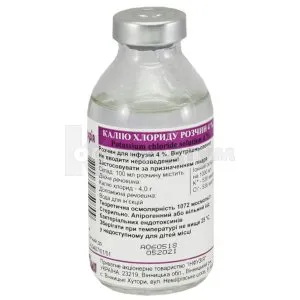
Table of Contents
INSTRUCTIONS FOR MEDICAL USE OF THE MEDICINAL PRODUCT POTASSIUM CHLORIDE SOLUTION 4%
Composition:
Active substance: potassium chloride;
100 ml of solution contains 4.0 g of potassium chloride;
Ionic composition per 1000 ml of product: K+ — 536 mmol, Cl− — 536 mmol;
Excipient: water for injections.
Pharmaceutical form. Infusion solution.
Main physicochemical properties: clear, colorless liquid, pH 4.0–7.0.
Theoretical osmolarity — 1072 mosmol/L.
Pharmacotherapeutic group. Electrolyte solutions. Potassium chloride. ATC code B05XA01.
Pharmacological properties.
Pharmacodynamics. Potassium — the active ingredient of the medicinal product — is the main intracellular cation in most tissues of the body. Potassium ions are essential for many vital physiological processes. They participate in regulating excitability, contractility, conduction, and automaticity of the myocardium; are necessary for maintaining intracellular pressure, nerve impulse conduction and synaptic transmission, maintaining potassium concentration in myocardial cells, skeletal muscles, and smooth muscle cells, as well as for normal kidney function. In small doses, potassium ions dilate coronary vessels, while in large doses they constrict them. Potassium promotes increased acetylcholine levels and stimulates the sympathetic division of the central nervous system (CNS). It has a moderate diuretic effect. Elevated potassium levels reduce the risk of cardiac glycoside-induced cardiotoxicity. Potassium also plays an important role in the development and correction of acid-base balance disorders.
Pharmacokinetics. Potassium is primarily excreted by the kidneys via secretion in the distal tubules, where sodium-potassium exchange also occurs. The kidneys' ability to conserve potassium is limited, and potassium excretion in urine continues even when body potassium levels are significantly reduced. Tubular potassium secretion depends on several factors, including chloride ion concentration, hydrogen ion exchange, acid-base balance, and adrenal hormones. A certain amount of potassium is excreted in feces; a negligible amount may be excreted in saliva, sweat, bile, or pancreatic juice.
Clinical characteristics.
Indications.
Hypokalemia; cardiac glycoside intoxication; arrhythmias of various origins, including paroxysmal tachycardia (mainly associated with electrolyte disturbances and absolute or relative hypokalemia).
Contraindications.
Impaired renal excretory function (potassium accumulates in blood plasma, which may lead to intoxication), acute and chronic renal failure (with oliguria or anuria, azotemia), retentional uremic stage in chronic renal failure, atrioventricular conduction disturbances, hyperkalemia, hyperchloremia, systemic acidosis, diabetic acidosis, acute dehydration, extensive burns, intestinal obstruction, Addison's disease, cerebral edema, heat cramps.
The medicinal product must not be administered simultaneously with blood preparations.
Interaction with other medicinal products and other forms of interactions.
When potassium chloride is used concomitantly with potassium-sparing diuretics (amiloride, spironolactone, triamterene), angiotensin-converting enzyme (ACE) inhibitors, angiotensin II receptor antagonists, aliskiren, cyclosporine, tacrolimus (not for topical use), trimethoprim, and nonsteroidal anti-inflammatory drugs (NSAIDs), the risk of developing severe hyperkalemia increases (serum potassium levels must be monitored). Particularly careful monitoring of blood potassium levels is required when these medicinal products are used in conditions that may cause elevated blood potassium levels.
Glucose infusions in patients with hypokalemia may lead to further reduction in blood potassium levels, even when potassium chloride is administered concomitantly (see section "Special precautions for use").
Under the influence of potassium preparations, the cardiac effect of quinidine and the adverse cardiovascular effects of disopyramide are enhanced. Potassium preparations improve tolerance to cardiac glycosides.
Special precautions for use
During treatment, it is recommended to regularly monitor serum potassium levels to avoid the development of hyperkalemia, as well as blood acid-base balance, and to perform cardiac monitoring using ECG, especially in patients with cardiovascular and renal diseases.
At the beginning of treatment, do not use with glucose solutions, as glucose may further reduce blood potassium levels.
Magnesium deficiency, which may accompany potassium deficiency, should also be treated. In patients with chronic kidney diseases or other conditions associated with impaired potassium excretion, or in case of very rapid intravenous administration of potassium chloride, hyperkalemia may develop, which potentially can lead to fatal outcomes. Use with caution in cardiovascular diseases, in conditions with significant tissue destruction (e.g., burns), and concomitantly with potassium-sparing diuretics or other medicinal products that may increase serum potassium levels (see section "Interaction with other medicinal products and other forms of interactions"). Concomitant parenteral administration of calcium ions may cause arrhythmia.
Sudden discontinuation of potassium chloride when used concomitantly with cardiac glycosides requires special caution, since the hypokalemia that develops under these conditions enhances the toxicity of digitalis preparations.
Use during pregnancy or breastfeeding
The medicinal product may be used when there are life-threatening indications, when benefit outweighs risk. It should be taken into account that potassium preparations reduce uterine tone.
The medicinal product should be used with caution in pregnant women with nephropathy.
Ability to influence reaction rate while driving or operating machinery
The drug should be used only under hospital conditions. Data on the effect of the drug on reaction rate while driving or operating machinery are lacking.
Administration and Dosage.
Administer intravenously by drip infusion.
Do not administer undiluted!
The 4% potassium chloride concentrate solution must be diluted before administration and thoroughly mixed. The concentration of the ready-to-use solution should not exceed 3 g/L or 40 mmol/L. As a diluent, 0.9% sodium chloride solution or 5% glucose solution may be used. The dose and rate of administration depend on the individual patient's condition. The required dose should be determined based on serum potassium levels. Potassium deficit should be calculated using the following formula:
Potassium = body weight × 0.2 × 2 × (4.5 − K+plasma),
where: potassium — calculation in mmol, body weight — calculation in kg, 4.5 — normal potassium level in mmol/L in blood serum, K+plasma — actual potassium concentration (mmol/L) in the patient's blood serum.
The result obtained represents the required amount (deficit) of potassium in the body in mmol. To determine the volume of medication to be used, note that the 4% potassium chloride solution contains 0.536 mmol of K+ ions per 1 mL.
If serum potassium concentration is above 2.5 mmol/L, the infusion rate should not exceed 10 mmol/hour, and the daily dose of potassium should not exceed 200 mmol.
If urgent treatment of severe hypokalemia is indicated (serum potassium concentration below 2 mmol/L, ECG changes, muscle paralysis), potassium chloride may be administered very cautiously at a rate of up to 40 mmol/hour. In such cases, up to 400 mmol of potassium may be administered within 24 hours. Continuous cardiac monitoring and regular control of serum potassium concentration are required to avoid hyperkalemia and cardiac arrest. In critical conditions, potassium chloride should be administered in 0.9% sodium chloride solution (unless contraindicated), rather than in glucose-containing solutions, as glucose may reduce serum potassium levels.
Children.
Data on the use of this medication in children are lacking.
Overdose.
Overdose may remain asymptomatic for a prolonged period until serum potassium concentration reaches high levels (6.5–8 mmol/L). Hyperkalemia and hyperhydration are possible.
Clinical symptoms of potassium overdose: paresthesia of extremities, muscle weakness or heaviness in legs, flaccid paralysis, abdominal pain, frequent shallow breathing, cardiac arrhythmias and conduction disturbances, pale and cold skin, peripheral vascular collapse, lethargy, confusion, possible loss of consciousness, elevated body temperature, apathy, decreased blood pressure and body weight, psychiatric disorders. Electrocardiogram (ECG) may show peaked T waves, ST segment depression, widened QRS complex, reduced P wave amplitude, and prolonged PQ interval. Extremely high plasma potassium concentration (8–11 mmol/L) may lead to fatal outcome due to suppression of cardiac activity, development of arrhythmias, and cardiac arrest.
Treatment: immediately discontinue potassium chloride administration. All medications containing potassium and potassium-sparing diuretics should be discontinued immediately. Symptomatic treatment should be directed toward supporting vital functions.
Plasma potassium concentration may be reduced by infusion of 300–500 mL/hour of 10% glucose solution containing up to 10 units of insulin per 20 g of glucose, or by infusion of sodium bicarbonate solution.
Plasma potassium concentration above 6.5 mmol/L or presence of cardiac arrhythmia requires urgent intravenous injection of 10–20 mL of 10% calcium gluconate over 1–5 minutes under ECG monitoring. In severe cases, hemodialysis or peritoneal dialysis is indicated.
During overdose management, ECG monitoring is required; plasma levels of urea, electrolytes, and creatinine should be determined; potassium levels should be checked (if necessary, every 2–3 hours). Patients without symptoms of overdose should be observed for 6 hours.
Too rapid reduction of serum potassium concentration during treatment of hyperkalemia in patients taking cardiac glycosides may lead to development of digitalis toxicity.
Adverse reactions.
Electrolyte imbalance disorders: hypophosphatemia; hypomagnesemia; hyperkalemia; hyponatremia.
Gastrointestinal disorders: dyspeptic disorders (nausea, abdominal pain).
Cardiovascular system disorders: bradycardia; cardiac conduction disturbances, arrhythmia, extrasystoles; arterial hypotension, cardiac arrest.
Immune system disorders: allergic reactions (hyperthermia, skin rashes, angioneurotic edema, shock).
Nervous system disorders: in isolated cases with high-dose administration, muscle weakness, paresthesia, paralysis, confusion may occur.
General body reactions: hypervolemia; suffocation; sore throat.
Local site reactions: pain, redness, phlebitis (during intravenous infusion of solutions containing 30 mmol/L or more potassium).
If adverse reactions occur, administration of the solution should be discontinued. Symptomatic therapy is recommended.
Reporting suspected adverse reactions
Reporting of adverse reactions after drug registration is of great importance. It enables continuous monitoring of the benefit-risk balance of the medicinal product. Healthcare and pharmaceutical professionals, as well as patients or their legal representatives, should report all suspected adverse reactions and lack of efficacy through the Automated Pharmacovigilance Information System at the following link: https://aisf.dec.gov.ua
Shelf life. 3 years.
Storage conditions. Store at a temperature not exceeding 25 °C, in a place inaccessible to children.
Incompatibilities.
Do not mix with other medicinal products. Do not use other medicinal products for dissolution except those specified in the section "Directions for use and dosage".
Packaging. 50 mL or 100 mL in bottles.
Prescription category. Prescription only.
Manufacturer. Private Joint Stock Company "Infuziya".
Manufacturer's address and location of operations.
84A Nemirovskе Highway St., Vinnytski Khutory Village, Vinnytsia District, Vinnytsia Region, 23219, Ukraine.