Kalimin® 60 h
Ukraine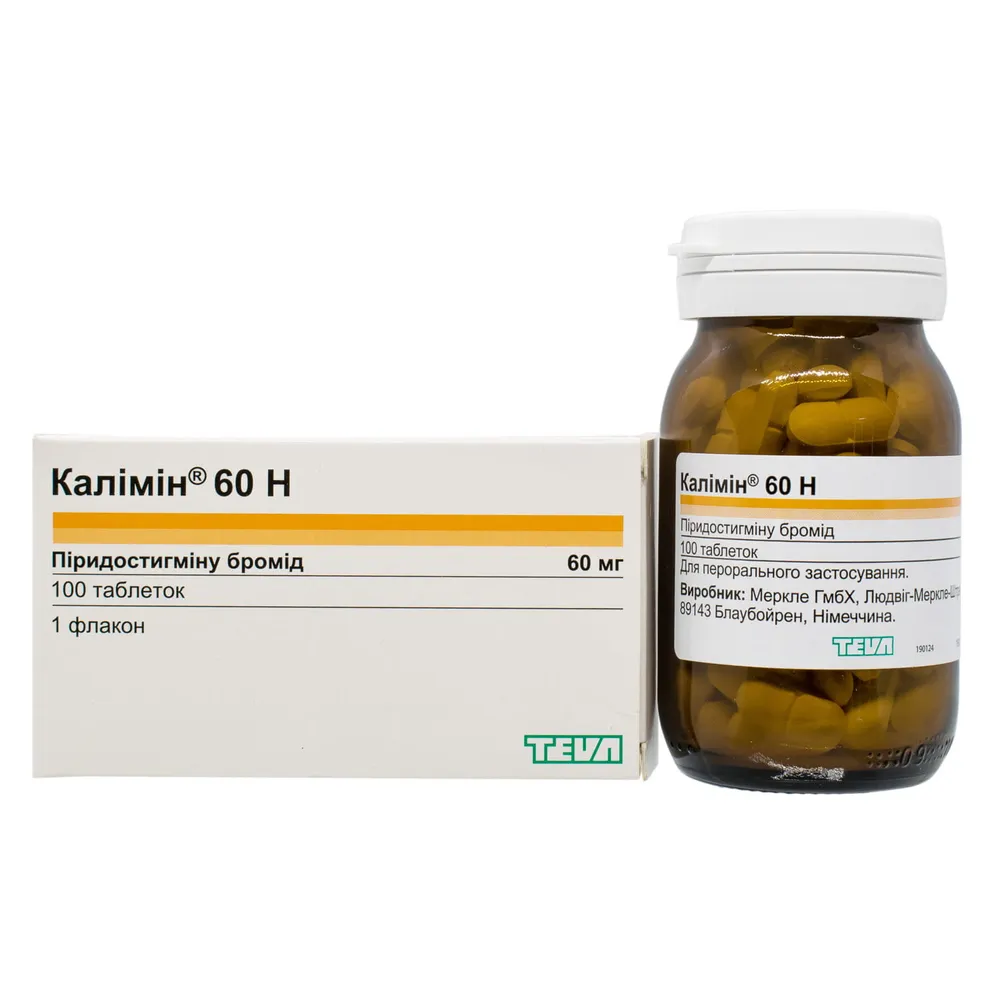
Table of Contents
INSTRUCTIONS FOR MEDICAL USE OF THE MEDICINAL PRODUCT Kalymin® 60 N (Kalymin 60 N)
Composition:
Active substance: pyridostigmine bromide;
One tablet contains pyridostigmine bromide 60 mg;
Excipients: microcrystalline cellulose, glutamic acid hydrochloride, magnesium stearate, corn starch, povidone, colloidal anhydrous silicon dioxide, precipitated silicon dioxide.
Pharmaceutical form. Tablets.
Main physicochemical properties: white, elongated, biconvex tablets with a score line on one side.
Pharmacotherapeutic group. Other agents affecting the nervous system. Parasympathomimetics. Anticholinesterase agents. Pyridostigmine. ATC code N07AA02.
Pharmacological properties.
Pharmacodynamics.
Pyridostigmine bromide inhibits cholinesterase. It belongs to indirectly acting parasympathomimetic agents. Inhibition of the enzyme promotes accumulation of acetylcholine at receptors in cholinergic synapses, resulting in a more pronounced and prolonged effect of acetylcholine. The drug primarily acts on the peripheral nervous system. It does not affect the functions of the central nervous system, as it does not cross the blood-brain barrier due to its low lipid solubility.
Pharmacokinetics.
Maximum plasma concentration of pyridostigmine bromide is reached within 1.7–3.2 hours after administration. After a 60 mg dose, plasma levels of pyridostigmine bromide range between 40–60 ng/mL. Individual variations in Cmax may occur by 4–7 times. In studies conducted in patients with myasthenia gravis, peak blood levels were achieved after 3 hours, while clinical and neurophysiological effects were observed within 30 minutes and reached maximum intensity within 120–150 minutes. Rapid distribution of pyridostigmine bromide at the neuromuscular junction and complete cholinesterase blockade likely occur by the time peak plasma levels are attained. There is no clear correlation between dose and plasma concentrations/blood levels or changes in myasthenia symptoms. However, efficacy does not increase at plasma levels above 100 ng/mL.
The volume of distribution of pyridostigmine bromide is approximately 0.5–1.7 L/kg body weight.
Pyridostigmine bromide is primarily metabolized in the liver. The main metabolite is 3-hydroxy-N-methylpyridine. Elimination occurs mainly via the kidneys; after intravenous administration, the plasma half-life is approximately 1.5 hours. Following oral administration, the half-life increases to 3–3.5 hours. Bioavailability of pyridostigmine bromide after oral administration ranges from 8 to 20%. In patients with myasthenia gravis, bioavailability may be reduced to less than 4%. The rate and extent of absorption may vary considerably among different patients.
Preclinical safety data
Subcutaneous injection of pyridostigmine bromide at toxic doses in rats resulted in hypersalivation, convulsions, tremor, and respiratory distress. Following oral administration of toxic doses, rats died from acute respiratory failure. Histological examination confirmed damage to neuromuscular synapses of the diaphragm. Prolonged oral administration in rats led to inhibition of plasma cholinesterase and erythrocyte acetylcholinesterase.
Standard in vitro and in vivo studies on genetic toxicity did not reveal any clinically significant genotoxic potential of pyridostigmine bromide.
Carcinogenicity studies of pyridostigmine bromide have not been conducted.
Reproductive toxicity studies were performed in rats following oral administration of pyridostigmine bromide. No effects on fertility in males or females were observed. In embryotoxicity studies, administration of toxic doses to pregnant females resulted in increased resorption rates and delayed ossification in fetuses. Peri- and postnatal studies showed reduced weight gain in offspring of treated females.
Clinical characteristics.
Indications.
Myasthenia gravis;
myasthenic syndrome (Lambert–Eaton syndrome) as part of combination therapy with guanidine.
Contraindications.
Kalymin® 60 H is contraindicated in patients with known hypersensitivity to any component of the drug, mechanical obstruction of the gastrointestinal or urinary tract; conditions associated with increased bronchial muscle tone (e.g., bronchial asthma and spasmodic bronchitis), eye inflammation (iritis), and during breastfeeding.
Interaction with other medicinal products and other forms of interaction.
Concomitant use with other cholinesterase inhibitors or parasympathomimetics may enhance the effect of pyridostigmine bromide. The drug may potentiate the parasympathomimetic effects of morphine and its derivatives. The action of depolarizing muscle relaxants (e.g., succinylcholine) is prolonged. Antimuscarinic agents (e.g., atropine) inhibit the muscarinic effects of pyridostigmine bromide on salivary glands, eyes, heart, bronchial muscles, and intestines. Nicotinic effects on skeletal muscles remain unchanged. Methylcellulose completely inhibits the absorption of pyridostigmine bromide, while activated charcoal almost completely adsorbs it. Aminoglycoside antibiotics (e.g., streptomycin, neomycin, kanamycin, gentamicin), polypeptide antibiotics (polymyxin, colistin), and certain other antibiotics such as oxytetracycline, clindamycin, and lincomycin, as well as numerous antiarrhythmic agents (quinidine, procainamide, propranolol), penicillamine, lithium, benzodiazepine-type tranquilizers, and phenothiazines (e.g., chlorpromazine) interfere with neuromuscular transmission and may reduce the effect of pyridostigmine, thereby provoking myasthenic symptoms. High doses of corticosteroids may also reduce the effect of pyridostigmine bromide.
Special precautions for use
Kalimin® 60 H should be prescribed to patients with gastric ulcer, thyrotoxicosis, decompensated heart failure, or myocardial infarction only after careful assessment of risks and expected beneficial effect. Kalimin® 60 H should be administered with particular caution to patients with bradycardia (low heart rate), diabetes mellitus, renal impairment (dose adjustment may be required), Parkinson's disease, history of liver disease, as well as after surgery on gastrointestinal organs.
If a dose of Kalimin® 60 H has been missed, the dose should not be doubled; treatment should continue according to the prescribed dosing regimen. Discontinuation of Kalimin® 60 H should not be performed without prior consultation with a physician, as symptoms of the disease may recur or worsen.
In patients with a history of liver disease, liver function should be monitored regularly.
Use during pregnancy or breastfeeding.
Pregnancy. There are insufficient data on the use of Kalimin® 60 H during pregnancy. Animal studies with pyridostigmine bromide have not shown teratogenic effects following oral administration; however, fetotoxicity and effects on offspring have been observed. It is known that intravenous administration of anticholinesterase agents during pregnancy may induce premature labor. The risk of premature delivery is higher when Kalimin® 60 H is administered late in pregnancy. Therefore, Kalimin® 60 H should be used during pregnancy only if clearly indicated and under strict medical supervision.
Breastfeeding. Pyridostigmine bromide passes into breast milk; therefore, Kalimin® 60 H should not be used during breastfeeding. If treatment with Kalimin® 60 H is considered absolutely necessary, breastfeeding must be discontinued.
Ability to affect reaction speed when driving or operating machinery.
Patients should avoid driving or operating machinery during treatment with this medicinal product. In cases of inadequate control of the underlying disease or development of cholinergic effects following relative overdose, the ability to drive or operate machinery may be impaired.
Dosage and Administration
For oral use. The dose and duration of treatment are determined by the physician depending on the course of the disease and the patient's response to therapy.
Myasthenia gravis
For symptomatic treatment of myasthenia gravis in adults, it is recommended to take 1–3 tablets of Kalymin® 60 H 3–4 times daily (180–720 mg per day).
Lambert-Eaton (myasthenic) syndrome
Treatment should be initiated with Kalymin® 60 H at a daily dose of 180–720 mg, divided into 3 or 4 doses. If this dose is not sufficiently effective, therapy may be supplemented with guanidine at a dose of 375–1000 mg, which should be administered between doses of Kalymin® 60 H. The dose must be individually adjusted depending on the patient's response to treatment.
Note. The dose of pyridostigmine bromide in myasthenia gravis must be individually adjusted depending on the severity of the disease and the patient's response to treatment. Therefore, dosage recommendations are purely indicative. In general, the maximum daily dose of pyridostigmine bromide should not be exceeded.
For administration of low doses, tablets containing 10 mg of pyridostigmine bromide are available.
The tablets should be taken with a small amount of liquid (approximately ½ glass of water). The tablets have a dividing mark on one side, allowing them to be split into two equal parts, thus enabling administration of half a tablet.
Treatment of patients with renal disease
In patients with significant impairment of renal function or renal insufficiency, the duration of action of pyridostigmine bromide may be prolonged, since pyridostigmine bromide is primarily excreted unchanged by the kidneys (75%). When plasma creatinine levels reach 2 mg/dL, half the maintenance dose should be administered or the dosing interval should be doubled. Therefore, the required dose should be individually adjusted for each patient depending on the response to therapy. Close medical supervision of such patients is recommended.
Children. Kalymin® 60 H should not be used in children.
Overdose
In case of accidental overdose of Kalymin® 60 H, seek immediate medical help.
Symptoms of intoxication: Salivation, lacrimation, skin flushing, increased sweating, fatigue, weakness, miosis (pupil constriction), visual disturbances, dizziness, nausea, vomiting, involuntary urination and fecal incontinence, abdominal cramps, and muscle paralysis (as a result of neuromuscular blockade), bronchospasm, pulmonary edema, decreased arterial pressure progressing to vascular collapse, bradycardia, and possible reflex tachycardia.
Treatment of overdose: The drug should be immediately discontinued. As a specific antidote, 1–2 mg of atropine sulfate should be slowly administered intravenously. The dosage depends on the effect of atropine sulfate; if necessary, the initial dose may be repeated depending on pulse rate after 2–4 hours. Maintain airway patency and provide artificial ventilation if needed.
In case of cardiac arrest, perform cardiac massage.
Restore fluid and electrolyte balance. In cases of overdose following oral administration of pyridostigmine bromide, gastric lavage and administration of activated charcoal are required.
Adverse reactions.
The following classification was used to determine the frequency of adverse reactions: very common (≥ 10%); common (≥ 1% to < 10%); uncommon (≥ 0.1% to < 1%); rare (≥ 0.01% to < 0.1%); very rare (< 0.01%, including isolated cases).
Gastrointestinal system disorders: nausea, vomiting, diarrhea, abdominal pain attacks due to increased intestinal peristalsis, hypersalivation.
Cardiovascular system disorders: following administration in high doses, a sharp drop in arterial pressure (arterial hypotension) and bradycardic cardiac rhythm disturbances are possible.
Respiratory system disorders: increased secretion of bronchial glands.
Skin disorders: in isolated cases – skin rashes.
Eye disorders: accommodation disorders, increased lacrimation.
Musculoskeletal system disorders: muscle spasms and muscle weakness, muscle tremor.
Other: increased sweating, frequent urination.
The above-mentioned adverse effects may be signs of overdose or cholinergic crisis. Therefore, the cause of symptoms must be determined, and if necessary, atropine sulfate should be administered subcutaneously, intramuscularly, or by slow intravenous injection to counteract parasympathomimetic effects.
Overdose of pyridostigmine bromide may lead to a cholinergic crisis characterized by pronounced or increasing muscle weakness up to respiratory paralysis, which is life-threatening. Other associated effects may include a sharp drop in arterial pressure leading to vascular collapse, as well as bradycardia progressing to complete cardiac arrest or paradoxical reflex tachycardia. In such cases, after immediate discontinuation of the drug, 1–2 mg of atropine sulfate should be administered by slow intravenous injection.
Shelf life. 3 years. After first opening – 6 months.
Storage conditions. The medicinal product does not require special storage conditions. Keep out of reach of children.
Packaging. 50 or 100 tablets in a bottle, 1 bottle in a box.
Prescription status. Prescription only.
Manufacturer. Merckle GmbH.
Manufacturer's address and location of its business operations.
Ludwig-Merckle-Strasse 3, 89143 Blaubeuren, Germany.