Cubiven peripheral
Ukraine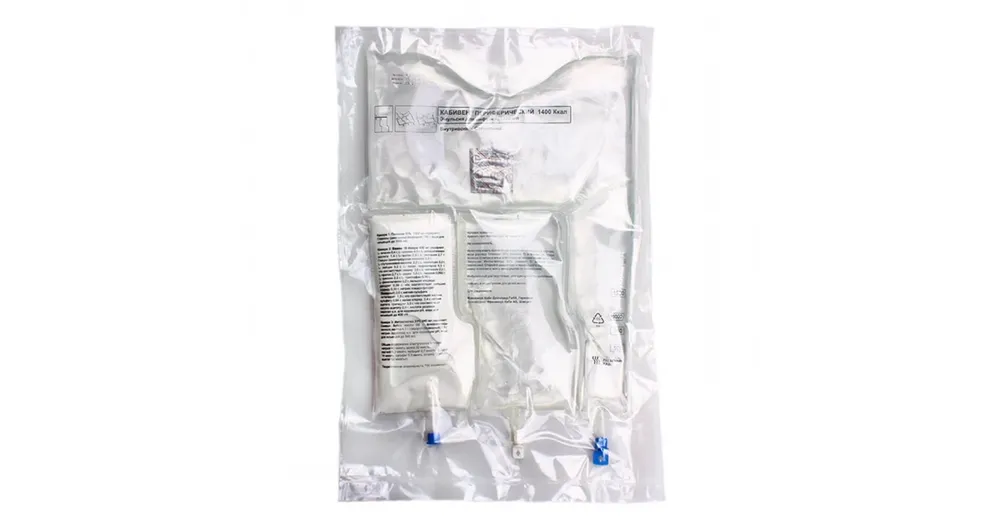
Table of Contents
INSTRUCTIONS FOR MEDICAL USE OF THE MEDICINAL PRODUCT KABIVEN PERIPHERAL (KABIVEN PERIPHERAL)
Composition:
Three-chamber container in 3 volumes. Each container contains the following solution volumes depending on its size:
| Container volume |
2400 ml |
1920 ml |
1440 ml |
| Chamber No. 1 |
|||
| Glucose (Glucose 11%) Chamber No. 2 |
1475 ml |
1180 ml |
885 ml |
| Amino acids and electrolytes (Vamin 18 Neofusin) Chamber No. 3 |
500 ml |
400 ml |
300 ml |
| Lipid emulsion (Intralipid 20%) |
425 ml |
340 ml |
255 ml |
Composition of the drug after mixing 3 chambers
| Active substances |
2400 ml |
1920 ml |
1440 ml |
| Purified soybean oil |
85 g |
68 g |
51 g |
| Monohydrate glucose corresponding to anhydrous glucose |
178 g 162 g |
143 g 130 g |
107 g 97 g |
| Alanine |
8.0 g |
6.4 g |
4.8 g |
| Arginine |
5.6 g |
4.5 g |
3.4 g |
| Aspartic acid |
1.7 g |
1.4 g |
1.0 g |
| Valine |
3.6 g |
2.9 g |
2.2 g |
| Histidine |
3.4 g |
2.7 g |
2.0 g |
| Glycine |
4.0 g |
3.2 g |
2.4 g |
| Glutamic acid |
2.8 g |
2.2 g |
1.7 g |
| Isoleucine |
2.8 g |
2.2 g |
1.7 g |
| Leucine |
4.0 g |
3.2 g |
2.4 g |
| Lysine hydrochloride corresponding to lysine |
5.6 g 4.5 g |
4.5 g 3.6 g |
3.4 g 2.7 g |
| Methionine |
2.8 g |
2.2 g |
1.7 g |
| Proline |
3.4 g |
2.7 g |
2.0 g |
| Serine |
2.2 g |
1.8 g |
1.4 g |
| Tyrosine |
0.12 g |
0.092 g |
0.069 g |
| Threonine |
2.8 g |
2.2 g |
1.7 g |
| Tryptophan |
0.95 g |
0.76 g |
0.57 g |
| Phenylalanine |
4.0 g |
3.2 g |
2.4 g |
| Calcium chloride dihydrate corresponding to calcium chloride |
0.49 g 0.37 g |
0.39 g 0.30 g |
0.29 g 0.22 g |
| Anhydrous sodium glycerophosphate |
2.5 g |
2.0 g |
1.5 g |
| Magnesium sulfate heptahydrate corresponding to magnesium sulfate |
1.6 g 0.80 g |
1.3 g 0.64 g |
0.99 g 0.48 g |
| Potassium chloride |
3.0 g |
2.4 g |
1.8 g |
| Sodium acetate trihydrate corresponding to sodium acetate |
4.1 g 2.4 g |
3.3 g 2.0 g |
2.5 g 1.5 g |
What corresponds to: 2400 ml, 1920 ml, 1440 ml
| Amino acids |
57 g |
45 g |
34 g |
| Nitrogen |
9.0 g |
7.2 g |
5.4 g |
| Fats |
85 g |
68 g |
51 g |
| Carbohydrates Anhydrous glucose |
162 g |
130 g |
97 g |
Nutritional value:
| Total |
1700 kcal |
1400 kcal |
1000 kcal |
| Non-protein |
1500 kcal |
1200 kcal |
900 kcal |
Electrolytes:
| Sodium |
53 mmol |
43 mmol |
32 mmol |
| Potassium |
40 mmol |
32 mmol |
24 mmol |
| Magnesium |
6.7 mmol |
5.3 mmol |
4.0 mmol |
| Calcium |
3.3 mmol |
2.7 mmol |
2.0 mmol |
| Phosphate |
18 mmol |
14 mmol |
11 mmol |
| Sulfate |
6.7 mmol |
5.3 mmol |
4.0 mmol |
| Chloride |
78 mmol |
62 mmol |
47 mmol |
| Acetate |
65 mmol |
52 mmol |
39 mmol |
Theoretical Osmolarity 750 mOsmol/L
Osmolality 830 mOsmol/kg water
pH 5.6;
Excipients: purified egg phospholipids, glycerol, sodium hydroxide, glacial acetic acid, water for injections.
Pharmaceutical form. Emulsion for infusion.
Main physicochemical properties: mixture of the contents of three chambers – a homogeneous white emulsion.
Pharmacotherapeutic group. Solutions for parenteral nutrition. Combinations.
ATC code B05BA10.
Pharmacological properties.
Pharmacodynamics.
The pharmacological properties of the medicinal product are determined by its composition.
Lipid emulsion (Intralipid 20%)
The lipid emulsion contained in Kabiven Peripheral is a source of long-chain fatty acids (including essential fatty acids), which are used in the body as an energy source and for building cell membranes.
Intralipid at recommended doses does not affect hemodynamics. No clinically significant cases of impaired lung function have been observed when the recommended infusion rates are followed. Elevated liver enzyme levels have been reported in a few patients. After discontinuation of parenteral nutrition, enzyme levels returned to baseline values. Similar changes are also observed during parenteral nutrition without lipid emulsion.
Amino acids and electrolytes (Vamin 18 Neofusin)
Amino acids are components of proteins in normal diet. They are used in the body for protein synthesis and partially in gluconeogenesis. Infusion of amino acids leads to increased metabolic rate and, consequently, increased heat production in the body.
Glucose (Glucose 11%)
Glucose has the same pharmacodynamic properties as glucose involved in normal metabolism.
Pharmacokinetics.
Lipid emulsion (Intralipid 20%)
Intralipid is biologically similar to endogenous chylomicrons. Unlike chylomicrons, Intralipid does not contain cholesterol esters or apolipoproteins. The phospholipid content in Intralipid is significantly higher than in chylomicrons.
Intralipid is cleared from the bloodstream via the same pathway as chylomicrons. Exogenous fat particles are mainly hydrolyzed in the blood and taken up by low-density lipoprotein receptors in the liver and peripheral tissues. The clearance rate is determined by the composition of the fat particles, the patient's clinical and nutritional status, and the infusion rate. The maximum clearance of Intralipid during fasting is equivalent to 3.8±1.5 g of triglycerides/kg body weight per day. The elimination and oxidation rate of the lipid emulsion is accelerated in sepsis and after trauma, and conversely, slowed down in renal failure and hypertriglyceridemia.
Amino acids and electrolytes (Vamin 18 Neofusin)
The pharmacokinetic characteristics of amino acids and electrolytes administered intravenously are the same as when they are ingested with food. However, dietary protein amino acids first enter the portal vein of the liver and only then enter systemic circulation, whereas amino acids administered intravenously enter directly into systemic circulation.
Glucose (Glucose 11%)
The pharmacokinetic characteristics of glucose administered by infusion are the same as those when ingested with normal food.
Clinical characteristics.
Indications.
Parenteral nutrition in adults and children aged 2 years and older when oral or enteral nutrition is impossible, inadequate, or contraindicated.
Contraindications.
Known hypersensitivity to egg, peanut, or soy proteins or to any component of the medicinal product.
Severe hyperlipidemia.
Severe hepatic insufficiency.
Severe coagulation disorders.
Inherited disorders of amino acid metabolism.
Severe renal insufficiency in the absence of hemodialysis or hemofiltration.
Acute phase of shock.
Hyperglycemia requiring insulin administration at doses exceeding 6 units/hour.
Pathologically elevated plasma concentration of any of the electrolytes contained in the medicinal product.
General contraindications to infusion therapy (pulmonary edema, hyperhydration, cardiac insufficiency, hypotonic dehydration).
Hemophagocytic syndrome.
Unstable conditions (including post-traumatic state, uncompensated diabetes mellitus, acute stage of myocardial infarction, metabolic acidosis, severe sepsis, and hyperosmolar coma).
Children under 2 years of age.
Interaction with other medicinal products and other forms of interactions.
Heparin, at clinically used doses, induces the release of lipoprotein lipase into the bloodstream, which may initially enhance lipolysis in blood plasma and subsequently reduce triglyceride clearance.
Insulin may also affect lipase activity; however, data on adverse effects of this factor on the therapeutic value of the product are lacking.
Vitamin K1 present in soybean oil acts as an antagonist of coumarin derivatives; therefore, careful monitoring of blood coagulation is recommended in patients receiving these medicinal products.
There are no data on other types of interactions having clinical significance.
Special precautions for use.
When using the drug, lipid elimination should be monitored. This is recommended to be done by measuring plasma triglyceride levels 5–6 hours after the last fat intake. The drug contains soy proteins and egg phospholipids, which may cause allergic reactions. Cross-sensitivity reactions between soy proteins and peanuts are possible.
Plasma triglyceride concentration during infusion should not exceed 3 mmol/L.
The container volume must be carefully selected. Each container is intended for single use only.
The volume of administered drug must be accurately calculated and adjusted according to the patient's fluid balance and nutritional status.
Significant electrolyte and fluid imbalances (e.g., abnormally high or low serum electrolyte levels) should be corrected prior to starting infusion.
Special clinical monitoring of the patient is required at the beginning of the infusion. Infusion must be stopped immediately if the patient's condition worsens. Since any central venous infusion carries an increased risk of infection, strict aseptic techniques must be followed during catheter insertion and any handling procedures to prevent infection.
Cabiven Peripherique should be used with caution in patients with impaired lipid metabolism, as observed in renal insufficiency, uncompensated diabetes mellitus, pancreatitis, liver dysfunction, hypothyroidism (with hypertriglyceridemia), and sepsis. Administration of Cabiven Peripherique to such patients must be performed under mandatory continuous monitoring of serum triglyceride concentrations.
Plasma glucose and electrolyte concentrations, plasma osmolarity, fluid balance, acid-base status, and liver enzyme activity should be monitored regularly.
During prolonged lipid administration, blood cell counts and coagulation parameters should be monitored.
In patients with renal insufficiency, phosphate and potassium balance must be closely monitored to prevent hyperphosphatemia and hyperkalemia.
The amount of additional electrolytes should be determined by regular monitoring of their concentrations, taking into account the patient's clinical condition.
This preparation does not contain vitamins or trace elements. Addition of trace elements and vitamins is possible. When adding vitamins, the same dosage calculations as used in pediatrics should be applied.
Parenteral infusion should be administered with caution to patients with metabolic acidosis (e.g., lactic acidosis), as increased serum osmolarity may require rehydration. Cabiven Peripherique should be used cautiously in patients with a tendency toward electrolyte retention.
Infusion must be stopped immediately if any signs of allergic reactions occur.
The presence of lipids in the preparation may alter the results of certain laboratory tests (e.g., bilirubin concentration, lactate dehydrogenase activity, blood oxygen saturation, hemoglobin level) if blood samples are taken before adequate clearance of lipids from the bloodstream. In most patients, infused lipids are cleared within 5–6 hours.
Intravenous administration of amino acids may be associated with increased renal excretion of trace elements, especially zinc. Patients requiring long-term parenteral nutrition may need additional supplementation of trace elements.
In severely malnourished patients, initiation of parenteral nutrition may lead to fluid imbalance, potentially resulting in pulmonary edema and congestive heart failure. Additionally, within 24–48 hours, plasma concentrations of potassium, phosphate, magnesium, and water-soluble vitamins may decrease. Parenteral nutrition should be initiated slowly, with careful monitoring and appropriate correction of fluid, electrolyte, vitamin, and trace element levels.
Cabiven Peripherique should not be administered through the same catheter simultaneously with blood or blood products.
Patients with hyperglycemia may require insulin administration.
Special considerations for infusion into peripheral veins.
Thrombophlebitis of peripheral veins may occur during administration of any hypertonic infusion solution. The risk of thrombophlebitis depends on multiple factors: catheter type, diameter and length, duration of infusion, pH and osmolarity of the solution, presence of infection, and frequency of venous manipulations. It is not recommended to use the vein designated for parenteral nutrition for administration of other solutions.
Use during pregnancy or breastfeeding.
Specific studies on the safety of the drug during pregnancy or breastfeeding have not been conducted. Before prescribing Cabiven Peripherique to pregnant women or women who are breastfeeding, the physician must assess the risk-benefit ratio.
Ability to affect reaction speed when driving or operating machinery.
No data available. The drug is intended for use only in a hospital setting.
Administration and Dosage.
For intravenous infusion into central or peripheral veins. To reduce the risk of thrombophlebitis when administered into peripheral veins, it is recommended to change the catheter insertion site once daily.
Fat clearance capacity and glucose metabolism should be taken into account when determining dosage and infusion rate.
The dose must be individually adjusted, as should the container volume, depending on the patient's condition, body weight, and nutritional requirements.
Nitrogen requirement for protein synthesis depends on the patient's condition (nutritional status, level of catabolic stress). In patients with normal nutritional status, the daily nitrogen requirement is 0.10–0.15 g nitrogen/kg body weight/day. For patients with moderate or severe catabolic stress, with or without malnutrition, the nitrogen requirement is 0.15–0.30 g nitrogen/kg body weight/day (1–2 g amino acids/kg body weight/day). Administration of such amounts of amino acids also requires concomitant administration of 2–6 g glucose and 1–2 g fat per kg body weight per day.
Total energy requirements depend on the patient's condition and are approximately 20–30 kcal/kg body weight/day. For patients with excess body weight, dosing should be based on ideal body weight.
CubiVene Peripheral is available in containers of three different volumes, allowing administration to patients with high, medium, or low requirements for parenteral nutrition. When administering parenteral nutrition, it may be necessary to add vitamins, essential electrolytes, or trace elements.
Adults
27–40 mL CubiVene Peripheral/kg body weight/day
(corresponding to 0.1–0.15 g nitrogen/kg body weight/day, or 0.7–1 g amino acids/kg body weight/day; energetically equivalent to 20–30 kcal/kg body weight/day).
Children aged 2 to 10 years
Infusion should be initiated at low doses for children aged 2 to 10 years:
14–28 mL CubiVene Peripheral/kg body weight/day (corresponding to 0.49–0.98 g fat/kg body weight/day, 0.34–0.67 g amino acids/kg body weight/day, and 0.95–1.9 g glucose/kg body weight/day), with dose escalation by 10–15 mL/kg/day until the maximum dose of 40 mL/kg body weight/day is reached.
Children aged 10 years and older
Dosage of CubiVene Peripheral is the same as for adults.
Infusion rate
Maximum glucose infusion rate: 0.25 g/kg body weight/hour.
Maximum amino acid infusion rate should not exceed 0.1 g/kg body weight/hour.
Maximum lipid infusion rate: 0.15 g/kg body weight/hour.
The infusion rate should not exceed 3.7 mL/kg body weight/hour, corresponding to glucose, amino acids, and lipids at doses of 0.25 g/kg body weight/hour, 0.09 g/kg body weight/hour, and 0.13 g/kg body weight/hour, respectively. The recommended duration of infusion is 12–24 hours.
Maximum daily dose
40 mL/kg body weight/day, equivalent to one container (largest volume) for patients weighing 64 kg, providing 0.96 g amino acids/kg body weight/day (0.16 g nitrogen/kg body weight/day), and 25 kcal/kg body weight/day of non-protein energy (2.7 g glucose/kg body weight/day and 1.4 g lipids/kg body weight/day).
Instructions for use of the three-chamber container
- Remove the outer pouch by tearing at the perforation and pulling along the container.
- Firmly grasp the side walls of the container above the middle of the clamp separating chambers 1 and 2 with the thumbs and index fingers of both hands. Pull the container walls apart and fully open the clamp.
- Similarly, open the clamp between chambers 2 and 3. Mix the contents by inverting the container several times.
- If additive administration is required (with known compatibility, e.g., vitamins, trace elements), disinfect the membrane of the entry port with an antiseptic.
- Place the container on a flat surface; while holding the base of the entry port, fully insert the needle through the center of the membrane and administer the additive (with known compatibility). Before administering a second additive, mix the contents thoroughly by inverting the container several times.
- Remove the cap from the infusion set needle by grasping the ring with the thumb and index finger and pulling the ring upward. Use an air-free infusion set if necessary to prevent air entry into the system.
- Place the container on a flat surface. Holding the container with the outlet port facing upward, fully insert the needle through the membrane, rotating and advancing it as needed. For secure fixation, the needle must be fully inserted.
- Hang the container on an IV pole and administer the infusion according to the instructions for the infusion set and infusion pump.
- Alternative method for opening clamps: Place the bag on a flat surface and roll it from the handle side until the clamps open. Mix the contents by inverting the bag several times.
Note: Separate administration of components from individual chambers of CubiVene Peripheral is technically not feasible (except for Intralipid). Administration of the components may be performed as separate medicinal products: glucose solution, Vamin, and Intralipid.
Children
May be used in children aged 2 years and older (see section "Administration and Dosage").
Overdose
Impaired fat clearance may lead to the development of fat overload syndrome (see section "Adverse Reactions").
Nausea, vomiting, and increased sweating may occur if the recommended amino acid infusion rate is exceeded.
In addition, overdose may result in disturbances of fluid and electrolyte balance, hyperglycemia, and hyperosmolarity.
If symptoms of overdose occur, the infusion rate should be reduced or administration stopped completely.
In severe cases of overdose, hemodialysis, hemofiltration, or hemodiafiltration should be initiated.
Adverse Reactions.
The following classification is used to assess the frequency of adverse effects: very common (≥ 1/10), common (≥ 1/100, < 1/10), uncommon (≥ 1/1000, < 1/100), rare (≥ 1/10000, < 1/1000), very rare (< 1/10000), frequency not known (cannot be estimated from available data).
Blood and lymphatic system disorders.
Very rare: haemolysis, reticulocytosis.
Immune system disorders.
Very rare: allergic reactions (e.g. anaphylactic reactions, skin rash, urticaria).
Nervous system disorders.
Uncommon: headache.
Vascular disorders.
Very rare: hypotension, hypertension.
Respiratory system disorders.
Very rare: tachypnoea.
Gastrointestinal disorders.
Uncommon: gastrointestinal disturbances (abdominal pain, vomiting, nausea).
Reproductive system disorders.
Very rare: priapism.
General disorders.
Common: increased body temperature.
Uncommon: chills, fatigue.
Investigations.
Uncommon: increased plasma levels of liver enzymes.
Thrombophlebitis of peripheral veins may occur during infusion, as with any other hypertonic infusion solution.
Fat overload syndrome.
Impaired ability to eliminate fats (Intralipid, fat emulsion contained in the preparation) may lead to the development of fat overload syndrome. This may result from overdose, but may also occur at the recommended infusion rate if the patient's clinical condition deteriorates rapidly and severe renal or hepatic failure develops.
Fat overload syndrome is characterized by hyperlipidaemia, fever, hepatomegaly, splenomegaly, anaemia, leucopenia, thrombocytopenia, coagulopathy and coma. If this syndrome occurs, infusion must be discontinued.
Reporting of suspected adverse reactions.
It is important to report suspected adverse reactions after administration of the medicinal product. This allows continuous monitoring of the benefit-risk balance of the medicinal product. Healthcare professionals are asked to report any suspected adverse reactions via the national reporting system.
Shelf life.
2 years in the original container.
Do not use after the expiry date stated on the packaging.
After opening the seals and mixing the three solutions, compatible additives may be added through the inlet port.
After opening the seals, the chemical and physical stability of the mixed contents of the three chambers is maintained for 24 hours at 25 °C.
To ensure microbiological safety, the mixture should be used immediately after preparation. If not used immediately, under conditions of aseptic addition of additives, the emulsion mixture may be stored for up to 6 days at 2–8 °C, after which the mixture must be used within 24 hours.
Storage conditions.
Store in the original packaging at a temperature not exceeding 25 °C.
Do not freeze.
Incompatibilities.
Addition of any medicinal products or other solutions to Kabiven Peripheral is possible only if their compatibility has been clinically confirmed and documented.
Packaging.
Three-chamber container "Biofine" with a volume of 1440 ml or 1920 ml, or 2400 ml (chamber No. 1 – 885 ml or 1180 ml, or 1475 ml of 11% glucose solution; chamber No. 2 – 300 ml or 400 ml, or 500 ml of Vamin 18 Neofusin; chamber No. 3 – 255 ml or 340 ml, or 425 ml of Intralipid 20%), together with an antioxidant, contained in an outer plastic bag.
Prescription status.
Prescription only.
Manufacturer.
Fresenius Kabi AB
Manufacturer's name and address.
Rapsvägen 7, Uppsala, 754 50, Sweden
Marketing Authorisation Holder.
Fresenius Kabi Deutschland GmbH.
Address of Marketing Authorisation Holder and/or its representative.
Else-Kröner-Strasse 1, 61352 Bad Homburg, Germany.