Intuban®
Ukraine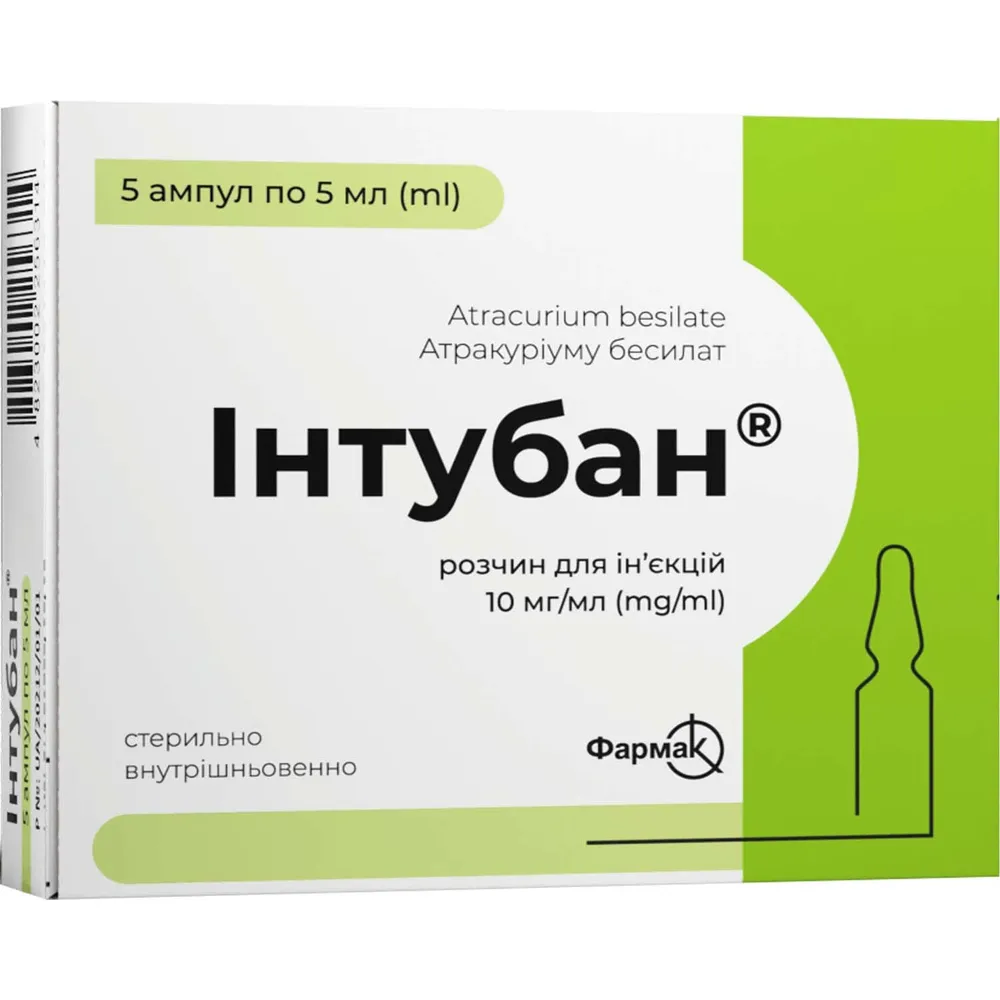
Table of Contents
INSTRUCTIONS FOR MEDICAL USE OF THE MEDICINAL PRODUCT INTUBAN® (INTUBAN)
Composition:
Active substance: atracurium besylate;
1 ml of solution contains 10 mg of atracurium besylate;
Excipients: benzenesulfonic acid, water for injections.
Pharmaceutical form. Solution for injection.
Main physicochemical properties: clear, colorless or light yellow liquid.
Pharmacotherapeutic group. Muscle relaxants with peripheral mechanism of action. Other quaternary ammonium compounds. ATC code M03A C04.
Pharmacological Properties.
Pharmacodynamics.
A highly selective nondepolarizing competitive peripheral-acting muscle relaxant with intermediate duration of action. Blocks nicotinic cholinoreceptors of the motor end plates of skeletal muscle fibers and prevents the depolarizing effect of acetylcholine, resulting in inhibition of neuromuscular transmission at the postsynaptic membrane level.
Children
Limited data are available on possible variability in onset and duration of action of atracurium in neonates (infants up to 1 month of age) compared to children of other ages (see section "Children").
Pharmacokinetics.
After intravenous administration, atracurium besylate is spontaneously metabolized via Hofmann elimination (a non-enzymatic process occurring at physiological pH and body temperature) and by ester hydrolysis mediated by nonspecific plasma esterases. Elimination of atracurium is independent of renal or hepatic function. The breakdown products of atracurium are laudanosine and other metabolites. The metabolites lack muscle relaxant activity. Plasma protein binding of atracurium besylate is approximately 82%, and elimination half-life is 20 minutes. Metabolites are excreted in urine and bile.
Metabolite concentrations are higher in blood in intensive care unit patients with impaired renal and/or hepatic function (see section "Special Warnings and Precautions for Use"). These metabolites do not contribute to neuromuscular blockade.
Clinical characteristics.
Indications.
For muscle relaxation during surgical interventions and diagnostic procedures (provided that equipment for endotracheal intubation and artificial ventilation of the lungs is available).
Contraindications.
Hypersensitivity to atracurium, cisatracurium, or benzenesulfonic acid.
Interaction with other medicinal products and other forms of interactions.
Neuromuscular blockade caused by atracurium besilate may be enhanced when used concomitantly with inhalational anesthetics such as halothane, isoflurane, and enflurane.
The intensity and duration of neuromuscular blockade induced by non-depolarizing muscle relaxants, including the medicinal product Intuban®, may be potentiated when administered simultaneously with:
- antibiotics, including aminoglycosides, polymyxins, spectinomycin, tetracyclines, lincomycin, clindamycin, and vancomycin;
- beta-blockers: propranolol, oxprenolol;
- antiarrhythmic agents: calcium antagonists, lidocaine, procainamide, quinidine;
- diuretics: furosemide and possibly mannitol, thiazide diuretics, acetazolamide;
- magnesium sulfate;
- ketamine;
- lithium salts;
- ganglion blockers (trimethaphan, hexamethonium).
Rarely – when co-administered with certain drugs that may enhance symptoms of myasthenia (including latent forms) and provoke the development of a myasthenic syndrome; as a result, increased sensitivity to atracurium besilate may occur. Such drugs include various antibiotics, beta-blockers (propranolol, oxprenolol), antiarrhythmic agents (procainamide, quinidine), antirheumatic agents (chloroquine, D-penicillamine), trimethaphan, chlorpromazine, steroids, phenytoin, and lithium.
During prolonged treatment with anticonvulsant drugs, the onset of neuromuscular blockade caused by atracurium besilate may be delayed and its duration reduced.
Concomitant use of non-depolarizing muscle relaxants with atracurium besilate may result in more intense neuromuscular blockade than that which might occur with an equivalent total dose of atracurium besilate alone. The synergistic effect may vary depending on the combination of these agents.
Depolarizing muscle relaxants (e.g., succinylcholine chloride) should not be used to prolong neuromuscular blockade induced by non-depolarizing muscle relaxants, including atracurium besilate, because prolonged and complex deep blockade may develop, which is difficult to reverse with anticholinesterase agents.
Administration of anticholinesterase drugs, widely used in the treatment of Alzheimer's disease, such as donepezil, may reduce the duration and intensity of neuromuscular blockade induced by atracurium.
Special precautions for use.
Like all other neuromuscular blocking agents, atracurium causes paralysis of respiratory muscles as well as other skeletal muscles, but does not affect consciousness. Therefore, the drug should be administered only under adequate general anesthesia, under close supervision of an experienced anesthesiologist, and only when appropriate equipment for endotracheal intubation and artificial ventilation of the lungs is available.
Atracurium may cause histamine release. Particular caution is required when treating patients with severe cardiovascular diseases who may be more susceptible to transient hypotension, as well as patients with a history of histamine hypersensitivity (e.g., severe hypersensitivity reactions to multiple antigens or asthma). In such patients, slow intravenous administration of divided doses is recommended.
Atracurium should be used with caution in patients with known hypersensitivity to other neuromuscular blocking agents, since reports indicate a high rate (over 50%) of cross-sensitivity between neuromuscular blocking agents (see section "Contraindications"). Therefore, whenever possible, hypersensitivity to other neuromuscular blocking agents should be ruled out before prescribing atracurium. Atracurium should be administered to patients suspected of hypersensitivity only under absolute indications. Patients with a history of hypersensitivity reactions during general anesthesia should undergo testing for hypersensitivity to other neuromuscular blocking agents.
In asthmatic patients receiving high doses of corticosteroids and neuromuscular blocking agents in the intensive care unit, monitoring of serial creatine phosphokinase levels is advisable.
When used at recommended doses, atracurium does not exhibit significant vagolytic or ganglion-blocking properties. Therefore, at recommended doses, atracurium does not significantly affect heart rate and does not prevent bradycardia that may be caused by anesthetic agents or vagus nerve stimulation during surgery. Thus, bradycardia may occur more frequently during anesthesia with atracurium than with other muscle relaxants.
As with other non-depolarizing muscle relaxants, increased sensitivity to atracurium may occur in patients with myasthenia gravis, other neuromuscular disorders, carcinomatosis, or with severe acid-base and/or electrolyte disturbances.
As with other non-depolarizing muscle relaxants, hypophosphatemia may prolong recovery time. Recovery time may be shortened. Atracurium should be administered over at least 60 seconds in patients who may be unusually sensitive to a drop in arterial pressure, for example, those with hypovolemia.
Atracurium is inactivated at high pH of the solution; therefore, it must not be mixed in the same syringe with thiopental or any other alkaline solution.
If the drug is administered by puncture of a small vein, a sufficient amount of 0.9% sodium chloride solution should be administered after injection. When co-administered with other drugs, the needle or cannula should be flushed each time with 0.9% sodium chloride solution.
The medicinal product Intuban® is a hypotonic solution and therefore must not be used in the same infusion system with blood products or during blood transfusion. It has been established that atracurium does not trigger the development of malignant hyperthermia in susceptible patients.
When other anesthetic agents are administered through the same needle or cannula as atracurium, it is essential to flush the needle or cannula with a sufficient volume of sterile, pyrogen-free water or 0.9% sodium chloride solution after each drug administration.
As with other non-depolarizing muscle relaxants, resistance to atracurium may develop in burn patients. Higher doses of the drug may be required depending on the time elapsed since the injury and the extent of the burns.
Intensive care unit patients
Clinical animal studies have shown that laudanosine, a metabolite of atracurium, may cause reversible hypotension and, in some individuals, cerebral excitatory effects when high doses of the drug are administered. Although seizures have been observed in intensive care unit patients treated with atracurium besylate, these cases have not been definitively attributed to laudanosine or atracurium, even when atracurium was administered by continuous infusion over a prolonged period (see section "Adverse reactions").
Use during pregnancy or breastfeeding.
Fertility
Studies on the effect on fertility have not yet been conducted.
Pregnancy
Animal studies have shown that atracurium besylate has no significant effect on fetal development. Like all neuromuscular blocking agents, atracurium besylate should be used during pregnancy only if the expected benefit to the pregnant woman outweighs the potential risk to the fetus.
The product Intuban® may be used during surgical procedures (e.g., cesarean section), as the drug does not cross the placental barrier in clinically significant amounts. However, the possibility of respiratory depression in the newborn should always be considered.
Lactation period
It is unknown whether atracurium besylate and its metabolites are excreted in breast milk.
Ability to affect reaction speed when driving or operating machinery.
Warnings regarding the effect on reaction speed when driving or operating machinery are not applicable to the indications for use of atracurium. Since atracurium is always administered in combination with general anesthetic agents, the effects of general anesthetics on attention and reaction speed should be taken into account.
Administration and Dosage
Route of Administration
Intravenous injection or continuous infusion.
The medicinal product Intuban® should be administered slowly to avoid transient hypotension, which may occasionally occur after rapid injection.
Adults
Administration by Injection
Intuban® is administered by intravenous injection. The dosage for adults ranges from 0.3 to 0.6 mg/kg body weight, depending on the required duration of complete neuromuscular blockade, providing adequate muscle relaxation for 15–35 minutes.
Endotracheal intubation can be performed within the first 90 seconds after intravenous administration of the drug at doses of 0.5–0.6 mg/kg body weight.
If prolonged blockade is required, additional doses of 0.1–0.2 mg/kg body weight may be administered. Proper supplemental dosing does not increase the cumulative effect of neuromuscular blockade.
Recovery of normal neuromuscular transmission occurs within 35 minutes, with recovery of tetanic response to 95% of normal neuromuscular function.
Neuromuscular blockade induced by Intuban® can be rapidly reversed by administration of standard doses of anticholinesterase agents (e.g., neostigmine) in combination with an anticholinergic agent (e.g., atropine).
Administration by Infusion
Following initial administration of an initial dose of 0.3–0.6 mg/kg body weight by intravenous injection, maintenance of neuromuscular blockade during prolonged surgical procedures is achieved by continuous intravenous infusion of the drug at a rate of 0.005–0.01 mg/kg/min.
The drug may be used by intravenous infusion during coronary artery bypass grafting at the infusion rate indicated above. If hypothermia to a body temperature of 25–26 °C is required, the rate of atracurium inactivation is reduced; therefore, in such cases, the infusion rate may be halved to maintain complete neuromuscular blockade.
Compatibility with other infusion/injection solutions and the drug's stability period are provided below:
| Solution for intravenous infusion |
Period of stability |
| Sodium chloride solution (0.9%) |
24 hours |
| Glucose solution (5%) |
8 hours |
| Ringer's solution |
8 hours |
| Sodium chloride solution (0.18%) and glucose solution (4%) |
8 hours |
| Lactated Ringer's solution |
4 hours |
When diluted in the solvents specified above and achieving an atracurium besylate concentration of 0.5–0.9 mg/mL or higher, the resulting solution remains stable under daylight conditions for the specified period of time at temperatures not exceeding 30°C.
The medicinal product Intuban® can also be diluted with water for injections to a concentration of 0.5–0.9 g/mL; however, this is not recommended for infusion administration. When diluted in this way, the solution remains stable for 8 hours at temperatures not exceeding 30°C.
Elderly patients
Use the standard dosage; however, it is recommended to administer the lowest initial dose and infuse the drug more slowly.
Patients with renal or hepatic impairment
The drug should be administered in standard doses regardless of the degree of renal or hepatic impairment, including end-stage disease.
Patients with cardiovascular disorders
In patients with clinically significant cardiovascular disorders, the initial dose should be administered slowly over a period of at least 60 seconds.
Patients in intensive care units
After administration of the required initial dose of 0.3 to 0.6 mg/kg body weight, maintenance of neuromuscular blockade is achieved by continuous intravenous infusion at a rate of 11 to 13 mcg/kg/min (0.65–0.78 mg/kg/hour). However, there is wide individual variability in dosage requirements, which may also change over time. Some patients may require a lower infusion rate, e.g., 4.5 mcg/kg/min (0.27 mg/kg/hour), while others may require a higher rate, e.g., 29.5 mc游戏副本/kg/min (1.77 mg/kg/hour). Available data indicate that dosage requirements for atracurium besylate may increase during prolonged administration in intensive care patients, particularly in those with peripheral edema.
The rate of recovery of neuromuscular transmission in patients is independent of the duration of drug administration. Clinical studies show that spontaneous recovery occurs approximately after 60 minutes, with a range of 32 to 108 minutes.
Monitoring
To individualize dosing, monitoring of neuromuscular transmission function is recommended, as with other neuromuscular blocking agents.
Children
The medicinal product Intuban® may be used in children aged 1 month and older at the same dosage regimens as in adults, with the dose calculated according to the child's body weight. Use in children under 1 month of age is not recommended due to limited data (see section "Pharmacokinetics").
Overdose
Symptoms
Prolonged skeletal muscle paralysis and its consequences are the main signs of overdose.
Treatment
Ensure unobstructed airway and provide artificial ventilation of the lungs until adequate spontaneous respiration returns.
Since patient consciousness is unaffected, full sedation may be necessary.
Anticholinesterase agents should be used together with atropine or glycopyrrolate as soon as signs of spontaneous recovery appear.
Adverse Reactions
The most commonly reported adverse reactions were arterial hypotension (mild, transient) and skin hyperemia. These reactions are associated with histamine release. Very rarely, severe anaphylactoid or anaphylactic reactions have been reported in patients receiving atracurium in combination with one or more anesthetic agents.
The adverse reactions listed below are classified by system organ class and frequency of occurrence. Frequency categories are defined as follows: very common (≥ 1/10); common (≥ 1/100 to < 1/10); uncommon (≥ 1/1000 to < 1/100); rare (≥ 1/10,000 to < 1/1000); very rare (< 1/10,000). The data for "very common", "common", and "uncommon" were obtained from clinical trials. The data for "rare" and "very rare" are generally derived from spontaneous reports. The term "frequency not known" is used when the frequency of the adverse reaction cannot be determined from the available data. Adverse reactions associated with histamine release are marked with an asterisk*.
Data from clinical trials
Vascular disorders
Common: arterial hypotension (mild, transient)*, flushing.
Respiratory, thoracic and mediastinal disorders
Uncommon: bronchospasm*.
Data from post-marketing experience
Immune system disorders
Very rare: anaphylactic reaction, anaphylactoid reaction, including shock, circulatory collapse, and cardiac arrest.
There have been isolated reports of severe anaphylactoid or anaphylactic reactions when atracurium besylate was used concomitantly with other anesthetic agents. In all reported cases, prompt resuscitation measures resulted in a positive outcome.
Nervous system disorders
Frequency not known: seizures.
There are isolated reports of seizures in critically ill patients receiving intensive care treatment while on atracurium besylate in combination with other drugs. These patients usually had one or more predisposing factors for seizures (head trauma, cerebral edema, viral encephalitis, hypoxic encephalopathy, uremia). A causal relationship with atracurium therapy has not been established. Clinical studies have not demonstrated a correlation between plasma laudanosine levels and the occurrence of seizures.
Skin and subcutaneous tissue disorders
Rare: urticaria.
Musculoskeletal and connective tissue disorders
Frequency not known: myopathy, muscle weakness.
Cases of muscle weakness and/or myopathy have been reported following prolonged use of neuromuscular blocking agents in critically ill patients treated in intensive care units. Most of these patients were also receiving concomitant corticosteroid therapy. These reports are infrequent, and a causal relationship with atracurium besylate has not been established.
Reporting of suspected adverse reactions
Reporting suspected adverse reactions after a medicinal product is authorized is important. It allows continued monitoring of the benefit-risk balance of the medicinal product. Healthcare professionals, pharmacists, patients, or their legal representatives should report any suspected adverse reactions and lack of efficacy via the Automated Pharmacovigilance Information System at: https://aisf.dec.gov.ua.
Shelf life. 2 years.
Storage conditions.
Store at 2 °C to 8 °C. Do not freeze. Store in the original packaging to protect from light. Keep out of reach of children.
Incompatibilities.
The medicinal product Intuban® is a hypotonic solution and therefore should not be administered in the same infusion system with blood products or during blood transfusion. Atracurium should not be mixed with thiopental or any alkaline solution, as it is inactivated at high pH.
Packaging.
2.5 ml or 5 ml in clear glass ampoules. 5 ampoules per blister. 1 blister per carton.
Prescription category. Prescription only.
Manufacturer. JSC "Farmak".
Manufacturer's address and location of operations.
74 Kyrylivska Street, Kyiv, 04080, Ukraine.