Inspiron
Ukraine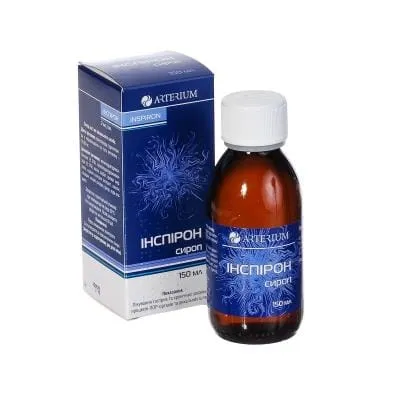
Table of Contents
INSTRUCTIONS FOR MEDICAL USE OF THE MEDICINAL PRODUCT INSPIRON (INSPIRON)
Composition:
Active substance: fenspiride;
5 ml of syrup contain fenspiride hydrochloride, calculated on anhydrous basis – 10.00 mg;
Excipients: methyl p-hydroxybenzoate (E 218), propyl p-hydroxybenzoate (E 216), potassium sorbate, honey-linden flavor, licorice root extract, vanillin, glycerin, sodium saccharin, sucrose, purified water.
Pharmaceutical form. Syrup.
Main physicochemical characteristics: colorless or yellowish liquid with a specific odor. Slight opalescence is permissible.
Pharmacotherapeutic group. Other systemic drugs used in obstructive respiratory diseases. Fenspiride. ATC code R03DX03.
Pharmacological properties.
Pharmacodynamics.
Inspiron has anti-bronchoconstrictor and anti-inflammatory properties due to the interaction of several related mechanisms:
- blockade of H1-histamine receptors and spasmolytic effect on bronchial smooth muscle;
- anti-inflammatory action leading to reduced production of various pro-inflammatory factors (cytokines, TNFα, arachidonic acid derivatives, prostaglandins, leukotrienes, thromboxane, free radicals), some of which also exert bronchoconstrictor effects;
- inhibition of α1-adrenoceptors that stimulate secretion of viscous mucus.
Pharmacokinetics.
Maximum plasma concentration is reached on average within 2.3 ± 2.5 hours (range from 0.5 to 8 hours) after oral administration. The half-life is 12 hours. Fenspiride is excreted from the body mainly via urine.
Clinical characteristics.
Indications.
Treatment of acute and chronic inflammatory processes of the ear, nose, throat, and respiratory tract (otitis, sinusitis, rhinitis, rhinopharyngitis, tracheitis, rhinotracheobronchitis, bronchitis), as part of complex therapy for bronchial asthma.
Seasonal and perennial allergic rhinitis and other respiratory system and ENT organ manifestations of allergy.
Respiratory manifestations of measles and influenza.
Symptomatic treatment of cough.
Contraindications.
- Hypersensitivity (allergy) to the active substance or to any of the excipients.
- Age under 2 years.
Interaction with other medicinal products and other forms of interaction.
Appropriate studies have not been conducted.
Concomitant use of fenspiride with sedative agents or alcohol consumption is not recommended. Sedative agents and alcohol may enhance the sedative effect of drugs possessing H1-histamine receptor blocking properties (including fenspiride).
Special precautions for use.
Treatment with this medicinal product does not replace antibiotic therapy.
The product contains sucrose; therefore, it is not recommended for patients with rare hereditary forms of fructose intolerance, glucose-galactose malabsorption syndrome, or sucrase-isomaltase deficiency.
Patients with diabetes mellitus should take into account the following information when using Inspiron syrup: 1 teaspoon (5 ml) of the product contains 3 g of sucrose; accordingly, 1 tablespoon (15 ml of syrup) contains 9 g of sucrose.
Due to the presence of parabens (methylparahydroxybenzoate and propylparahydroxybenzoate) in the formulation, this medicinal product may cause allergic reactions (possibly delayed).
Shake well before use.
Use during pregnancy or breastfeeding.
Pregnancy. Data on the use of fenspiride during pregnancy are limited. Therefore, the use of this medicinal product during pregnancy is not recommended. However, diagnosis of pregnancy during fenspiride treatment is not an indication for termination of pregnancy.
In animal studies, fenspiride was associated with the occurrence of cleft palate in rats and rabbits.
Breastfeeding. It is unknown whether fenspiride passes into breast milk. Therefore, Inspiron should not be used during breastfeeding.
Fertility. Preclinical studies on the effect of fenspiride on reproductive function showed no impact on fertility in male or female rats.
Ability to influence reaction speed when driving or operating machinery.
Studies on the effect of Inspiron on the ability to drive vehicles or operate machinery have not been conducted.
Since the medicinal product may cause drowsiness, it may have a minor effect on the ability to drive vehicles or operate machinery, particularly at the beginning of treatment or when alcohol is consumed concurrently.
Dosage and Administration
For oral use.
For use in children aged 2 years and older and adults. The use of this medication is contraindicated in children under 2 years of age.
The daily dose should be divided into 2–3 doses and taken before meals.
The recommended daily dose should be determined based on the child's body weight and age, but must not exceed the recommended maximum daily dose (see information below).
Children aged 2 years and older.
The recommended daily dose is 4 mg/kg body weight (2 ml/kg).
- If body weight is less than 10 kg:
The daily dose is 2 to 4 teaspoonfuls of syrup (10–20 ml), corresponding to 20–40 mg of fenspiride hydrochloride per day.
- If body weight is over 10 kg:
The daily dose is 2 to 4 tablespoonfuls of syrup (30–60 ml), corresponding to 60–120 mg of fenspiride hydrochloride per day.
Administration in adults and children aged 12 years and older.
The daily dose of syrup is 3 to 6 tablespoonfuls (45–90 ml), corresponding to 90–180 mg of fenspiride hydrochloride per day.
Adults may be administered the drug in tablet form.
1 teaspoon of syrup (5 ml) contains 10 mg of fenspiride hydrochloride.
1 tablespoon of syrup (15 ml) contains 30 mg of fenspiride hydrochloride.
Treatment duration.
The duration of treatment depends on the course of the disease and is determined individually by the physician.
Children. The drug may be used in pediatric practice in children aged 2 years and older.
Overdose.
Following ingestion of a large amount of the drug, somnolence or excitement, nausea, vomiting, and sinus tachycardia may occur.
Treatment. Gastric lavage should be performed, and ECG monitoring is required. Symptomatic treatment is indicated.
Adverse reactions.
The most common adverse reactions associated with the use of fenspiride are gastrointestinal disorders.
During clinical studies and/or post-marketing use of fenspiride, the following adverse reactions have been reported with the following frequency: very common (≥ 1/10); common (≥ 1/100, < 1/10); uncommon (≥ 1/1000, < 1/100); rare (≥ 1/10000, < 1/1000); very rare (≥ 1/100000, < 1/10000); frequency not known (cannot be estimated from available data).
| System organ classification |
Frequency |
Adverse reactions |
| Neurological disorders |
Uncommon |
Somnolence |
| Frequency unknown* |
Dizziness |
|
| Cardiac disorders |
Frequency unknown* |
Moderate tachycardia, which decreases after dose reduction |
| Palpitations, likely related to tachycardia |
||
| Vascular disorders |
Frequency unknown* |
Arterial hypotension, likely related to tachycardia |
| Gastrointestinal disorders |
Common |
Dyspepsia |
| Nausea |
||
| Stomach pain |
||
| Frequency unknown* |
Diarrhea |
|
| Vomiting |
||
| Skin and subcutaneous tissue changes |
Uncommon |
Erythema |
| Rash |
||
| Urticaria |
||
| Angioedema |
||
| Fixed erythema |
||
| Frequency unknown* |
Pruritus |
|
| Toxic epidermal necrolysis |
||
| Stevens-Johnson syndrome |
||
| General disorders |
Frequency unknown* |
Asthenia (weakness) |
| Fatigue |
* According to post-registration surveillance data.
Shelf life. 2 years.
Storage conditions.
Store in the original packaging at a temperature not exceeding 25 °C. Keep out of reach of children. Do not freeze. After opening, store for no more than 30 days.
Packaging. 150 ml in a bottle, 1 bottle per carton.
Prescription status. Prescription only.
Manufacturer. JSC "Halychpharm".
Manufacturer's address and location of its business activities. Ukraine, 79024, Lviv, Opryshkivska St., 6/8.
INSTRUCTION
for medical use of medicinal product
INSPIRON
(INSPIRON)
Composition:
Active ingredient: fenspiride;
5 ml of syrup contains fenspiride hydrochloride equivalent to dry substance – 10.00 mg;
Excipients: methyl parahydroxybenzoate (E 218), propyl parahydroxybenzoate (E 216), potassium sorbate, aroma honey-linden, licorice root extract, vanillin, glycerol, sodium saccharin, sucrose, purified water.
Pharmaceutical form. Syrup.
Main physicochemical properties: colorless or yellowish liquid with a specific odor. Slight opalescence is permissible.
Pharmacotherapeutic group. Other agents for systemic use in obstructive respiratory diseases. Fenspiride. ATC code R03DX03.
Pharmacological properties.
Pharmacodynamics.
Inspiron has anti-bronchoconstrictive and anti-inflammatory properties, due to the interaction of several related mechanisms:
- blockade of H1-histamine receptors and spasmolytic effect on bronchial smooth muscle;
- anti-inflammatory action, leading to reduced production of various pro-inflammatory factors (cytokines, TNFα, arachidonic acid derivatives, prostaglandins, leukotrienes, thromboxane, free radicals), some of which also exert bronchoconstrictive effects;
- inhibition of α1-adrenoreceptors, which stimulate secretion of viscous mucus.
Pharmacokinetics.
Maximum plasma concentration is reached on average within 2.3 ± 2.5 hours (range from 0.5 to 8 hours) after oral administration. Elimination half-life is 12 hours. Fenspiride is excreted from the body mainly in urine.
Clinical characteristics.
Indications.
Treatment of acute and chronic inflammatory processes of ENT organs and respiratory tract (otitis, sinusitis, rhinitis, rhinopharyngitis, tracheitis, rhinotracheobronchitis, bronchitis), as part of combination therapy for bronchial asthma.
Seasonal and perennial allergic rhinitis and other manifestations of allergy affecting the respiratory system and ENT organs.
Respiratory manifestations of measles, influenza.
Symptomatic treatment of whooping cough.
Contraindications.
- Hypersensitivity (allergy) to the active substance or to any component of the medicinal product.
- Children under 2 years of age.
Interaction with other medicinal products and other types of interactions.
Appropriate studies have not been conducted.
Concomitant use of fenspiride with sedatives or alcohol consumption is not recommended. Sedatives and alcohol may enhance the sedative effect of drugs possessing H1-histamine receptor blocking properties (including fenspiride).
Special precautions.
Treatment with this medicinal product does not replace antibiotic therapy.
The product contains sucrose; therefore, it is not recommended for patients with rare hereditary forms of fructose intolerance, glucose-galactose malabsorption syndrome, or sucrase-isomaltase deficiency.
Patients with diabetes mellitus should take into account the following information when using Inspiron syrup: 1 teaspoon (5 ml) of the syrup contains 3 g of sucrose, thus 1 tablespoon (15 ml of syrup) contains 9 g of sucrose.
Due to the presence of parabens (methyl parahydroxybenzoate and propyl parahydroxybenzoate) in the formulation, this medicinal product may cause allergic reactions (possibly delayed).
Shake well before use.
Use during pregnancy or breastfeeding.
Pregnancy. Data on the use of fenspiride during pregnancy are limited. Therefore, the use of the medicinal product during pregnancy is not recommended. However, diagnosis of pregnancy during fenspiride treatment is not a reason for pregnancy termination.
In animal studies with fenspiride, cases of cleft palate were observed in rats and rabbits.
Breastfeeding. It is unknown whether fenspiride passes into breast milk; therefore, Inspiron should not be used during breastfeeding.
Fertility. Preclinical studies on the effect of fenspiride on reproductive function demonstrated no effect of fenspiride on fertility in male and female rats.
Ability to influence reaction rate when driving or operating machinery.
Studies on the effect of Inspiron on the ability to drive or operate machinery have not been conducted.
Since the medicinal product may cause drowsiness, it has a slight influence on the ability to drive or operate machinery, especially at the beginning of treatment or when alcohol is consumed concurrently.
Administration and dosage.
For oral use.
Recommended for children from 2 years of age and adults. Use of the medicinal product is contraindicated in children under 2 years of age.
The daily dose should be divided into 2–3 doses and taken before meals.
The recommended daily dose should be prescribed according to body weight and age of the child, but must not exceed the recommended maximum daily dose (see information below).
Children from 2 years of age.
Recommended daily dose is 4 mg/kg body weight (2 ml/kg).
- If body weight is less than 10 kg:
daily dose is 2 to 4 teaspoons of syrup (10–20 ml), corresponding to 20–40 mg fenspiride hydrochloride per day.
- If body weight is more than 10 kg:
daily dose is 2 to 4 tablespoons of syrup (30–60 ml), corresponding to 60–120 mg fenspiride hydrochloride per day.
Use in adults and children from 12 years of age.
Daily dose of syrup is 3 to 6 tablespoons (45–90 ml), corresponding to 90–180 mg fenspiride hydrochloride per day.
The medicinal product should be prescribed in tablet form for adults.
1 teaspoon of syrup (5 ml) contains 10 mg fenspiride hydrochloride.
1 tablespoon of syrup (15 ml) contains 30 mg fenspiride hydrochloride.
Duration of treatment.
Duration of treatment depends on the course of the disease and is determined individually by a physician.
Children. The medicinal product can be used in pediatric practice for children from 2 years of age.
Overdose.
After ingestion of a large amount of the medicinal product, drowsiness or excitement, nausea, vomiting, and sinus tachycardia may occur.
Treatment. Gastric lavage is required. ECG monitoring should be performed. Symptomatic treatment.
Adverse reactions.
The most common adverse reactions associated with fenspiride use are gastrointestinal disorders.
During clinical trials and/or post-marketing use of fenspiride, the following adverse reactions have been reported with the following frequencies: very common (≥ 1/10), common (≥ 1/100, < 1/10), uncommon (≥ 1/1,000, < 1/100), rare (≥ 1/10,000, < 1/1,000), very rare (≥ 1/100,000, < 1/10,000), frequency not known (cannot be estimated from available data).
| Organ system classification |
Frequency |
Adverse reactions |
| Neurological disorders |
Uncommon |
Somnolence |
| Frequency unknown* |
Dizziness |
|
| Cardiac disorders |
Frequency unknown* |
Mild tachycardia, which decreases after dose reduction |
| Palpitations, likely related to tachycardia |
||
| Vascular disorders |
Frequency unknown* |
Arterial hypotension, likely related to tachycardia |
| Gastrointestinal disorders |
Common |
Dyspepsia |
| Nausea |
||
| Stomach pain |
||
| Frequency unknown* |
Diarrhea |
|
| Vomiting |
||
| Skin and subcutaneous tissue alterations |
Uncommon |
Erythema |
| Rash |
||
| Urticaria |
||
| Angioedema |
||
| Fixed erythema |
||
| Frequency unknown* |
Pruritus |
|
| Toxic epidermal necrolysis |
||
| Stevens-Johnson syndrome |
||
| General disorders |
Frequency unknown* |
Asthenia (weakness) |
| Fatigue |
* According to post-marketing surveillance data.
Shelf life. 2 years.
Storage conditions.
Store in the original packaging at a temperature not exceeding 25 ºC. Keep out of reach of children. Do not freeze. After opening, store for no more than 30 days.
Packaging. 150 ml in a bottle, 1 bottle per pack.
Prescription status. Prescription only.
Manufacturer. JSC "Galichpharm".
Manufacturer's address and place of business. 6/8 Opryshkovska St., Lviv, 79024, Ukraine.