Inflamaferitin
Ukraine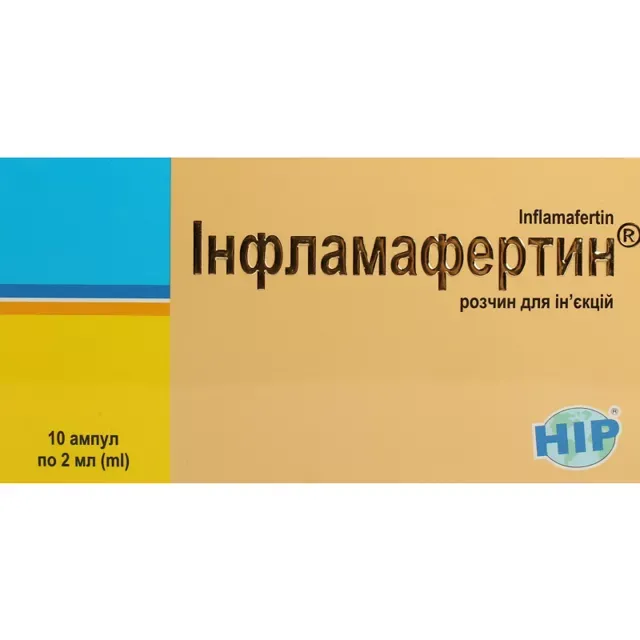
Table of Contents
INSTRUCTIONS FOR MEDICAL USE OF THE MEDICINAL PRODUCT INFLAMAFERTIN® (INFLAMAFERTIN)
Composition:
Active substance: 1 ml of solution contains not less than 5 mg of inflamafertin (regulatory peptides obtained from placental tissue of cattle);
Excipients: sodium chloride, water for injections, chinosol.
Pharmaceutical form. Injection solution.
Main physicochemical characteristics: clear liquid ranging in color from light yellow to light brown.
Pharmacotherapeutic group.
Immunostimulants. ATC code L03AX.
Pharmacological Properties
Pharmacodynamics.
The medicinal product has immunotropic effects: it stimulates the functional capacity of phagocytes in mucous membranes and blood, enhances the synthesis of anti-inflammatory cytokines, and influences the regulatory activity of lymphocyte subpopulations. In autoimmune diseases or syndromes, it reduces manifestations of immune-dependent inflammation, increases the number of CD4+/25+ and CD8+/25+ cells, and particularly elevates serum IL-10 levels. The drug exerts pronounced anti-inflammatory and resorptive effects, reduces the intensity of destructive, infiltrative, and proliferative processes at the inflammatory site. It accelerates epithelialization and regeneration, and prevents the development of adhesion formation. Reduction of edema and adhesion formation helps prevent tubal infertility. With regard to its impact on the proliferative and exudative phases of inflammation, it significantly exceeds placenta extract in efficacy.
Pharmacokinetics.
Inflamafertin® is a complex mixture of regulatory peptides, some of which naturally occur in free form or as high-molecular-weight precursor proteins in the human and animal organism; therefore, studying its pharmacokinetic properties is not feasible.
Clinical characteristics.
Indications.
Prevention and treatment of female infertility caused by chronic inflammatory diseases (salpingitis, oophoritis, periophoritis, salpingo-oophoritis, parametritis), as well as the aforementioned pathological conditions occurring after abortions. Prevention and therapy of postoperative adhesions following surgeries on pelvic organs. Treatment of early stages of systemic autoimmune diseases, particularly scleroderma and rheumatoid arthritis. Use as part of combination therapy for diseases with an inflammatory component.
Contraindications.
Hypersensitivity to the components of the drug. Acute infections. History of allergy to animal proteins.
Interaction with other medicinal products and other types of interactions.
No interactions have been observed.
Special precautions for use.
Due to the potential risk of allergic reactions, this medicinal product should be administered with caution to individuals with a history of hypersensitivity to animal proteins. Immunological monitoring is recommended during treatment of autoimmune diseases.
Use during pregnancy or breastfeeding.
The drug is contraindicated in women during pregnancy or breastfeeding.
Ability to influence reaction speed when driving or operating machinery.
Clinical trials have shown no effect of the drug on the ability to drive or operate machinery.
Administration and Dosage
Administer the drug intramuscularly to adults at a dose of 2 ml (1 ampoule) every other day. The total course of treatment consists of 10 injections. When treating systemic autoimmune diseases, it is recommended to take 1–2 week breaks after every 5 consecutive injections. Several courses may be repeated at intervals of 1 month.
Children
There is no experience with use in children; therefore, the drug should not be used in pediatric practice.
Overdose
Cases of overdose have not been reported.
Adverse reactions.
The most common adverse reactions observed after the 3rd–4th injection are local site reactions, including hyperemia, swelling, and itching, which are associated with the drug's effect due to the development of anti-inflammatory responses. In isolated cases, body temperature may rise to subfebrile levels, specifically 37–37.2 °C. These reactions do not require specific treatment; however, if they cause concern, it is advisable to interrupt therapy for 3–5 days, after which the course may be completed. Such a break does not affect the treatment outcome. After discontinuation of the drug, all adverse reactions resolve spontaneously within 2–5 days. Allergic reactions are possible in individuals with increased hypersensitivity.
Shelf life.
2 years.
Storage conditions.
Store in the original packaging at a temperature from +2 °C to +8 °C, in a place inaccessible to children. Do not freeze!
Incompatibility.
Incompatibility has not been observed. Do not mix with other medicinal products in the same syringe.
Packaging.
2 ml in a vial, 5 or 10 vials per cardboard box with a polymer blister insert.
Prescription status.
Prescription only.
Manufacturer.
LLC "NIR".
Manufacturer's address and location of business activity.
50 Kharkivske Shose, Kyiv, 02155, Ukraine.