Indirab rabies vaccine purified, inactivated
Ukraine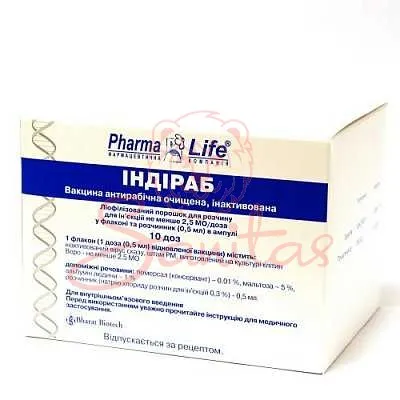
Table of Contents
INSTRUCTIONS FOR MEDICAL USE OF THE MEDICINAL PRODUCT INDIRAB Anti-rabies vaccine, purified, inactivated
Composition:
Active substance: rabies, inactivated, whole virus;
One dose (0.5 mL) of reconstituted vaccine contains inactivated rabies virus, strain PM, produced on Vero cell culture – not less than 2.5 IU;
Excipients: maltose – 5%, human albumin – 1%;
Preservative: thiomersal – 0.01%;
Solvent: sodium chloride 0.3% injection solution – 0.5 mL.
The vaccine contains traces of neomycin sulfate.
Pharmaceutical form. Lyophilized powder for solution for injection and solvent.
Main physicochemical characteristics: the anti-rabies vaccine is a lyophilized powder of white or slightly pinkish color. After reconstitution, it forms a clear or slightly opalescent solution.
The solvent is a transparent, colorless liquid, practically free from visible particles.
Pharmacotherapeutic group. Antiviral vaccines. Purified, inactivated anti-rabies vaccine. ATC code J07BG01.
Immunological and biological properties.
The vaccine consists of the Pitman Moore (PM) strain of rabies virus grown on Vero cell culture, inactivated with beta-propiolactone, concentrated by chromatography, and further purified by ultrafiltration and sterile filtration.
Pharmacodynamics.
The vaccine induces immunity against the rabies virus.
Pharmacokinetics.
Assessment of pharmacokinetic properties is not required for vaccines.
Clinical characteristics.
Indications.
Prophylactic immunization (pre-exposure immunization)
Recommended for individuals belonging to risk groups due to their professional activities, particularly employees of veterinary laboratories, clinics, and other laboratories working with the standard rabies virus; hunters; foresters; veterinary specialists; slaughterhouse workers; taxidermists; persons engaged in capturing and keeping stray animals; animal shelter staff; military personnel; mail carriers; children who are in constant contact with animals and have a high risk of rabies virus infection.
Therapeutic-prophylactic immunization (post-exposure immunization)
Recommended for individuals who have been bitten, scratched, or had mucous membranes contaminated by animals known or suspected to be infected with rabies.
Contraindications.
Prophylactic immunization (pre-exposure immunization):
- Acute infectious or non-infectious diseases or exacerbation of chronic illness (vaccination should be postponed until recovery);
- Allergic reactions to previous administration of this product, such as generalized rash, Quincke's edema, etc.;
- Known hypersensitivity to any component of the vaccine (active or excipient ingredients, including neomycin);
- Pregnancy.
Therapeutic-prophylactic immunization (post-exposure immunization):
- There are no contraindications to therapeutic-prophylactic immunization, since rabies is a fatal disease.
Interaction with other medicinal products and other forms of interaction.
Antirabies immunoglobulin is administered according to indications as part of combined treatment with antirabies vaccine in certain injury cases (see section "Administration and dosage"). Antirabies immunoglobulin and the INDIRAB vaccine must not be mixed in the same syringe or administered into the same body site (see section "Incompatibility").
Interactions between the antirabies vaccine and other vaccines/toxoids when used simultaneously have not been studied. Therefore, such combinations are possible only after careful evaluation by a physician of the benefit-risk ratio.
Radiation therapy, chloroquine, corticosteroids, and other immunosuppressive agents may suppress the process of antibody formation, and therefore vaccination may not produce the desired effect. Thus, when vaccinating during treatment with corticosteroids or immunosuppressants, determination of virus-neutralizing antibody levels is mandatory. If virus-neutralizing antibodies are absent, an additional treatment course should be administered.
To avoid undesirable interactions between multiple medicinal products, the vaccinated person's medical history should be reviewed prior to vaccination. In the presence of conflicting risk factors related to pre-exposure immunization, the consequences of potential infection should be considered, and if vaccination is necessary, all precautionary measures should be taken.
Special precautions for use.
The medicinal product is not suitable for use:
- if the integrity of the primary packaging and labelling is compromised;
- if there are changes in colour or clarity;
- after the expiry date;
- if storage instructions have not been followed.
Opening of the vial and the vaccination procedure must be carried out under strict adherence to aseptic techniques.
Intravenous administration is not permitted. The injection must be administered in such a way that the needle does not enter a blood vessel.
Vaccination rooms must be equipped with emergency anti-shock therapy equipment.
As with any injectable vaccine, all necessary medications for immediate medical intervention in case of anaphylactic reactions should be readily available, especially when administering prophylactic immunization to individuals with known hypersensitivity to polymyxin B, streptomycin, neomycin, or any other antibiotic of the same class. Patients should remain under medical supervision for 30 minutes after vaccination.
Syncope (fainting) may occur during or shortly after any injectable vaccination, as a psychogenic response to needle injection. Vaccination should only be performed with the recipient in a sitting or lying position, and the person should remain in this position (sitting or lying) for 15 minutes after vaccination to prevent the risk of injury.
As with any injectable vaccine, caution should be exercised when administering to patients with thrombocytopenia or coagulation disorders, as intramuscular injection may cause bleeding in such individuals.
The potential risk of apnea and the need for respiratory monitoring for 48–72 hours should be considered when administering the primary immunization course to very premature infants (born at or before 28 weeks of gestation), particularly those with a history of respiratory immaturity. Since the benefit of immunization for this group of infants is high, vaccination should not be delayed or omitted.
Rabies immunoglobulin and the INDIRAB vaccine must not be mixed in the same syringe and must not be administered at the same anatomical site. The vaccine should be administered at a site opposite to that used for rabies immunoglobulin injection.
For 7 days following injury, wound suturing is not recommended. However, if suturing is necessary, rabies immunoglobulin should always be administered before suturing. Antibiotics may be prescribed, and the patient’s vaccination status for tetanus should be checked; if necessary, a tetanus vaccination should be administered.
In cases of severe injuries (category III), as much of the recommended dose of rabies immunoglobulin as possible should be infiltrated into and around the wound site. Prior to administration of heterologous (equine) immunoglobulin, the recipient’s sensitivity to the product should be tested. Rabies immunoglobulin should not be administered in doses higher than recommended, as there is a risk of suppressing antibody production.
When seeking rabies post-exposure prophylaxis at a medical facility, a “Rabies Prophylaxis Patient Card” (Form № 045/o), approved by the current Order of the Ministry of Health of Ukraine dated 28.07.2014 № 527, must be completed for each patient. Based on this card, a certificate is issued after completion of the immunization course, indicating the type and batch number of the products used, vaccination schedule, and post-vaccination reactions.
This medicinal product contains:
- thiomersal as a preservative, trace amounts of neomycin sulfate, which may cause an allergic reaction in you/your child. Inform your doctor if you/your child have had or develop allergic reactions;
- less than 1 mmol (23 mg)/dose of sodium, i.e., practically sodium-free.
Use during pregnancy or breastfeeding.
Studies on the effects of the vaccine on reproductive function in animals have not been conducted. Data on the use of the vaccine in pregnant or breastfeeding women are lacking. Prophylactic immunization (pre-exposure immunization) is contraindicated in pregnancy and should be postponed.
Since rabies is a fatal disease, pregnancy is not a contraindication for therapeutic-prophylactic immunization (post-exposure immunization).
When there is a high likelihood of rabies exposure, the risk-benefit ratio of vaccination should always be carefully considered. Pregnant women and breastfeeding mothers are advised to consult a physician before vaccination.
Ability to affect the speed of reactions when driving vehicles or operating machinery.
Studies on the effect of the medicinal product on the ability to drive vehicles or operate machinery have not been conducted. One should be aware of the possibility of dizziness occurring.
Administration and Dosage.
Route of administration.
The dose for children and adults is 0.5 mL for intramuscular injection.
The 0.5 mL vaccine dose should be administered into the deltoid muscle of the upper arm in adults and into the upper part of the anterolateral thigh in young children.
The vaccine should not be injected into the gluteal muscle. Intravascular administration of the vaccine is not permitted.
The vaccinated individual must remain under medical supervision for at least 30 minutes. Vaccination rooms must be equipped with emergency anti-shock therapy supplies.
Dosage.
Preventive immunization (pre-exposure immunization)
Recommended for rabies prevention in individuals whose professional activities place them at risk of exposure to the rabies virus. All individuals under continuous risk of infection, such as diagnostic, research, and production personnel working with the rabies virus in laboratories, are recommended to receive pre-exposure prophylaxis (see Table 1).
Table 1
Vaccination schedule (route of administration – intramuscular injection)
| 1st dose |
Day 0 |
| 2nd dose |
Day 7 |
| 3rd dose |
Day 28 |
| 1st revaccination |
After 1 year |
| Further revaccination |
Every 5 years |
Therapeutic-prophylactic vaccination (post-exposure vaccination)
After a confirmed contact with an animal with confirmed or suspected rabies, vaccination should be administered immediately. Therapeutic-prophylactic immunization must be performed under medical supervision, only at a rabies treatment center, and as soon as possible after exposure.
Therapeutic-prophylactic measures include local non-specific wound treatment, active immunization, and, if necessary, passive immunization with rabies immunoglobulin. The required measures depend on the type of wound/injury category and the health status of the animal that caused the injury.
First aid: local wound treatment
It should be remembered that the wound must be treated as quickly as possible after the bite. First, the wound should be thoroughly washed with plenty of water and soap or a disinfectant, followed by treatment with 70% ethanol or an alcoholic iodine solution.
During therapeutic-prophylactic immunization, the vaccinated person must remain under medical supervision. Vaccination is recommended according to the guidelines outlined below (see Table 2).
Table 2
Vaccination schedule (route of administration – intramuscular injection)
| 1st dose |
Day 0 |
| 2nd dose |
Day 3 |
| 3rd dose |
Day 7 |
| 4th dose |
Day 14 |
| 5th dose |
Day 28 |
WHO recommendations for preventive and therapeutic immunization (post-exposure immunization) in unvaccinated individuals. Vaccination schedule: a dose of 0.5 ml on day 0, day 3, day 7, day 14, and day 28, administered by intramuscular injection according to the category of injury (see Table 3).
For category III (see Table 3), combined treatment is recommended, involving simultaneous administration of the vaccine and rabies immunoglobulin.
Table 3
WHO recommendations for preventive and therapeutic measures depending on the category of contact and severity of injury in unvaccinated individuals
| Category |
Type of contact with a rabid animal or with a domestic or wild animal suspected of rabies, or an animal for which further observation is not possible |
Recommended vaccination strategy |
| I |
Feeding or touching the animal, contact of the animal's saliva with intact skin, contact with animals without mucosal exposure of skin |
Not indicated, if no signs of disease in the animal are observed. If in doubt, administer immunization according to the schedule specified in Table 1. |
| II |
Mucosal exposure1 of damaged skin, minor/small bites on uncovered skin areas, bites on unprotected skin, minor scratches, superficial bite2,3 (but not on the head, neck, shoulder girdle, arm, forearm, or wrist) or scratches without bleeding |
Immediately administer vaccination according to the schedule specified in Table 2. Discontinue post-exposure prophylaxis if, after 10 days of observation of the animal or in case of humane euthanasia of the animal and obtaining appropriate laboratory test results, it is confirmed that the animal was healthy. Local wound treatment. |
| III |
Single or multiple transdermal bites4,5,6, deep or extensive bites or scratches, particularly on the head, face, neck, shoulder girdle, arm, forearm, or wrist, or mucosal exposure (including exposure of damaged skin) |
Immediately initiate combined treatment: vaccine administered simultaneously with rabies immunoglobulin according to the schedule specified in Table 2. Discontinue post-exposure prophylaxis if, after 10 days of observation of the animal or in case of humane euthanasia of the animal and obtaining appropriate laboratory test results, it is confirmed that the animal was healthy. Local wound treatment. |
-
Salivation – contact with saliva on skin or mucous membranes directly from an animal (licking) or via an object that may have had fresh saliva.
-
Bite – any injury to the skin or mucous membranes caused by an animal's tooth. Injuries to the skin or mucous membranes caused by any object (scalpel, knife) contaminated with animal brain tissue or fresh saliva are considered equivalent to a bite.
-
Superficial bite – a bite involving damage to the skin and subcutaneous fat layer up to the superficial fascia.
-
Wide bite – a bite causing a skin wound larger than 5 cm.
-
Deep bite – a bite involving damage to the superficial fascia.
-
Transdermal bite – a bite with visible bleeding.
Additional passive immunization on Day 0.
On Day 0, rabies immunoglobulin must be administered simultaneously with the vaccine in cases of Category III exposure.
Rabies immunoglobulin should be administered at the following doses: human rabies immunoglobulin (HRIG) – 20 IU per kg body weight, or equine rabies immunoglobulin (ERIG) – 40 IU per kg body weight. Prior to administration of heterologous (equine) rabies immunoglobulin (ERIG), individual sensitivity to equine protein must be tested. For more detailed information, refer to the instructions for medical use of human rabies immunoglobulin (HRIG) or equine rabies immunoglobulin (ERIG). Depending on the circumstances (e.g., in enzootic areas), severity and location of injuries (considering whether nerve endings are affected), and considering delayed medical consultation or presence of immunodeficiency in the patient, two injections may be administered on Day 0 (one vaccine dose and one recommended dose of rabies immunoglobulin).
Vaccination of individuals previously vaccinated against rabies
If vaccination is administered less than 5 years after primary vaccination (with rabies vaccine):
The patient should receive two booster doses: one dose on Day 0 and another on Day 3, administered intramuscularly.
If booster vaccination is administered more than 5 years after primary vaccination or incomplete vaccination, the booster schedule should be as follows:
Five intramuscular injections on Day 0, Day 3, Day 7, Day 14, and Day 28; if necessary, combined with simultaneous administration of rabies immunoglobulin. In practice, if the last booster was administered more than 5 years ago or was incomplete, the individual's vaccination status is considered uncertain.
When conducting immunization in Ukraine, current regulatory documents issued by the Ministry of Health of Ukraine must be followed.
Instructions for use.
Transfer 0.5 mL of the diluent provided with the vaccine into the vial containing the vaccine powder. Gently swirl the vial until the powder is completely dissolved. The solution should be homogeneous, clear, and free of undissolved particles.
Draw the required amount of solution into a syringe.
The reconstituted INDIRAB vaccine must be stored at +2 to +8 °C and used within 6–8 hours after reconstitution. Shake well before use.
After reconstitution, the INDIRAB vaccine should be used immediately.
Do not use the vaccine after the expiration date.
Children
The vaccine may be administered to children as indicated (see sections "Indications", "Administration and Dosage").
Overdose
Not possible.
Adverse reactions.
Gastrointestinal disorders: nausea, abdominal pain, vomiting, diarrhea.
Immune system disorders: allergic reactions, including immediate-type allergic reactions; anaphylactic reactions; Quincke's edema (angioedema); erythematous rash; maculopapular rash, urticaria.
Disorders of the nervous system: headache, dizziness, asthenia (weakness), paresthesia, encephalopathy.
Eye disorders: visual disturbances.
Musculoskeletal and connective tissue disorders: limb tremors, arthralgia, myalgia, muscle weakness.
General disorders: malaise, mild fever, chills, dyspnea.
Injection site reactions: pain, redness, swelling, itching, and induration at the injection site.
After administration of equine rabies immunoglobulin (ERIG), the following may occur: anaphylactic shock, local allergic reactions (occurring on days 1–2 after administration); serum sickness (usually occurring on days 6–8 after administration).
Notice to vaccinated individuals! Inform your physician about any health disturbances.
Healthcare professionals must report any adverse reactions through the adverse reaction reporting system in Ukraine.
Shelf life.
The shelf life of the vaccine with the solvent is 3 years.
The reconstituted INDIRAB vaccine should be stored at +2 to +8 °C and used within 6–8 hours after reconstitution.
Storage conditions.
Store in a light-protected place at +2 to +8 °C.
Keep out of reach of children.
Do not freeze!
Incompatibility.
INDIRAB vaccine must not be mixed with other medicinal products.
Rabies immunoglobulin and the INDIRAB vaccine must not be mixed in the same syringe and must not be administered into the same body site. The vaccine should be administered at a body site opposite to the site where rabies immunoglobulin was administered.
Packaging.
Lyophilized powder – not less than 2.5 IU/dose – in glass vials type 1 (USP) with a capacity of 2 ml, closed with bromobutyl rubber stoppers and caps. Solvent – 0.5 ml – in glass ampoules type 1 (USP) with a capacity of 1 ml.
1 vial of lyophilized powder and 1 ampoule of solvent in a plastic case.
1 or 10 plastic cases in a cardboard box.
Prescription status.
Prescription only.
Manufacturer.
LLC "Pharma Life" (packaging from bulk supplied by the manufacturer Bharat Biotech International Limited, India), Ukraine.
Marketing Authorization Holder.
LLC "Pharma Life", Ukraine.
Manufacturer/Marketing Authorization Holder address and business location address.
Ukraine, 79040, Lviv, D. Apostola St., 2; tel. (032) 297 16 88.