Immunovel®
Ukraine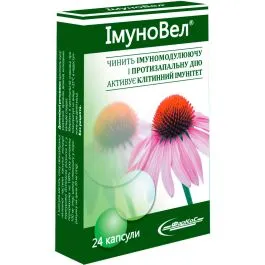
Table of Contents
INSTRUCTIONS FOR MEDICAL USE OF THE MEDICINAL PRODUCT ImunoVel®
Composition:
Active substances: juice from freshly harvested aerial parts of flowering purple coneflower; zinc gluconate;
1 capsule contains juice from freshly harvested aerial parts of flowering purple coneflower (Echinacea purpurea L.), calculated as 100% dry substance 100 mg, zinc gluconate calculated as zinc 20 mg;
Excipients: maize starch, colloidal silicon dioxide, calcium stearate.
Dosage form. Capsules.
Main physicochemical properties: hard gelatin capsules with a white body and a green cap.
Pharmacotherapeutic group.
Immunostimulants. ATC code L03A X.
Pharmacological Properties
Pharmacodynamics
Echinacea: a plant-derived biogenic stimulant that exerts immunomodulatory and anti-inflammatory effects, stimulates bone marrow hematopoiesis, thereby increasing the number of leukocytes and reticuloendothelial cells of the spleen. It predominantly activates cellular immunity, enhances macrophage phagocytic activity and granulocyte chemotaxis, promotes cytokine release, increases interleukin-1 production by macrophages, accelerates transformation of B-lymphocytes into plasma cells, enhances antibody production and T-helper activity. Increases non-specific resistance of the body (including against influenza pathogens).
Zinc: a structural component of biological membranes, cellular receptors, and proteins; it is part of more than 200 enzymatic systems. Participates in immune and antioxidant defense reactions, hematopoiesis, amino acid synthesis, and in the preservation and transmission of genetic information.
Zinc supports cell growth and development, proper functioning of the immune system and ensures immunological response. It improves twilight vision, taste sensation, and smell perception. Helps maintain normal blood levels of vitamin A, prolongs insulin action, and facilitates its accumulation.
Pharmacokinetics
Echinacea: well absorbed in the gastrointestinal tract. Excreted in urine and feces.
Zinc: absorbed along the entire length of the small intestine. When administered on an empty stomach as an aqueous solution, absorption ranges from 41–79%. When taken with food, absorption decreases to 10–40%. Maximum plasma zinc concentration is reached within 2 hours after administration. In the body, zinc accumulates predominantly in leukocytes and erythrocytes, as well as in muscles, bones, skin, kidneys, liver, pancreas, prostate gland, and retina. Approximately 60% of zinc is bound to albumin, 30–40% to alpha-2-macroglobulin, and 1% to amino acids, primarily histidine and cysteine. Zinc is excreted mainly in feces (90%), to a lesser extent in urine and sweat. Calcium supplementation and a calcium-rich diet (e.g., dairy products) can reduce zinc absorption by nearly 50%, while caffeine and alcohol enhance its elimination from the body.
Clinical characteristics.
Indications.
Use for relief of symptoms of cold and acute respiratory viral infection (ARVI).
Contraindications.
Hypersensitivity to Echinacea, other plants of the Asteraceae family (Asteraceae) (chamomile, arnica, calendula, yarrow) or to any other component of the medicinal product.
Progressive systemic diseases (e.g., tuberculosis, sarcoidosis, rheumatism, systemic lupus erythematosus); autoimmune diseases (e.g., collagenoses, multiple sclerosis); immunodeficiency states (e.g., HIV infection, AIDS); immunosuppression (e.g., cytostatic therapy for oncological diseases, history of organ or bone marrow transplantation); blood disorders (e.g., agranulocytosis, leukemia). Hereditary predisposition to allergic reactions (e.g., urticaria, atopic dermatitis, bronchial asthma, chronic viral diseases). Neoplasms, diabetes mellitus.
Pregnancy or breastfeeding period. Children's age.
Interaction with other medicinal products and other forms of interaction.
Interactions related to Echinacea.
Due to its immunostimulatory effect, Echinacea may reduce the effectiveness of drugs with immunosuppressive action (cyclosporine, methotrexate).
The medicinal product is not recommended to be used concomitantly with drugs having hepatotoxic effects, such as amiodarone, ketoconazole, steroid preparations.
An enhancement or reduction of effect cannot be excluded when co-administering drugs whose elimination depends on the activity of cytochrome P450, CYP3A or CYP1A2 isoenzymes.
Interactions related to zinc.
Tetracyclines. The medicinal product reduces absorption of tetracyclines. Therefore, it should be administered no earlier than 2 hours after taking tetracyclines.
Copper preparations. High doses of zinc may inhibit copper absorption (zinc salts should be administered no earlier than 2 hours after taking these preparations).
Thiazide diuretics increase urinary excretion of zinc.
Diet rich in fiber (e.g., bran), phosphorus (e.g., dairy products), whole-grain bread products, and phytates reduces zinc absorption due to formation of non-absorbable complexes. Therefore, the interval between consumption of the above-mentioned products and intake of zinc preparations should be at least 2 hours.
Folic acid may slightly impair zinc absorption.
High doses of iron administered orally significantly reduce zinc absorption (the medicinal product should be administered no earlier than 2 hours after taking iron preparations).
Penicillamine and other chelating agents reduce zinc absorption (the medicinal product should be administered no earlier than 2 hours after taking these preparations).
Multivitamin preparations (e.g., multivitamin preparations with mineral compounds). Concurrent use of multiple products containing zinc may lead to excessively high zinc concentration in blood plasma.
Quinolones. Zinc reduces absorption of drugs from the quinolone/fluoroquinolone group (e.g., norfloxacin, ciprofloxacin, ofloxacin). For this reason, at least a 2-hour interval should be maintained between administration of zinc salts and quinolones.
Special precautions for use.
Do not exceed recommended doses.
If respiratory diseases recur frequently and have prolonged symptoms such as difficulty breathing, fever, expectoration with pus or blood, medical advice should be sought. If symptoms worsen or do not resolve within 10 days, or if body temperature increases during treatment, immediate medical advice should be sought.
Patients with atopic diseases or with hereditary predisposition to allergies are at risk of developing anaphylactic reactions. Such patients should consult a physician before starting treatment with the drug.
During prolonged use of preparations containing zinc, the risk of copper deficiency should be considered; therefore, levels of these trace elements should be monitored.
Diets rich in fiber (e.g., bran), phosphates (e.g., dairy products), whole-grain cereal products, and phytates reduce zinc absorption due to complex formation. An interval of at least 2 hours should be maintained between consumption of these products and administration of zinc preparations.
The intake of the medicinal product is recommended to be combined with vitamins A, E, and C.
Use during pregnancy or breastfeeding.
There is no experience with the use of the medicinal product during pregnancy or breastfeeding; therefore, it should not be used during these periods. There are no data regarding the effect of the drug on fertility.
Ability to affect reaction rate when driving or operating machinery.
Due to the possible effect of echinacea on the nervous system, the medicinal product should be used with caution when driving or operating machinery.
Zinc salts do not affect psychomotor reaction speed.
Dosage and Administration.
Take capsules orally with sufficient amount of water. Usually, take 1 hour before meals or 2 hours after eating, since many food products interfere with zinc absorption. If gastrointestinal irritation symptoms occur, the medication may be taken immediately before or during meals; however, in this case, the bioavailability of the drug may be reduced.
Adults are prescribed 1 capsule twice daily. Maximum daily dose — 4 capsules.
Duration of treatment — 10 days with daily use or 20 days when taking the medication every other day. Treatment should be initiated at the first signs of illness. The patient should consult a physician if symptoms do not resolve within 10 days of using the medication or if adverse reactions not listed in the instructions occur.
Children.
The medication is not used in children due to lack of experience with its use.
Overdose.
Related to echinacea
Symptoms: nausea, vomiting, diarrhea, constipation, increased excitability, sleep disturbances (insomnia).
Treatment: symptomatic therapy, gastric lavage, enteral sorbents.
Related to zinc
Overdose may cause burning pain in the mouth and throat, watery or bloody diarrhea, tenesmus (painful defecation urges), belching, hypotension (dizziness), jaundice (yellowing of eyes and skin), pulmonary edema (chest pain, breathing difficulty), vomiting, hematuria, anuria, collapse, seizures, hemolysis, increased fatigue.
If the above symptoms occur, the patient should drink milk or water, followed by intramuscular or intravenous administration of calcium disodium edetate (ethylene-diamine-tetraacetic acid disodium salt) at a dose of 50–75 mg/kg body weight per day, given in 3–6 doses over 5 days. Induction of vomiting or gastric lavage should not be performed in case of overdose.
Cases of hyperglycemia and fatal outcomes have been reported following oral ingestion of 10 g of zinc sulfate.
Prolonged use of zinc may lead to copper deficiency.
Side effects
Associated with Echinacea
The frequency of adverse reactions cannot be determined from the available data. The adverse reactions listed below may occur in individual cases.
Immune system disorders: hypersensitivity reactions (e.g., pruritus, skin rashes, skin hyperemia, facial swelling); Stevens-Johnson syndrome; angioneurotic skin edema; Quincke's edema; anaphylactic shock. Allergic reactions in patients with hereditary predisposition to allergy. Effects on the course of autoimmune diseases (disseminated encephalomyelitis, nodular erythema, immune thrombocytopenia, Evans syndrome, and Sjögren's syndrome with impaired renal tubular function).
Respiratory, thoracic and mediastinal disorders: bronchospasm with obstruction and bronchial asthma as part of hypersensitivity reactions.
Blood and lymphatic system disorders: leukopenia during long-term use (over 8 weeks).
Gastrointestinal disorders: gastrointestinal disturbances including nausea, vomiting, diarrhea, abdominal pain.
Nervous system disorders: excitation, dizziness, sleep disturbances.
Cardiovascular disorders: arterial hypotension.
Associated with Zinc
The following adverse reactions may occur during zinc therapy (frequency unknown — cannot be estimated from the available data).
Gastrointestinal disorders: gastrointestinal disturbances (nausea, vomiting, dyspepsia, heartburn, abdominal pain, diarrhea, gastritis), usually after intake of high zinc doses.
Blood and lymphatic system disorders: hematological disorders due to copper deficiency, including leukopenia (elevated body temperature, chills, sore throat), neutropenia (oral and pharyngeal ulcers), sideroblastic anemia (feeling of fatigue, weakness).
Nervous system disorders: headache, metallic taste in the mouth.
Immune system disorders: hypersensitivity reactions.
Skin and subcutaneous tissue disorders: rash, pruritus, skin redness, urticaria, eczema.
Non-clinical safety data
Non-clinical data from traditional pharmacological safety studies regarding repeated-dose toxicity, genotoxicity, potential carcinogenic effects, and reproductive toxicity show no special risk for humans.
Shelf life
2 years.
Storage conditions
Store in the original packaging at a temperature not exceeding 25 °C.
Keep out of reach of children.
Packaging
12 capsules in a blister; 2 blisters per carton.
Supply category
Over-the-counter.
Manufacturer
LLC "Pharmaceutical Company "Farkos".
Manufacturer's address and location of business activity
360, Sviato-Pokrovska St., village of Hostomel, Irpin, Kyiv region, 08290, Ukraine.
Marketing Authorization Holder
LLC "Pharmaceutical Company "Farkos".
Address of the Marketing Authorization Holder
50-A, Zodchykh St., Kyiv, 03162, Ukraine.