Immunoglobulin antirabies (equine)
Ukraine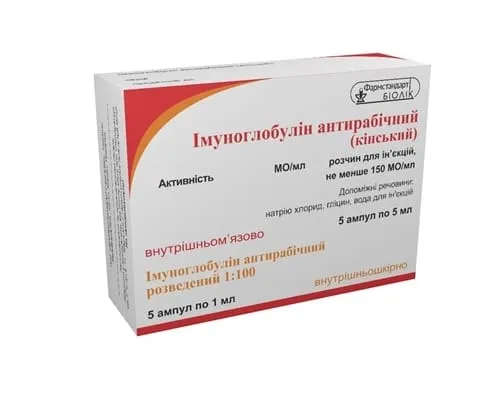
Table of Contents
INSTRUCTIONS FOR MEDICAL USE OF THE MEDICINAL PRODUCT Anti-Rabies Immunoglobulin (Equine)
Composition:
Active substance: specific antibodies;
1 ml of Anti-Rabies Immunoglobulin (Equine) contains: specific antibodies – not less than 150 IU;
Excipients: sodium chloride – 9 mg, glycine – 22.5 mg, water for injections – up to 1 ml;
1 ml of Anti-Rabies Immunoglobulin diluted 1:100 contains: specific antibodies – not less than 1.5 IU;
Excipients: sodium chloride – 9 mg, glycine – 0.225 mg, water for injections – up to 1 ml.
Pharmaceutical form. Solution for injection.
Main physicochemical properties: Anti-Rabies Immunoglobulin (Equine) is a transparent or slightly opalescent, colorless or yellowish liquid. A faint pinkish tint of the preparation is permissible.
Pharmacotherapeutic group. Anti-Rabies Immunoglobulin.
ATC Code: J06BB05.
Immunological and biological properties.
Pharmacodynamics.
Anti-Rabies Immunoglobulin (Equine) has the ability to neutralize the rabies virus both in vitro and in vivo.
Pharmacokinetics.
Assessment of pharmacokinetic data is not applicable.
Clinical characteristics.
Indications.
For passive therapeutic and prophylactic immunization of patients suspected of infection with rabies virus in case of single or multiple transdermal bites or scratches, contamination of mucous membranes with animal saliva, or contact of damaged skin with saliva from animals suspected of or confirmed to have rabies (Category III exposure according to WHO recommendations).
Anti-rabies immunoglobulin (equine) must always be used in combination with anti-rabies vaccine.
Contraindications.
None.
Interaction with other medicinal products and other types of interactions.
Enhances the effect (mutually) of anti-rabies vaccines and is used in combination with them.
Compatible with anti-tetanus serum and antibiotics.
Special precautions for use.
The drug must not be administered intravenously!
Anti-rabies immunoglobulin (equine) must be administered simultaneously with anti-rabies vaccine as soon as possible after contact with an animal suffering from or suspected of having rabies. However, in some cases, the product may be administered no later than 7 days after the first vaccine dose.
Anti-rabies immunoglobulin (equine) must always be used exclusively in combination with anti-rabies vaccine, but administered with separate syringes and at different body sites. Administration must be performed under medical supervision and in accordance with current National legislation.
Individuals who have previously received a complete course of preventive or post-exposure prophylactic vaccinations and in whom the presence of anti-rabies antibodies has been confirmed should not receive anti-rabies immunoglobulin. These individuals should receive only the anti-rabies vaccine.
In cases of strongly positive reactions to anti-rabies immunoglobulin administration, in patients with a history of severe allergic reactions to anti-rabies serum or other equine serum products, and in pregnant women, administration of anti-rabies immunoglobulin is recommended to be carried out in a hospital setting equipped with resuscitation facilities.
After administration of Anti-rabies immunoglobulin (equine), the patient must remain under intensive medical observation for at least 1 hour.
Before injection, check the ampoules for integrity and proper labeling. The product in ampoules with damaged integrity or labeling, as well as in cases of changes in its physicochemical properties (color, clarity, etc.), expired shelf life, or if storage conditions have been compromised, must not be used.
Opening of ampoules and administration of the product must be performed under strict adherence to aseptic and antiseptic procedures.
The product contains 0.154 mmol (3.54 mg) Na per 1 ml of the product and 0.154 mmol (3.54 mg) Na per dose of the 1:100 diluted product for sensitivity testing. Caution should be exercised when administering the product to patients on a sodium-restricted diet.
Use during pregnancy or breastfeeding.
Pregnancy or breastfeeding is not a contraindication for the use of this product due to the extreme danger and absolute lethality of rabies infection.
Ability to affect reaction speed when operating vehicles or machinery.
Due to the potential for allergic reactions, patients should refrain from driving or operating machinery after administration of the product.
Administration and Dosage
Immediately or as soon as possible after a bite or injury, locally treat the wound. Thoroughly wash the wound with soapy water (or detergent) and disinfect with 40–70% alcohol or iodine solution. After local wound treatment, specific therapy should be initiated urgently. The most effective approach is administration of Rabies Immunoglobulin (equine) within the first 24 hours after possible exposure. Delaying administration of Rabies Immunoglobulin reduces its effectiveness.
Administer Rabies Immunoglobulin (equine) intramuscularly at a dose of 40 international units (IU) per 1 kg of body weight for both adults and children.
Calculate the required dose of immunoglobulin using the following formula:
where – dose (volume) of immunoglobulin to be administered, in ml;
m – patient's body weight, in kg;
c – potency of the product as indicated on the vial and packaging, in IU.
Do not administer more than 30 ml of Rabies Immunoglobulin (equine) due to increasing risk of serum sickness!
The product should be used under life-threatening indications by the method of specific desensitization according to Bezredka as follows:
Diluted Rabies Immunoglobulin 1:100 (vials marked in red) is administered intradermally in a dose of 0.1 ml into the flexor surface of the forearm.
If within 20–30 minutes swelling or redness at the injection site is less than 1 cm in diameter, administer 0.7 ml of the 1:100 diluted immunoglobulin subcutaneously into the shoulder. If no reaction occurs within 30 minutes, administer the entire calculated dose of immunoglobulin in small portions in three divided doses at 10–15 minute intervals. The immunoglobulin should be warmed to (37±0.5) °C; for each portion, draw the solution from unopened vials.
The calculated dose of immunoglobulin should be infiltrated around and into the depth of the wound. If the anatomical location of the injury (e.g., fingertips, etc.) does not allow administration of the full dose around the wound, any remaining amount should be administered intramuscularly at sites different from those used for rabies vaccine (e.g., gluteal muscles, upper thigh, or forearm). The entire dose of Rabies Immunoglobulin (equine) must be administered within one hour.
If within 20 minutes swelling or redness at the injection site reaches 1 cm or more, or if an allergic reaction occurs after subcutaneous injection, the immunoglobulin should be administered with special caution. Initially, it is recommended to administer 1:100 diluted Rabies Immunoglobulin subcutaneously into the shoulder in doses of 0.5 ml, 2.0 ml, and 5.0 ml at 15–20 minute intervals, followed by 0.1 ml of undiluted immunoglobulin. Then, after 30–60 minutes, administer the entire prescribed intramuscular dose of the product, warmed to (37±0.5) °C, in small divided doses given three times at 10–15 minute intervals. Prior to the first injection, parenteral administration of antihistamines (suprastin, diphenhydramine, tavegyl, etc.) is recommended. To prevent shock, it is recommended to administer 0.1% adrenaline solution subcutaneously at age-appropriate doses simultaneously with immunoglobulin administration.
When administering Rabies Immunoglobulin, solutions of adrenaline, diphenhydramine, tavegyl, or suprastin must always be readily available.
To prevent allergic complications after immunoglobulin administration, oral antihistamines (suprastin, diphenhydramine, tavegyl, fenkarol, etc.) should be prescribed at age-appropriate doses, twice daily, for 7–10 days.
In patients who have received equine antivenom serum within the preceding 24 hours, Rabies Immunoglobulin (equine) should be administered without prior intradermal administration of the 1:100 diluted immunoglobulin. The administered vaccination must be recorded in the established documentation forms, indicating the dose, date, manufacturer, batch number, and reaction to administration.
Children. The product may be used in children.
Overdose. No cases of overdose have been reported.
Side effects.
The adverse reactions listed below are based on post-marketing surveillance data.
Blood and lymphatic system disorders: lymphadenopathy.
Immune system disorders: allergic reactions, including Quincke's edema, serum sickness, anaphylactic shock.
Psychiatric disorders: insomnia.
Nervous system disorders: hyperreflexia, hyperesthesia, numbness, dizziness, headache, somnolence.
Cardiac disorders: tachycardia.
Vascular disorders: arterial hypotension.
Respiratory, thoracic and mediastinal disorders: throat irritation, cough, dyspnea.
Gastrointestinal disorders: nausea, vomiting, dysphagia, epigastric pain.
Skin and subcutaneous tissue disorders: allergic dermatitis, rash, urticaria, pruritus, hyperemia, burning sensation, sweating.
Musculoskeletal and connective tissue disorders: arthralgia, myalgia, neck muscle rigidity, joint swelling.
Renal and urinary disorders: decreased urine output.
General disorders and administration site conditions: increased body temperature, weakness, chills, chest pain, edema; erythema, infiltration, pain at injection site.
Shelf life. 2 years.
Storage conditions.
Store in a place protected from light at a temperature between 2 °C and 8 °C. Do not freeze! Keep out of reach of children.
Packaging.
1 ampoule of anti-rabies immunoglobulin (3 mL, ampoule marked with blue color) in combination with 1 ampoule of anti-rabies immunoglobulin diluted 1:100 (1 mL, ampoule marked with red color), 5 sets per pack; or 1 ampoule of anti-rabies immunoglobulin (5 mL, ampoule marked with blue color) in combination with 1 ampoule of anti-rabies immunoglobulin diluted 1:100 (1 mL, ampoule marked with red color), 5 sets per pack.
Prescription category. Prescription only.
Manufacturer. LLC "BIOLIK PHARMA".
Manufacturer's location and address of the place of business activity.
Legal entity location:
Pomirky, 70, Kharkiv, Kharkiv Oblast, 61070, Ukraine.
Place of business activity address:
Pomirky-70, building without number, Kharkiv, Kharkiv Oblast, 61070, Ukraine.