Imovax polio® vaccine for prophylaxis of poliomyelitis inactivated liquid
Ukraine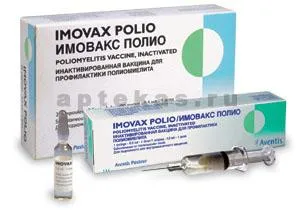
Table of Contents
INSTRUCTIONS FOR MEDICAL USE OF THE MEDICINAL PRODUCT IMOVAX POLIO® Inactivated Polio Vaccine Liquid
Composition:
Active substances: Poliomyelitis, trivalent, inactivated, whole virus vaccine: type 1 (Mahoney), type 2 (MEF-1), type 3 (Saukett)
One immunizing dose of vaccine (0.5 mL) contains:
Inactivated poliovirus type 1 (Mahoney) 40 D antigen units*
Inactivated poliovirus type 2 (MEF-1) 8 D antigen units*
Inactivated poliovirus type 3 (Saukett) 32 D antigen units*
Excipients:
2-phenoxyethanol** 2–3 µL
Formaldehyde 2–20 µg
Medium 199 with Hank's salts*** up to 0.5 mL****
* D antigen content determined in D units by immunochemical method
** 2-phenoxyethanol is a solution of 2-phenoxyethanol in 50% ethanol
*** Medium 199 with Hank's salts (without phenol red) contains a mixture of amino acids (including phenylalanine), mineral salts, vitamins and other components (including glucose), with addition of polysorbate 80, dissolved in water for injections
**** pH is adjusted with hydrochloric acid or sodium hydroxide
The vaccine complies with the requirements of the European Pharmacopoeia and WHO recommendations.
Pharmaceutical form.
Injection suspension.
Main physicochemical properties: clear, colorless liquid containing polioviruses of three types (1, 2 and 3), cultivated on Vero continuous cell line and inactivated with formaldehyde.
Pharmaco-therapeutic group. Inactivated vaccine for prevention of poliomyelitis. ATC code J07BF03.
Pharmacological properties.
Pharmacodynamics.
The vaccine is produced from polioviruses of types 1, 2, and 3, cultivated on a continuous Vero cell line culture, purified, and inactivated with formaldehyde.
One month after the third dose of the primary vaccination course, the seroprotection rate is 100% for polioviruses types 1 and 3 and ranges from 99% to 100% for poliovirus type 2.
In younger children, the first booster dose (fourth dose) results in a very high increase in titers, with seroprotection rates ranging from 97.5% to 100% for all poliovirus types. Four to five years after revaccination, the protection level for all three poliovirus types ranges from 94% to 99%.
In vaccinated adults, administration of the first booster dose is accompanied by a secondary immune response.
These data are primarily derived from studies conducted with combination vaccines containing the vaccine for poliomyelitis prevention.
Immunity persists for at least 5 years after the fourth injection.
Pharmacokinetics.
Not applicable.
Clinical characteristics.
Indications.
For prevention of poliomyelitis in infants, children, and adults, for primary vaccination and booster doses.
When administering immunization to patients in Ukraine, current orders of the Ministry of Health of Ukraine must be followed.
Contraindications.
Known hypersensitivity to any component of the vaccine or to a vaccine of similar composition, or to any excipient, or to neomycin, streptomycin, polymyxin B.
General temporary contraindications to any vaccination: illness with elevated body temperature or acute illness. In such cases, vaccination should be postponed.
Interaction with other medicinal products and other forms of interaction
Currently, there are no known risks associated with administering Imovax Polio® vaccine simultaneously with other routine vaccines. If simultaneous administration is necessary, injections should be given using separate syringes and at different body sites.
Special precautions for use.
Do not administer intravascularly: ensure that the needle has not entered a blood vessel.
As with any injectable vaccine, Imovax Polio® should be administered with caution to individuals with thrombocytopenia or coagulation disorders, as bleeding may occur following intramuscular injection.
As with any injectable vaccine, appropriate medical treatment and supervision must be readily available in case of rare but severe allergic reactions or anaphylactic shock. For this reason, patients should remain under medical supervision for 30 minutes after vaccination.
The immunogenicity of Imovax Polio® vaccine may be reduced in patients with immunodeficiency or those receiving immunosuppressive therapy. In such cases, vaccination should be postponed until completion of immunosuppressive treatment or adequate patient protection should be ensured. However, vaccination is recommended for patients with chronic immunodeficiency, such as HIV infection, even though the immune response may be diminished (see section "Interaction with other medicinal products and other forms of interaction"). When deciding on immunization during immunosuppressive therapy, the duration and cumulative doses of the medicinal products used should be taken into account, and current orders of the Ministry of Health of Ukraine on preventive vaccinations should be followed.
Imovax Polio® vaccine is also indicated for patients with contraindications to oral poliomyelitis vaccine, as well as for booster immunization in individuals previously vaccinated with oral poliomyelitis vaccine.
The potential risk of apnea and the need for respiratory monitoring for 48–72 hours should be considered when administering primary vaccination to very premature infants (born ≤28 weeks of gestation), especially in newborns with documented respiratory immaturity. Since the benefit of vaccination in this group of infants is high, vaccination should not be delayed or postponed.
This medicinal product contains:
less than 1 mmol (39 mg)/dose of potassium, i.e. practically potassium-free;
less than 1 mmol (23 mg)/dose of sodium, i.e. practically sodium-free;
a small amount of ethanol, less than 100 mg/dose;
phenylalanine, which may be harmful for patients with phenylketonuria (see section "Composition").
Imovax Polio® vaccine may contain trace amounts of neomycin, streptomycin, and polymyxin B (see section "Contraindications").
Use during pregnancy or breastfeeding.
Based on clinical data, this vaccine may be administered during pregnancy in situations where there is a high risk of exposure to poliomyelitis. In such cases, general recommendations for vaccination of adults at increased risk of poliomyelitis should be followed, including: individuals traveling to regions or countries with poliomyelitis outbreaks or endemic transmission; members of communities or specific population groups affected by wild poliovirus infections; laboratory personnel handling specimens that may contain polioviruses; healthcare workers in close contact with patients who may excrete wild polioviruses; unvaccinated adults whose children will receive oral poliomyelitis vaccine; individuals with immunodeficiency.
This vaccine may be used during breastfeeding.
No studies on the effect of the medicinal product on fertility have been conducted.
Ability to affect reaction speed when driving or operating machinery.
No studies on the ability to affect reaction speed when driving or operating machinery have been conducted.
Administration and Dosage
When conducting immunization in Ukraine, current orders of the Ministry of Health of Ukraine must be followed.
Vaccination is administered by medical personnel in preventive vaccination clinics of healthcare facilities.
Dosage
The single immunizing dose for infants, children, and adults is 0.5 mL.
Children
Dosage schedule according to recommendations:
- Two injections with a two-month interval — one at the age of 2 months and one at the age of 4 months (primary vaccination), followed by the first booster dose at 11 months of age.
Alternative dosage schedules according to current national recommendations should be used when necessary and in accordance with WHO recommendations:
- Three consecutive doses of 0.5 mL of Imovax Polio® administered starting at the age of 6 weeks or 2 months, with intervals of 1 or 2 months; the first booster dose is administered 6–12 months after the last dose of primary vaccination.
- In countries where live oral polio vaccine (trivalent, bivalent, or monovalent OPV) is used within the standard schedule of preventive vaccinations, Imovax Polio® may be used in combination (for simultaneous administration) or sequentially with OPV, in accordance with WHO recommendations and current national guidelines.
Any subsequent booster doses of the vaccine (to be administered during childhood, adolescence, or adulthood) should be given in accordance with current national recommendations.
Adults
Dosage schedule according to recommendations:
- In adults who have not been previously vaccinated, two consecutive doses of 0.5 mL should be administered with a 2-month interval, followed by the first booster dose 8–12 months after the first dose of primary vaccination.
Alternative dosage schedules according to current national recommendations should be used when necessary and in accordance with WHO recommendations:
- Two consecutive doses of 0.5 mL with a 1-month or preferably 2-month interval should be administered to adults who have not been previously vaccinated; the first booster dose is administered 6–12 months after the last dose of primary vaccination.
Any subsequent booster doses of the vaccine should be administered in accordance with current national recommendations.
Route of Administration
The preferred route of administration of Imovax Polio® is intramuscular, although the vaccine may also be administered subcutaneously.
The injection site should be the middle third of the anterolateral thigh area for infants and young children, and the most substantial part of the deltoid muscle for older children and adults.
The vaccine must be clear and colorless: do not use the vaccine if it is cloudy.
For routine use of multidose vials, refer to WHO recommendations.
When using a multidose vial for repeated withdrawal of the vaccine, a new syringe and a new sterile needle must be used for each administration, and the product must be withdrawn from the vial under strict aseptic conditions.
| Vaccine Vial Monitors (VVMs) are located on the label of the Imovax Polio® vaccine supplied by Sanofi Pasteur. The color indicator on the vial label is the VVM (vaccine vial monitor). This time- and temperature-sensitive indicator shows the cumulative heat exposure the vial has experienced. It alerts the end-user to ensure proper cold chain maintenance. |
Children.
Imovax Polio® vaccine can be used in children for primary vaccination and booster doses according to the recommendations provided in the section "Administration and dosage."
Overdose.
Information not available.
Adverse Reactions
Adverse reactions are classified using MedDRA terminology by system organ class and frequency:
Very common: ≥ 10 %
Common: ≥ 1 % and < 10 %
Uncommon: ≥ 0.1 % and < 1 %
Rare: ≥ 0.01 % and < 0.1 %
Very rare: < 0.01 %
Frequency not known: cannot be estimated based on available data.
According to spontaneous reports, certain adverse events have very rarely occurred after administration of the medicinal product Imovax Polio®. Since reports of these events are voluntary and the population size is unknown, it is not always possible to reliably estimate their frequency or establish a causal relationship to the use of this vaccine. Therefore, the frequency of these adverse events is classified as "Frequency not known".
The adverse reactions listed below were observed during clinical trials or reported from spontaneous reports in the post-marketing period.
The most commonly reported adverse reactions following administration of this vaccine are local reactions at the injection site (pain, redness, induration) and body temperature elevation above 38.1 °C.
Immune system disorders
Frequency not known: Type I hypersensitivity reactions to one of the vaccine components, such as urticaria, angioedema, anaphylactic reactions or anaphylactic shock.
Psychiatric disorders
Frequency not known: irritability, somnolence and restlessness occurring within the first hours or days after vaccination and resolving rapidly.
Nervous system disorders
Frequency not known: seizures (isolated or associated with elevated body temperature) occurring within several days after vaccination; headache; mild and transient paraesthesia (mainly in lower limbs) occurring within 2 weeks after vaccination.
Skin and subcutaneous tissue disorders
Frequency not known: rash.
Musculoskeletal and connective tissue disorders
Frequency not known: cases of myalgia and mild and transient arthralgia have been reported within several days after vaccination.
General disorders and administration site conditions
Very common: pain at injection site, body temperature elevation above 38.1 °C.
Common: redness at injection site.
Uncommon: induration at injection site.
Frequency not known: lymphadenopathy, local reactions at injection site such as swelling, which may occur within 48 hours after vaccination and last for 1 or 2 days.
Additional information regarding specific patient populations
Apnoea in very premature infants (born at gestational age ≤ 28 weeks) (see section "Special precautions for use").
If any adverse reactions occur, please inform your physician.
Healthcare professionals must report any adverse reactions via Ukraine's pharmacovigilance system.
Shelf life
3 years.
Storage conditions
Store at 2 to 8 °C (in a refrigerator). Do not freeze.
Protect from light. Keep out of reach of children.
A multidose vial may be used for up to 28 days after opening, provided it is stored at 2 to 8 °C.
Incompatibilities
This vaccine must not be mixed with other vaccines or with other medicinal products.
Packaging
Suspension for injection, 0.5 mL (1 dose) in pre-filled syringes with attached needle (or 2 separate needles).
1 syringe in a cardboard box with the instruction for medical use.
1 syringe in a cardboard box containing standard export packaging and the instruction for medical use.
Suspension for injection, 5 mL (10 doses) in vials, No. 1 or No. 10.
1 or 10 vials in a cardboard box, with the instruction for medical use.
1 or 10 vials in a cardboard box containing standard export packaging and the instruction for medical use.
Prescription category
Prescription only.
Manufacturer
Sanofi Pasteur, France / Sanofi Pasteur, France.
Sanofi-Aventis Zrt., Hungary / Sanofi-Aventis Zrt., Hungary.
Manufacturer's address and location
1541 avenue Marcel Mérieux, 69280 Marcy l’Etoile, France / 1541 avenue Marcel Merieux, 69280 Marcy l’Etoile, France.
Parc Industriel d’Incarville, 27100 Val-de-Reuil, France / Parc Industriel d’Incarville, 27100 Val-de-Reuil, France.
Building 5, Kaponia Utca 1, Budapest XXII, 1225, Hungary.
Marketing Authorisation Holder
Sanofi Pasteur, France / Sanofi Pasteur, France.
Location of Marketing Authorisation Holder
14 Espace Henri Vallée, 69007 Lyon, France / 14 Espace Henry Vallée, 69007 Lyon, France.
Representative of the Marketing Authorisation Holder
LLC "Sanofi-Aventis Ukraine", Sanofi Pasteur vaccines division.
Address of the representative
48-50A Zhylianska St., Kyiv, 01033, Ukraine. Tel. (044) 354-20-00, Fax (044) 354-20-01.