Ilomedin
Ukraine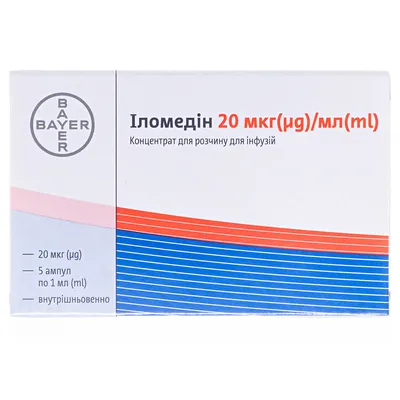
Table of Contents
INSTRUCTIONS FOR MEDICAL USE OF THE MEDICINAL PRODUCT ILOMEDIN (ILOMEDIN®)
Composition:
Active substance: iloprost;
1 ml of solution contains 0.027 mg of iloprost tromethamine, equivalent to 20 μg of iloprost;
Excipients: tromethamine, ethanol 96%, sodium chloride, diluted hydrochloric acid, water for injections.
Pharmaceutical form. Concentrate for solution for infusion.
Main physicochemical properties: clear particle-free liquid.
Pharmacotherapeutic group. Antiplatelet agents.
ATC code B01AC11.
Pharmacological Properties
Pharmacodynamics
Iloprost is a synthetic analogue of prostacyclin, whose pharmacological effects include:
- inhibition of platelet aggregation, adhesion, and release reaction;
- dilation of arterioles and venules;
- increased capillary density and reduction of elevated vascular permeability in the microcirculation system;
- activation of endogenous fibrinolysis;
- inhibition of leukocyte adhesion following endothelial injury and leukocyte accumulation in damaged tissue, as well as reduction of free oxygen radical release.
The exact mechanism of action is unknown.
Pharmacokinetics
Distribution
Steady-state equilibrium between administration and metabolic inactivation of iloprost (steady-state concentration) is achieved within 10–20 minutes after initiation of intravenous infusion. The steady-state plasma concentration is linearly dependent on the dose administered per unit of time. At a dosage of 3 ng/kg/min, the concentration reaches approximately 135 ± 24 pg/mL. After termination of the infusion, the plasma concentration of iloprost decreases very rapidly (due to its high metabolic rate). The metabolic clearance of the active substance from plasma is approximately 20 ± 5 mL/kg/min. The terminal half-life in plasma is 0.5 hours; thus, two hours after discontinuation of infusion, the concentration of the active substance is less than 10% of the steady-state level.
The pharmacokinetics of iloprost are independent of patient age and gender. However, elimination of the active substance is reduced by 2–4 times in patients undergoing dialysis for chronic renal failure and in patients with liver cirrhosis. Drug interactions at the level of plasma protein binding are unlikely, as the majority of iloprost is bound to plasma albumins (protein binding – 60%), resulting in only extremely low concentrations of free iloprost. Similarly, the likelihood that iloprost therapy affects the biotransformation of other medicinal products is extremely low due to its metabolic pathways and low absolute dose.
Biotransformation
Iloprost is metabolized primarily via β-oxidation of the side carboxyl chain. The substance is not excreted unchanged. The main metabolite is tetranor-iloprost, which is excreted in urine in free and conjugated forms as four diastereoisomers. Tetranor-iloprost is pharmacologically inactive. Elimination of iloprost metabolites occurs via the kidneys (80%) and biliary tract (20%).
Elimination
Elimination of metabolites from plasma and urine occurs in two phases, with half-lives in plasma of approximately 2 hours in the first phase and 5 hours in the second phase, and from urine of 2 and 18 hours, respectively.
Preclinical safety data
Based on traditional studies evaluating pharmacological safety, repeated-dose toxicity, genotoxicity, and carcinogenic potential, preclinical investigations revealed no specific risks for humans. Preclinical effects were observed only after administration of doses significantly exceeding the maximum recommended human doses. Their relevance to humans is considered negligible.
Clinical characteristics.
Indications.
Progressive obliterative thromboangiitis (Buerger's disease) with severe perfusion impairment when there are no indications for revascularization.
Contraindications.
- Hypersensitivity to the active substance or to any other component of the medicinal product.
- Pregnancy.
- Lactation period.
- Pathological conditions in which the drug's effect on platelets may increase the risk of bleeding (e.g., active peptic ulcer, trauma, intracranial hemorrhage).
- Severe ischemic heart disease or unstable angina.
- Myocardial infarction within the last 6 months.
- Acute or chronic congestive heart failure of NYHA class II–IV.
- Severe cardiac arrhythmias.
- Suspected pulmonary congestion.
Amputation indicated on an emergency basis (e.g., in case of infected gangrene) should not be delayed in favor of attempting therapy with the medicinal product Iloprost.
Special precautions.
Administration of undiluted Iloprost solution into perivascular tissues may lead to injection site reactions. Contact of the medicinal product Iloprost with skin and eyes should be avoided; oral use and contact with mucous membranes must also be avoided. Contact with the skin may result in prolonged, although painless, erythema. If Iloprost comes into contact with the skin, it should be immediately washed off with large amounts of water or isotonic sodium chloride solution.
Interaction with other medicinal products and other types of interactions.
Iloprost may enhance the antihypertensive effect of β-blockers, calcium channel blockers, vasodilating agents, and angiotensin-converting enzyme inhibitors. If significant undesirable hypotension occurs, the dose of iloprost should be reduced.
The vasodilatory effect of iloprost is reduced if experimental animals have previously received glucocorticoids, while the anti-aggregatory effect remains unchanged. The significance of these findings for humans has not yet been established.
Due to iloprost's inhibition of platelet aggregation, its use in combination with anticoagulants (e.g., heparin, coumarin derivatives) or other platelet aggregation inhibitors (such as acetylsalicylic acid, nonsteroidal anti-inflammatory drugs, phosphodiesterase inhibitors, or nitro-containing vasodilators such as molsidomine) may increase the risk of bleeding. If bleeding develops, iloprost infusion should be discontinued.
Premedication with acetylsalicylic acid at a dose of up to 300 mg daily for 8 days had no effect on the pharmacokinetic properties of iloprost. Clinical study results indicate that iloprost infusions do not affect the pharmacokinetic properties of digoxin in patients receiving repeated oral doses. In addition, iloprost has no effect on the pharmacokinetic properties of tissue plasminogen activator when administered concomitantly.
Although no clinical studies have been conducted on this subject, in vitro studies investigating the inhibitory effect of iloprost on cytochrome P450 enzyme activity suggest that iloprost does not inhibit the metabolism of medicinal products via these enzymes.
Special precautions for use.
Patients should be strongly advised to stop smoking.
It should be taken into account that in patients with impaired liver function or renal insufficiency requiring dialysis, elimination of iloprost from the body is slowed down (see sections "Posology and method of administration" and "Pharmacological properties").
When administering IloMend, precautions should be taken to prevent further lowering of blood pressure in patients with low arterial pressure. Patients with severe heart disease must be under close medical supervision.
Orthostatic hypotension may occur when patients move from a horizontal to a vertical position after completion of IloMend infusion.
If the patient has experienced a cerebrovascular event (e.g., transient ischemic attack, stroke) within the previous 3 months, the benefit and risk of treatment should be carefully evaluated (see also section "Contraindications").
Currently, there are only isolated reports regarding use in children and adolescents.
Important information regarding specific excipients.
IloMend contains alcohol.
This medicinal product contains 1.62 mg of alcohol (ethanol) per 1 ml ampoule, i.e., an amount equivalent to less than 1 ml of beer or wine. The small amount of alcohol (ethanol) in this medicinal product will not have a noticeable effect on the patient.
IloMend contains less than 1 mmol of sodium (23 mg) per ml, i.e., it is practically sodium-free.
Use during pregnancy or breastfeeding.
Pregnancy. Data on the use of iloprost in pregnant women are lacking. According to preclinical studies, iloprost shows reproductive toxicity. The potential risk for humans is unknown. IloMend is contraindicated in pregnant women. Women of childbearing potential must use reliable contraceptive methods during treatment with IloMend (see section "Contraindications").
Breastfeeding. Small amounts of iloprost pass into the milk of rats. It is not known whether iloprost passes into human breast milk. Administration of iloprost is contraindicated in women who are breastfeeding (see section "Contraindications").
Fertility. Animal studies have not shown any effect on fertility in men or women.
Ability to influence the speed of reactions while driving or operating machinery.
Unknown.
Method of Administration and Dosage
Treatment with the medicinal product Iloprost should be conducted only under the careful supervision of physicians experienced in this type of therapy and familiar with modern monitoring techniques for the cardiovascular system in general hospitals or in surgical departments equipped accordingly.
Dosage
After dilution according to these instructions, the medicinal product Iloprost should be administered as a 6-hour intravenous infusion daily into a peripheral vein or via a catheter placed in a central vein. The dose administered per unit of time depends on individual tolerance and ranges from 0.5 to 2.0 ng of iloprost/kg body weight per minute.
During the first 2–3 days, individual tolerance to the drug should be established—treatment should begin at a dose of 0.5 ng/kg/min for 30 minutes. After this period, the dose should be gradually increased by 0.5 ng/kg/min approximately every 30 minutes until the maximum dose of 2.0 ng/kg/min is reached. The exact infusion rate should be calculated based on body weight within the range of 0.5 to 2.0 ng/kg/min (see the infusion rate tables below when using an infusion pump or syringe driver).
If adverse effects such as headache, nausea, or undesirable reduction in arterial blood pressure occur, the infusion rate should be reduced until a well-tolerated dose is achieved. In the event of severe adverse reactions, the infusion must be discontinued. Typically, the well-tolerated dose established during the first 2–3 days is maintained throughout the 4-week treatment period.
Duration of treatment: up to 4 weeks.
Continuous infusion over several days is not recommended due to the potential development of tachyphylaxis regarding the effect on platelets. After completion of therapy in such patients, increased platelet aggregation tendency may occur. However, there have been no reports of any clinical complications associated with these phenomena.
Patients with Renal or Hepatic Impairment
In patients with renal insufficiency requiring dialysis or with liver cirrhosis, elimination of iloprost from the body is reduced. In these cases, the recommended dose should be reduced (e.g., by half).
Method of Administration
The infusion solution should be prepared daily to ensure sterility.
The contents of the ampoule and diluent must be thoroughly mixed.
Heart rate (HR) and arterial blood pressure (BP) must be monitored at the beginning of the infusion and after each dose increase.
Depending on the infusion technique used, there are two different methods for diluting the contents of the Iloprost ampoule. One of these diluted solutions has a concentration (0.2 µg/mL) ten times lower than the other (2 µg/mL), and this lower concentration can only be used with an infusion pump (e.g., Infusomat®). Conversely, the higher concentration solution (2 µg/mL) is administered using a syringe driver (e.g., Perfusor®).
Disposal
No special requirements.
Instructions for Use
The infusion solution should be prepared immediately before administration to ensure sterility. The medicinal product Iloprost must be administered only after dilution according to these instructions. No other medicinal product should be added to the prepared infusion solution due to the possibility of drug interactions. The infusion solution should be prepared daily to maintain sterility.
The ready-to-use solution may be used for only one patient and only for a single infusion. Any unused contents of the ampoule and/or infusion solution must be discarded. Any unused medicinal product or materials should be disposed of in accordance with local regulations.
If the infusion solution is not used immediately after preparation, the healthcare professional who prepared it is responsible for the storage time and conditions. Generally, the shelf life of the ready-to-use infusion solution should not exceed 24 hours at a temperature of 2–8 °C (except when the solution was prepared under controlled and proper aseptic conditions).
In case of contact of the medicinal product Iloprost with the skin, it should be immediately washed off with a large amount of water or isotonic sodium chloride solution (see section "Special Precautions").
Depending on the infusion system to be used, the following are the procedures for preparing ready-to-use infusion solutions.
Administration Using an Infusion Pump (e.g., Infusomat®)
Typically, the ready-to-use solution is administered intravenously using an infusion pump (e.g., Infusomat®).
The contents of one 1 mL ampoule (i.e., 20 µg) of the medicinal product Iloprost should be diluted in sterile isotonic sodium chloride solution or 5% glucose solution, bringing the final volume of the infusion solution to 100 mL. The contents of the ampoule and the diluent must be thoroughly mixed.
When using Iloprost at a concentration of 0.2 µg/mL, the required infusion rate should be determined according to the described dosing scheme based on body weight, ranging from 0.5 to 2.0 ng/kg/min (Table 1). Intermediate values for dose adjustment according to the patient's actual body weight should be calculated so that the infusion rate delivers the target dose in ng/kg/min.
Table 1. Infusion rate (mL/hour) for administering various doses using an infusion pump (e.g., Infusomat®).
| Ready for infusion solution 0.2 mcg/mL |
||||
| Body weight (kg) |
Dose (ng/kg/min) |
|||
| 0.5 |
1.0 |
1.5 |
2.0 |
|
| Infusion rate (mL/hour) |
||||
| 40 |
6.0 |
12 |
18.0 |
24 |
| 50 |
7.5 |
15 |
22.5 |
30 |
| 60 |
9.0 |
18 |
27.0 |
36 |
| 70 |
10.5 |
21 |
31.5 |
42 |
| 80 |
12.0 |
24 |
36.0 |
48 |
| 90 |
13.5 |
27 |
40.5 |
54 |
| 100 |
15.0 |
30 |
45.0 |
60 |
| 110 |
16.5 |
33 |
49.5 |
66 |
Administration using an automated syringe (e.g., Perfusor®)
Alternatively, a 50-mL automated syringe (e.g., Perfusor®) may also be used for infusion. For this purpose, the contents of one vial of the medicinal product IloMédin (i.e., 20 mcg of iloprost) should be diluted with sterile isotonic sodium chloride solution or 5% glucose solution to a final volume of 10 mL for infusion. The vial contents and diluent must be thoroughly mixed.
When using IloMédin at a concentration of 2 mcg/mL, the infusion rate should be determined according to the dose-by-body-weight scheme described below, with an infusion rate of 0.5 to 2.0 ng/kg/min (Table 2). Intermediate values for dose adjustment according to the patient’s actual body weight should be calculated so that the infusion rate achieves the target dose in ng/kg/min.
Table 2. Infusion rate (mL/h) for administering various doses when using an automated syringe (e.g., Perfusor®).
| Ready-to-use infusion solution 2.0 mcg/mL |
||||
| Body weight (kg) |
Dose (ng/kg/min) |
|||
| 0.5 |
1.0 |
1.5 |
2.0 |
|
| Infusion rate (mL/h) |
||||
| 40 |
0.60 |
1.2 |
1.80 |
2.4 |
| 50 |
0.75 |
1.5 |
2.25 |
3.0 |
| 60 |
0.90 |
1.8 |
2.70 |
3.6 |
| 70 |
1.05 |
2.1 |
3.15 |
4.2 |
| 80 |
1.20 |
2.4 |
3.60 |
4.8 |
| 90 |
1.35 |
2.7 |
4.05 |
5.4 |
| 100 |
1.50 |
3.0 |
4.50 |
6.0 |
| 110 |
1.65 |
3.3 |
4.95 |
6.6 |
Children.
Currently, there are only isolated cases of the use of the medicinal product in children and adolescents.
Overdose.
Symptoms of overdose. Hypotensive reactions may occur, as well as headache, facial flushing, nausea, vomiting, and diarrhea; increased blood pressure, bradycardia or tachycardia, and pain in the legs and back are also possible.
Treatment in case of overdose. Specific antidotes are unknown. Discontinuation of infusion, monitoring of vital signs, and symptomatic therapy are recommended.
Adverse reactions.
The overall safety profile of the medicinal product IloMedin is based on post-marketing surveillance data and combined results from clinical studies. The reported cases are based on a pooled database of 3325 patients who received iloprost in controlled and uncontrolled clinical trials or during the implementation of a compassionate use program, primarily elderly patients with multiple comorbidities and occlusive peripheral arterial disease at advanced stages (Stage III and IV), as well as patients with thromboangiitis obliterans (see details in Table 3).
The most frequently observed adverse reactions (≥10%) during clinical trials in patients treated with iloprost were headache, flushing, nausea, vomiting, and hyperhidrosis. These reactions typically occurred at the beginning of treatment during dose titration to determine the optimal individually tolerated dose. Generally, all these adverse reactions rapidly resolved upon dose reduction.
The most serious adverse reactions observed in patients receiving iloprost included cerebrovascular events (e.g., stroke), myocardial infarction, pulmonary artery embolism, heart failure, seizures, arterial hypotension, tachycardia, asthma, angina pectoris, dyspnea, and pulmonary edema.
Another group of adverse reactions was related to local infusion site reactions. At the infusion site, erythema and pain may occur, and cutaneous vasodilation may sometimes lead to a linear erythematous streak along the vein above the puncture site.
Adverse reactions associated with the use of IloMedin are listed in Table 3. They are categorized according to organ system classes (MedDRA version 14.1). Appropriate MedDRA terms were used to describe specific reactions, their symptoms, and symptomatically similar conditions.
Adverse events recorded during clinical trials are classified according to frequency of occurrence.
The following categories were used as the basis for determining the frequency of adverse reactions.
Table 3. Adverse reactions reported during clinical trials and post-marketing surveillance in patients receiving IloMedin therapy.
| System organ classes (MedDRA) |
Very common (≥1/10) |
Common (≥1/100, <1/10) |
Uncommon (≥1/1000, <1/100) |
Rare (from ≥1/10000 to <1/1000) |
| Blood and lymphatic system disorders |
thrombocytopenia |
|||
| Immune system disorders |
allergic reactions |
|||
| Metabolism and nutrition disorders |
loss of appetite |
|||
| Psychiatric disorders |
apathy, confusion |
anxiety, depression, hallucinations |
||
| Nervous system disorders |
headache |
dizziness/vertigo, paraesthesia/hypoaesthesia/hyperaesthesia/burning sensation, anxiety/agitation, lethargy, stupor |
epileptic seizure*, loss of consciousness, tremor, migraine |
|
| Eye disorders |
visual acuity reduced, eye irritation, eye pain |
|||
| Ear and labyrinth disorders |
vestibular disorders |
|||
| Cardiac disorders |
tachycardia*, bradycardia, angina pectoris* |
myocardial infarction*, heart failure*, arrhythmia/extrasystole |
||
| Vascular disorders |
flushing |
arterial hypotension*, increased blood pressure |
cerebrovascular events*/cerebral ischemia, pulmonary artery thromboembolism*, deep vein thrombosis |
|
| Respiratory, thoracic and mediastinal disorders |
dyspnea* |
asthma*, pulmonary edema |
cough |
|
| Gastrointestinal disorders |
nausea, vomiting |
diarrhea, abdominal discomfort/abdominal pain |
haemorrhagic diarrhea, rectal bleeding, dyspepsia, tenesmus, constipation, eructation, dysphagia, dry mouth/dysgeusia (taste disorders) |
proctitis |
| Hepatobiliary disorders |
jaundice |
|||
| Skin and subcutaneous tissue disorders |
sweating |
pruritus |
||
| Musculoskeletal and connective tissue disorders |
jaw pain/trismus, myalgia/arthritis |
tetany, muscle spasms, increased muscle tone |
||
| Renal and urinary disorders |
kidney pain, painful spasms in genitourinary organs, changes in urine laboratory parameters, dysuria, urinary tract disorders |
|||
| General disorders and administration site conditions |
pain, fever/pyrexia, feeling of warmth, asthenia/malaise, chills, feeling of increased fatigue, thirst, injection site reactions (erythema, pain, phlebitis) |
*Life-threatening conditions and/or conditions resulting in fatal outcomes have been reported.
Iloprost may provoke angina pectoris, especially in patients with ischemic heart disease. The risk of bleeding is increased in patients concurrently receiving platelet aggregation inhibitors, heparin, or coumarin-type anticoagulants.
Reporting of suspected adverse reactions
Reporting of suspected adverse reactions after drug registration is important. It allows ongoing monitoring of the benefit-risk balance of the medicinal product. Healthcare professionals should report any suspected adverse reactions.
Shelf life.
4 years.
Storage conditions.
Keep out of reach of children and store at a temperature not exceeding 30 °C.
Do not use after the expiry date.
Incompatibilities.
No other medicinal product should be added to the prepared infusion solution due to the possibility of drug interactions.
Packaging.
1 ml in an ampoule, 5 ampoules in a cardboard box.
Prescription status.
Prescription only.
Manufacturer.
Berlimed, S.A.
Manufacturer's address and place of business.
Polígono Industrial Santa Rosa, Calle Francisco Alonso 7, Alcalá de Henares, 28806 Madrid, Spain.