Ibandronic acid-vista
Ukraine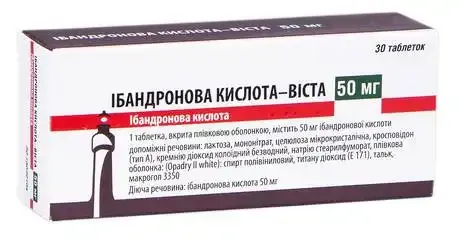
Table of Contents
INSTRUCTIONS FOR MEDICAL USE OF THE MEDICINAL PRODUCT IBANDRONIC ACID-VISTA (IBANDRONIC ACID-VISTA)
Composition:
Active substance: ibandronic acid;
One film-coated tablet contains 50 mg of ibandronic acid in the form of sodium ibandronate monohydrate 56.25 mg;
Excipients: lactose monohydrate; microcrystalline cellulose, crospovidone (type A), colloidal anhydrous silicon dioxide, sodium stearyl fumarate;
Film coating (Opadry II white): polyvinyl alcohol, titanium dioxide (E 171), talc, macrogol 3350.
Pharmaceutical form. Film-coated tablets.
Main physicochemical properties: elongated white or almost white film-coated tablets, with "I9ВЕ" engraved on one side and "50" on the other.
Pharmacotherapeutic group.
Agents affecting bone structure and mineralization. Bisphosphonates. Ibandronic acid. ATC code M05BA06.
Pharmacological Properties
Pharmacodynamics
Ibandronic acid is a bisphosphonate that acts specifically on bone tissue. It exerts a selective effect on bone tissue due to its high affinity for the mineral components of bone. It inhibits the activity of osteoclasts, although the exact mechanism remains unknown.
In vivo, ibandronic acid prevents bone destruction induced experimentally by gonadal function blockade, retinoids, tumors, and tumor extracts. Inhibition of endogenous bone resorption has also been documented in 45Ca kinetic studies by measuring the release of previously administered radioactive tetracycline. Ibandronic acid does not affect bone mineralization when administered at doses significantly exceeding pharmacologically effective ones.
Bone resorption associated with malignancy is characterized by excessive bone tissue resorption that is not balanced by adequate bone formation. Ibandronic acid selectively inhibits osteoclast activity, thereby reducing bone resorption and consequently decreasing skeletal complications of malignancy.
In clinical studies in patients with breast cancer and bone metastases, a dose-dependent inhibitory effect on bone osteolysis has been demonstrated, as assessed by bone resorption markers, along with a dose-dependent effect on skeletal events.
Pharmacokinetics
Absorption
After oral administration, ibandronic acid is rapidly absorbed in the upper gastrointestinal tract. The time to reach maximum plasma concentration is 0.5–2 hours (median: 1 hour) when administered on an empty stomach, with an absolute bioavailability of approximately 0.6%. Absorption is impaired when administered with food or beverages (other than plain water). Bioavailability decreases by approximately 90% when taken with a standard breakfast compared to administration on an empty stomach. When ibandronic acid is taken 30 minutes before food intake, bioavailability decreases by approximately 30%. No significant reduction in bioavailability is observed when administered 60 minutes before food intake. Bioavailability decreases by approximately 75% when ibandronic acid tablets are taken 2 hours after a standard meal. Therefore, ibandronic acid tablets should be taken in the morning (after at least 6 hours without food) and food should not be consumed for at least 30 minutes after administration of Ibandronic Acid-Vista (see section "Administration and Dosage").
Distribution
After initial systemic exposure, ibandronic acid rapidly binds to bone tissue or is excreted in urine. In humans, the apparent volume of distribution is at least 90 L. Approximately 40–50% of the circulating drug penetrates and accumulates in bone tissue. At therapeutic concentrations, approximately 87% is bound to plasma proteins, resulting in a low potential for interaction with other medicinal products due to displacement.
Metabolism
There are no data on the metabolism of ibandronic acid in animals or humans.
Excretion
The absorbed portion of ibandronic acid is removed from the bloodstream either by bone uptake (approximately 40–50%) or excreted unchanged by the kidneys. The unabsorbed portion is excreted unchanged in feces. The range of apparent elimination half-life is broad and depends on the administered dose and the sensitivity of the analytical method; however, the apparent terminal half-life ranges from 10 to 60 hours. Nevertheless, the initial plasma concentration of the drug declines rapidly, reaching 10% of peak levels within 3 hours and 8 hours after intravenous administration or oral administration, respectively.
Total clearance of ibandronic acid is low, averaging 84–160 mL/min. Renal clearance (approximately 60 mL/min in healthy postmenopausal women) accounts for 50–60% of total clearance and depends on creatinine clearance. The difference between apparent total and renal clearance reflects uptake of the drug by bone tissue.
Excretion pathways apparently do not involve known acidic or basic transport systems involved in the elimination of other active substances. Furthermore, ibandronic acid does not inhibit major human hepatic P450 isoenzymes and does not induce the cytochrome P450 system in rats.
Pharmacokinetics in Special Situations
Sex
Bioavailability and pharmacokinetic parameters of ibandronic acid are independent of sex.
Race
There are no data on clinically significant inter-ethnic differences between Mongoloid and Caucasian patients regarding the distribution of ibandronic acid. Data for Negroid race patients are insufficient.
Patients with Renal Impairment
Renal clearance of ibandronic acid in patients with various degrees of renal impairment is correlated with creatinine clearance. In patients with severe renal impairment (creatinine clearance ≤30 mL/min) receiving oral ibandronic acid 10 mg for 21 days, plasma concentrations were 2–3 times higher than in patients with normal renal function (creatinine clearance ≥80 mL/min). Total clearance of ibandronic acid was reduced to 44 mL/min in patients with severe renal impairment compared to 129 mL/min in those with normal renal function. Dose adjustment is not required for patients with mild renal impairment (creatinine clearance ≥50 mL/min and <80 mL/min). Dose adjustment is recommended for patients with moderate renal impairment (creatinine clearance ≥30 mL/min and <50 mL/min) and severe renal impairment (creatinine clearance <30 mL/min) (see section "Administration and Dosage").
Patients with Hepatic Impairment (see section "Administration and Dosage")
There are no data on the pharmacokinetics of ibandronic acid in patients with hepatic impairment. The liver does not play a significant role in the clearance of ibandronic acid, which is not metabolized but is excreted by the kidneys and through uptake by bone tissue. Therefore, dose adjustment is not required in patients with hepatic impairment. Since plasma protein binding of ibandronic acid at therapeutic concentrations is low (approximately 87%), it is unlikely that hypoalbuminemia in severe liver disease would lead to a clinically significant increase in free drug concentration.
Elderly Patients (see section "Administration and Dosage")
Pharmacokinetic parameters studied do not depend on age. Since renal function declines with age, this is the only factor that should be considered (see section "Patients with Renal Impairment").
Children (see section "Administration and Dosage")
There are no data on the use of Ibandronic Acid-Vista in children under 18 years of age.
Clinical characteristics.
Indications.
Prevention of skeletal events (pathological fractures, bone complications requiring radiation therapy or surgical intervention) in patients with breast cancer and metastatic bone involvement.
Contraindications.
Hypersensitivity to ibandronic acid or to any other component of the medicinal product (see section "Composition"). Hypocalcemia. Esophageal disorders with delayed esophageal emptying, such as stricture or achalasia. Inability to remain in an upright position (standing or sitting) for at least 60 minutes.
Interaction with other medicinal products and other forms of interaction.
Interaction of the medicinal product with food
Foods containing calcium, including milk, and other polyvalent cations (aluminum, magnesium, iron) may interfere with the absorption of ibandronic acid. Therefore, such foods and food products should be taken no earlier than 30 minutes after oral administration of Ibandronic Acid-Vista.
Bioavailability was reduced by approximately 75% when Ibandronic Acid-Vista film-coated tablets were administered 2 hours after a standard meal. Therefore, Ibandronic Acid-Vista should be taken in the morning (after at least 6 hours without food intake), and food should not be consumed for at least 30 minutes after administration of the medicinal product (see section "Dosage and administration").
Interaction with other medicinal products.
Metabolic interactions are considered unlikely, as ibandronic acid does not inhibit the major human hepatic CYP450 isoenzymes and does not induce the hepatic cytochrome P450 system in rats (see section "Pharmacokinetics"). Ibandronic acid is excreted via renal elimination and does not undergo biotransformation.
H2-receptor antagonists and other medicinal products that increase gastric pH.
In a study involving healthy volunteers (men) and postmenopausal women, intravenous ranitidine increased the bioavailability of ibandronic acid by approximately 20% (within the normal range of variability of ibandronic acid bioavailability), possibly due to reduced gastric acidity. However, dose adjustment of Ibandronic Acid-Vista when co-administered with H2-receptor antagonists or other agents that increase gastric pH is not required.
Acetylsalicylic acid and nonsteroidal anti-inflammatory drugs (NSAIDs).
Since acetylsalicylic acid, NSAIDs, and bisphosphonates may cause gastrointestinal irritation, caution should be exercised when using NSAIDs concomitantly with Ibandronic Acid-Vista (see section "Special precautions").
Aminoglycosides.
Bisphosphonates should be used with caution together with aminoglycosides, as both substances may reduce serum calcium levels over a prolonged period. Hypomagnesemia should also be monitored when these agents are used concomitantly.
Special precautions for use.
Patients with impaired bone and mineral metabolism.
Hypocalcemia and other disturbances of bone tissue metabolism and mineral metabolism must be corrected prior to initiating treatment with Ibandronic acid-Vista. Patients should receive adequate amounts of calcium and vitamin D. If dietary intake of calcium and/or vitamin D is insufficient, supplementation with these nutrients in the form of dietary supplements should be considered.
Gastrointestinal tract irritation.
Oral bisphosphonates may cause local irritation of the mucosa of the upper gastrointestinal tract. Due to these potential effects and the possibility of worsening underlying conditions, caution should be exercised when administering Ibandronic acid-Vista to patients with active upper gastrointestinal disorders (Barrett's esophagus, dysphagia, other esophageal diseases, gastritis, duodenitis, peptic ulcers). Adverse reactions such as esophagitis, esophageal ulcers, and esophageal erosions have been reported with oral bisphosphonate use; in some cases, these reactions were severe, required hospitalization, and rarely were associated with bleeding or subsequent development of stricture or perforation. The risk of developing severe esophageal adverse reactions is higher in patients who do not follow dosing instructions and/or in individuals who continue taking oral bisphosphonates after developing symptoms indicative of esophageal irritation. Therefore, patients must strictly adhere to dosing recommendations (see section "Dosage and administration").
Physicians should be vigilant for any signs or symptoms suggesting possible esophageal reactions or esophageal irritation and should inform patients of the necessity to discontinue Ibandronic acid and seek medical advice if dysphagia, pain upon swallowing, retrosternal pain, heartburn, or worsening heartburn occurs.
Although an increased risk was not observed in controlled clinical trials, cases of gastric and duodenal ulcers have been reported during post-marketing use of oral bisphosphonates. Some of these cases were severe and associated with complications.
Acetylsalicylic acid and NSAIDs.
Since acetylsalicylic acid, NSAIDs, and bisphosphonates may all cause gastrointestinal irritation, concomitant use of these medicinal products with Ibandronic acid-Vista should be done with caution.
Osteonecrosis of the jaw.
Osteonecrosis of the jaw has been very rarely reported during post-marketing use in patients receiving ibandronic acid for oncological indications (see section "Adverse reactions").
Initiation or re-initiation of treatment should be delayed in patients with unhealed open soft tissue lesions of the oral cavity. Prior to starting ibandronic acid therapy, patients with concomitant risk factors are recommended to undergo a dental examination with appropriate preventive interventions and individual assessment of benefit/risk ratio.
When assessing the risk of developing osteonecrosis of the jaw, the following risk factors should be considered:
- Potency of the bone resorption-inhibiting agent (risk is higher with highly potent compounds), route of administration (risk is higher with parenteral administration), and cumulative dose of bone resorption therapy.
- Malignant neoplasms, concomitant pathological conditions (e.g., anemia, coagulopathy, infection), tobacco smoking.
- Concomitant therapies: corticosteroids, chemotherapy, angiogenesis inhibitors, radiotherapy to the head and neck region.
- Poor oral hygiene, periodontal disease, ill-fitting dentures, history of dental disease, invasive dental procedures such as tooth extraction.
All patients undergoing treatment with ibandronic acid should maintain good oral hygiene, undergo regular dental check-ups, and promptly report any oral symptoms such as loose teeth, pain, swelling, non-healing ulcers, or discharge. Invasive dental procedures should only be performed after careful consideration during treatment and should be avoided during and shortly after administration of ibandronic acid. Management of patients who develop osteonecrosis of the jaw should be carried out in close collaboration between the physician and a dentist or maxillofacial surgeon experienced in treating osteonecrosis of the jaw. Consideration should be given to temporarily interrupting ibandronic acid treatment until improvement occurs and contributing risk factors are reduced.
Osteonecrosis of the external auditory canal.
Osteonecrosis of the external auditory canal has been reported with bisphosphonate use, primarily during long-term therapy. Potential risk factors for osteonecrosis of the external auditory canal include steroid hormone use, chemotherapy, and/or local risk factors such as infections or trauma. The possibility of osteonecrosis of the external auditory canal should be considered in patients receiving bisphosphonates who present with ear symptoms, including chronic ear infections.
Atypical femoral fractures.
Atypical subtrochanteric and diaphyseal femoral fractures have been reported with bisphosphonate therapy, particularly in patients receiving long-term treatment for osteoporosis. These transverse or short oblique fractures may occur anywhere along the femur, from slightly below the lesser trochanter to just above the supracondylar flare. These fractures occur after minimal or no trauma, and some patients experience thigh or groin pain, often associated with characteristic features of stress fractures, weeks to months before the fracture manifests as a complete femoral fracture. Fractures are often bilateral; therefore, the contralateral femur should also be evaluated in patients receiving bisphosphonate therapy who have sustained a femoral shaft fracture. Poor healing of these fractures has also been reported.
The question of discontinuing bisphosphonate therapy in patients with suspected atypical femoral fractures should be considered pending full assessment of the patient, taking into account individual benefit/risk evaluation.
Patients undergoing bisphosphonate therapy should be advised to report new thigh, hip, or groin pain; all patients with such symptoms should be evaluated for incomplete femoral fracture.
Atypical fractures of other long bones.
Atypical fractures of other long bones (ulna and tibia) have been reported in patients receiving long-term therapy. As with atypical femoral fractures, these fractures occur after minimal or no trauma, and some patients experience prodromal pain prior to the occurrence of a complete fracture. In cases of ulnar fracture, this may be related to repetitive stress associated with prolonged use of walking aids (see section "Adverse reactions").
Renal impairment.
Clinical studies have not shown evidence of kidney function impairment with long-term therapy with Ibandronic acid. However, during treatment with this medicinal product, renal function, as well as serum calcium, phosphorus, and magnesium levels, should be monitored according to clinical assessment of each patient.
Patients with hypersensitivity to other bisphosphonates.
Caution should be exercised in patients with hypersensitivity to other bisphosphonates.
Disposal of unused medicine and expired products
Medicinal product entry into the environment should be minimized. The medicine should not be disposed of via wastewater or household waste. Disposal should be carried out via a dedicated waste collection system, if available.
Important information about excipients.
The medicine contains lactose. Patients with rare hereditary problems such as galactose intolerance, Lapp lactase deficiency, or glucose-galactose malabsorption should not take this medicine.
Use during pregnancy or breastfeeding.
Pregnancy.
There are no adequate data on the use of ibandronic acid in pregnant women. Reproductive toxicity was observed in rat studies. The potential risk to humans is unknown. Ibandronic acid-Vista should not be used during pregnancy.
Breastfeeding.
It is unknown whether ibandronic acid passes into breast milk. Studies in lactating rats have demonstrated low levels of ibandronic acid in milk after intravenous administration. Ibandronic acid-Vista should not be used during breastfeeding.
Fertility.
There are no data on the effect of ibandronic acid in humans. In reproductive studies in rats, ibandronic acid administered orally or intravenously at high daily doses reduced fertility.
Ability to influence the ability to drive and use machines.
Given the pharmacodynamic and pharmacokinetic profile and the reported adverse reactions, Ibandronic acid-Vista is expected to have no effect or a negligible effect on the ability to drive or operate machinery.
Administration and Dosage
Treatment with Ibandronic Acid-Vista should only be prescribed by a physician experienced in the management of malignant neoplasms.
Dosage
The recommended dose is 1 tablet (50 mg) once daily.
The tablets should be taken orally in the morning (after at least 6 hours of fasting) and before the first intake of food or drink of the day. Similarly, other medicinal products and dietary supplements (including calcium) should be avoided until after the administration of ibandronic acid tablets. Food should also be avoided for at least 30 minutes after taking Ibandronic Acid-Vista. Plain water may be consumed at any time during treatment with Ibandronic Acid (see section "Interaction with other medicinal products and other forms of interactions"). Water with a high calcium concentration should not be consumed. If there is concern about potentially high calcium levels in drinking water (hard water), it is recommended to use bottled water with a low mineral content. The tablets should be swallowed whole, not chewed, crushed, or divided, with a glass of plain water (180–240 mL), while in an upright position (sitting or standing).
Patients should remain upright and should not lie down for 60 minutes after taking the medication.
The tablets should not be chewed, sucked, or crushed due to the risk of developing ulcers in the oropharyngeal mucosa.
Ibandronic Acid-Vista should only be taken with plain water.
Special dosage recommendations
Patients with hepatic impairment
Dose adjustment is not required (see section "Pharmacokinetics in special situations").
Patients with renal impairment
For patients with mild renal impairment (creatinine clearance ≥50 mL/min and <80 mL/min), no dose adjustment is necessary.
For patients with moderate renal impairment (creatinine clearance ≥30 mL/min and <50 mL/min), the recommended dosage is reduced to 1 tablet of 50 mg every other day (see section "Pharmacokinetics in special situations").
For patients with severe renal impairment (creatinine clearance <30 mL/min), the recommended dosage is 1 tablet of 50 mg once weekly.
Elderly patients
Dose adjustment in elderly patients is not required (see section "Pharmacokinetics in special situations").
Children
The safety and efficacy of Ibandronic Acid-Vista in children (under 18 years of age) have not been established. No data are available (see sections "Pharmacokinetics in special situations" and "Administration and dosage").
Overdose
There is no specific information on the treatment of overdose with Ibandronic Acid-Vista. However, in the case of oral overdose, gastrointestinal reactions such as gastrointestinal disturbances, heartburn, esophagitis, gastritis, or ulceration may occur. To bind the drug, milk or antacids should be administered. Due to the risk of esophageal irritation, vomiting should not be induced. Patients should remain in an upright position.
Side effects
Summary of safety profile
The most serious adverse reactions reported are anaphylactic reaction/shock, atypical femoral fractures, osteonecrosis of the jaw, gastrointestinal irritation, and ocular inflammation (see "Description of selected adverse reactions" and section "Special warnings and precautions for use"). The most common treatment-related adverse event was a decrease in serum calcium levels below the normal range (hypocalcaemia). The next most frequent adverse reaction was dyspepsia.
The adverse reactions listed below were observed in two phase III pivotal studies (prevention of skeletal events in patients with breast cancer and bone metastases: 286 patients treated with the drug at a dose of 50 mg orally), as well as those reported during post-marketing use.
Adverse reactions are listed below according to the Medical Dictionary for Regulatory Activities (MedDRA) system organ class and frequency categories. Frequencies are defined as follows: very common (≥1/10), common (≥1/100 to <1/10), uncommon (≥1/1,000 to <1/100), rare (≥1/10,000 to <1/1,000), very rare (<1/10,000), and frequency not known (cannot be estimated from available data). Within each frequency group, adverse reactions are listed in order of decreasing severity.
Blood and lymphatic system disorders:
Uncommon – anaemia.
Immune system disorders:
Very rare – hypersensitivity†, bronchospasm†, angioedema†, anaphylactic reaction/shock**†; frequency not known – asthma exacerbation.
Metabolism and nutrition disorders:
Common – hypocalcaemia**.
Nervous system disorders:
Uncommon – paraesthesia, dysgeusia (taste disturbance).
Eye disorders:
Rare – eye inflammation†**.
Gastrointestinal disorders:
Common – oesophagitis, abdominal pain, dyspepsia, nausea; uncommon – gastrointestinal haemorrhage, duodenal ulcer, gastritis, dysphagia, dry mouth.
Skin and subcutaneous tissue disorders:
Uncommon – pruritus; very rare – Stevens-Johnson syndrome†, erythema multiforme†, bullous dermatitis†.
Musculoskeletal and connective tissue disorders:
Rare – atypical subtrochanteric and diaphyseal femoral fractures†; very rare – osteonecrosis of the jaw†**, osteonecrosis of the external auditory canal (an adverse reaction typical of bisphosphonates as a class)†; frequency not known – fractures of long bones other than the femur.
Renal and urinary disorders:
Uncommon – azotaemia (uraemia).
General disorders and administration site conditions:
Common – asthenia; uncommon – chest pain, influenza-like syndrome, malaise, pain.
Investigations:
Uncommon – increased serum parathyroid hormone levels.
** See below for detailed information.
† Identified during post-marketing use.
Description of selected adverse reactions
Hypocalcaemia
Reduced renal excretion of calcium may be accompanied by a decrease in serum phosphate levels, which does not require therapeutic intervention. Serum calcium levels may decrease to levels consistent with hypocalcaemia.
Osteonecrosis of the jaw
Cases of osteonecrosis of the jaw have been reported, primarily in patients with malignancies receiving bone resorption-inhibiting medicinal products, including ibandronic acid (see section "Special warnings and precautions for use"). Cases of osteonec游戏副本