Ibandronic acid - farmeks
Ukraine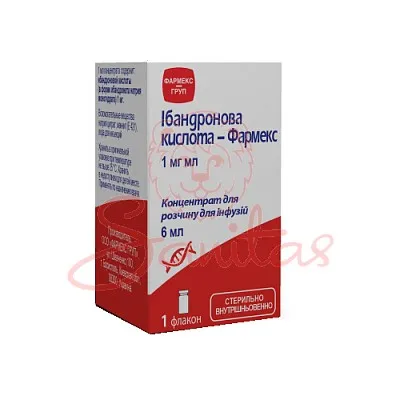
Table of Contents
INSTRUCTIONS FOR MEDICAL USE OF THE MEDICINAL PRODUCT IBANDRONIC ACID-PHARMEX (IBANDRONIC ACID-PHARMEX)
Composition:
Active substance: ibandronic acid;
1 ml of concentrate contains 1 mg of ibandronic acid (as sodium ibandronate monohydrate);
Excipients: sodium chloride, glacial acetic acid, sodium acetate trihydrate, water for injections.
Pharmaceutical form. Concentrate for solution for infusion.
Main physicochemical properties: clear, colorless liquid.
Pharmacotherapeutic group. Agents affecting bone structure and mineralization. Bisphosphonates. ATC code M05BA06.
Pharmacological properties.
Pharmacodynamics.
Ibandronate acid is a bisphosphonate that specifically acts on bone tissue. It exerts selective action on bone tissue due to its high affinity for mineral components of bone. It inhibits osteoblast activity, although the exact mechanism remains unknown.
In vivo, ibandronate acid prevents bone destruction caused by blockade of sex gland function, retinoids, tumor processes, and tumor extracts. Inhibition of endogenous bone resorption has also been confirmed in kinetic studies.
It does not impair bone mineralization when administered at doses significantly exceeding pharmacologically effective levels.
Ibandronate acid selectively inhibits osteoclast activity, thereby reducing bone resorption and consequently decreasing skeletal complications of malignant disease.
Pharmacokinetics.
After 2-hour infusion at doses of 2, 4, and 6 mg, pharmacokinetic parameters of ibandronate acid are dose-proportional.
Distribution.
Following entry into systemic circulation, ibandronate acid rapidly binds to bone tissue or is excreted in urine. Terminal volume of distribution is at least 90 L.
Approximately 40–50 % of the circulating drug readily penetrates into bone tissue and accumulates there. About 87 % is protein-bound in plasma.
Metabolism. There are no data on the metabolism of ibandronate acid in animals and humans.
Elimination. Ibandronate acid is eliminated from the bloodstream via bone uptake (40–50 %), with the remainder excreted unchanged by the kidneys. The mean elimination half-life ranges from 10 to 60 hours. Plasma levels decline rapidly and reach 10 % of peak values within 3 hours after intravenous administration. With intravenous administration of ibandronate acid every 4 weeks over 48 weeks in patients with bone metastases, no systemic accumulation was observed. Total clearance of ibandronate acid is 84–160 ml/min. Renal clearance (approximately 60 ml/min in healthy postmenopausal women) accounts for 50–60 % of total clearance and correlates with creatinine clearance. The difference between total and renal clearance reflects uptake of the drug by bone tissue. Secretion pathways apparently do not involve known acid and base transport systems involved in the excretion of other active substances. Furthermore, ibandronate acid does not inhibit major human hepatic P450 isoenzymes and does not induce the cytochrome P450 system in rats.
Gender. Bioavailability and pharmacokinetic parameters of ibandronate acid are independent of gender.
Race. There are no data on clinically significant differences in the distribution of ibandronate acid between Mongoloid and Caucasian patients. Data on distribution in Negroid patients are insufficient.
Patients with renal impairment.
Ibandronate dosage in patients with various stages of renal impairment is related to creatinine clearance.
In patients with severe renal impairment (mean creatinine clearance – 21.2 ml/min), after a single 15-minute intravenous infusion of 2 mg ibandronate, the mean area under the concentration–time curve (AUC0–24) increased by 110 % compared to healthy volunteers. In patients with mild (mean creatinine clearance – 68.1 ml/min) and moderate renal impairment (mean creatinine clearance – 41.2 ml/min), after a single 15-minute intravenous infusion of 6 mg ibandronate, the mean AUC0–24 increased by 14 % and 86 %, respectively, compared to healthy volunteers (mean creatinine clearance – 120 ml/min). Mean Cmax did not increase in patients with mild renal impairment and increased by 12 % in patients with moderate renal impairment. Dose adjustment is not required for patients with mild renal impairment (creatinine clearance ≥ 50 and < 80 ml/min). For patients with bone metastases from breast cancer and moderate (creatinine clearance ≥ 30 and < 50 ml/min) or severe renal impairment (creatinine clearance < 30 ml/min) receiving treatment for prevention of skeletal events, dose adjustment is recommended.
Patients with hepatic impairment. There are no pharmacokinetic data on ibandronate acid in patients with impaired liver function. The liver plays a minor role in the clearance of ibandronate acid, which is not metabolized but excreted by the kidneys and through uptake by bone tissue. Therefore, dose adjustment is not required in patients with hepatic impairment. Since plasma protein binding of ibandronate acid at therapeutic concentrations is low (85 %), it is unlikely that hypoalbuminemia in severe liver disease will lead to a clinically significant increase in free drug concentration (see "Route of administration and dosage" and "Special dosage recommendations").
Elderly. Pharmacokinetic parameters studied do not depend on age. However, since renal function declines with age, this is the only factor that should be considered (see "Special dosage recommendations").
Children. There are no data on the use of ibandronate acid in children (see "Special dosage recommendations").
Clinical characteristics.
Indications.
Prevention of skeletal-related events (pathological fractures, bone complications requiring radiation therapy or surgical intervention) in patients with breast cancer and metastatic bone involvement.
Treatment of hypercalcemia of malignancy with or without metastases.
Contraindications.
Hypersensitivity to ibandronic acid or to any other component of the medicinal product. Hypocalcemia (see section "Special precautions").
Interaction with other medicinal products and other forms of interaction.
Metabolic interactions are unlikely, since ibandronic acid does not inhibit the major human hepatic CYP450 isoenzymes and does not induce the hepatic cytochrome P450 system in rats. Ibandronic acid is excreted via renal excretion and is not subject to biotransformation processes.
Use ibandronic acid with caution in combination with aminoglycosides, as both substances may reduce serum calcium levels for a prolonged period. Also, hypomagnesemia should be monitored when these drugs are used concomitantly.
Special precautions for use.
Patients with impaired bone and mineral metabolism
Hypocalcemia and other disturbances of bone metabolism and electrolyte balance should be corrected prior to initiating treatment with ibandronic acid for metastatic bone disease. Adequate intake of calcium and vitamin D should be ensured.
If dietary intake of calcium and/or vitamin D is insufficient, supplementation with these nutrients in the form of dietary supplements should be provided.
Anaphylactic reaction/shock
Cases of anaphylactic reaction/shock, including fatal cases, have been reported in patients receiving intravenous ibandronic acid. Appropriate medical support and monitoring measures should be readily available during intravenous administration. If an anaphylactic or other severe hypersensitivity/allergic reaction occurs, the infusion should be immediately discontinued and appropriate treatment initiated.
Osteonecrosis of the jaw
Osteonecrosis of the jaw has been reported very rarely during post-marketing use in patients receiving ibandronic acid for oncological indications (see section "Adverse reactions").
Initiation or re-initiation of treatment should be delayed in patients with unhealed open soft tissue lesions in the oral cavity. Prior to starting treatment with ibandronic acid, patients with concomitant risk factors should undergo a dental examination with appropriate preventive interventions and an individual benefit-risk assessment.
Factors to consider when assessing the risk of developing osteonecrosis of the jaw include:
- Potency of the bone-resorbing inhibiting agent (higher risk with highly potent compounds), route of administration (higher risk with parenteral administration), and cumulative dose of bone-resorption therapy.
- Malignant neoplasms, concomitant medical conditions (e.g., anemia, coagulopathy, infection), and tobacco smoking.
- Concomitant therapies: corticosteroids, chemotherapy, angiogenesis inhibitors, radiotherapy to the head and neck region.
- Poor oral hygiene, periodontal disease, ill-fitting dentures, history of dental disease, and invasive dental procedures such as tooth extractions.
During treatment with the medicinal product, all patients should be advised to maintain good oral hygiene, undergo regular dental check-ups, and promptly report any oral symptoms such as tooth mobility, pain or swelling, non-healing ulcers, or discharge. Invasive dental procedures should only be performed after careful consideration and should be avoided during and for some time after ibandronic acid treatment. Management of patients who develop osteonecrosis of the jaw should be conducted in close collaboration with a dentist or oral and maxillofacial surgeon experienced in managing this condition. Temporary discontinuation of treatment should be considered until improvement occurs and, if possible, until concomitant risk factors are reduced.
Osteonecrosis of the external auditory canal
Osteonecrosis of the external auditory canal has been reported with bisphosphonate use, primarily with long-term therapy. Potential risk factors include corticosteroid and chemotherapy use and/or local risk factors such as infection or trauma. Osteonecrosis of the external auditory canal should be considered in patients receiving bisphosphonates who present with ear symptoms, including chronic ear infections.
Atypical femoral fractures
Atypical subtrochanteric and diaphyseal femoral fractures have been reported with bisphosphonate therapy, particularly in patients receiving long-term treatment for osteoporosis. These transverse or short oblique fractures may occur anywhere along the femur, from slightly below the lesser trochanter to just above the supracondylar flare. These fractures occur following minimal or no trauma. Some patients experience thigh or groin pain, often associated with characteristic features of a stress fracture, for several weeks to months before the fracture becomes a complete femoral fracture. Fractures are often bilateral; therefore, the contralateral femur should also be examined in patients receiving bisphosphonate therapy who have sustained a femoral shaft fracture. Poor healing of these fractures has also been reported. The possibility of discontinuing bisphosphonate therapy should be considered in cases of suspected atypical femoral fracture pending full assessment of the patient, taking into account the individual benefit-risk assessment.
During bisphosphonate therapy, patients should be advised to report any thigh, hip, or groin pain. All patients presenting with such symptoms should be evaluated for incomplete femoral fracture.
Atypical fractures of other long bones
Atypical fractures of other long bones, such as the ulna and tibia, have also been reported in patients receiving long-term bisphosphonate therapy. As with atypical femoral fractures, these fractures occur following minimal or no trauma, and some patients report prodromal pain prior to complete fracture. In cases of ulnar fracture, this may be associated with repetitive stress from prolonged use of walking aids (see section "Adverse reactions").
Renal impairment
In clinical studies in patients with breast cancer metastatic to bone, no evidence of renal function impairment was observed with long-term ibandronic acid therapy. However, renal function, as well as serum calcium, phosphate, and magnesium levels, should be monitored during treatment.
Hepatic impairment
Due to the lack of clinical data, the medicinal product should not be administered to patients with severe hepatic impairment.
Heart failure
Patients at risk of developing heart failure should avoid excessive hydration.
Patients with hypersensitivity to other bisphosphonates
Caution should be exercised in patients with hypersensitivity to other bisphosphonates.
Excipients with known effect
This medicinal product contains less than 1 mmol (23 mg) of sodium per vial, i.e., essentially "sodium-free".
Disposal of unused medicinal product and waste materials: Environmental contamination should be minimized. The medicinal product must not be disposed of via wastewater or household waste. Disposal should be carried out via a designated waste collection system, if available.
Use during pregnancy or breastfeeding.
Pregnancy
There is no clinical experience with the use of ibandronic acid in pregnant women.
The potential risk to humans is unknown. Ibandronic acid should not be used during pregnancy.
Breastfeeding
It is unknown whether ibandronic acid is excreted in human milk; therefore, the use of this medicinal product is not recommended during pregnancy or breastfeeding.
Fertility
There are no data on the effect of ibandronic acid in humans.
Ability to affect reaction speed when driving or operating machinery.
Considering the pharmacodynamic and pharmacokinetic properties and the adverse reactions profile, ibandronic acid is expected to have no effect or a negligible effect on the ability to drive or operate machinery.
Administration and Dosage
Treatment with ibandronic acid should only be prescribed by a physician experienced in the management of malignant diseases.
Prevention of skeletal complications in patients with cancer and metastatic bone disease: 6 mg administered intravenously as a continuous infusion over at least 15 minutes every 3–4 weeks, after prior dilution in 100 mL of 0.9% sodium chloride solution or 100 mL of 5% glucose solution.
A 15-minute infusion is only recommended for patients with normal renal function or mild renal impairment (creatinine clearance > 50 mL/min). The efficacy and safety of a 15-minute infusion have not been studied in patients with creatinine clearance < 50 mL/min (see section "Special Dosage Recommendations").
Treatment of hypercalcemia of malignancy.
Ibandronic acid therapy should only be initiated after adequate hydration with 0.9% sodium chloride solution. The dose depends on the severity of hypercalcemia and the type of tumor. Patients with severe hypercalcemia (albumin-corrected serum calcium ≥ 3 mmol/L or ≥ 12 mg/dL) should receive a single dose of 4 mg. Patients with moderate hypercalcemia (albumin-corrected serum calcium < 3 mmol/L or < 12 mg/dL) should receive a single dose of 2 mg. The maximum single dose of 6 mg does not provide additional therapeutic benefit.
If the initial dose is insufficient or if hypercalcemia recurs, repeat administration of the drug may be considered.
The albumin-corrected calcium concentration is calculated using the following formula:
Serum calcium (mmol/L) – [0.02 × albumin (g/L)] + 0.8
or albumin-corrected serum calcium (mg/dL) + 0.8 × [4 – albumin (g/dL)].
In most cases, hypercalcemia resolves within 7 days. After administration of a 2 mg or 4 mg dose, repeat dosing may be performed after 18–19 days. After administration of a 6 mg dose, repeat dosing may be performed after 26 days.
The medicinal product should be diluted in 500 mL of 0.9% sodium chloride solution or 500 mL of 5% glucose solution and administered as an infusion over 1–2 hours.
Special Dosage Recommendations
Patients with hepatic impairment
Dose adjustment is not required (see "Pharmacokinetics in Special Situations").
Patients with renal impairment
For patients with mild renal impairment (creatinine clearance ≥ 50 and < 80 mL/min), no dose adjustment is necessary.
To prevent skeletal-related events in patients with metastatic bone disease due to breast cancer and moderate renal impairment (creatinine clearance ≥ 30 and < 50 mL/min) or severe renal impairment (creatinine clearance < 30 mL/min), the following recommendations should be observed (see section "Pharmacokinetics"):
| Creatinine clearance (ml/min) |
Dose |
Volume1 and duration2 of infusion |
| ≥ 50 to < 80 |
6 mg (6 ml concentrate for solution for infusion) |
100 ml over 15 minutes |
| ≥ 30 to < 50 |
4 mg (4 ml concentrate for solution for infusion) |
500 ml over 1 hour |
| < 30 |
2 mg (2 ml concentrate for solution for infusion) |
500 ml over 1 hour |
- 0.9% sodium chloride solution or 5% glucose solution.
- Administration once every 3–4 weeks.
Data on administration over 15 minutes in patients with creatinine clearance less than 50 ml/min are lacking.
Elderly patients (>65 years of age).
Dose adjustment in elderly individuals is not required.
Special instructions for use
For single use only. Only clear, particle-free solutions should be used. Ibandronic acid should be administered only as an intravenous infusion. Ibandronic acid must not be administered intra-arterially or paravenously, as this may lead to tissue damage.
From a microbiological standpoint, the product should be used immediately. If not used immediately, the storage duration and conditions of the prepared solution are the responsibility of the user, provided that the dilution is carried out under controlled and validated aseptic conditions. The prepared solution may be stored for no more than 24 hours at 2–8°C.
Children. The safety and efficacy of ibandronic acid in pediatric patients (under 18 years of age) have not been established.
Overdose
There is no information on acute overdose with ibandronic acid. There is no specific antidote for ibandronic acid overdose. Due to the potential toxic effects on the liver and kidneys, organ function should be monitored. In the event of hypocalcemia, treatment with calcium gluconate should be administered.
Adverse Reactions
The most serious adverse reactions reported are anaphylactic reaction/shock, atypical femoral fractures, osteonecrosis of the jaw, and ocular inflammation (see "Description of specific adverse reactions" and section "Special precautions").
Treatment of malignancy-related hypercalcemia was most frequently associated with increased body temperature. Hypocalcemia (serum calcium levels below normal) was reported less frequently. In most cases, no specific treatment was required and symptoms resolved within several hours/days.
Use for prevention of skeletal events in patients with breast cancer and bone metastases was most frequently associated with asthenia, accompanied by fever and headache.
Adverse reactions are listed below according to the MedDRA Medical Dictionary for Regulatory Activities terminology by system organ class and frequency category. Adverse reactions are categorized by frequency as follows: very common (≥ 1/10), common (≥ 1/100 to < 1/10), uncommon (≥ 1/1000 to < 1/100), rare (≥ 1/10000 to < 1/1000), very rare (< 1/10000), frequency not known (cannot be estimated from available data). Within each frequency category, adverse reactions are listed in decreasing order of severity.
Infections and infestations: common: infections; uncommon: cystitis, vaginitis, oral candidiasis.
Benign, malignant and unspecified neoplasms (including cysts and polyps): uncommon: benign skin neoplasms.
Blood and lymphatic system disorders: uncommon: anemia, blood disorder.
Immune system disorders: very rare: hypersensitivity reactions, bronchospasm, angioneurotic edema, anaphylactic reaction/shock; frequency not known: asthma exacerbation.
Endocrine disorders: common: disorders of parathyroid glands.
Metabolism and nutrition disorders: common: hypocalcemia; uncommon: hypophosphatemia.
Psychiatric disorders: uncommon: sleep disorders, anxiety, emotional lability.
Nervous system disorders: common: headache, dizziness, taste disturbance; uncommon: cerebrovascular disorders, nerve root compression, amnesia, migraine, neuralgia, hypertension, hyperesthesia, perioral paresthesia, parosmia.
Eye disorders: common: cataract; rare: ocular inflammation.
Ear and labyrinth disorders: uncommon: deafness.
Cardiac disorders: common: bundle branch block; uncommon: myocardial ischemia, cardiovascular disorders, palpitations.
Respiratory, thoracic and mediastinal disorders: common: pharyngitis; uncommon: pulmonary edema, stridor.
Gastrointestinal disorders: common: diarrhea, dyspepsia, vomiting, gastrointestinal pain, dental disorders; uncommon: gastroenteritis, dysphagia, gastritis, oral ulceration, cheilitis.
Hepatobiliary disorders: uncommon: cholelithiasis.
Skin and subcutaneous tissue disorders: common: skin disorders, ecchymosis; uncommon: rash, alopecia; very rare: Stevens-Johnson syndrome, erythema multiforme, bullous dermatitis.
Musculoskeletal and connective tissue disorders: common: bone pain, myalgia, osteoarthritis, arthralgia, joint disorders; rare: atypical subtrochanteric and diaphyseal femoral fractures; very rare: osteonecrosis of the jaw; frequency not known: atypical fractures of other long bones. Osteonecrosis of the external auditory canal (an adverse reaction characteristic of bisphosphonates as a class).
Renal and urinary disorders: uncommon: urinary retention, renal cysts.
Reproductive system and breast disorders: uncommon: pelvic pain.
General disorders and administration site conditions: common: asthenia, influenza-like symptoms, peripheral edema, thirst; uncommon: hypothermia, injection site reactions, pyrexia.
Investigations: common: increased gamma-glutamyl transferase levels, increased creatinine levels; uncommon: increased alkaline phosphatase levels, weight decreased.
Injury, poisoning and procedural complications: uncommon: injury, injection site pain.
Description of specific adverse reactions
Hypocalcemia
Reduced renal calcium excretion may be accompanied by decreased serum phosphate levels, which does not require therapeutic intervention. Serum calcium levels may decrease to the point of hypocalcemia.
Influenza-like illness
The influenza-like syndrome included symptoms such as fever, chills, and bone and/or muscle pain. In most cases, no specific treatment was required and symptoms resolved within several hours/days.
Osteonecrosis of the jaw
Osteonecrosis of the jaw has been observed in patients receiving bisphosphonates. Most reports involved cancer patients, but cases of osteonecrosis of the jaw have also been reported in patients receiving treatment for osteoporosis. Osteonecrosis of the jaw is generally associated with tooth extraction and/or local infection (including osteomyelitis). The presence of malignancy, chemotherapy, radiation therapy, corticosteroid use, and poor oral hygiene are also considered risk factors (see section "Special precautions").
Atypical subtrochanteric and diaphyseal femoral fractures
Although the pathophysiology is not fully understood, epidemiological data suggest an increased risk of atypical subtrochaneric and diaphyseal femoral fractures with long-term bisphosphonate therapy for postmenopausal osteoporosis, particularly after three to five years of treatment. The absolute risk of atypical subtrochanteric and diaphyseal fractures of long bones (a class effect of bisphosphonates) remains very low.
Ocular inflammation
Inflammatory eye disorders such as uveitis, episceritis, and scleritis have been reported during ibandronate therapy. In some cases, these inflammatory conditions resolved only after discontinuation of bisphosphonates.
Anaphylactic reaction/shock
Cases of anaphylactic reaction/shock, including fatal cases, have been observed in patients receiving intravenous ibandronate.
Reporting of suspected adverse reactions
Reporting suspected adverse reactions after marketing authorization is important. It allows continued monitoring of the benefit-risk balance of the medicinal product. Healthcare professionals are asked to report any suspected adverse reactions via the national pharmacovigilance system.
Shelf life.
3 years.
Storage conditions.
Store in the original packaging at a temperature not exceeding 25 °C. Keep out of reach of children.
Incompatibilities. To avoid incompatibility, ibandronate should be diluted only in 0.9% sodium chloride solution or 5% glucose solution. Ibandronate should not be mixed with solutions containing calcium.
Packaging. 6 mL in a vial, 1 vial per cardboard pack.
Prescription status. Prescription only.
Manufacturer. LLC "FARMEKS GROUP".
Manufacturer's address and place of business.
100 Shevchenka St., Boryspil, Kyiv Oblast, 08301, Ukraine.