Glutargin
Ukraine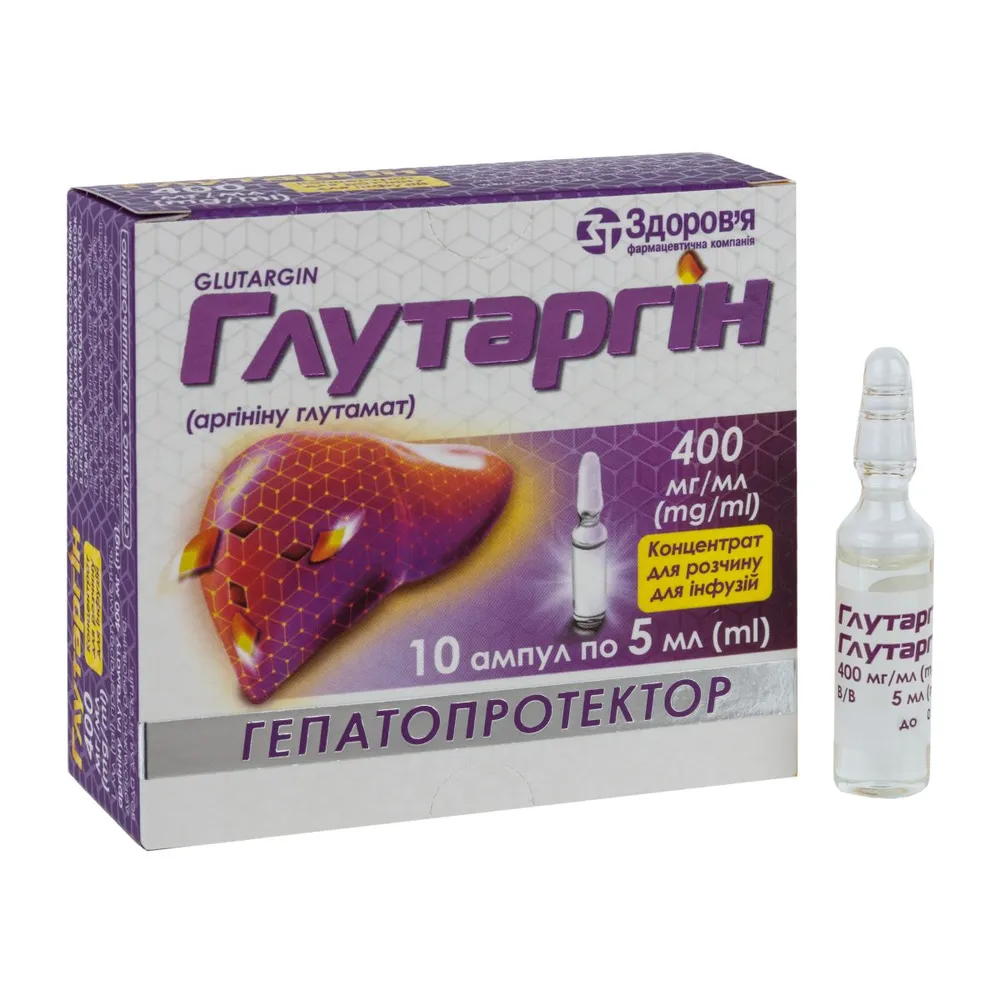
Table of Contents
INSTRUCTIONS FOR MEDICAL USE of the medicinal product GLUTARGIN (GLUTARGIN)
Composition:
Active substance: arginine glutamate;
1 ml of solution contains 40 mg of arginine glutamate;
Excipient: water for injections.
Pharmaceutical form. Solution for injection.
Main physicochemical properties: clear, colorless solution.
Pharmacotherapeutic group. Agents used in liver diseases, lipotropic substances. Hepatotropic agents. Arginine glutamate. ATC code A05BA01.
Pharmacological properties.
Pharmacodynamics. Glutargin is a combination of arginine and glutamic acid, which play an important role in supporting biochemical processes of neutralization and elimination from the body of highly toxic metabolite of nitrogenous substances metabolism – ammonia. The hypoammonemic effects of the drug are achieved through activation of ammonia detoxification in the ornithine cycle of urea synthesis, binding of ammonia into non-toxic glutamine, as well as enhanced removal of ammonia from the central nervous system (CNS) and its excretion from the body. Due to these properties, the drug reduces general toxic, including neurotoxic, effects of ammonia.
Glutargin also has hepatoprotective action due to its antioxidant, anti-hypoxic, and membrane-stabilizing properties, and positively influences energy supply processes in hepatocytes.
In alcohol intoxication, the drug stimulates utilization of alcohol in the hepatic monooxygenase system, prevents inhibition of the key enzyme in ethanol metabolism – alcohol dehydrogenase; accelerates inactivation and elimination of toxic metabolites of ethanol by increasing the formation and oxidation of succinic acid; reduces the depressant effect of alcohol on the central nervous system (CNS) due to the excitatory neurotransmitter properties of glutamic acid. Thanks to these properties, the drug exhibits detoxifying and sobering effects.
In pregnancy-related disorders, due to its endothelioprotective action, the drug reduces impaired vascular permeability and thromboresistance, prevents hypercoagulation, and decreases vascular sensitivity to vasoconstrictive agents (endothelin, angiotensin, thromboxane) that cause generalized vasospasm. After prior biotransformation into nitric oxide, arginine exerts vasodilatory effects, positively influences blood coagulation and functional properties of circulating blood elements. As a result of vasodilatory and anti-hypoxic effects, maternal-fetal hemodynamics improves and fetal intrauterine hypoxia decreases. In pregnancy-related disorders, the drug also exhibits detoxifying and hepatoprotective activity and acts as a non-specific metabolic regulator of metabolic processes. Due to these properties, during pregnancy the drug reduces levels of circulating immune complexes, diminishes severity of the "metabolic" intoxication syndrome and immunotoxicosis, and enhances the body's compensatory and adaptive responses.
Glutargin does not exhibit embryotoxic, gonadotoxic, or mutagenic effects and does not cause allergic or immunotoxic reactions.
Pharmacokinetics. Not studied.
Clinical characteristics.
Indications. In complex therapy of acute and chronic hepatitis of various etiologies, including poisoning with hepatotropic toxins (e.g., Amanita phalloides, chemicals, and drugs), liver cirrhosis, leptospirosis, including conditions accompanied by hyperammonemia.
Hepatic encephalopathy, precoma, and coma associated with hyperammonemia.
Acute alcohol intoxication of moderate to severe degree, including alcoholic encephalopathy and coma. Post-intoxication disorders caused by alcohol consumption.
Complications in the third trimester of pregnancy: late gestosis, including its severe forms—preeclampsia and eclampsia, fetoplacental insufficiency, chronic pathologies of the hepatobiliary system in pregnant women, including conditions accompanied by hyperammonemia.
Contraindications. Hypersensitivity to the components of the drug. State of collapse, increased excitability and psychotic reactions with stormy course, severe impairment of renal filtration (nitrogen-excreting) function.
Interaction with other medicinal products and other types of interactions. When used concomitantly, aminophylline potentiates the increase in blood concentration of endogenous insulin. Glutargin may enhance the effect of antiplatelet agents (dipyridamole). It prevents and reduces neurotoxic manifestations that may occur during isoniazid administration. It diminishes the effect of vinblastine.
Special precautions for use
When prescribing the drug to patients with endocrine gland function disorders, it should be taken into account that the drug stimulates insulin and growth hormone secretion. The drug activates ammonia binding into urea, which may be accompanied by a transient increase in blood urea levels.
After completing a course of treatment with Glutargin solution, if necessary, transition to Glutargin tablets may be performed.
Use during pregnancy or breastfeeding. The safety of clinical use of the drug during the first and second trimesters of pregnancy and during breastfeeding has not been studied. If use of the drug is necessary, breastfeeding should be discontinued.
Ability to influence reaction rate while driving or operating machinery. Since adverse reactions from the central nervous system (headache, dizziness, tremor) may occur during treatment with the drug, caution should be exercised when driving or operating machinery.
Dosage and Administration
The drug is intended for intravenous use in adults.
Hepatitis, hyperammonemia. Administer by drip infusion twice daily, 50 ml (2 g) diluted in 150–250 ml of 0.9% sodium chloride solution or 5% glucose solution, at a rate of 60–70 drops per minute. In severe cases, the daily dose may be increased to 150–200 ml (6–8 g). Treatment duration: 5–10 days. Maximum daily dose: 200 ml (8 g).
Alcohol intoxication. Administer 20 ml (0.8 g) twice daily by drip infusion in 150–250 ml of 0.9% sodium chloride solution or 5% glucose solution at a rate of 60–70 drops per minute for 2–3 days, then reduce the dose to 10 ml (0.4 g) twice daily for 10 days. In severe cases (alcoholic coma), increase the daily dose to 50 ml (2 g) twice daily.
After completing the course of treatment with Glutargin solution, if necessary, switch to oral Glutargin tablets.
Pregnancy complications. Administer once or twice daily, 50 ml (2 g) per dose. Treatment duration: 5–7 days. Maximum daily dose: 100 ml (4 g).
Children. The efficacy and safety of the drug have not been sufficiently studied; therefore, the drug should not be used in this age group.
Overdose.
Symptoms: Exaggeration of adverse reactions, chest pain, atrioventricular block.
Treatment: In case of overdose, administer corticosteroids intravenously. Symptomatic therapy.
Adverse Reactions. Rarely possible:
General disorders: Dyspnea, substernal pain, hyperthermia, chills;
Cardiovascular system: Cardiac rhythm disturbances such as atrial fibrillation, arterial hypotension, tachycardia;**
Gastrointestinal tract: Nausea, epigastric pain;
Nervous system: Headache, dizziness, tremor, weakness;
Skin: Itching, rash, hyperemia;
Immune system: Hypersensitivity reactions, including urticaria, Quincke's edema;
Local reactions: Injection site reactions, phlebitis.
Shelf life. 4 years.
Storage conditions. Store in original packaging at a temperature not exceeding 25 °C. Keep out of reach of children.
Incompatibility. Data not available. Use only recommended solvents.
Packaging. 5 ml in ampoules, 10 ampoules per box; 10 (5×2) in blisters in a box.
Release category. Prescription only.
Manufacturer. LIMITED LIABILITY COMPANY "CORPORATION "ZDOROV'YA".
Manufacturer’s address and place of business.
22 Shevchenka Street, Kharkiv, Kharkiv Oblast, 61013, Ukraine.