Glautan
Ukraine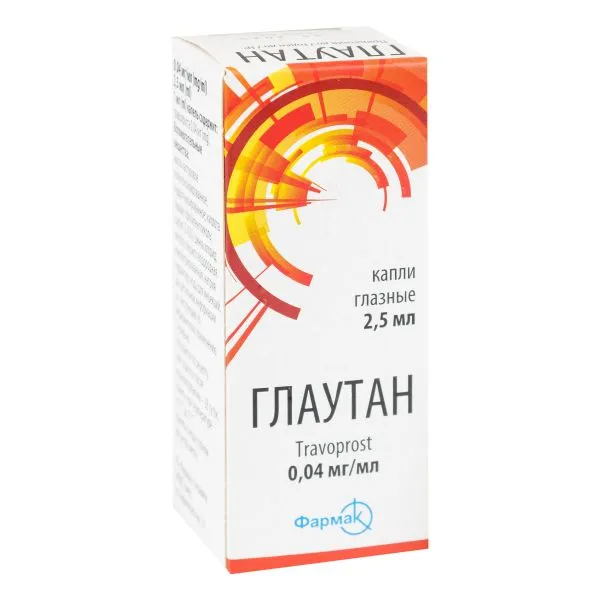
Table of Contents
INSTRUCTION FOR MEDICAL USE OF THE MEDICINAL PRODUCT GLAUTAN (GLAUTAN)
Composition:
Active substance: travoprost;
1 ml of drops contains 0.04 mg of travoprost;
Excipients: polyoxyl 40 hydrogenated castor oil; boric acid; propylene glycol; sorbitol (E 420); zinc chloride; hydrochloric acid concentrated; sodium hydroxide; water for injections.
Pharmaceutical form. Eye drops.
Main physicochemical properties: clear, colourless liquid.
Pharmacotherapeutic group. Medicinal products used in ophthalmology. Antiglaucoma preparations and miotics. Prostaglandin analogues. ATC code S01E E04.
Pharmacological properties.
Pharmacodynamics.
Travoprost, a prostaglandin F2α analogue, is a potent and selective full agonist of the prostaglandin FP receptor, with high affinity for FP receptors. It reduces intraocular pressure (IOP) by increasing the outflow of aqueous humor through the trabecular meshwork and uveoscleral pathway. Reduction in IOP begins approximately 2 hours after administration of the drug, with maximum effect achieved by 12 hours. A significant reduction in IOP following a single dose may persist for more than 24 hours.
In clinical studies of patients with open-angle glaucoma or ocular hypertension and baseline IOP of 25–27 mmHg, travoprost administered once daily in the evening resulted in a reduction of IOP by 7–8 mmHg. Subgroup analyses of these studies showed that IOP reduction in black patients was 1.8 mmHg greater than in other patients. At present, it is unknown whether this difference is related to race or to heavily pigmented irides.
Pharmacokinetics.
Travoprost is an isopropyl ester prodrug. It is absorbed through the cornea, where the isopropyl ester is hydrolyzed by corneal esterases to the active free acid. Data from four pharmacokinetic studies (total of 107 patients) showed that plasma concentrations of the free acid were below 0.01 ng/mL (the lower limit of quantitation) in two-thirds of patients. In subjects with measurable plasma concentrations (N=38), mean Cmax in plasma was 0.018±0.007 ng/mL (range: 0.01 to 0.052 ng/mL), reached within 30 minutes. According to these studies, the elimination half-life in plasma is 45 minutes. There were no differences in plasma concentrations between day 1 and day 7, indicating that steady-state concentration was achieved early and that significant accumulation did not occur.
Systemically, the free acid of travoprost is metabolized to inactive metabolites via beta-oxidation of the alkyl side chain (carboxylic acid) to form 1,2-dinor and 1,2,3,4-tetranor analogues, as well as via oxidation of the 15-hydroxyl group and cleavage of the 13,14 double bond.
Elimination of the free acid of travoprost from plasma was rapid, with levels typically below the limit of quantitation within 1 hour after dosing. The terminal half-life of the free acid of travoprost was estimated in 14 patients and ranged from 17 to 86 minutes, with a mean half-life of 45 minutes. Less than 2% of the topically administered ocular dose of travoprost is excreted in urine within 4 hours as the free acid of travoprost.
Clinical characteristics.
Indications.
Reduction of elevated intraocular pressure in patients with ocular hypertension or open-angle glaucoma.
Contraindications.
Hypersensitivity to the active substance or to any of the excipients of the medicinal product.
Interaction with other medicinal products and other forms of interactions.
Studies on interactions with other medicinal products have not been conducted.
Special precautions for use.
Pigmentation
Ophthalmic travoprost solution has been reported to cause tissue pigmentation. Increased pigmentation of the iris, periorbital area (eyelids), and eyelashes has been most frequently reported. Pigmentation increases as long as travoprost is administered. The pigmentation is due to increased melanin content in melanocytes, not to an increase in the number of melanocytes. After discontinuation of travoprost, iris pigmentation is likely to be permanent, whereas pigmentation of the periorbital area and changes in the eyelash area may be reversible in some patients. Patients using the medication should be informed about the possibility of increased pigmentation. The long-term effects of increased pigmentation are unknown.
The change in iris color may not be noticeable for several months to several years. Typically, brown pigmentation spreads concentrically from around the pupil toward the periphery of the iris of the affected eye; however, the entire iris or parts of it may become more intensely brown. No changes in iris nevi or freckles have been observed under therapy. Treatment with Glautan may be continued if noticeable iris pigmentation occurs, but patients should undergo regular ophthalmic examinations.
Changes in eyelashes
Travoprost may gradually alter the structure of eyelashes and vellus hair of the treated eye. Such changes include increased length, thickness, and number of eyelashes. Eyelash changes are usually reversible and disappear after discontinuation of travoprost treatment.
Ocular inflammation
Glautan should be used with caution in patients with ocular inflammatory disorders, such as uveitis, as inflammation may be exacerbated.
Angle-closure glaucoma, inflammatory or neovascular glaucoma
There is no experience with the use of travoprost in angle-closure, inflammatory, or neovascular glaucoma.
Macular edema
Macular edema, including cystoid macular edema, has been reported during treatment with travoprost solution.
Glautan should be prescribed with caution to patients with aphakia, pseudophakia, rupture of the posterior lens capsule, anterior chamber lenses, or other risk factors for macular edema.
Bacterial keratitis
Cases of bacterial keratitis have been reported associated with the use of multidose containers for topical ophthalmic products. These containers were accidentally contaminated by patients, most of whom had concurrent corneal disease or disruption of the ocular epithelial surface integrity.
Use in elderly patients
Overall, no clinically significant differences in safety and efficacy have been observed between elderly patients and other adult patients.
Excipients
Glautan contains propylene glycol, which may cause skin irritation.
The product contains hydrogenated polyoxyl 40 castor oil, which may cause skin reactions.
Contacts lenses
Patients must remove contact lenses before instilling Glautan eye drops. They should wait 15 minutes after instillation before reinserting contact lenses.
Use with other ophthalmic medications
If more than one topical ophthalmic agent is being used, medications should be administered at least 5 minutes apart.
Use during pregnancy or breastfeeding.
Pregnancy
Animal studies have shown adverse effects of travoprost on the fetus. Adequate and well-controlled studies in pregnant women have not been conducted. Travoprost should be used during pregnancy only if the potential benefit justifies the potential risk to the fetus.
Teratogenic effects
Travoprost was teratogenic in rats at intravenous doses up to 10 mcg/kg/day (doses exceeding the maximum recommended human ocular dose (MRHD) by more than 250 times), as evidenced by increased incidence of skeletal malformations and external and visceral malformations such as sternal fusion, domed head, and hydrocephalus. No teratogenic effects were observed in rats at intravenous doses of 3 mcg/kg/day (75 times higher than MRHD) or in mice at subcutaneous doses up to 1 mcg/kg/day (25 times higher than MRHD). Travoprost caused increased post-implantation loss and reduced fetal viability in rats at intravenous doses above 3 mcg/kg/day (75 times higher than MRHD) and in mice at subcutaneous doses above 0.3 mcg/kg/day (7.5 times higher than MRHD).
In offspring of female rats treated subcutaneously with travoprost from day 7 of gestation to day 21 of lactation at a dose of 0.12 mcg/kg/day (3 times higher than MRHD), postnatal mortality increased, neonatal body weight gain decreased, and neonatal development was impaired, as indicated by delayed eye opening, delayed ear unfolding, delayed prepuce separation, and reduced motor activity.
Breastfeeding
It is unknown whether travoprost or its metabolites from ophthalmic drops pass into human breast milk. Animal studies have shown that travoprost and its metabolites can be excreted in milk; therefore, Glautan is not recommended during breastfeeding.
Effect on ability to drive or operate machinery.
As with any eye drops, transient blurred vision or other visual disturbances may affect the ability to drive or operate machinery. If blurred vision occurs immediately after instillation, the patient should wait until vision clears before driving or operating machinery.
Method of Administration and Dosage
For ophthalmic use.
Use in adults, including elderly patients
One drop of Glautan into the conjunctival sac of the affected eye once daily. The optimal effect is achieved when the dose is administered in the evening. Glautan should not be administered more than once daily, as more frequent administration of prostaglandin analogs leads to reduced efficacy in lowering elevated IOP.
After instillation, nasolacrimal occlusion or gentle eyelid closure is recommended. This reduces systemic absorption of ophthalmically administered drugs and decreases the likelihood of systemic adverse effects.
Glautan may be used concomitantly with other topical ophthalmic medicinal products for IOP reduction. If more than one topical ophthalmic agent is used, the interval between their administration should be at least 5 minutes.
If a dose is missed, treatment should continue with the next scheduled dose. The daily dose must not exceed one drop in the affected eye once daily.
When switching from another ophthalmic anti-glaucoma medication to Glautan, the previous medication should be discontinued and Glautan treatment initiated the following day.
Use in hepatic and renal impairment
The use of travoprost has been studied in patients with hepatic dysfunction and in patients with renal impairment (creatinine clearance below 14 ml/min). No clinically significant changes in hematology, blood biochemistry, or urinary laboratory parameters were observed in these patients. Dose adjustment is not required in such patients.
To prevent contamination of the dropper tip and solution, care must be taken not to touch the eyelids, adjacent areas, or other surfaces with the tip of the dropper bottle.
Children
The use of Glautan is not recommended in pediatric patients under 16 years of age due to potential safety concerns related to increased pigmentation following long-term use.
Overdose
There have been no reports of any cases of overdose. Local overdose is unlikely to result in a toxic effect. In case of local overdose with Glautan, the eye(s) should be irrigated with lukewarm water. In the event of accidental ingestion, symptomatic and supportive therapy should be administered.
Adverse Reactions
The data on adverse reactions were obtained during clinical trials and from post-marketing experience with the medicinal product.
Eye disorders: conjunctival hyperemia, ocular hyperemia, increased pigmentation of the iris, eye pain, photophobia, eye discomfort, foreign body sensation in the eye, decreased visual acuity, blurred vision, dry eye, eye pruritus, keratitis, eye inflammation, corneal staining, blepharitis, conjunctivitis, cataract, eyelid margin scaling, subconjunctival hemorrhage and tears, macular edema, visual disturbances, iris depigmentation, deepening of the periorbital skin folds, epiphora.
Skin and subcutaneous tissue disorders: reversible hyperpigmentation of periorbital tissues and eyelashes, reversible increase in length, thickness, and number of eyelashes.
Immune system disorders: allergy.
Nervous system disorders: headache, anxiety, depression, insomnia.
Cardiac disorders: angina pectoris, bradycardia, arrhythmia, tachycardia.
Vascular disorders: arterial hypertension or hypotension.
Respiratory system disorders: influenza-like syndrome, chest pain, bronchitis, sinusitis, nasal bleeding.
Gastrointestinal disorders: gastrointestinal disorders, dyspepsia, vomiting.
Musculoskeletal and connective tissue disorders: arthritis, back pain.
Renal and urinary disorders: urinary incontinence, urinary tract infections, prostate disorders.
Other: hypercholesterolemia, infection, pain.
Shelf life. 2 years.
The shelf life of the medicinal product after opening the bottle is 28 days.
Do not use the medicinal product after the expiry date stated on the packaging.
Storage conditions.
Store at a temperature between 2°C and 8°C. Keep out of the reach of children.
Packaging. 2.5 ml in a bottle. 1 bottle in a carton.
Prescription status. Prescription only.
Manufacturer. JSC "Farmak".
Manufacturer's name and address.
74, Kyrylivska Street, Kyiv, 04080, Ukraine.