Hyoscine butylbromide calcex
Ukraine
Table of Contents
INSTRUCTION FOR MEDICAL USE OF THE MEDICINAL PRODUCT HIOSCINE BUTYLBROMIDE KALCEKS (HYOSCINE BUTYLBROMIDE KALCEKS)
Composition:
Active substance: hyoscine butylbromide;
1 ml of solution (1 ampoule) contains 20 mg of hyoscine butylbromide;
Excipients: sodium chloride; hydrochloric acid, concentrated; sodium hydroxide; water for injections.
Pharmaceutical form. Injection solution.
Main physicochemical properties: clear, colorless or almost colorless solution.
Pharmacotherapeutic group. Drugs for the treatment of functional gastrointestinal disorders. Semisynthetic belladonna alkaloids. Quaternary ammonium compounds.
ATC code: A03BB01.
Pharmacological properties.
Pharmacodynamics.
Butylbromide hyoscine is a spasmolytic agent that relaxes smooth muscles of the abdominal and pelvic organs. It is believed to act primarily on intramural parasympathetic ganglia of these organs.
Pharmacokinetics.
Absorption and distribution
After intravenous administration, butylbromide hyoscine is rapidly distributed (t½α = 4 min, t½β = 29 min) into tissues. The volume of distribution (Vss) is 128 L (approximately 1.7 L/kg). Due to its high affinity for muscarinic and nicotinic receptors, butylbromide hyoscine is predominantly distributed into smooth muscle cells of the abdominal and pelvic organs, as well as into intramural ganglia of abdominal organs. Plasma protein binding is approximately 4.4%. Animal studies indicate that butylbromide hyoscine does not cross the blood-brain barrier, but clinical data on this phenomenon are lacking. Butylbromide hyoscine (1 mM) has been shown to interact with the choline transport system (1.4 nM) in human placental epithelial cells in vitro.
Biotransformation and elimination
The main metabolic pathway is hydrolytic cleavage of the ester bond. The terminal elimination half-life (t½γ) is approximately 5 hours. Total clearance is 1.2 L/min. After intravenous administration, 42–61% of the dose is excreted in urine and 28.3–37% in feces. Approximately 50% of the dose is excreted unchanged in urine. Renal metabolites exhibit weak affinity for muscarinic receptors and are therefore not considered to contribute to the pharmacological activity of butylbromide hyoscine.
Paediatric population
No specific pharmacokinetic studies of butylbromide hyoscine have been conducted in children.
Clinical characteristics.
Indications.
For the treatment of gastrointestinal, biliary, lower urinary tract, and female genital organ spasms. Used as an adjunct in endoscopic procedures and for functional diagnostics during gastrointestinal examinations.
Contraindications.
- Hypersensitivity to the active substance or to any of the excipients.
- Uncontrolled closed-angle glaucoma.
- Prostatic hypertrophy with urinary retention.
- Mechanical gastrointestinal obstruction.
- Paralytic or obstructive ileus.
- Megacolon.
- Tachycardia and tachyarrhythmia.
- Myasthenia gravis.
Butylbromide hyoscine should not be administered intramuscularly to patients receiving anticoagulants, as intramuscular hematoma may occur. In such patients, the drug should be administered subcutaneously or intravenously.
Interaction with other medicinal products and other forms of interaction.
Butylbromide hyoscine may enhance the anticholinergic effects of medicinal products such as tricyclic and tetracyclic antidepressants, antihistamines, quinidine, amantadine, antipsychotics (phenothiazines, butyrophenones), disopyramide, and other anticholinergic agents (e.g., tiotropium, ipratropium, atropine-like compounds).
Butylbromide hyoscine may intensify tachycardia induced by beta-adrenergic agents.
Concomitant use with dopamine antagonists, such as metoclopramide, may result in reduced gastrointestinal effects of both agents.
Special precautions for use
If severe abdominal pain of unknown origin persists or worsens, or occurs together with such symptoms as fever, nausea, vomiting, changes in intestinal motility, abdominal tenderness, decreased blood pressure, loss of consciousness, or blood in the stool, appropriate diagnostic measures should be taken to determine the underlying cause of symptoms.
Hyoscine butylbromide may cause tachycardia, hypotension, and anaphylaxis; therefore, it should be used with caution in patients with cardiac disorders such as heart failure, ischemic heart disease, cardiac arrhythmia, or hypertension, as well as in patients undergoing cardiac surgery. Monitoring of such patients is recommended. Appropriate resuscitation equipment and medical personnel experienced in resuscitation procedures should be readily available.
Since anticholinergics may reduce sweating, hyoscine butylbromide should be administered with caution to patients with hyperthermia.
Increased intraocular pressure may occur after administration of anticholinergic agents such as hyoscine butylbromide in patients with undiagnosed and therefore untreated angle-closure glaucoma. Therefore, patients should seek emergency ophthalmological consultation immediately if, after administration of hyoscine butylbromide, they develop a painful red eye with loss of vision.
Cases of anaphylaxis, including episodes of shock, have been reported following parenteral administration of hyoscine butylbromide. Patients receiving hyoscine butylbromide should be under medical supervision.
This medicinal product contains less than 1 mmol of sodium (23 mg) per dose, i.e., essentially "sodium-free".
Use during pregnancy or breastfeeding
Pregnancy
Data on the use of hyoscine butylbromide in pregnant women are limited. Reproductive toxicity studies in animals are insufficient. As a precautionary measure, hyoscine butylbromide is not recommended during pregnancy.
Breastfeeding
There is insufficient information on the passage of hyoscine butylbromide and its metabolites into breast milk. Newborns have been shown to be particularly sensitive to certain anticholinergic agents. Risk to newborns/infants cannot be excluded. Use of hyoscine butylbromide during breastfeeding is not recommended.
Fertility
Studies on the effect on human fertility have not been conducted.
Ability to affect reaction speed while driving or operating machinery
Studies on the effect of hyoscine butylbromide on the ability to drive or operate machinery have not been conducted. Patients should be informed that during treatment with hyoscine butylbromide they may experience adverse effects such as accommodation disorders or dizziness. Therefore, caution should be exercised when driving a car or operating machinery. If patients experience such adverse effects, they should avoid potentially hazardous activities such as driving a car or operating equipment.
Administration and Dosage
Dosage
Adults
1–2 vials of Hyoscine Butylbromide Kalzeks (20–40 mg) several times daily by slow intravenous, intramuscular or subcutaneous injection, up to a maximum daily dose of 100 mg, which must not be exceeded.
Special patient populations
Elderly patients: There is no specific information on the use of this medicinal product in elderly patients. Clinical trials included patients aged 65 years and older, and no adverse reactions specific to this age group were reported.
Pediatric population
Children aged 6 to 18 years
The drug should be administered at a dose of 0.3–0.6 mg/kg (maximum daily dose – 1.5 mg/kg).
Hyoscine Butylbromide Kalzeks should not be used continuously on a daily basis for more than 3 days without establishing the cause of abdominal pain.
Injections of hyoscine butylbromide must not be used continuously on a daily basis or over prolonged periods without investigating the cause of abdominal pain.
Hyoscine Butylbromide Kalzeks may be used in diluted form (see below).
Instructions for use
For slow intravenous, intramuscular or subcutaneous injection.
For single use only. After opening, any unused portion must be discarded.
The medicinal product must be visually inspected before use. Only clear, particle-free solution should be used.
Hyoscine Butylbromide Kalzeks can be diluted with glucose solution or 0.9% sodium chloride solution for injection.
How to open the ampoule
- Turn the ampoule with the coloured dot facing upwards. If any solution is present in the upper part of the ampoule, gently tap with a finger to ensure all solution flows into the lower part.
- Use both hands to open the ampoule; hold the lower part of the ampoule in one hand and snap off the top part in the direction away from the coloured dot (see figures below).
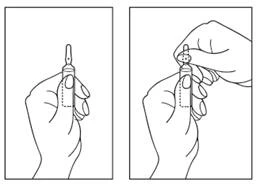
Fig. 1. Fig. 2.
Any unused medicinal product or waste material should be disposed of in accordance with local requirements.
Children. The drug may be administered to children aged 6 years and older.
Overdose.
Symptoms
No serious signs of poisoning have been observed following acute overdose. In case of overdose, anticholinergic symptoms may occur, such as urinary retention, dry mouth, skin flushing, tachycardia, gastrointestinal motility depression, and visual disturbances. Cheyne-Stokes respiration has also been reported.
In animal studies, administration of extremely high doses resulted in ataxia, tremor, seizures, dyspnea, and anticholinergic effects (mydriasis, dry mucous membranes, tachycardia, and gastrointestinal motility depression with food accumulation in the stomach and intestine). Death occurred due to respiratory paralysis.
Treatment
Symptoms of hyoscine butylbromide overdose respond to parasympathomimetic agents. Topical pilocarpine should be administered to patients with glaucoma. Cardiovascular complications should be treated according to standard therapeutic principles. In case of respiratory paralysis, intubation and artificial ventilation of the lungs should be performed.
Catheterization may be required in cases of complicated urinary elimination.
Additionally, appropriate supportive life-sustaining measures should be applied as necessary.
Adverse Reactions
Many of the adverse events listed below can be attributed to the anticholinergic properties of butylscopolamine bromide.
Undesirable adverse reactions are listed according to MedDRA system organ classes and frequency of occurrence as follows:
very common (≥ 1/10),
common (≥ 1/100 to < 1/10),
uncommon (≥ 1/1000 to < 1/100),
rare (≥ 1/10000 to < 1/1000),
very rare (< 1/10000),
frequency not known (cannot be estimated from available data).
Immune system disorders
Frequency not known*: anaphylactic shock, including cases with fatal outcome; anaphylactic reactions, dyspnea, other hypersensitivity reactions.
Eye disorders
Common: accommodation disorders.
Frequency not known*: mydriasis, increased intraocular pressure.
Cardiac disorders
Common: tachycardia.
Vascular disorders
Common: dizziness.
Frequency not known*: decreased blood pressure, skin flushing.
Gastrointestinal disorders
Common: dry mouth.
Constipation.
Skin and subcutaneous tissue disorders
Frequency not known*: skin reactions (e.g., urticaria, rash, erythema, pruritus), increased sweating.
Renal and urinary disorders
Frequency not known: urinary retention*.
Pain at the injection site may occur, especially after administration.
Due to its chemical structure as a quaternary ammonium derivative, butylscopolamine bromide is not expected to reach the central nervous system. Butylscopolamine bromide poorly penetrates the blood-brain barrier. However, it cannot be completely ruled out that under certain circumstances, psychiatric disorders (e.g., confusion) may occur after administration of the medicinal product.
* = This adverse reaction was observed in post-marketing surveillance. With 95% probability, the frequency category does not exceed "uncommon", but may be lower. An exact frequency estimate is not possible, as the adverse event was not observed in the clinical trial database of 185 patients.
Reporting of suspected adverse reactions
Reporting of suspected adverse reactions after marketing authorization is an important procedure. It allows continued monitoring of the benefit-risk balance of the medicinal product. Healthcare professionals are requested to report all suspected adverse reactions via the National Pharmacovigilance System.
Shelf life
Unopened ampoules: 5 years.
Shelf life after first opening: the medicinal product should be used immediately after opening the ampoule.
Storage after dilution
Chemical and physical stability in use has been demonstrated for 24 hours at 25 °C and at 2–8 °C.
From a microbiological standpoint, the product should be used immediately. If not used immediately, the user is responsible for the storage conditions and duration prior to use, which should not exceed 24 hours at a temperature of 2 °C to 8 °C, unless the dilution was performed under controlled and validated aseptic conditions.
Storage conditions
No special storage conditions required.
Do not freeze.
Keep out of reach of children.
Incompatibilities
This medicinal product must not be mixed with other medicinal products except those specified in the section "Administration and dosage".
Packaging
1 ml in a clear glass ampoule of hydrolytic class I, with scoring rings and a break point.
5 ampoules in a blister pack made of polyvinyl chloride film.
1 or 2 blister packs with the package leaflet for medical use in a cardboard carton.
Prescription category
Prescription only.
Manufacturer
Manufacturer responsible for batch release:
JSC "Kalceks"
Manufacturer's address and place of business
71E Krustpils Street, Riga, LV-1057, Latvia
Marketing Authorization Holder
JSC "Kalceks"
Address of the Marketing Authorization Holder
71E Krustpils Street, Riga, LV-1057, Latvia