Hiokzizon
Ukraine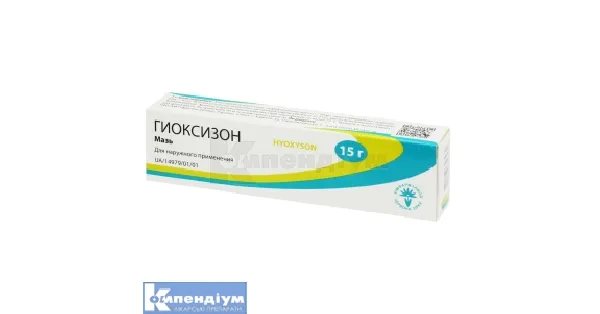
Table of Contents
INSTRUCTIONS FOR MEDICAL USE OF THE MEDICINAL PRODUCT HYOXYSON (HYOXYSON)
Composition:
Active substances: hydrocortisone, oxytetracycline;
1 g of ointment contains: hydrocortisone acetate 10 mg, oxytetracycline hydrochloride 30 mg;
Excipients: methylparahydroxybenzoate (E 218), mineral oil, yellow soft paraffin.
Pharmaceutical form. Ointment.
Main physicochemical properties: yellow-colored ointment.
Pharmacotherapeutic group. Low-potency corticosteroids in combination with antibiotics. Hydrocortisone and antibiotics.
ATC code D07CA01.
Pharmacological Properties
Pharmacodynamics
The medicinal product Gioxizon has combined effects.
Oxytetracycline is an antibiotic belonging to the tetracycline group, whose mechanism of action is based on inhibition of microbial protein synthesis. The drug exerts a bacteriostatic effect against both gram-positive and gram-negative bacteria.
Hydrocortisone acetate belongs to the group of corticosteroids and has moderate local anti-inflammatory, antipruritic, and vasoconstrictive actions.
Pharmacokinetics
Oxytetracycline, when applied topically, is absorbed into the systemic circulation in small amounts.
Hydrocortisone acetate, when applied topically, especially to small skin areas, is absorbed through the skin, metabolized to hydrocortisone and other metabolites directly in the epidermis, and only a minor portion is subsequently absorbed into the liver.
Metabolites and a minor amount of unchanged hydrocortisone acetate are excreted in the urine or bile.
Clinical Characteristics
Indications
Treatment of complicated infected dermatoses (dry forms and desquamating areas); primary allergic dermatoses, various forms of eczema, prurigo, contact and seborrheic dermatitis, and chronic psoriasis.
Contraindications
Skin lesions caused by bacterial infections (e.g., pyoderma, syphilitic lesions), viral infections (e.g., herpes zoster, common warts, flat warts, genital warts, molluscum contagiosum); fungal and yeast infections; parasitic infections (e.g., scabies); skin ulcers; ichthyosis, juvenile plantar dermatosis, acne vulgaris, rosacea, skin capillary fragility, skin atrophy; skin neoplasms.
Hypersensitivity to corticosteroids, oxytetracycline hydrochloride, or any other component of the drug. Should not be used in common or rosacea-like acne, perioral dermatitis (dermatitis perioralis), or following prophylactic vaccinations. Should not be applied to wounds, precancerous skin conditions, or skin cancer. Contraindicated in bacterial infections (including tuberculosis) and viral infections (including herpes, varicella).
Special Precautions
Treatment should be discontinued if skin irritation symptoms occur.
If no improvement is observed after 7 days of treatment, therapy should be stopped, as hydrocortisone may mask symptoms of developing infection.
Should not be used continuously for more than 2 weeks. Prolonged use may lead to bacterial resistance to oxytetracycline hydrochloride and mitotic superinfection.
Contact of the drug with eyes, mucous membranes, and wounds should be avoided.
Do not use around the eyes due to the risk of glaucoma or cataract.
The facial skin, scalp, and genital areas are particularly susceptible to adverse reactions. With inappropriate use, or in the presence of bacterial, parasitic, fungal, or viral infections, manifestations of these conditions may be masked and/or exacerbated. Application to the face and groin area should only be performed when absolutely necessary, as increased absorption and a high risk of adverse effects (e.g., telangiectasia, perioral dermatitis) may occur even after short-term use. The drug should be used cautiously in patients with subcutaneous atrophy, particularly elderly individuals.
Since corticosteroids may penetrate the skin, prolonged use and application over large skin areas should be avoided. The drug should not be used under occlusive dressings due to the risk of epidermal atrophy, skin striae, and superinfection. Corticosteroids may cause systemic adverse effects, including hypothalamic-pituitary-adrenal (HPA) axis dysfunction, hyperglycemia in Cushing's syndrome, and glucosuria.
Due to the presence of corticosteroids, the drug should be used with caution in patients with psoriasis.
The drug contains methylparahydroxybenzoate (E 218), which may cause allergic reactions (possibly delayed).
Interaction with Other Medicinal Products and Other Types of Interactions
No interactions have been reported with topical use at recommended doses.
Concomitant use of two or more topical medicinal products is not recommended due to possible changes in the concentration of active substances at the application site or skin erythema.
Vaccination against smallpox or other types of immunization should not be performed during treatment with this ointment.
Special precautions for use.
Use during pregnancy or breastfeeding.
The drug is contraindicated during pregnancy and breastfeeding.
Ability to affect reaction speed when driving or operating machinery.
The medicinal product does not impair mental and motor abilities, as well as the ability to drive vehicles or operate other machinery.
Dosage and Administration.
The medicinal product is intended for topical use. Apply the ointment as a thin layer to dry affected skin and scaling areas 2–3 times daily. The ointment should not be applied under occlusive dressing. Treatment is usually carried out for 1–2 weeks. The ointment should not be used on the facial skin for more than 1 week. During one week, no more than 10 g of the ointment should be used.
Children.
The drug should not be used in children.
Overdose.
With prolonged application over large skin areas, in high doses, or when applied under occlusive dressing, symptoms of overdose may occur, manifested by an increase in systemic adverse effects typical for corticosteroids (hyperglycemia, glucosuria, Cushing's syndrome) or for oxytetracycline. In case of overdose, the drug should be gradually discontinued.
Adverse Reactions.
Skin and subcutaneous tissue disorders:
- Local skin irritation, rash, burning sensation, itching, miliaria, dry skin;
- Hypertrichosis, skin discoloration or depigmentation;
- Contact dermatitis, eczema, delayed wound healing, erythema, striae formation, steroid-induced purpura, skin color changes, skin maceration, acneiform eruptions;
- Perioral dermatitis, with or without skin atrophy, epidermal growth suppression, subcutaneous tissue atrophy;
- Hair follicle inflammation, development of secondary bacterial or fungal infections;
- "Rebound effect" which may lead to steroid dependence;
- Telangiectasia.
Endocrine system disorders: Adrenocortical suppression, hyperglycemia, glucosuria.
Systemic disorders occur due to systemic absorption of hydrocortisone acetate into the bloodstream and may cause:
- Cushing's syndrome, intracranial hypertension;
- Angioedema;
- Increased bacterial strain resistance;
- Blastomycosis.
Eye disorders: Increased intraocular pressure and risk of cataract development (with repeated exposure of the drug to the conjunctiva).
Immune system disorders: Allergic reactions, hypersensitivity reactions, including angioedema, photosensitization.
Shelf life.
3 years.
Storage conditions.
Store in the original packaging at a temperature not exceeding 25 °C.
Keep out of reach of children.
Packaging. 15 g ointment in a tube, 1 tube per cardboard box.
Prescription status.
Prescription only.
Manufacturer.
JSC "CHIMFARMZAVOD "CHERVONA ZIRKA".
Manufacturer's address and place of business.
1 Gordienkovskaya Street, Kharkiv, Kharkiv region, 61010, Ukraine.