Ginomax
Ukraine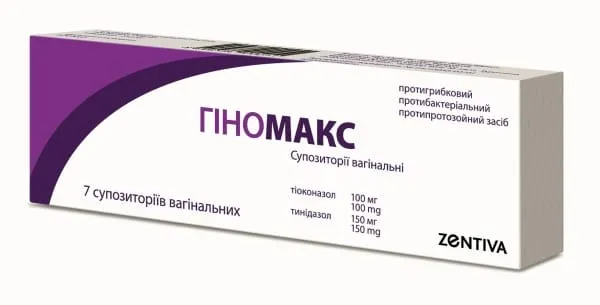
|
INSTRUCTION for medical use of the medicinal product GYNOMAX (GYNOMAX) Composition: Active substances: thiocanazole and tinidazole; 1 vaginal suppository contains: thiocanazole 100 mg and tinidazole 150 mg; Excipient: Witepsol. Pharmaceutical form. Vaginal suppositories. Main physicochemical properties: flat suppository of white to yellowish color with a smooth surface. Pharmacotherapeutic group. Antimicrobial and antiseptic agents used in gynecology, excluding combinations with corticosteroids. Combination of imidazole derivatives. ATC code G01AF20. Pharmacological properties. Pharmacodynamics. Thiocanazole is a synthetic antifungal agent highly active in vitro against yeast-like fungi and other fungi (including dermatophytes). It is also effective against Trichomonas vaginalis , Gardnerella vaginalis , bacteria of the Bacteroides family, and some Gram-positive bacteria (including Staphylococcus and Streptococcus species). Clinical studies have shown that thiocanazole is effective in treating infections caused by Candida albicans and other Candida species ( Torulopsis glabrata ), as well as vaginal infections caused by Trichomonas vaginalis . Thiocanazole acts by altering the permeability of the fungal cell membrane. Ergosterol is an essential component of the fungal cell membrane. Thiocanazole inhibits ergosterol synthesis by interacting with 14α-demethylase, a cytochrome P450 enzyme that converts lanosterol to ergosterol. Inhibition of ergosterol synthesis leads to increased cell permeability and, consequently, leakage of intracellular phosphorus and potassium compounds through the cell membranes. Tinidazole is effective against protozoa and anaerobic bacteria. Its antiprotozoal activity covers Trichomonas vaginalis , Entamoeba histolytica , and Giardia lamblia . Tinidazole is effective against Gardnerella vaginalis and most anaerobic bacteria ( Bacteroides fragilis, Bacteroides melaninogenicus , bacteria of the Bacteroides family, bacteria of the Clostridium family, Eubacterium , Peptostreptococcus , and Veillonella ). The mechanism of action of tinidazole is not fully understood. Reduction of the nitro group occurs via a ferredoxin system and due to the low redox potential produced only by anaerobic bacteria. This may explain why tinidazole uptake is more active in anaerobes than in aerobes, although tinidazole penetrates the cell membranes of both types of microorganisms. The reduction process creates reactive intermediates and a diffusion gradient that enhances tinidazole uptake. Pharmacokinetics. Absorption Tinidazole. Absorption of tinidazole after intravaginal administration is approximately 10%. The mean peak plasma concentration was 1.0 μg/mL; in 6 healthy volunteers, the time to reach this level (tmax) after administration of a vaginal suppository containing 500 mg tinidazole was 8.7 hours. Thiocanazole. After intravaginal administration, thiocanazole is absorbed in low concentrations by the mucous membrane. The mean peak plasma concentration after a single 300 mg dose of thiocanazole administered as an ointment to women with candidal vulvovaginitis was 18 μg/mL. Distribution Tinidazole. Tinidazole is almost completely distributed in all body tissues and fluids and crosses the blood-brain barrier. The apparent volume of distribution is about 50 liters. Plasma protein binding of tinidazole is 12%. Tinidazole crosses the placental barrier and is excreted in breast milk. Thiocanazole. In most clinical studies, after intravaginal administration of a single 300 mg dose of thiocanazole, concentrations in vaginal fluid were sufficient to inhibit the growth of Candida albicans for 2–3 days. It is unknown whether thiocanazole is excreted in breast milk. Biotransformation Tinidazole. Tinidazole is partially metabolized via oxidation, hydroxylation, and conjugation. Tinidazole is primarily biotransformed by cytochrome CYP3A4. Thiocanazole. The main metabolite of thiocanazole is the glucuronide conjugate. Thiocanazole is not metabolized in vaginal fluid, but part of the drug absorbed systemically after intravaginal administration undergoes metabolism. One registered metabolite is formed via N-glucuronidation of the nitrogen in the imidazole ring; another is formed via O-deethylation of the chlorothienyl group, hydration to alcohol, and glucuronidation. Elimination Tinidazole. The elimination half-life of tinidazole is about 12–14 hours. Tinidazole is eliminated via the liver and kidneys. It is excreted predominantly unchanged in urine (about 20–25% of the administered dose). Approximately 12% of the drug is excreted in feces. Thiocanazole. After intravaginal administration, thiocanazole is eliminated from plasma within 72 hours. After oral administration, 25–27% of the dose is excreted in urine as metabolites, and 59% of the dose is excreted in feces (mainly unchanged). Clinical characteristics. Indications. Treatment of candidal vulvovaginitis caused by Candida albicans , bacterial vaginosis caused by Gardnerella vaginalis and anaerobic bacteria, trichomonal vaginitis caused by Trichomonas vaginalis , and vaginitis caused by mixed infections. Contraindications.
Interaction with other medicinal products and other types of interactions. Due to absorption of tinidazole, the following interactions with other drugs may occur. Acenocoumarol , anisindione, dicoumarol, phenidione, phenprocoumon, warfarin : increased risk of bleeding. Cholestyramine : reduced efficacy of tinidazole. Cimetidine : increased plasma concentration of tinidazole. Cyclosporine : increased cyclosporine levels. Disulfiram : adverse effects on the central nervous system (e.g., psychotic reactions). Fluorouracil : increased blood concentration of fluorouracil and signs of possible intoxication (granulocytopenia, anemia, thrombocytopenia, stomatitis, vomiting). Fosphenytoin : increased fosphenytoin toxicity and/or decreased blood concentration of tinidazole. Ketoconazole : increased blood concentration of tinidazole. Lithium : increased blood concentration of lithium and signs of lithium intoxication (weakness, tremor, polydipsia, confusion). Phenobarbital : decreased blood concentration of tinidazole. Phenytoin: increased risk of phenytoin intoxication and/or decreased blood concentration of tinidazole. Rifampicin : decreased plasma concentration of tinidazole. Tacrolimus : increased tacrolimus levels. CYP3A4 inducers/inhibitors : reduced efficacy of tinidazole or increased risk of adverse reactions (CYP3A4 inhibitors such as cimetidine and ketoconazole may prolong elimination half-life, reduce tinidazole clearance, and increase plasma concentration of tinidazole). Oxycodone : concomitant use of tinidazole and oxycodone may increase oxycodone plasma concentration and reduce its clearance. Special precautions. For intravaginal use only. Do not swallow or insert elsewhere. As with other drugs with a similar structure, tinidazole should not be used in patients with hematopoietic disorders, including in history. Transient leukopenia and neutropenia may develop. Patients should refrain from consuming alcohol during treatment and for at least 3 days after completion of therapy due to the increased risk of disulfiram-like reactions. Should not be used in girls who have not had sexual intercourse. GYNOMAX is not recommended during menstruation due to reduced efficacy and difficulties in application. Suppositories should not be used with barrier contraceptives – diaphragm and condoms – as the suppository base may adversely interact with rubber. Other intravaginal products (e.g., tampons, douching, or spermicides) should not be used simultaneously with treatment. When treating patients with trichomonal vaginitis, simultaneous treatment of the sexual partner is required. Use during pregnancy or lactation. Since the effects of the active ingredients of GYNOMAX on the fetus and newborn are unknown, women using this product should avoid pregnancy using effective contraceptive methods. Tinidazole crosses the placental barrier. Data from animal studies on the effects of the drug on pregnancy, embryonic/fetal development, labor, and postnatal development are insufficient. The potential risk to humans is unknown. The drug is contraindicated during the first trimester of pregnancy. The possibility of prescribing the drug during the second and third trimesters should be evaluated by a physician, considering the benefit-risk ratio. The drug should not be used during pregnancy unless clearly necessary. Breastfeeding should be discontinued during treatment, as tinidazole passes into breast milk. Breastfeeding may be resumed 72 hours after completion of treatment. It is unknown whether thiocanazole passes into breast milk. Breastfeeding should be discontinued, as most medicinal products pass into breast milk. In a 60-day reproductive toxicity study, tinidazole at a dose of 600 mg/kg/day reduced fertility and induced histopathological changes in the testes of male animals. Doses of 300 and 600 mg/kg/day caused spermatogenic effects. The no-observed-adverse-effect level for testicular and sperm effects was 100 mg/kg/day. These effects are characteristic of 5-nitroimidazole-class drugs. In male animals, no effect on fertility was observed after oral administration of thiocanazole at doses up to 150 mg/kg/day. However, data indicate preimplantation losses in female rats after oral administration at doses above 35 mg/kg/day. Ability to affect reaction rate when driving or operating machinery. It is unknown whether GYNOMAX affects the ability to drive or operate machinery. Method of administration and dosage. For intravaginal use only. GYNOMAX should be inserted deeply into the vagina in a lying position. Administer one suppository at bedtime for 7 consecutive nights. Alternative regimen: one suppository twice daily for 3 days. Do not swallow or insert elsewhere. Additional information for special populations: Renal/hepatic impairment In patients with severe renal impairment (CrCL < 22 mL/min), no significant changes in pharmacokinetic parameters of tinidazole were observed. Therefore, dose adjustment is not required in these patients. Tinidazole clearance is significantly increased during hemodialysis, and elimination half-life decreases from 12 hours to 4.9 hours. During a 6-hour dialysis procedure, 43% of available tinidazole is removed. If tinidazole is administered before hemodialysis, it is recommended to administer half the recommended dose after hemodialysis. There are no data on tinidazole pharmacokinetics in patients with hepatic impairment. The recommended dose of tinidazole should be administered with caution in patients with hepatic impairment. Elderly The same dose as for adults is recommended for patients over 65 years of age. Children. Not to be used in children. Overdose. Systemic adverse effects may occur with excessive use of the drug, but life-threatening effects are not expected with intravaginal administration. There is no specific antidote for tinidazole. In case of overdose, symptomatic and supportive therapy should be initiated. Gastric lavage may be considered. Since systemic absorption of thiocanazole is very low, overdose is unlikely with local application. Adverse effects in case of overdose are unknown. Adverse reactions. The frequency of the following adverse events is defined according to the following classification: very common (> 1/10); common (> 1/100 – < 1/10); uncommon (> 1/1,000 to < 1/100); rare (> 1/10,000 to < 1/1,000); very rare (< 1/10,000); unknown (cannot be estimated from available data). No adverse effects have been reported with vaginal use of GYNOMAX. Some adverse effects associated with systemic use of tinidazole are listed below. Since plasma concentrations of tinidazole are much lower with intravaginal administration, these effects are expected to be less pronounced. Blood and lymphatic system disorders Unknown: leukopenia (transient), neutropenia. Immune system disorders Unknown: allergic reactions. Nervous system disorders Common: weakness, increased fatigue, malaise, headache, dizziness. Unknown: ataxia, coma (rare), confusion (rare), depression (rare), somnolence, insomnia, sleep disturbances, vertigo, peripheral neuropathy, seizures, restlessness, disorientation. Gastrointestinal disorders Common: metallic/bitter taste in mouth, nausea, anorexia, loss of appetite, flatulence, dyspepsia, abdominal cramps, epigastric discomfort, vomiting, constipation. Unknown: stomach pain, diarrhea, coated tongue, stomatitis, tongue discoloration, dryness of oral mucosa, pseudomembranous colitis. Skin and subcutaneous tissue disorders Unknown: pruritus, urticaria, angioedema, skin rash. Renal and urinary disorders Common: dark urine color. General disorders and administration site conditions Unknown: burning sensation during urination and at the site of application, local swelling and irritation, pruritus, vaginal discharge, dyspareunia, nocturia, vaginal pain. In case of adverse events, side effects, or lack of therapeutic effect, please contact: LLC "ZENTIVA UKRAINE", 5V Brovarskyi Avenue, Kyiv, 02002, Ukraine, tel./fax: +38 044 517-75-00, e-mail: [email protected] Shelf life. 3 years. Storage conditions. Store below 25 °C in a place inaccessible to children. Packaging. 7 vaginal suppositories per strip in a cardboard package with labeling in Ukrainian. Prescription status. Prescription only. Manufacturer. Exceltis Ilac Sanayi ve Ticaret Anonim Sirketi. Manufacturer's address and place of business. Cerekoy Organize Sanayi Bolgesi, Gazi Osmanpasa Mah. Fatih Bulvari No 19/2, Cerekoy, 59500 Tekirdag, Turkey. |