Gino-tardiferon
Ukraine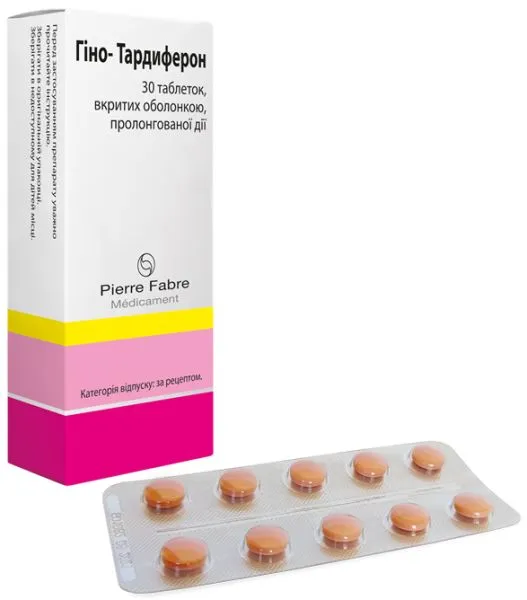
Table of Contents
INSTRUCTIONS FOR MEDICAL USE OF THE MEDICINAL PRODUCT GYNO-TARDYFERON
Composition:
Active substances: 1 tablet contains 247.25 mg of dried iron sulfate, equivalent to 80 mg of iron (II), and 0.35 mg of folic acid;
Excipients: maltodextrin, microcrystalline cellulose, ammonium methacrylate copolymer dispersion (type B), ammonium methacrylate copolymer dispersion (type A), talc, triethyl citrate, glycerol dibehenate, yellow iron oxide (E 172), red iron oxide (E 172), titanium dioxide (E 171); Sepifilm LP010 (hypromellose, microcrystalline cellulose, stearic acid).
Pharmaceutical form. Prolonged-release coated tablets.
Main physicochemical properties: round, coated tablets of pale pink color.
Pharmacotherapeutic group.
Antianemic agents. Iron preparations. Preparations containing iron (iron sulfate) in combination with folic acid. ATC code B03AD03.
Pharmacological Properties
Pharmacodynamics
Pharmacodynamic properties of iron
Iron is an essential mineral that plays a key physiological role and is required for many functions, such as oxygen transport, ATP production, DNA synthesis, and electron transport.
Mechanism of action
As the central atom of heme, iron is a component of hemoglobin and is also essential for erythropoiesis.
Pharmacodynamic effect
Iron differs from other minerals in that iron balance in the human body is regulated solely by absorption, as there is no physiological mechanism for its excretion. Absorption of iron sulfate occurs via the divalent metal ion transporter (DMT1) in the duodenum and proximal segment of the small intestine.
Absorptive capacity in patients with anemia may be many times greater than in healthy subjects, resulting in a significant distal extension of the absorption surface. The absorption process is sensitive to various dietary factors and other influences that may interfere with this process, leading to inadequate absorption and, consequently, iron deficiency.
Clinical efficacy and safety
Clinical studies have shown that hematological response (modification of Hb) and restoration and maintenance of iron stores (normalization or maintenance of ferritin) were achieved by oral administration of iron sulfate in combination with folic acid.
The composition of Gino-Tardiferon allows its use under conditions of altered absorption in the body in anemia or for prevention of iron and folic acid deficiency during pregnancy.
Pharmacodynamic properties of folic acid
Mechanism of action
Folate acts as a coenzyme in the transfer of carbon atoms during the biosynthesis of purine nucleotides and deoxythymidylate, which are necessary for DNA and RNA synthesis. In general, cells of the nervous system, smooth muscles, and erythrocytes grow and proliferate rapidly and therefore require adequate amounts of folates.
Pharmacodynamic effect
The human body cannot synthesize folic acid and must therefore obtain it from food. Folic acid has significantly higher bioavailability than natural folates and is rapidly absorbed through the intestine.
Clinical efficacy and safety
Clinical studies have shown that hematological response (modification of Hb) and restoration of folic acid concentration were achieved by oral administration of iron sulfate in combination with folic acid.
The composition of Gino-Tardiferon allows its use under conditions of altered absorption in the body in anemia or for prevention of iron and folic acid deficiency during pregnancy.
Pharmacokinetics
Pharmacokinetic properties of iron
Absorption
Iron absorption is an active process, primarily occurring in the duodenum and proximal segment of the small intestine. The combination of iron sulfate with excipients ensures gradual and continuous release of iron. Absorption increases when iron stores are depleted and decreases when they are elevated.
Concomitant intake of certain food products or simultaneous administration with specific drugs may interfere with iron absorption (see sections "Interaction with other medicinal products and other forms of interaction" and "Special precautions").
Distribution
In the body, iron stores are located predominantly in the bone marrow (erythroblasts), erythrocytes, liver, and spleen. Iron is transported through the blood by transferrin, primarily to the bone marrow, where it is incorporated into hemoglobin.
Metabolism
Iron is a metal ion and is not metabolized by the liver.
Excretion
There is no active mechanism for iron excretion.
The average daily iron excretion in healthy patients is estimated at 0.8–1 mg/day.
The main routes of iron excretion are the gastrointestinal tract (desquamation of enterocytes, degradation of heme following extravasation of erythrocytes), the urogenital tract, and the skin. Excess ingested iron is primarily excreted in feces.
Pharmacokinetic properties of folic acid
Absorption
Folic acid is rapidly absorbed in the gastrointestinal tract, primarily in the proximal segment of the small intestine.
Distribution
Folates are distributed throughout the body. The main site of folate storage is the liver. They are also actively concentrated in cerebrospinal fluid. Folates are excreted in breast milk.
Metabolism
Folates are converted into the metabolically active form 5-methyltetrahydrofolate (5-MTHF) in plasma and liver. Folate metabolites participate in enterohepatic circulation.
Excretion
Folate metabolites are excreted in urine, and excess folates are excreted unchanged in urine.
Preclinical safety data
Preclinical data on iron and folic acid obtained from standard studies on pharmacological safety, repeated-dose toxicity, genotoxicity, carcinogenicity, as well as reproductive function and developmental studies, revealed no special hazard to humans when used at recommended doses.
Clinical characteristics.
Indications.
Prevention and treatment of folate-deficiency and iron-deficiency anemias; including in women during pregnancy, when adequate intake of iron and folic acid cannot be ensured through diet.
Contraindications.
Hypersensitivity to the active substances or to any component of the medicinal product. Excess iron content in the body (hemidosiderosis, hemochromatosis); anemias not caused by iron deficiency (e.g. megaloblastic anemia due to vitamin B9 or B12 deficiency (pernicious anemia), hemolytic anemia, aplastic anemia, sideroblastic anemia, iron-refractory anemia, anemia in lead poisoning, thalassemia); esophageal stricture and/or other obstructive gastrointestinal disorders, intestinal diverticulosis, intestinal obstruction; regular blood transfusions, concomitant use of parenteral iron preparations, malignant neoplasms.
Interaction with other medicinal products and other forms of interaction.
Some medicinal products cannot be used simultaneously.
Iron
Combinations not recommended
- Iron salts (for parenteral administration)
Possible syncope or shock due to rapid release of iron from its complex form and transferrin saturation.
Combinations requiring special precautions
- Bisphosphonates
Reduced gastrointestinal absorption of bisphosphonates due to formation of poorly absorbable complexes.
Do not take iron salts simultaneously with bisphosphonates (an interval of more than 2 hours should be ensured).
- Tetracyclines (for oral administration): tetracyclines and tetracycline derivatives
Reduced gastrointestinal absorption of tetracyclines and iron due to formation of poorly absorbable complexes.
Do not take iron salts simultaneously with tetracyclines (an interval of more than 2 hours should be ensured).
- Fluoroquinolones
Reduced gastrointestinal absorption of fluoroquinolones due to formation of poorly absorbable complexes.
Do not take iron salts simultaneously with fluoroquinolones (an interval of more than 2 hours should be ensured).
- Methyldopa, levodopa, carbidopa
Reduced gastrointestinal absorption of dopa derivatives due to formation of poorly absorbable complexes.
Do not take iron salts simultaneously with dopa derivatives (an interval of more than 2 hours should be ensured).
- Penicillamine
Reduced gastrointestinal absorption of penicillamine due to formation of poorly absorbable complexes. Increased risk of D-penicillamine toxicity when iron sulfate treatment is discontinued.
Do not take iron salts simultaneously with penicillamine (an interval of more than 2 hours should be ensured).
- Thyroid hormones / thyroxine
Reduced gastrointestinal absorption of thyroid hormones / thyroxine due to formation of poorly absorbable complexes, leading to hypothyroxinemia.
Do not take thyroid hormones simultaneously with iron (an interval of more than 2 hours should be ensured).
- Antacids: preparations containing calcium, aluminum, and magnesium (magnesium trisilicate)
Reduced gastrointestinal absorption of iron salts.
An interval of more than 2 hours between administrations should be ensured.
- Cholestyramine
Reduced gastrointestinal absorption of iron salts.
Do not take iron salts simultaneously with cholestyramine (they should be taken, for example, 1–2 hours before or 4 hours after cholestyramine administration).
- Calcium, zinc
Reduced gastrointestinal absorption of iron salts by calcium and zinc.
Reduced gastrointestinal absorption of zinc by iron salts.
Do not take iron salts simultaneously with zinc and calcium (an interval of more than 2 hours should be ensured).
- Concurrent administration of iron with salicylates or NSAIDs may enhance the irritant effect of iron on the gastrointestinal mucosa. If it is necessary to take both medicinal products, an interval of at least 2 hours should be ensured.
- Iron salts reduce the absorption of gold compounds.
- Other forms of interaction
Phytic acid (whole grains), polyphenols (tea, coffee, red wine), calcium (milk, dairy products), and certain proteins (eggs) significantly slow down iron absorption.
Do not take iron salts simultaneously with these food products (an interval of more than 2 hours should be ensured).
Due to the presence of folic acid, combinations requiring special precautions exist
- Anticonvulsants (e.g. phenobarbital, phenytoin, fosphenytoin, primidone) may cause folic acid deficiency. Taking folic acid together with anticonvulsants may reduce their plasma concentration and efficacy in preventing seizures. Clinical monitoring, plasma concentration control, and dose adjustment of anticonvulsants, if necessary, should be performed during and after folic acid administration.
- Folic acid antagonists (e.g. methotrexate or sulfasalazine) may reduce serum folate levels.
- When used with fluorouracil, high doses may cause severe diarrhea.
- Chloramphenicol should not be used in patients with folic acid deficiency, as it may reduce the response to treatment with Gino-Tardiferon.
Cytostatics, sulfonamides, antiepileptics, and barbiturates affect the absorption of folic acid.
Special precautions for use.
It should be noted that iron-deficiency anemias associated with inflammatory syndromes are not responsive to treatment with iron preparations.
Iron therapy should be combined with treatment of the underlying cause of anemia, whenever possible.
Accidental aspiration of tablets containing ferrous sulfate into the respiratory tract (if you choke) may lead to necrosis of the bronchial mucosa, which can result in cough, hemoptysis, bronchial stenosis and/or pulmonary infection (even if this occurred several days or months before symptom onset). Elderly patients and patients with swallowing difficulties should only be treated after careful assessment of the risk of aspiration of tablets containing ferrous sulfate. Alternative dosage forms should be considered. In case of accidental aspiration of tablets into the respiratory tract (if you choke), medical advice must be sought (see section "Adverse reactions").
Published data have reported cases of gastrointestinal melanosis in elderly patients with chronic kidney disease, diabetes mellitus and/or hypertension who were receiving multiple medications for these conditions and were treated with iron preparations for associated anemia (see section "Adverse reactions").
Tablets should not be sucked, chewed, or held in the mouth. They must be swallowed whole with water due to the risk of developing oral ulcers and tooth discoloration.
Use with caution in patients with the following conditions: leukemia, chronic liver and kidney diseases, inflammatory gastrointestinal disorders, peptic ulcer disease of the stomach and duodenum, intestinal diseases (enteritis, ulcerative colitis, Crohn's disease). Exacerbation may occur in patients with rheumatoid arthritis. To prevent constipation, the preparation should be taken with a large amount of liquid.
Approximately every 4 weeks, the following parameters should be determined to assess the degree of iron deficiency, response to treatment, and need for continued iron supplementation: hemoglobin, erythrocyte count, mean corpuscular volume (MCV), mean corpuscular hemoglobin (MCH), reticulocyte count, serum iron, transferrin. Determination of serum ferritin allows assessment of iron stores; a serum ferritin level < 15 μg/L indicates absence of body iron stores.
During prolonged use, monitoring of vitamin B12 levels is required.
Avoid consuming large amounts of tea, coffee, or red wine, as these may reduce iron absorption in the body.
It is not recommended to take this preparation simultaneously with whole grains (bran, legumes, oilseeds), certain proteins (eggs), or food products and beverages containing calcium (cheese, milk, etc.).
The interval between administration of iron salts and these products should be at least 2 hours.
Use during pregnancy or breastfeeding.
Iron
Pregnancy.
Extensive data on use during pregnancy indicate no congenital developmental malformations with therapeutic use of ferrous iron salts. Animal studies do not indicate reproductive toxicity.
Gino-Tardiferon may be used during pregnancy if necessary.
Breastfeeding.
Iron salts are excreted in breast milk, but when administered in therapeutic doses, no adverse effects on newborns/infants are expected.
Gino-Tardiferon may be used during breastfeeding if necessary.
Fertility.
Animal studies showed no effect on fertility.
When used in therapeutic doses, no effect on human fertility is expected.
Folic acid
Pregnancy.
Controlled clinical trials on use during pregnancy are lacking. However, a large amount of published data (over 1000 cases) exists due to widespread medical use. These data do not indicate teratogenic or fetal/neonatal toxic effects. In addition, animal studies do not indicate reproductive toxicity.
Gino-Tardiferon may be used during pregnancy if necessary.
Breastfeeding.
Folic acid is excreted in breast milk. No adverse effects of folic acid on newborns/infants have been observed during breastfeeding.
Gino-Tardiferon may be used during breastfeeding if necessary.
Fertility.
Animal studies did not show any effect on reproductive function.
Ability to affect reaction speed when driving or operating machinery.
Gino-Tardiferon does not affect the ability to drive or operate machinery.
Dosage and Administration
Gino-Tardiferon is intended for oral use in adults and children aged 12 years and older.
The tablets should not be sucked, chewed, or held in the mouth. They must be swallowed whole with a large amount of water. It is advisable to take the tablets before or during meals, depending on gastrointestinal tolerance (except for certain food products specified in the section "Special Warnings and Precautions for Use").
Recommended Dosage
- Prophylaxis of iron and folic acid deficiency during pregnancy: 1 tablet daily (in the morning).
- Treatment of iron-deficiency anemia:
- in adults with mild iron-deficiency anemia – 1 tablet daily (in the morning);
- in adults with severe iron-deficiency anemia – 1 tablet twice daily (in the morning and evening);
- in children aged 12 years and older – 1 tablet daily (in the morning).
Duration of Treatment
- Prophylaxis of iron and folic acid deficiency during pregnancy: throughout the last two trimesters of pregnancy (or from the 4th month).
- Treatment of iron-deficiency anemia: treatment should be sufficient to correct anemia and replenish iron stores. Treatment may last from 3 to 6 months and may be extended after consultation with a physician.
Monitoring efficacy is meaningful only after 3 months from the start of treatment and should include checking parameters for correction of anemia (Hb, MCV) and restoration of iron stores (serum ferritin, serum transferrin receptor, and transferrin saturation coefficient).
Children
The medicinal product can be used in children aged 12 years and older.
Overdose
Cases of iron salt overdose, particularly in children, due to accidental ingestion of very high doses, have been reported. The risk of iron intoxication begins at a dose of elemental iron of 20 mg/kg and increases at doses above 60 mg/kg body weight.
Iron poisoning develops in five consecutive symptomatic stages:
- gastrointestinal stage (including signs of gastrointestinal tract irritation or mucosal necrosis, accompanied in most cases by abdominal pain, nausea, vomiting, diarrhea), latent stage, shock and metabolic acidosis followed by hepatic and renal failure, stage of hepatotoxicity, and intestinal obstruction stage.
Diagnosis is primarily based on clinical symptoms and confirmed by elevated serum iron levels. Abdominal radiography may also be performed (if iron tablets have been ingested) to detect radio-opaque tablets.
Treatment must be initiated as soon as possible:
- Symptomatic treatment: careful patient monitoring is required. Shock, dehydration, and acid-base imbalances should be managed according to standard practices in specialized units (respiratory support, volume status, fluid and electrolyte balance, and diuresis).
- Gastrointestinal decontamination: to confirm the presence of iron tablets in the gastrointestinal tract (stomach or small intestine), abdominal radiography may be performed. If a large quantity of iron tablets has been ingested (iron intake exceeding 20 mg/kg body weight or if symptomatic), and only if less than 1 hour has passed since ingestion, part of the ingested iron may be removed by gastrointestinal decontamination in a hospital setting:
- induce vomiting if the patient is conscious;
- administration of a polyethylene glycol-based lavage solution (e.g., polyethylene glycol solution for bowel irrigation) at a rate of 15–40 mL/kg/hour over 4–8 hours may also be considered. This is indicated if serum iron levels continue to rise despite effective vomiting.
Abdominal radiography should be repeated after lavage to detect any remaining iron tablets or fragments.
Warning: gastrointestinal decontamination should not be routinely used in the management of iron poisoning.
- Iron chelation therapy: a chelating agent is recommended if poisoning is severe. Intravenous deferoxamine is the primary treatment. For more detailed information, refer to the deferoxamine medical product information.
Dimercaprol is contraindicated in iron poisoning.
Note: the amount of folic acid contained in the medicinal product does not pose a risk of folic acid overdose.
Adverse Reactions
Adverse reactions are categorized according to frequency as follows: very common (≥ 1/10), common (≥ 1/100, < 1/10), uncommon (≥ 1/1000, < 1/100), rare (≥ 1/10,000, < 1/1000), very rare (< 1/10,000), and not known (available data do not allow estimation of the frequency of these reactions).
Immune system disorders
Not known: hypersensitivity, anaphylactic reaction.
Respiratory, thoracic and mediastinal disorders
Uncommon: laryngeal edema.
Not known: pulmonary necrosis2, pulmonary granuloma2, bronchial stenosis2, pharyngeal ulcers2.
Gastrointestinal disorders
Common: constipation, diarrhea, abdominal distension, abdominal pain, change in stool color, nausea.
Uncommon: abnormal bowel movements, dyspepsia, vomiting, gastritis.
Not known: tooth discoloration1, oral ulcers1, gastrointestinal melanosis, esophageal lesions2, esophageal ulcers2.
Skin and subcutaneous tissue disorders
Uncommon: pruritus, erythematous rash.
Not known: angioneurotic edema, urticaria, allergic dermatitis.
1 Tooth discoloration and oral ulcers may occur if the tablets are chewed, sucked, or held in the mouth due to incorrect use.
2 Esophageal lesions (e.g., esophageal ulcers), pharyngeal ulcers, bronchial granulomas, and/or bronchial necrosis may occur, particularly in elderly patients and those with swallowing difficulties, if iron sulfate-containing tablets accidentally enter the respiratory tract, potentially leading to bronchial stenosis (see section "Special Warnings and Precautions for Use").
Other specific population groups.
Published data have reported cases of gastrointestinal melanosis in elderly patients with chronic kidney disease, diabetes mellitus and/or hypertension, who were receiving multiple medications for these conditions and were treated with iron preparations for associated anemia (see section "Special Warnings and Precautions for Use").
Reporting of suspected adverse reactions.
Reporting suspected adverse reactions after authorization of the medicinal product is important. It allows continued monitoring of the benefit-risk balance of the medicinal product. Healthcare professionals are asked to report any suspected adverse reactions via the national reporting system.
Shelf life
3 years.
Storage conditions
Store in the original packaging. Keep out of the reach of children.
Packaging
10 tablets in a blister; 3 blisters in a cardboard box.
Prescription status
Prescription only.
Manufacturer
Pierre Fabre Médicament Production.
Pierre Fabre Medicament Production.
Manufacturer's name and address
Production site Progipharm, 4 Rue du Lycée, 45500 Gien, France.
site Progipharm, Rue du Lycee, 45500 Gien, France.