Ginkor forte
Ukraine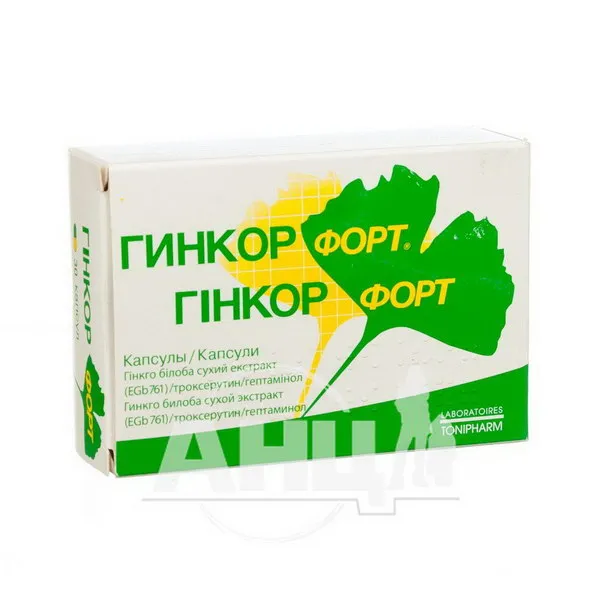
Table of Contents
INSTRUCTIONS FOR MEDICAL USE OF THE MEDICINAL PRODUCT GINKOR FORT®
Composition:
Active substances: 1 capsule contains Ginkgo biloba dry extract (EGb 761) 14 mg;
hexaminole hydrochloride 300 mg; troxerutin 300 mg;
Excipients: colloidal anhydrous silicon dioxide, magnesium stearate;
Capsule shell composition: iron oxide yellow (E 172), indigotine (E 132), titanium dioxide (E 171), gelatin.
Pharmaceutical form. Capsules.
Main physicochemical properties: capsules with an opaque green cap and an opaque yellow body, containing a pale yellow compressed powder.
Pharmacotherapeutic group.
Vasoprotectives. Capillary stabilizing agents. Bioflavonoids. Troxerutin combinations.
ATC code: C05CA54.
Pharmacological Properties.
Pharmacodynamics.
The medicinal product is a venotonic and angioprotective agent that increases venous tone, regulates venous bed filling, and reduces vascular wall permeability.
The medicinal product has the ability to locally inhibit certain mediators of pain and inflammation (histamine, bradykinin, serotonin), lysosomal enzymes, and free radicals that lead to inflammation and degeneration of collagen fibers.
The medicinal product stimulates venous return due to the presence of heptaminol hydrochloride in its composition.
Pharmacokinetics.
Pharmacokinetic studies in humans have not been conducted.
Clinical characteristics.
Indications.
- Symptomatic treatment of venous-lymphatic insufficiency manifested by sensation of heaviness, paresthesia, and leg pain.
- Treatment of functional symptoms associated with hemorrhoidal crisis.
Contraindications.
Hypersensitivity to the active or excipient ingredients, gastric and duodenal ulcer, chronic gastritis (in the phase of exacerbation).
Since the medicinal product contains heptaminol, it should not be used in hyperthyroidism; also, it must not be used concomitantly with monoamine oxidase inhibitors due to the risk of arterial hypertension.
Special precautions.
Since the medicinal product contains heptaminol, blood pressure should be monitored at the beginning of treatment in patients with severe forms of arterial hypertension.
Due to the presence of Ginkgo biloba (EGb 761) in the medicinal product, careful monitoring is recommended in patients who are concurrently taking medicinal products metabolized by cytochrome P450 3A4. There is no information on abuse of Ginkgo biloba (EGb 761). Given the pharmacological characteristics of the medicinal product, Ginkgo biloba (EGb 761) has no potential for abuse.
Patients with a tendency to bleeding (hemorrhagic state) and those undergoing concomitant treatment with anticoagulants and antiplatelet agents should consult a physician before taking this medicinal product.
Medicinal products containing ginkgo may increase the tendency to bleeding. Therefore, this medicinal product should be discontinued 3–4 days before any surgery.
In patients with epilepsy, the potential for additional seizures induced by ginkgo-containing preparations cannot be excluded.
Concomitant use of ginkgo-containing preparations and efavirenz is not recommended.
Hemorrhoidal crisis: this medicinal product should not be used as specific treatment for other diseases of the rectum. Treatment should be short-term. If symptoms do not rapidly resolve, a proctological examination should be performed and the treatment regimen reviewed.
Venous-lymphatic insufficiency: to enhance the effectiveness of the medicinal product, it is necessary to:
- avoid sun exposure and heat, prolonged standing, and weight gain;
- engage in regular walking and wear supportive stockings to promote venous circulation.
Heptaminol, contained in the medicinal product, may cause a positive doping test result in athletes.
Interaction with other medicinal products and other forms of interaction.
Concomitant use of this medicinal product with MAO inhibitors is contraindicated due to the potential for increased blood pressure caused by the presence of heptaminol.
Clinical studies on interactions with Ginkgo biloba (EGb 761) have demonstrated potentiation or inhibition of cytochrome P450 isoenzymes. Changes in midazolam concentration were observed after concomitant administration of Ginkgo biloba (EGb 761), suggesting an interaction via CYP3A4. Therefore, medicinal products that are primarily metabolized via CYP3A4 and have a narrow therapeutic index should be used with caution.
If this product is taken concomitantly with anticoagulants (phenprocoumon, warfarin) or antiplatelet agents (clopidogrel, acetylsalicylic acid, or other nonsteroidal anti-inflammatory drugs), their effects may be altered.
Studies conducted with warfarin have not shown any interactions between warfarin and ginkgo-containing preparations; however, monitoring is necessary when initiating, discontinuing, changing the dose, or replacing ginkgo-containing products at any time.
Interaction studies with talinolol have shown that ginkgo may inhibit intestinal P-glycoproteins. This may increase the effects of medicinal products sensitive to intestinal P-glycoproteins, such as dabigatran etexilate. Precautions should be taken when using ginkgo concomitantly with dabigatran.
Interaction studies have shown that Cmax of nifedipine may increase with ginkgo. In some individuals, this increase may reach up to 100%, leading to dizziness and increased intensity of hot flushes.
Concomitant use of ginkgo-containing preparations and efavirenz is not recommended. Plasma concentrations of efavirenz may decrease due to induction of cytochrome CYP3A4.
Special precautions for use.
The medicinal product should be prescribed with caution to patients with severe liver and gallbladder diseases.
Use during pregnancy or breastfeeding.
This medicinal product must not be used during pregnancy due to the vasotropic effect of heptaminol and the anti-aggregatory activity of Ginkgo biloba (EGb 761).
It is unknown whether the medicinal product is excreted in breast milk; therefore, its use is not recommended during breastfeeding.
Ability to influence reaction rate while driving or operating machinery.
Studies evaluating the effect on reaction speed while driving or operating machinery have not been conducted. However, dizziness may impair the ability to drive or operate machinery.
Method of administration and dosage.
- Venous-lymphatic insufficiency: 1 capsule twice daily, in the morning and evening.
- Hemorrhoidal crises: 3–4 capsules daily during meals. Treatment duration as part of combination therapy is 7 days.
The medicinal product should preferably be taken during meals.
Children.
There is insufficient clinical experience regarding the use of this medicinal product in children; therefore, the drug should not be used in pediatric practice.
Overdose.
Symptoms: The manifestations of adverse reactions may become more pronounced.
Treatment: Discontinue the drug. Induction of vomiting or gastric lavage is recommended, along with symptomatic treatment. If necessary, peritoneal dialysis may be performed.
Adverse reactions
Adverse reactions are categorized according to frequency as follows: very common (≥ 1/10), common (≥ 1/100, < 1/10), uncommon (≥ 1/1000, < 1/100), rare (≥ 1/10,000, < 1/1000), very rare (< 1/10,000), and not known (available data do not allow estimation of the frequency of these reactions).
The following adverse reactions may occur very rarely:
- Gastrointestinal disorders: upper abdominal pain, epigastric discomfort, nausea, diarrhea, dyspepsia, flatulence;
- Nervous system disorders: headache, dizziness, syncope (including vasovagal), sleep disturbances;
- Skin and subcutaneous tissue disorders: hypersensitivity, anaphylactic reactions including angioedema, urticaria, dyspnea, pruritus, allergic dermatitis (eczematous), rash, skin inflammation, erythema, ecchymoses; severe allergic reactions;
- General disorders: fatigue.
Cardiac disorders (frequency not known): hypertension.
Reporting of suspected adverse reactions
Reporting suspected adverse reactions after authorization of the medicinal product is important. It allows continued monitoring of the benefit-risk balance of the medicinal product. Healthcare professionals are asked to report any suspected adverse reactions via the national reporting system.
Shelf life
3 years.
Storage conditions
Store in the original packaging at a temperature not exceeding 30 °C. Keep out of the reach of children.
Packaging
10 capsules in a blister, 3 blisters in a cardboard box.
Availability without prescription
Over-the-counter.
Manufacturer
MAIOLI INDUSTRIE.
Manufacturer's address and place of business
Rue Hte de Virton 28100 Dreux, France.