Gynenorm
Ukraine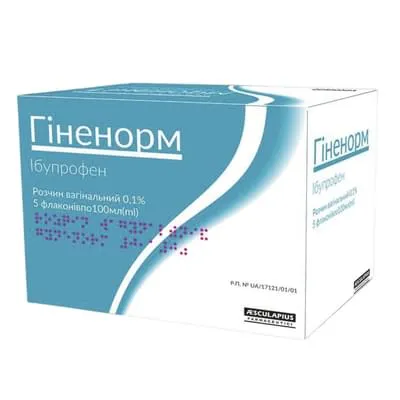
Table of Contents
INSTRUCTIONS FOR MEDICAL USE OF THE MEDICINAL PRODUCT GINENORM
Composition:
Active ingredient: ibuprofen;
100 ml of solution contains ibuprofen isobutanolammonium 0.1 g, equivalent to ibuprofen 0.0698 g;
Excipients: 2-phenoxyethanol-methyl-ethyl-propyl-butyl p-hydroxybenzoate (undebenzo-phen), polysorbate 20, propylene glycol, floral extract, deionized water.
Pharmaceutical form. Vaginal solution.
Main physicochemical properties: clear, colorless solution.
Pharmacotherapeutic group. Non-steroidal anti-inflammatory drugs for intravaginal use. ATC code G02C C01.
Pharmacological properties.
Pharmacodynamics. Gynenorm contains as active ingredient ibuprofen isobutanolamine. The medicinal product is a non-steroidal anti-inflammatory drug (NSAID). The action of this drug is based on inhibition of the enzyme cyclooxygenase, which synthesizes prostaglandins.
Pharmacokinetics. Bioavailability studies have shown that topical application of the drug does not lead to changes in blood plasma levels that would have any clinical and/or toxicological significance. Drug levels in blood plasma are very low, at the limit of analytical sensitivity. Preclinical data indicate no risk to humans based on safety studies, repeated-dose toxicity, genotoxicity, carcinogenic potential, and reproductive toxicity.
Clinical characteristics.
Indications.
Vulvovaginitis and cervicovaginitis of all types.
Pre- and postoperative treatment in gynecological surgery.
Contraindications.
Hypersensitivity to the active substance or to any of the excipients. Pregnancy and breastfeeding. Severe vulvovaginitis, specific or nonspecific. Pediatric age.
Interaction with other medicinal products and other forms of interaction.
Interaction studies have not been conducted.
Special precautions for use
Severe skin adverse reactions
Severe skin adverse reactions (SSARs), including exfoliative dermatitis, erythema multiforme, Stevens–Johnson syndrome (SJS), toxic epidermal necrolysis (TEN), drug reaction with eosinophilia and systemic symptoms (DRESS syndrome), and acute generalized exanthematous pustulosis (AGEP), which may be life-threatening or lead to fatal outcomes, have been reported with ibuprofen use (see section "Adverse reactions"). Most such reactions occurred within the first month of treatment. If signs or symptoms suggesting these reactions occur, ibuprofen should be discontinued immediately and alternative therapy should be considered (if necessary). Prolonged use, especially long-term, of topical medicinal products may provoke hypersensitivity reactions.
Patients should be informed about the signs and symptoms of the aforementioned skin reactions, and should be closely monitored for their development.
The medicinal product must not be used in cases of severe specific or non-specific vulvovaginitis.
It is recommended to follow the physician's instructions regarding the use of the medicinal product.
Important information about excipients
The product contains parahydroxybenzoates (preservatives) and propylene glycol, which may cause allergic reactions (possibly delayed). The medicinal product contains propylene glycol and may therefore cause skin irritation.
Use during pregnancy or breastfeeding
Clinical data on the use of topical medicinal products containing ibuprofen during pregnancy are lacking. Even though systemic exposure is lower compared to oral administration, it is unknown whether the systemic exposure to ibuprofen achieved after topical application could be harmful to the embryo/fetus. During the first and second trimesters of pregnancy, ibuprofen should not be used unless clearly necessary. If used, the dose should be as low as possible and the duration of treatment as short as possible.
During the third trimester of pregnancy, systemic use of prostaglandin synthetase inhibitors, including ibuprofen, may cause cardiopulmonary and renal toxicity in the fetus. Towards the end of pregnancy, prolonged bleeding may occur in both mother and child, and labor may be delayed. The medicinal product is contraindicated during pregnancy and breastfeeding (see section "Contraindications").
Ability to affect reaction speed when driving or operating machinery
Gynenorm does not affect the ability to drive or operate machinery.
Method of Administration and Dosage
Use the ready-to-use solution according to the severity of inflammation and as directed by a physician. It is recommended to administer 1 or 2 vaginal douchings per day using the bottle containing the ready-to-use solution. The solution may be used at room temperature, or its temperature may be increased by holding the bottle under a stream of warm water.
- Press the protruding part of the cap sideways to open it.
- Remove the sterile cannula from its protective packaging, insert it into the bottle, and ensure it is securely attached.
- Carefully insert the cannula into the vagina and squeeze the bottle until it is completely emptied.
- Retain the liquid in the vagina for several minutes to ensure the therapeutic effect of the solution.
Children. Not applicable.
Overdose.
No cases of overdose have been reported. In severe poisoning, metabolic acidosis may occur.
Side effects
All adverse reactions are listed by system organ class and frequency: very common (≥ 1/10), common (≥ 1/100 – < 1/10), uncommon (≥ 1/1000 – < 1/100), rare (≥ 1/10,000 – < 1/1000), very rare (< 1/10,000), frequency not known (cannot be estimated from available data).
Immune system disorders: very rare – serious allergic reactions have been reported, some of which were fatal, including exfoliative dermatitis, bullous reactions, Stevens-Johnson syndrome and toxic epidermal necrolysis associated with the use of NSAIDs. Patients are at higher risk of developing adverse reactions during the early stages of treatment.
Skin and subcutaneous tissue disorders: very rare: severe skin adverse reactions (SSARs) (including erythema multiforme, exfoliative dermatitis, Stevens-Johnson syndrome and toxic epidermal necrolysis).
Frequency not known: photosensitivity reactions; acute generalized exanthematous pustulosis (AGEP); drug reaction with eosinophilia and systemic symptoms (DRESS syndrome).
Treatment with Gynenorm should be discontinued if skin rash, mucosal lesions or other signs of hypersensitivity occur.
General disorders and administration site conditions: local application of the medicinal product, especially prolonged, may lead to hypersensitivity reactions. In such cases, treatment must be interrupted and appropriate therapy initiated.
Reporting of suspected adverse reactions
Reporting suspected adverse reactions after authorization of the medicinal product is important. It allows ongoing monitoring of the benefit-risk balance of the medicinal product. Healthcare professionals and patients, as well as their legal representatives, are encouraged to report any suspected adverse reactions and lack of efficacy of the medicinal product via the Automated Pharmacovigilance Information System at the following link: https://aisf.dec.gov.ua
Shelf life. 3 years.
Storage conditions. Store at a temperature not exceeding 25 °C. Keep out of reach and sight of children.
Packaging.
5 vials of 100 ml each made of low-density polyethylene, containing a ready-to-use clear solution, supplied with a sterile cannula in a cardboard package.
Prescription status. Prescription only.
Manufacturer. A. SELLÁ CHEMICAL-PHARMACEUTICAL LABORATORY S.R.L.
Manufacturer's address and location of operations.
Via Vicenza, 67-36015 Schio (VI), Italy.
Marketing Authorization Holder. Esculapius Pharmaceuticals S.r.l.
Location and address of operations.
Via Cefalonia, 70 - 25124 Brescia, Italy.