Herbion® primrose syrup
Ukraine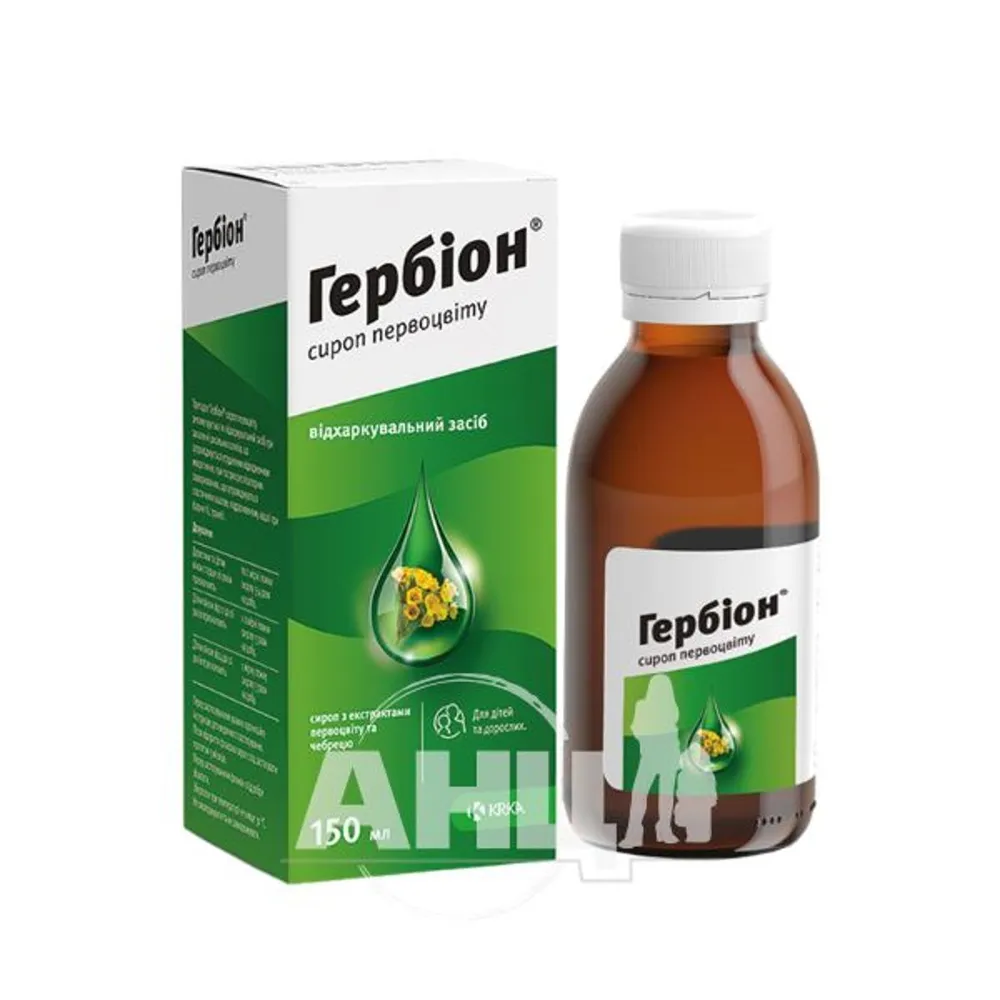
Table of Contents
INSTRUCTIONS FOR MEDICAL USE OF THE MEDICINAL PRODUCT HERBION® COWSLIP SYRUP (HERBION® COWSLIP SYRUP)
Composition:
Active ingredient: liquid extract of primrose root and thyme herb;
5 ml of syrup (1 measuring spoon) contains 3.08 g of liquid extract (extractant – water) of primrose root (Radix Primulae veris L., Radix Primulae elatior L. Hill) and thyme herb (Herba Thymi vulgaris L., Herba Thymi zygis L.);
Excipients: levomenthol, sucrose, methyl 4-hydroxybenzoate (E 218).
Pharmaceutical form. Syrup.
Main physicochemical characteristics: brown syrup with a characteristic odor and taste. A slight sediment may be present, typical for natural substances.
Pharmacotherapeutic group.
Medicinal products used in cough and colds. ATC code R05C.
Pharmacological properties.
Pharmacodynamics.
The effect of the drug has not been determined in clinical studies and was established based on pharmacological research and many years of empirical experience (level of evidence regarding efficacy – IV). The medicinal product contains a mixture of aqueous extracts of primrose root (Primula veris L. and/or Primula elatior L. Hill) and thyme herb (Thymus vulgaris L. and/or Thymus zygis L.).
These active substances promote expectoration of thick mucus from the bronchi in respiratory inflammation, colds, and influenza. Due to its high saponin content, the primrose root extract is used as an expectorant (mucolytic) agent.
Saponins stimulate vagus nerve receptors located in the gastric mucosa, thereby activating the gastro-pulmonary reflex, increasing bronchial secretion, and improving expectoration. The surface activity of saponins involves the formation of a monomolecular film, enabling their spread from the throat along the adjacent mucous membranes of the respiratory tract, thus locally affecting the liquefaction and removal of thick mucus from the bronchi.
Thyme herb promotes expectoration and acts as a bronchodilator due to its essential oil content, the main part of which is excreted through the lungs. On its way to the lungs, the preparation stimulates mucus secretion and expectoration of phlegm, while simultaneously exerting a mild spasmolytic effect on the smooth muscles of the respiratory tract, thereby relieving spasms. Thymol, the main component of the essential oil, has an antiseptic effect.
Pharmacokinetics.
Studies on absorption, distribution, and metabolism of the active substances in the syrup have not been conducted, as it is unknown which active substance and to what extent contributes to the effect.
There are no data on the pharmacokinetics of saponins contained in primrose root. It is known that a small amount of saponins is absorbed. After oral administration, the main component of thyme extract essential oil—thymol—is rapidly absorbed. Its maximum plasma concentration is reached within 1.97 hours. In the body, thymol is metabolized into sulfate and glucuronide. Sulfate is predominantly present in plasma. A portion of thymol or thyme essential oil is excreted via the lungs. Within 24 hours, 16% of thymol is excreted in the urine as glucuronide and sulfate.
Clinical characteristics.
Indications.
As an expectorant in respiratory tract inflammation accompanied by difficult expectoration of mucus.
Contraindications.
Hypersensitivity to the active substances or to any of the excipients; hypersensitivity to other plants of the genus primrose (Primula); hypersensitivity to other plants of the family Lamiaceae (Lamiaceae), sensitivity to celery and birch pollen (cross-reactivity possible). Gastritis, peptic ulcer disease. History of acute obstructive laryngitis in children; bronchial asthma. Children under 4 years of age.
Interaction with other medicinal products and other forms of interaction.
Not known. If concomitant use of any other medicinal products is required, consult a physician.
Special precautions.
Herbion® primrose syrup contains sucrose and therefore cannot be recommended for patients with diabetes mellitus.
If the patient's condition worsens during treatment and/or dyspnea, fever, or purulent sputum occur, consult a physician or qualified healthcare provider.
If symptoms do not resolve after 1 week of using the syrup, consult a physician or qualified healthcare provider regarding further therapy.
Special information about certain excipients
Herbion® primrose syrup contains sucrose. Therefore, patients with rare hereditary disorders such as fructose intolerance, glucose-galactose malabsorption syndrome, or sucrase-isomaltase deficiency should not take this medicine.
Use during pregnancy or breastfeeding
Due to insufficient reliable data on the use of the medicine during pregnancy or breastfeeding, its use during these periods is not recommended.
There are no data available on the effect on fertility.
Ability to influence reaction speed when driving or operating machinery
There are no data available on the effect of the medicine on the ability to drive or operate machinery.
Dosage and Administration.
For adults and children aged 16 years and older, the recommended dose is 2 measuring spoons of syrup 3−4 times daily.
Children aged 4 years and older.
For children aged 10 to 16 years, the recommended dose is 1−2 measuring spoons of syrup 3 times daily.
For children aged 4 to 10 years, the recommended dose is 1 measuring spoon of syrup 3 times daily.
Patients should avoid eating food or drinking immediately after taking the medication, as this may accelerate removal of the medication from the mucous membranes of the oral cavity and throat.
During treatment with the syrup, it is recommended to drink plenty of tea or other warm beverages.
Administration method.
For oral use. The syrup should be shaken well before use.
Children
The syrup is contraindicated in children under 4 years of age.
Overdose.
There have been no reports of overdose.
Overdose may cause gastrointestinal disturbances, vomiting, or diarrhea. Treatment is symptomatic.
Adverse reactions.
The adverse effects that may occur during the use of Herbion® primrose syrup are classified by frequency as follows:
- very common (> 1/10),
- common (> 1/100, < 1/10),
- uncommon (> 1/1,000, < 1/100),
- rare (> 1/10,000, < 1/1,000),
- very rare (< 1/10,000),
- not known (frequency cannot be estimated from available data).
Immune system disorders.
Not known: allergic reactions, hypersensitivity reactions (including anaphylactic shock and angioneurotic edema).
If severe adverse reactions occur, treatment should be discontinued.
Methyl parahydroxybenzoate (E 218) may cause allergic reactions (possibly delayed).
Gastrointestinal disorders.
Very rare: gastrointestinal disturbances (including nausea, vomiting, diarrhea).
If the patient's condition does not improve during the treatment period or if adverse effects not listed in this section occur, the use of the medicinal product should be discontinued and medical advice should be sought.
Shelf life. 3 years.
After opening the bottle, the syrup should be used within 3 months.
Storage conditions.
Store at a temperature not exceeding 30 °C. Do not cool or freeze. Keep out of reach of children.
Packaging.
150 ml of syrup in a bottle, together with a plastic measuring spoon, in a cardboard box.
Pharmaceutical category. Over-the-counter (without prescription).
Manufacturer.
KRKA, d.d., Novo mesto, Slovenia / KRKA, d.d., Novo mesto, Slovenia.
Manufacturer's address and place of business.
Šmarješka cesta 6, 8501 Novo mesto, Slovenia / Smarjeska cesta 6, 8501 Novo mesto, Slovenia.