Heparizin
Ukraine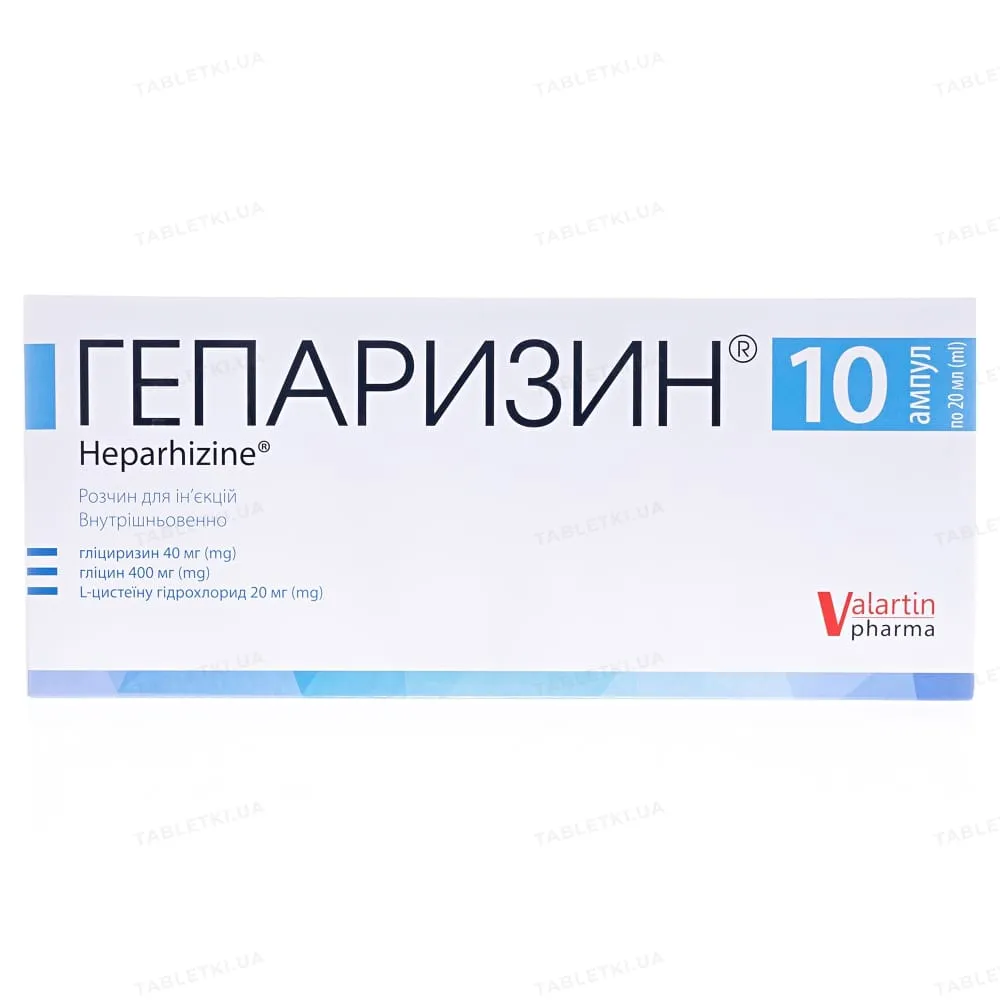
Table of Contents
INSTRUCTION FOR MEDICAL USE OF THE MEDICINAL PRODUCT Heparhizine® (Heparhizine®)
Composition:
Active substances:
1 ampoule contains: monoammonium glycyrrhizinate equivalent to glycyrrhizin 40 mg, glycine 400 mg, L-cysteine hydrochloride 20 mg;
Excipients: sodium sulfite anhydrous, sodium chloride, water for injections, concentrated ammonia solution.
Pharmaceutical form.
Injection solution.
Main physico-chemical characteristics: colorless clear solution.
Pharmacotherapeutic group.
Drugs used in liver diseases, lipotropic substances. Hepatotropic agents. ATC code A05B A.
Pharmacological Properties
Pharmacodynamics
Anti-inflammatory effect
- Anti-allergic: Glycyrrhizin may prevent the development of allergic reactions such as the Arthus phenomenon and the Shwartzman phenomenon in animals. This medicinal product may cause stress-induced suppression of corticosteroid hormone and simultaneously inhibit granulation and thymic atrophy induced by this hormone. The drug does not affect the exudative effect of the hormone.
- Blockade of metabolic enzymes in the arachidonic acid cycle: Glycyrrhizin can bind to phospholipase A2 (an activator of the arachidonic acid cascade) and lipoxygenase (which affects arachidonic acid and its induced synthesis of inflammatory mediators), thereby selectively inhibiting phosphorylation of these enzymes and consequently inhibiting their activation.
Immunoregulatory effects
In in vitro studies, glycyrrhizin:
- modulates T-cell activation;
- induces interferon-γ;
- activates NK cells;
- promotes extrathymic differentiation of T-lymphocytes.
Inhibitory effect on experimental hepatocyte injury
Under in vitro conditions, glycyrrhizin is capable of preventing damage to primary cultures of animal hepatocytes.
Proliferative effect on hepatocytes
Under in vitro conditions using primary hepatocyte cultures, glycyrrhizic acid and glycyrrhetinic acid have been shown to stimulate proliferation of primary hepatocyte cultures.
Inhibition of viral replication and viral deactivation
In animal experiments infected with mouse hepatitis virus (MHV), administration of glycyrrhizin prolonged animal survival.
In animals infected with vaccinia virus, glycyrrhizin may prevent the development of pox.
Other in vitro experiments have further demonstrated a virus-inactivating effect as well as an inhibitory effect on viral spread.
Glycine and cysteine hydrochloride may suppress or reduce manifestations of pseudoaldosteronism caused by metabolic disturbances in electrolyte balance during prolonged use of glycyrrhizin.
Pharmacokinetics
Blood concentration
In studies involving healthy volunteers, after intravenous administration of 40 mL of the drug (corresponding to 80 mg of glycyrrhizin), blood concentration rapidly decreases after an initial increase over the next 10 hours, followed by a gradual decline. Glycyrrhizic acid (the hydrolyzed metabolite of glycyrrhizin) appears in the blood 6 hours after administration, reaches peak levels at 24 hours, and is almost completely eliminated by 48 hours.
Excretion in urine
In studies involving healthy volunteers, after intravenous administration, the concentration of glycyrrhizin in urine decreases gradually. The excreted volume averages 1.2% of the administered dose within 27 hours after administration. Glycyrrhizic acid appears in urine 6 hours after administration and reaches peak concentration between 22 and 27 hours.
Pharmacokinetics in animals
Distribution: Analysis of internal organs began 10 minutes after intravenous administration of 3H-glycyrrhizin to animals. Glycyrrhizin distributes throughout all internal organs of animals. The highest accumulation of the administered drug is observed in the liver (73%). Drug accumulation decreases in the following organs (listed in descending order): kidneys, lungs, heart, adrenal glands.
Clinical characteristics.
Indications.
Improvement of impaired liver function in chronic liver diseases.
Contraindications.
Hypersensitivity to the components of the medicinal product.
The drug is contraindicated in patients with aldosteronism, myopathy, or hypokalemia (risk of exacerbating hypokalemia, hypertension).
Interaction with other medicinal products and other types of interactions.
Loop diuretics (ethacrynic acid, furosemide), thiazide diuretics, and other antihypertensive diuretics (trichlormethiazide, trichlorothalidone) enhance the potassium-excreting effect of glycyrrhizin, thereby reducing serum potassium concentration. Due to the risk of hypokalemia (flaccid paralysis, muscle weakness), appropriate monitoring, including determination of serum potassium concentration, is required.
As a result of decreased serum potassium concentration caused by potassium excretion under the influence of glycyrrhizic acid contained in this drug, the action of moxifloxacin hydrochloride may lead to the development of ventricular tachycardia (including torsades de pointes) and QT interval prolongation syndrome.
Special precautions for use.
Use with caution
This medicinal product should be used with caution in elderly patients.
There have been reports of possible development of rhabdomyolysis with oral administration of glycyrrhizin or other medicinal products containing glycyrrhizin.
General precautions
A detailed medical history should be obtained prior to administration in order to prevent hypersensitivity reactions.
Appropriate emergency equipment should be available in case of hypersensitivity reactions.
The patient should remain at rest after administration of the drug. Close monitoring of the patient is required after administration.
Pseudoaldosteronism may develop when used concomitantly with other medicinal products containing glycyrrhizin.
During intravenous injection, the patient must be closely monitored and the infusion rate should be minimized. The ampoule should be opened only after disinfection with alcohol solution.
Use in elderly patients
This medicinal product should be administered with caution to elderly patients due to the increased risk of developing hypokalemia.
This medicinal product contains 45 mg of sodium per dose. Caution should be exercised when administering to patients on a sodium-restricted diet.
Due to the presence of sodium sulfite, the medicinal product may rarely cause hypersensitivity reactions and bronchospasm.
Use during pregnancy or breastfeeding
Not recommended, as safety and efficacy have not been established.
Ability to influence reaction rate when driving or operating machinery
Does not affect the ability to drive or operate machinery.
Dosage and Administration.
40-60 ml of the drug should be administered once daily by intravenous injection or infusion. The physician may adjust the dose depending on the patient's age and symptoms of the disease. The maximum daily dose should not exceed 100 ml.
Children.
Studies on the efficacy and safety of the drug in children have not been conducted.
Overdose.
Data not available.
Side effects
Side effects most frequently observed
Shock and anaphylactic shock (frequency unknown): shock or anaphylactic shock may occur (including sudden drop in blood pressure, loss of consciousness, dyspnea, cardiopulmonary failure, flushing, facial swelling). Due to the above, patients require careful monitoring. If symptoms of an adverse reaction occur, the drug must be discontinued immediately and appropriate treatment initiated.
Anaphylactic reactions (frequency unknown): anaphylaxis may occur (including dyspnea, flushing, and facial swelling). Due to the above, patients require careful monitoring. If symptoms of an adverse reaction occur, the drug must be discontinued immediately and appropriate treatment initiated.
Pseudohyperaldosteronism (frequency unknown): increased dose or long-term continuous administration of the drug may lead to symptoms of pseudohyperaldosteronism such as severe hypokalemia, increased frequency of hypokalemia, elevated blood pressure, sodium and fluid retention, edema, and weight gain. Careful monitoring is required (including determination of serum potassium concentration). If symptoms of an adverse reaction occur, the drug must be discontinued immediately.
In addition, hypokalemia may cause generalized weakness or moderately pronounced muscle weakness.
Other side effects
The adverse reactions listed below may occur with increased dosage and may lead to decreased serum potassium levels and elevated blood pressure.
| Frequency Adverse reaction |
0.1–5% |
Less than 0.1% |
Frequency unknown |
| Immune system disorders |
- |
Rash |
Urticaria, pruritus |
| Electrolyte metabolism |
Hypokalemia, increased blood pressure |
Edema, fatigue, muscle pain |
- |
| Gastrointestinal disorders |
- |
Epigastric discomfort |
Nausea, vomiting |
| Respiratory system disorders |
- |
- |
Cough |
| Ocular disorders |
- |
- |
Transient visual disturbances (blurred vision, photopsia) |
| Other |
- |
Exanthema, skin discomfort, headache, fever, myalgia, malaise, paresthesia (numbness, tingling sensation), hyperthermia, hyperventilation syndrome (feeling of heat in shoulders, cold sensation in extremities, cold sweat, dry mouth, palpitations), glucosuria |
Feeling of warmth, dysphoria |
Shelf life.
3 years.
Storage conditions.
Store in the original packaging at a temperature not exceeding 25 °C. Keep out of reach of children.
Incompatibility.
The medication must not be mixed with other medicinal products.
Packaging.
20 ml of solution in a vial, 10 vials per cardboard box.
Prescription status.
Prescription only.
Manufacturer.
Beijing Kawin Technology Share-Holding Co., Ltd.
Manufacturer's address.
Buildings 201 and 203, No.7, East Rongchang Street, Beijing Economic-Technological Development Area, Beijing, China.
Marketing Authorization Holder.
VALARTIN PHARMA LLC.
Address of the Marketing Authorization Holder.
60, Hrushevskoho Street, Chayky, Kyiv-Sviatoshyn District, Kyiv Oblast, Ukraine, 08135.