Heparin ointment
Ukraine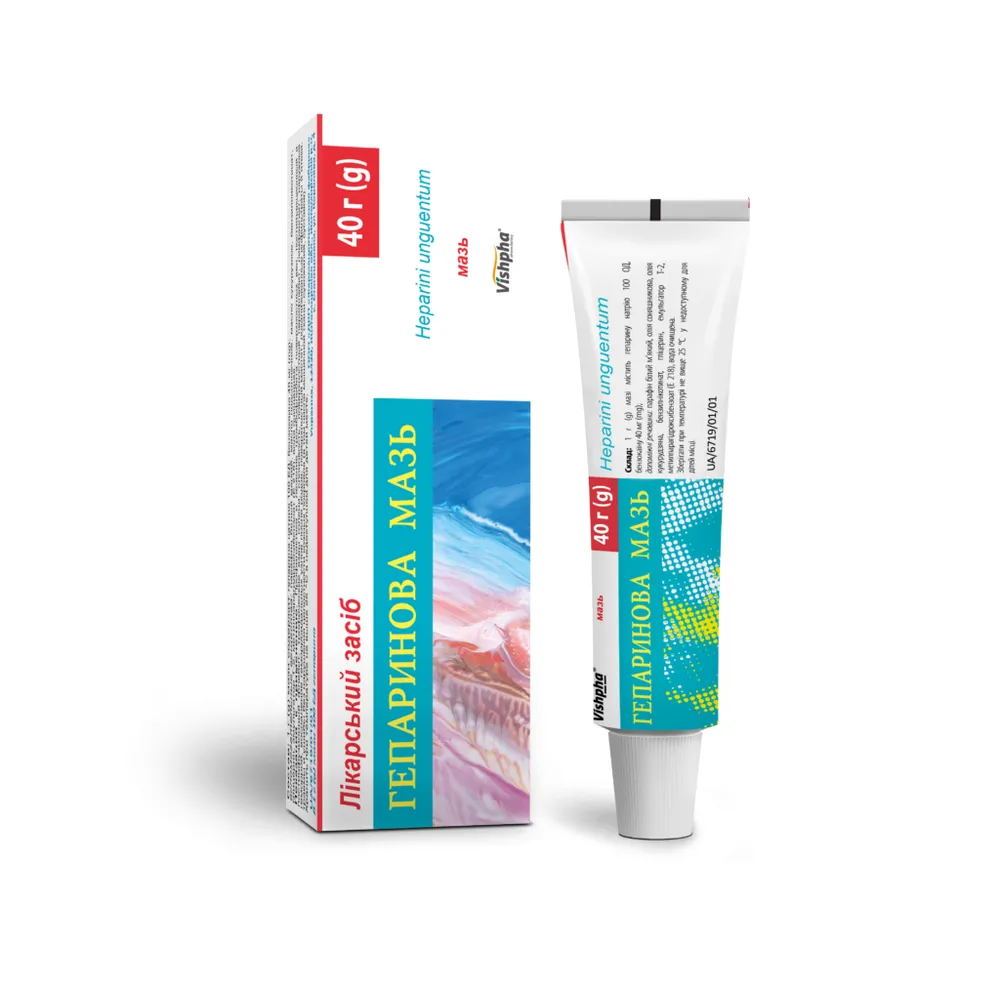
Table of Contents
INSTRUCTIONS FOR MEDICAL USE OF THE MEDICINAL PRODUCT HEPARIN OINTMENT (HEPARINI UNGUENTUM)
Composition:
Active substances: sodium heparin, benzocaine;
1 g of ointment contains sodium heparin 100 IU, benzocaine 40 mg;
Excipients: white soft paraffin, sunflower oil, corn oil, benzyl nicotinate, glycerin, emulsifier T-2, methyl parahydroxybenzoate (E 218), purified water.
Pharmaceutical form. Ointment.
Main physicochemical properties: ointment from white to white with a yellowish tinge.
Pharmacotherapeutic group.
Agents used in varicose veins. Heparin, combinations.
ATC code C05BA53.
Pharmacological properties.
Pharmacodynamics.
Heparin ointment is a direct-acting anticoagulant that exerts anti-inflammatory and local analgesic effects, prevents thrombus formation, and promotes dissolution of existing thrombi.
Pharmacokinetics.
Not determined.
Clinical characteristics.
Indications.
Prophylaxis and treatment of thrombophlebitis of superficial veins, postinjection and postinfusion phlebitis, leg trophic ulcers, elephantiasis, superficial periphlebitis, lymphangitis; external hemorrhoids, inflammation of hemorrhoidal nodes after childbirth; superficial mastitis; localized infiltrates and edema, injuries and contusions without skin integrity impairment (including muscle tissue, tendons, joints).
Contraindications.
Hypersensitivity to any component of the drug. Ulcerative-necrotic processes, traumatic impairment of skin integrity, open infected wounds, hemorrhagic diathesis, purpura, thrombocytopenia, hemophilia, tendency to bleeding.
Special precautions.
The drug should be used under physician supervision in patients with thrombocytopenia or increased tendency to bleeding.
Interaction with other medicinal products and other forms of interaction.
The effect of the ointment is enhanced by anticoagulants, acetylsalicylic acid, and other nonsteroidal anti-inflammatory agents. The efficacy of the ointment is reduced by cardiac glycosides, tetracyclines, nicotine, and antihistamine drugs. Concomitant use of heparin may prolong prothrombin time in patients receiving oral anticoagulants. The drug should not be used concomitantly with topical medicinal products, for example, those containing tetracycline, hydrocortisone, salicylic acid, or anticoagulants.
Special precautions for use.
With prolonged use of the ointment on large areas and simultaneous administration of oral medicinal products affecting the blood coagulation system and/or hematopoiesis, coagulation time and prothrombin time should be monitored. Similar monitoring is recommended for prolonged treatment courses over extensive affected areas in women aged 65 years and older.
The ointment should not be applied to open wounds with purulent processes. The use of the ointment is not recommended in deep vein thrombosis.
The product should not be administered during bleeding, nor applied to mucous membranes, infected skin areas, eyes, or areas around the eyes, ulcers, or blisters. In case of coagulation disorders, application to large skin areas is not recommended.
Use during pregnancy or breastfeeding.
Do not use the product during pregnancy or breastfeeding.
Ability to affect reaction rate when driving or operating machinery.
No effect.
Method of Administration and Dosage
Apply the preparation topically to adults.
In superficial venous thrombophlebitis of the limbs, apply the ointment in a thin layer to the affected area (approximately 0.5–1 g (2–4 cm of ointment) per area with a diameter of 3–5 cm) and gently rub into the skin 2–3 times daily for 3–7 days, until inflammatory symptoms disappear. The possibility of a longer treatment course is determined by the physician.
In hemorrhoidal vein thrombosis, apply the ointment onto a piece of gauze, which should then be applied directly to the hemorrhoidal nodes and secured with a bandage (it is also possible to use a tampon coated with the ointment, which should be inserted into the anal canal) 2–3 times daily until inflammatory signs resolve, on average for 3–14 days. The possibility of prolonged use is determined individually by the physician.
Children
Do not use.
Overdose
Due to the low level of absorption of Heparin ointment, overdose is impossible.
Side effects.
Redness, skin rash, urticaria, angioneurotic edema, hemorrhages; occasionally small pustules, vesicles or blisters may occur. Local irritant effects are possible, manifesting as burning, itching or slight swelling of the skin. The presence of methylparahydroxybenzoate (E 218) in the formulation may cause allergic reactions (possibly delayed); when applied to large areas of skin, systemic allergic reactions and hyperemia are possible.
Shelf life. 3 years.
Do not use the drug after the expiry date stated on the packaging.
Storage conditions.
Store at a temperature not exceeding 25 °C in a place inaccessible to children.
Packaging.
25 g or 40 g in a tube; 1 tube in a box.
Supply classification.
Over-the-counter.
Manufacturer.
LLC "DKP "Pharmaceutical Factory".
Manufacturer's address and location of business activity.
Stanyshivka, Korolova St., b. 4, Zhytomyr district, Zhytomyr region, 12430, Ukraine.