Gensulin m30
Ukraine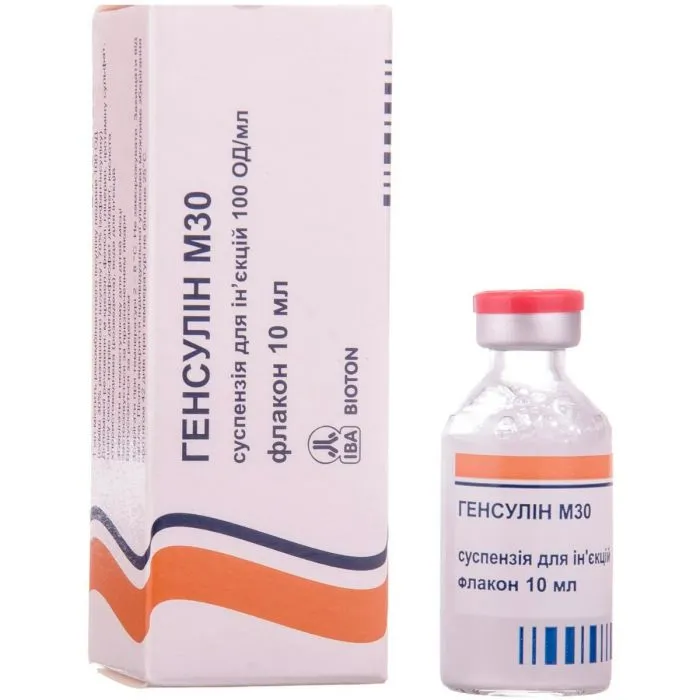
Table of Contents
INSTRUCTIONS FOR MEDICAL USE OF THE MEDICINAL PRODUCT GENSULIN M30 (GENSULIN M30)
Composition:
active substance: recombinant human insulin (a mixture of 30% soluble insulin and 70% isophane insulin);
1 ml of suspension contains recombinant human insulin 100 IU (a mixture of 30% soluble insulin and 70% isophane insulin);
excipients: m-cresol; phenol; glycerin; protamine sulfate; zinc oxide; sodium dihydrogen phosphate dihydrate; hydrochloric acid (diluted); water for injections.
Pharmaceutical form. Injection suspension.
Main physicochemical properties: white suspension, which upon standing separates into a white sediment and a colorless or almost colorless liquid.
Pharmacotherapeutic group. Antidiabetic agents. Insulins and analogues. Short-acting insulins in combination with intermediate-acting insulins for injection. Human insulins.
ATC code A10AD01.
Pharmacological Properties
Pharmacodynamics
Gensulin M30 is a medicinal product containing recombinant human insulin (a mixture of 30% soluble insulin and 70% isophane insulin), produced by genetic engineering using a genetically modified, non-pathogenic strain of E. coli. Insulin is a hormone produced by pancreatic beta cells. It plays a key role in the metabolism of carbohydrates, proteins, and fats, particularly by reducing blood glucose concentration.
Insulin exerts several anabolic and anti-catabolic effects, depending on the tissue type. In muscle tissue, insulin enhances the synthesis of glycogen, fatty acids, glycerol, and proteins. It increases amino acid uptake and simultaneously reduces the rates of glycogenolysis, gluconeogenesis, ketogenesis, lipolysis, protein catabolism, and amino acid utilization. Insulin deficiency in the body leads to diabetes mellitus. Injected insulin acts in the same way as endogenously produced insulin.
Pharmacokinetics
Gensulin M30 begins to act within 30 minutes after administration; the peak effect occurs between 2 and 8 hours, and the duration of action lasts up to 24 hours, depending on the dose administered. In healthy individuals, up to 5% of insulin is bound to plasma proteins. Insulin has been detected in cerebrospinal fluid at concentrations approximately 25% of those found in blood serum.
Insulin is metabolized in the liver and kidneys. Small amounts are also metabolized in muscle and adipose tissue. In patients with diabetes mellitus, insulin metabolism proceeds similarly to that in healthy individuals. Insulin is excreted by the kidneys, with trace amounts eliminated via bile. The elimination half-life of human insulin is approximately 4 minutes. Renal or hepatic impairment may delay insulin clearance. In elderly individuals, insulin elimination is slower, and the duration of hypoglycemic effect is prolonged.
Clinical characteristics.
Indications.
Treatment of patients with diabetes mellitus requiring insulin therapy.
Contraindications.
Hypoglycemia. Hypersensitivity to the medicinal product Gensulin M30 or to any of its components, except in cases when used as desensitizing therapy.
Do not administer intravenously.
Special precautions.
Do not use the medicinal product Gensulin M30:
- if the cartridge or pen has been dropped or subjected to external pressure, as this may damage the device and cause insulin leakage;
- if it has been stored improperly or has been frozen;
- if the liquid inside is not uniformly cloudy;
- if the vial or cartridge cannot be used when, after mixing, the suspension remains clear or if a white sediment forms at the bottom;
- if after mixing, white flakes or white particles float in the vial or cartridge, or remain adhered to the container walls, making the preparation appear as if frozen.
Alcohol consumption may lead to dangerous lowering of blood glucose levels.
Interaction with other medicinal products and other forms of interaction.
Patients should inform their physician about any concomitant therapy administered together with human insulin.
Gensulin M30 should not be mixed with animal insulin or biosynthetic insulins from other manufacturers. Many medicinal products (including certain antihypertensive and cardiac drugs, lipid-lowering agents, drugs used in pancreatic disorders, certain antidepressants, antiepileptic agents, salicylates, and antibacterial agents) as well as oral contraceptives may affect insulin action and the efficacy of insulin therapy.
Medicinal products and substances that enhance insulin action: ß-adrenergic blockers, chloroquine, angiotensin-converting enzyme inhibitors, monoamine oxidase inhibitors (antidepressants), methyldopa, clonidine, pentamidine, salicylates, anabolic steroids, cyclophosphamide, sulfonamides, tetracyclines, quinolone antibiotics, and ethanol.
Medicinal products that reduce insulin action: diltiazem, dobutamine, estrogens (including oral contraceptives), phenothiazines, phenytoin, pancreatic hormones, heparins, calcitonin, corticosteroids, antiviral drugs used in HIV infection treatment, niacin, thiazide diuretics.
Insulin requirement may increase when using drugs with hyperglycemic activity, such as glucocorticoids, thyroid hormones and growth hormone, danazol, β2-sympathomimetics (e.g., ritodrine, salbutamol, terbutaline), thiazides.
Insulin requirement may decrease when using drugs with hypoglycemic activity, such as oral hypoglycemic agents, salicylates (e.g., acetylsalicylic acid), certain antidepressants (monoamine oxidase inhibitors), certain angiotensin-converting enzyme inhibitors (captopril, enalapril), non-selective β-blockers, or alcohol. Somatostatin analogs (octreotide, lanreotide) may either increase or decrease insulin requirement.
When Gensulin M30 is used concomitantly with pioglitazone, symptoms of heart failure may occur, particularly in patients with risk factors for heart failure. When using this combination, patients should be monitored for signs and symptoms of heart failure, weight gain, and edema. Pioglitazone therapy should be discontinued if cardiac symptoms worsen.
Special precautions for use.
Decisions regarding changes in insulin dosing regimens, mixing insulin products, or switching from one insulin product to another must be made solely by a physician. Such decisions must be made under direct medical supervision and may affect the dose of insulin required. If dose adjustments are needed, they may be initiated with the first dose or later over several weeks or months. During insulin therapy, monitoring of blood glucose and urine glucose concentrations, glycated hemoglobin (HbA1c), and fructosamine levels is necessary. Patients should be trained to self-monitor blood and urine glucose levels using simple tests (e.g., test strips). Hypoglycemic symptoms (low blood sugar) may appear at different times and with varying intensity in different individuals. Therefore, patients should be taught to recognize their individual symptoms of hypoglycemia. For patients switching from animal-sourced insulin to human insulin, a reduction in insulin dose may be required (due to the risk of hypoglycemia). In some patients, early symptoms of hypoglycemia after switching to recombinant human insulin may be milder than those experienced with animal-sourced insulin. Early signs of hypoglycemia may also be less pronounced in patients whose glucose levels have been stabilized after long-standing diabetes, in patients with diabetic neuropathy, or in those concurrently using beta-adrenergic blocking agents. Both untreated hypoglycemia and hyperglycemia can lead to loss of consciousness, coma, or death.
Insulin requirements may change due to high fever, severe infection (which may significantly increase insulin requirements), emotional stress, illness, or gastrointestinal disorders associated with nausea, vomiting, diarrhea, constipation, or impaired absorption. The presence of such conditions always requires medical intervention. In such cases, blood and urine glucose levels should be monitored frequently. In renal insufficiency, insulin excretion is reduced and its duration of action prolonged.
Patients whose diabetes is associated with pancreatic disease or who have Addison’s disease or hypopituitarism are highly sensitive to insulin and usually require very low doses.
Insulin requirements may change in patients with disorders of the pituitary gland, pancreas, adrenal glands, thyroid gland, or in those with hepatic or renal insufficiency.
Antibody production may occur during treatment with human insulin, although generally at lower concentrations than with purified animal-sourced insulin.
With prolonged insulin therapy, insulin resistance may develop. If insulin resistance occurs, higher insulin doses may be required.
Incorrect dosing or discontinuation of treatment (especially in patients with insulin-dependent diabetes) may lead to hyperglycemia and potentially fatal diabetic ketoacidosis. Dose adjustments may be necessary when there are changes in the level of physical activity or usual dietary patterns.
Patients planning long journeys involving multiple time zones should consult their physician regarding adjustments to their insulin schedule.
Patients must be advised to rotate injection sites regularly to reduce the risk of lipodystrophy and cutaneous amyloidosis. There is a potential risk of delayed insulin absorption and impaired glycemic control following insulin injections into affected areas. Switching injection sites to unaffected skin areas has been reported to cause hypoglycemia. Blood glucose monitoring is recommended after changing injection sites, and dose adjustments of antidiabetic medications may be considered.
This medicinal product contains less than 1 mmol (23 mg) of sodium per dose, i.e., essentially "sodium-free."
Use during pregnancy or breastfeeding.
Insulin does not cross the placental barrier. For patients with pre-existing diabetes or gestational diabetes, maintaining adequate carbohydrate metabolism control throughout pregnancy is crucial. Insulin requirements may decrease during the first trimester and increase during the second and third trimesters. Immediately after delivery, insulin requirements drop sharply, increasing the risk of hypoglycemia. Therefore, careful blood glucose monitoring is essential. There are no restrictions on the use of GenSulin M30 during breastfeeding. However, breastfeeding women with diabetes may require adjustments in insulin dosage and/or dietary regimen, as insulin requirements during lactation fall below pre-pregnancy levels. Insulin requirements return to pre-pregnancy levels within 6–9 months after delivery.
Ability to influence reaction speed when driving or operating machinery.
The ability to drive may be impaired due to hypoglycemia, which can cause peripheral nervous system disturbances and symptoms such as headache, anxiety, diplopia (double vision), and impaired judgment or distance perception. During the initial phase of insulin therapy, when changing insulin products, or during periods of stress or excessive physical exertion—especially when blood glucose levels fluctuate significantly—patients may experience reduced ability to drive or operate moving machinery. Blood glucose monitoring is recommended during long journeys.
Patients should be informed about the necessary precautions to take before driving to avoid episodes of hypoglycemia, particularly if early warning symptoms of hypoglycemia are absent, unclear, or if hypoglycemic episodes occur frequently. Under such circumstances, driving should be avoided.
Method of Administration and Dosage.
In clinical practice, many insulin treatment regimens are known. The choice of an appropriate individual regimen for a specific patient should be made by a physician, taking into account the patient's insulin requirements. Based on the established blood glucose concentration, the physician determines the necessary dosage and type of insulin preparation for the individual patient. In type 2 diabetes, the average initial dose is 0.2 IU/kg body weight.
Gensulin M30 is administered subcutaneously by injection into the abdominal wall, thigh, shoulder, deltoid, or gluteal area. Injection sites should always be rotated within one area to reduce the risk of lipodystrophy and cutaneous amyloidosis (see sections "Special Instructions" and "Adverse Reactions"). In exceptional cases, it may be administered intramuscularly. Gensulin M30 should be administered 15–30 minutes before a meal. Approximately 10–20 minutes before the planned injection, the insulin should be removed from the refrigerator to allow it to warm to room temperature.
Before administration, carefully inspect the vial or cartridge containing insulin. The Gensulin M30 suspension should be homogeneous, opaque (uniformly cloudy or milky in appearance).
Particular attention should be paid to ensuring that the needle does not enter the lumen of a blood vessel during insulin injection.
Administration of the drug using syringes.
Special syringes with dosage markings are available for insulin administration. In the absence of disposable syringes and needles, reusable syringes and needles may be used, which must be sterilized before each injection. It is recommended to use syringes of the same type and manufacturer. Always ensure that the syringe being used is calibrated according to the dosage units of the insulin preparation being administered.
The vial of Gensulin M30 should be rotated in the palms until the suspension becomes uniformly cloudy or milky in appearance.
Injection Procedure:
- Remove the plastic cap, but do not remove the actual cap from the vial;
- Wipe the vial stopper with an alcohol swab; do not remove the cap from the vial!
- Draw into the syringe an amount of air equal to the selected insulin dose;
- Pierce the rubber stopper and inject the air into the vial;
- Turn the vial with the syringe upside down;
- Ensure that the tip of the needle is immersed in the insulin;
- Draw the required volume of insulin solution into the syringe;
- Remove air bubbles from the syringe back into the vial by expelling insulin;
- Recheck the accuracy of the drawn dose and withdraw the needle from the vial;
- Disinfect the skin at the planned injection site;
- With one hand, stabilize the skin by pinching it into a fold;
- Hold the syringe in the other hand like a pencil. Insert the needle into the skin at a 90° angle. Ensure that the needle is fully inserted and properly placed in the subcutaneous fat layer, not in deeper tissue layers (in thin individuals, the needle should be inserted at a smaller angle, not perpendicularly);
- To administer the insulin, push the syringe plunger fully, delivering the dose over at least 5 seconds;
- Hold an alcohol-soaked cotton swab close to the needle and withdraw the needle from the skin. Apply the alcohol-soaked swab to the injection site for several seconds. Do not rub the skin at the injection site!
- To avoid tissue damage, it is recommended to change the injection site with each injection. The next injection site should be at least 1–2 cm away from the previous one.
Mixing Gensulin M30 suspension with Gensulin R solution.
The decision to mix Gensulin M30 with the above-mentioned Gensulin R solution may be made only by a physician.
Use of Gensulin M30 in cartridges for pen devices.
Gensulin M30 cartridges can be used with reusable pen-type injection devices ("pens"). When filling the pen device, attaching the needle, and administering the injection, strictly follow the manufacturer's instructions for the pen device. If necessary, insulin can be drawn from the cartridge into a standard insulin syringe and administered as described above (depending on insulin concentration and type).
The Gensulin M30 suspension must be mixed before each injection by inverting the vial 10 times or by rotating it in the palms until the suspension becomes uniformly cloudy or milky in appearance.
Children.
There is insufficient experience with the use of this drug in children.
Overdose.
In case of insulin overdose, symptoms of hypoglycemia appear, including hunger, apathy, dizziness, muscle tremors, disorientation, restlessness, rapid heartbeat, excessive sweating, vomiting, headache, confusion, and impaired consciousness. In mild hypoglycemia, oral intake of a sweet beverage or carbohydrate-rich food is sufficient. Rest is recommended. Patients should always carry sugar cubes, glucose, or candies. Chocolate is not recommended, as the fat it contains delays glucose absorption.
Severe hypoglycemia may lead to seizures and loss of consciousness, even to a fatal outcome. If the patient is in a coma, intravenous glucose must be administered. After insulin overdose, symptoms of hypokalemia (decreased blood potassium concentration) with subsequent myopathy may also develop. In significant hypokalemia, when the patient cannot take food orally, 1 mg of glucagon should be administered intramuscularly and/or a glucose solution intravenously. After regaining consciousness, the patient should eat. It may also be necessary to continue giving carbohydrates and to monitor blood glucose levels further, as hypoglycemia may recur even after clinical recovery.
Adverse Reactions
In the presence of symptoms of severe hypoglycemia or hyperglycemia with development of ketoacidosis, immediate medical intervention is required. The most commonly observed adverse reactions during insulin therapy include hypoglycemia (decreased blood glucose level) and hyperglycemia (increased blood glucose concentration), as well as local manifestations of allergic reactions.
Hypoglycemia. Signs of moderate hypoglycemia: excessive sweating, dizziness, tremor, sensation of hunger, anxiety, tingling in palms, soles, lips or tongue, difficulty concentrating, drowsiness, sleep disturbances, confusion, mydriasis, blurred vision, speech disturbances, depression, irritability. Signs of severe hypoglycemia: disorientation, loss of consciousness, seizures.
Hyperglycemia. In patients with type 1 diabetes, prolonged hyperglycemia leads to ketoacidosis and diabetic coma, which are life-threatening conditions. The first symptoms of acidosis, which develop gradually over several hours or even days, include: drowsiness, facial flushing, thirst, loss of appetite, acetone odor on the breath, increased levels of glucose and ketone bodies in blood and urine, tachypnea, and rapid pulse.
Other adverse effects occurring sporadically during administration of biosynthetic insulins include: insulin-induced lipodystrophy (atrophy or hypertrophy of fatty tissue at the injection site), insulin allergy, insulin resistance.
Local manifestations of allergic reactions – common adverse effect (1/100 to <1/10), including redness of the skin, swelling or itching at the injection site.
Generalized allergic reactions are rare (<1/10,000) but potentially dangerous. Cases of generalized allergy may include generalized rash, dyspnea, wheezing, hypotension, increased heart rate, and increased sweating.
Disorders of the skin and subcutaneous tissue. Frequency unknown: cutaneous amyloidosis; lipodystrophy and cutaneous amyloidosis may occur at the injection site and may delay local absorption of insulin. Regular rotation of injection sites within the same injection area may help reduce or prevent these reactions (see section "Special Instructions").
Lipodystrophy may occur at the injection site (frequency from 1/1000 to <1/100).
To avoid tissue damage, it is recommended to change the injection site with each administration.
Other reported cases include:
- Edema during insulin therapy, particularly during initial improvement of previously poor metabolic control;
- Weight gain;
- Injection site reactions: skin discoloration at the injection site, bleeding, induration, swelling at the injection site, injection nodules, pain, urticaria, and pustules at the injection site;
- Localized pruritus and generalized itching;
- Dizziness.
Shelf life.
3 years.
Do not use the medicinal product after the expiry date stated on the packaging.
Storage conditions.
After opening the individual package, store for up to 28 days at a temperature not exceeding 25 °C. Store at 2–8 °C in a protected from light place. Do not freeze. Keep out of reach of children.
Incompatibility.
Generally, insulin may be mixed with substances with which its compatibility is known.
Medicinal products added to insulin may cause its degradation, for example, preparations containing thiols or sulfites.
Packaging.
10 ml in glass vials closed with an aluminum cap and a two-layer rubber disc, with a plastic cap, № 1 in a cardboard box; 3 ml in cartridges, № 5 in a cardboard box.
Prescription status.
By prescription only.
Manufacturer.
BIOTON S.A., Poland (BIOTON S.A., Poland).
Manufacturer's address and place of business.
Legal address: Poland, 02-516, Warsaw, ul. Staroscinska 5 (Poland, 02-516, Warsaw, 5 Staroscinska str.).
Manufacturing address: Macierzysz, ul. Poznanska 12, 05-850 Ozarow Mazowiecki, Poland (Macierzysz, 12, Poznanska Street, 05-850 Ozarow Mazowiecki, Poland).