Heloplasma
Ukraine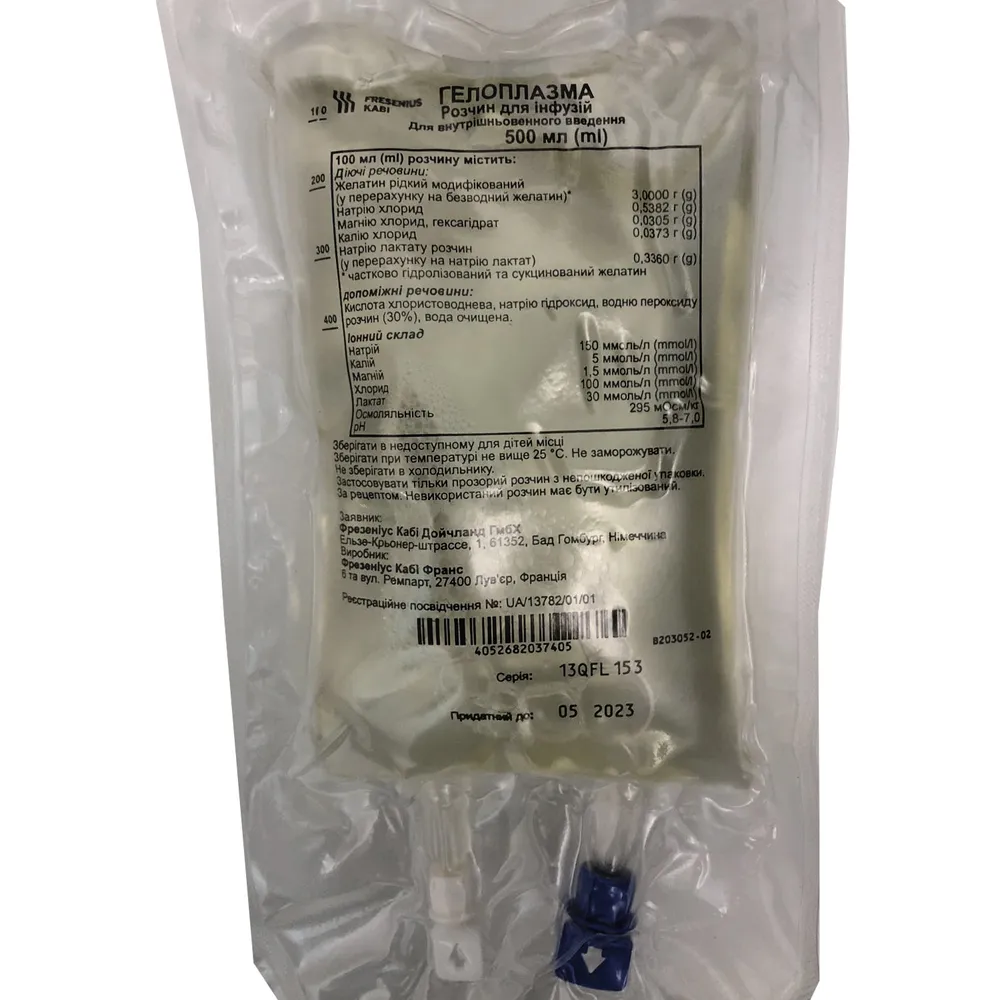
Table of Contents
INSTRUCTIONS FOR MEDICAL USE OF THE MEDICINAL PRODUCT GELOPLAZMA (GELOPLAZMA)
Composition:
Active substances:
100 ml of solution contains: modified liquid gelatin, calculated as anhydrous gelatin − 3.0000 g, sodium chloride − 0.5382 g, magnesium chloride, hexahydrate − 0.0305 g, potassium chloride − 0.0373 g, sodium lactate solution, calculated as sodium lactate − 0.3360 g;
Excipients: hydrochloric acid, sodium hydroxide, hydrogen peroxide solution (30%), water for injections.
Ion composition:
sodium 150 mmol/L
potassium 5 mmol/L
magnesium 1.5 mmol/L
chloride 100 mmol/L
lactate 30 mmol/L
Osmolality 295 mOsm/kg
pH 5.8–7.0
Pharmaceutical form. Infusion solution.
Main physicochemical properties: clear, colorless or light yellow solution.
Pharmacotherapeutic group. Blood substitutes and perfusion solutions. Gelatin derivatives.
ATC code B05A A06.
Pharmacological properties.
Pharmacodynamics.
Haemoplasmal is a solution of modified liquid gelatin in physiological saline with a mean molecular weight (Mw) of 45,000 Daltons. Due to succinylation, gelatin molecules become more negatively charged and thus more elongated. Haemoplasmal acts as a plasma substitute but does not exert a plasma-expanding effect.
The solution of the medicinal product influences the restoration of ionic balance and correction of acidosis and slightly increases diuresis.
The solution of the medicinal product is used independently, without blood transfusion, in cases of blood loss from 10 to 20% of the total blood volume and during infusions of limited volume (approximately 500 ml). Such administrations do not affect blood group changes and exert a neutral effect on blood coagulation mechanisms.
In the presence of severe bleeding, alternate administration of blood and liquid gelatin preparations ensures adequate hemodilution (restoration of blood volume and maintenance of oncotic pressure).
Pharmacokinetics.
After infusion, the medicinal product rapidly distributes into the intravascular space and partially—depending on the low fraction of molecular weight—into the interstitial space. The presence of low-molecular-weight substances in the composition affects kidney function and increases diuresis. The volume-replacement effect of the medicinal product persists for 4–5 hours after infusion. It is rapidly eliminated (75% within 24 hours), primarily via the kidneys with urine.
Clinical characteristics.
Indications.
Emergency treatment of shock states:
- hypovolemic shock caused by hemorrhage, dehydration, blood loss during surgery, burns;
- vasoplegic shock of traumatic, surgical, septic, or toxic origin.
Treatment of concomitant hypovolemia associated with hypotension in the context of vasoplegia induced by antihypertensive drugs, particularly during anesthesia.
Contraindications.
- Hypersensitivity to solutions containing gelatin or to any of the active or excipient ingredients;
- increased sensitivity to galactose-α-1,3-galactose (alpha-Gal) or known allergy to red meat (mammalian meat) and organ meats;
- hyperkalemia;
- predominantly extracellular hyperhydration;
- metabolic alkalosis;
- end of pregnancy (labor/delivery).
Interaction with other medicinal products and other forms of interaction.
Concomitant intravenous administration of other substances is not recommended, as the pharmacokinetics of components in such mixtures has not been studied. Since this solution contains potassium, it is advisable to avoid potassium intake and drugs that may cause hyperkalemia (e.g., potassium-sparing diuretics, ACE inhibitors).
Special precautions for use
The solution must not be administered intramuscularly.
Prior to infusion, the physician must visually inspect the bags containing the medicinal product. The medicinal product is suitable for use only if the packaging is intact and undamaged.
The solution must be clear and transparent. Cloudy solutions must not be used.
The medicinal product may cause metabolic alkalosis due to the presence of lactate ions.
Hepatic impairment
The alkalizing effect of the medicinal product may not be achieved in patients with hepatic insufficiency due to impaired lactate metabolism.
The solution must not be administered simultaneously (in the same infusion system) with blood or blood-derived products (e.g. packed red blood cells, plasma, and plasma fractions). Administration must be performed only through separate infusion systems.
Blood group determination, antibody testing, and other blood laboratory analyses are possible in patients who have received up to 2 liters of the gelatin-containing medicinal product, although interpretation of results may be complicated by hemodilution. Therefore, blood samples for such tests should preferably be collected before infusion of the gelatin solution.
Monitoring of the patient's condition is necessary due to the possibility of allergic reactions (anaphylactic/anaphylactoid reactions).
Due to possible cross-reactivity, patients with hypersensitivity to galactose-α-1,3-galactose (alpha-Gal) may have a significantly increased risk of hypersensitivity and corresponding anaphylactic reactions to gelatin-containing solutions. This includes patients with known allergy to red meat (mammalian meat) and offal and/or with a positive test for anti-alpha-Gal IgE antibodies. Gelatin-containing colloidal solutions should not be administered to such patients.
In the event of allergic reactions, infusion must be immediately discontinued and appropriate treatment initiated.
The solution contains 5 mmol/l of potassium and 150 mmol/l of sodium. This information must be taken into account when prescribing the solution to patients with renal impairment or those on potassium- and sodium-restricted diets.
Safety measures
Administration of this medicinal product requires monitoring of the patient's clinical condition and laboratory parameters:
- measurement of arterial pressure and, if necessary, central venous pressure;
- monitoring of diuresis;
- assessment of hematocrit and electrolyte levels.
Particular caution is required in the following conditions:
- congestive heart failure;
- impaired lung function;
- severe renal dysfunction;
- edema/salt retention;
- circulatory overload;
- treatment with corticosteroids and their derivatives;
- severe coagulation disorders.
Hematocrit should not fall below 25%; in elderly patients, it should not fall below 30%. Dilutional coagulopathy due to dilution of clotting factors should be avoided. In chronic heart failure, infusion should be performed slowly due to the risk of circulatory overload. If more than 2000–3000 ml of Geloplasma has been administered before or during surgery, serum protein concentration should be checked postoperatively, especially if signs of tissue edema are present.
Use during pregnancy or breastfeeding
There is insufficient information on the use of plasma substitutes during pregnancy or breastfeeding. No cases of embryotoxic effects of the medicinal product have been reported in this patient group, but there is a risk of anaphylactic/anaphylactoid reactions leading to fetal or neonatal distress due to maternal arterial hypotension. Since allergic reactions may occur, the medicinal product is not recommended for use during the third trimester of pregnancy. The medicinal product should be administered during pregnancy only when the expected benefit to the pregnant woman outweighs the potential risk to the fetus, as the risk of anaphylactoid/anaphylactic reactions cannot be completely excluded.
The medicinal product must not be used for prophylaxis of hypovolemia during labor analgesia or epidural anesthesia. However, it may be used for treatment of hypovolemia when plasma volume replacement is required during pregnancy.
There are no data on the passage of the medicinal product into breast milk. Experience with its use during breastfeeding is insufficient. Risk to newborns/infants cannot be excluded.
Fertility
Controlled studies on the effect of the medicinal product on fertility in animals or humans are lacking.
Ability to affect reaction rate when driving vehicles or operating machinery
There is no information available regarding the influence of the medicinal product on the ability to drive vehicles or operate complex machinery.
Method of Administration and Dosage
For intravenous use only.
The volume and rate of infusion depend on the individual patient's condition, circumstances of use, and response to volume expansion.
The medicinal product is administered as an intravenous infusion (drip). The use of an infusion pump may increase the infusion rate.
Dosage and infusion rate depend on the patient's needs, the volume of blood being replaced, and the patient's hemodynamic status.
The recommended dose is on average from 500 to 1000 mL (1–2 bags), and sometimes more.
Adults and children with body weight over 25 kg receive 500 mL (1 bag) at an appropriate rate depending on the patient's condition. The infusion rate may be increased in cases of severe blood loss.
If blood loss in an adult patient exceeds 1.5 L (i.e., more than 20% of blood volume), blood transfusion should usually be administered in addition to Geloplasma. Hemodynamic, hematological, and coagulation parameters should be monitored.
Children.
Used in pediatric practice (see section "Method of Administration and Dosage").
Overdose.
Higher doses of the medicinal product may cause circulatory overload with a significant decrease in hematocrit and plasma proteins. Increased pressure in the pulmonary circulation may lead to fluid leakage into the extravascular space and cause pulmonary edema. Infusion must be immediately stopped as soon as symptoms of circulatory overload due to overdose appear.
In case of overdose, the infusion should be discontinued and a fast-acting diuretic administered.
Symptomatic treatment of the patient and monitoring of electrolyte levels are required.
Adverse reactions.
The following classification is used to assess the frequency of adverse effects: very common (≥ 1/10), common (≥ 1/100, < 1/10), uncommon (≥ 1/1 000, < 1/100), rare (≥ 1/10 000, < 1/1 000), very rare (< 1/10 000), frequency not known (cannot be estimated based on available data).
Undesirable effects observed during administration of the drug:
| Uncommon (≥ 1/10 000, < 1/1 000) |
Very rare (< 1/10 000) |
|
| Immune system disorders |
Anaphylactic shock, particularly hypersensitivity to galactose-α-1,3-galactose (alpha-Gal) and allergies to red meat and offal |
|
| Skin and subcutaneous tissue disorders |
Allergic skin reactions |
|
| Vascular disorders |
Hypotension |
|
| Cardiac disorders |
Slowing of heart rate |
|
| Respiratory, thoracic and mediastinal disorders |
Dyspnea |
|
| General disorders and administration site conditions |
Fever, chills |
Reporting of suspected adverse reactions
Reporting of adverse reactions following registration of the medicinal product is of great importance. It allows continuous monitoring of the benefit-risk balance of the medicinal product. Medical and pharmaceutical professionals, as well as patients or their legal representatives, should report all suspected adverse reactions and lack of efficacy of the medicinal product via the Automated Pharmacovigilance Information System at the following link: https://aisf.dec.gov.ua
Shelf life.
2 years.
Storage conditions.
Store out of reach of children at a temperature not exceeding 25°C. Do not freeze. Do not store in the refrigerator.
Incompatibilities.
Physico-chemical incompatibility with certain antibiotics (chlortetracycline, amphotericin B (IV), oxytetracycline, vancomycin).
Due to the lack of compatibility studies, this medicinal product must not be mixed with other medicinal products.
Packaging.
500 ml in a Freeflex bag.
500 ml in a Freeflex bag; 20 Freeflex bags in a cardboard box.
Prescription status.
Prescription only.
Manufacturer.
Fresenius Kabi France.
Manufacturer's address and location of its business operations.
6 rue Rempart, 27400 Louviers, France.
Marketing Authorization Holder.
Fresenius Kabi Deutschland GmbH.
Address of the Marketing Authorization Holder and/or its representative.
Else-Kröner-Straße 1, 61352 Bad Homburg, Germany.