Helaspan 4 %
Ukraine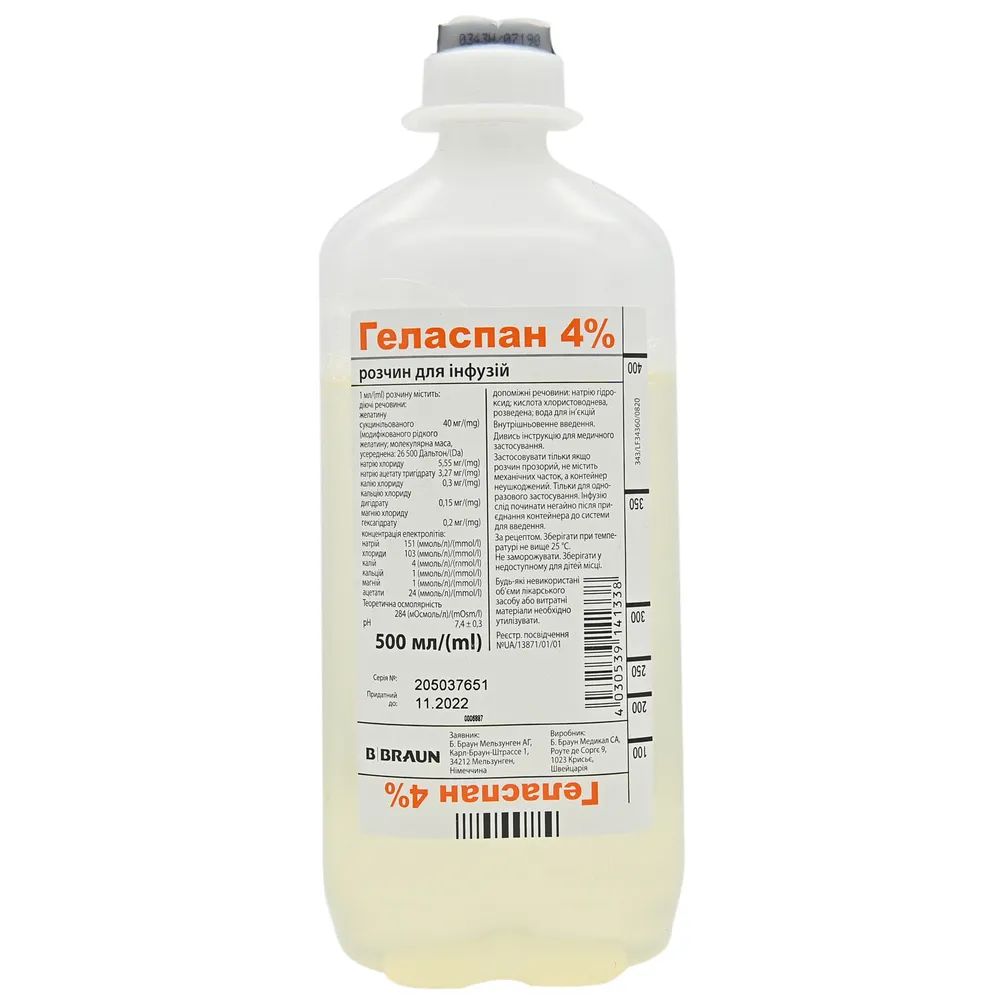
Table of Contents
INSTRUCTIONS for medical use of the medicinal product GELASPAN 4% (GELASPAN 4%)
Composition:
Active substances: 1 ml of solution contains succinylated gelatin (modified liquid gelatin; average molecular weight: 26,500 Dalton) 40 mg; sodium chloride 5.55 mg; sodium acetate trihydrate 3.27 mg; potassium chloride 0.3 mg; calcium chloride dihydrate 0.15 mg; magnesium chloride hexahydrate 0.2 mg;
| electrolyte concentration: |
||
| sodium |
151 |
mmol/L; |
| chlorides |
103 |
mmol/L; |
| potassium |
4 |
mmol/L; |
| calcium |
1 |
mmol/L; |
| magnesium |
1 |
mmol/L; |
| acetates |
24 |
mmol/L; |
Excipients: sodium hydroxide, diluted hydrochloric acid, water for injections.
Dosage form. Infusion solution.
Main physicochemical properties: clear, straw-colored solution, practically free from foreign particles.
Theoretical osmolarity 284 mOsmol/L; pH 7.4 ± 0.3.
Pharmacotherapeutic group. Blood substitutes and perfusion solutions. Gelatin preparations.
ATC code B05A A06.
Pharmacological properties.
Pharmacodynamics. Gelspan is a solution of succinylated gelatin (also known as modified fluid gelatin) with a concentration of 40 mg/mL and an average molecular weight of 26,500 Daltons (averaged) in a plasma-adapted, balanced isotonic electrolyte solution. The negative charge introduced into the molecule by succinylation causes molecular expansion. Therefore, its molecular volume is larger than that of a non-succinylated gelatin molecule with the same molecular weight.
In healthy volunteers, the measured initial volume effect of Gelspan ranges from 80 to 100% of the administered volume, with a sufficient volume effect lasting for 4–5 hours.
Mechanism of action
The colloid-osmotic pressure of the solution determines its initial volume effect. The duration of the effect depends on colloid clearance, primarily through renal excretion. Since the volume effect of Gelspan is equivalent to the amount of solution administered, Gelspan is a plasma substitute, not a plasma expander. The solution also restores the extravascular space without disturbing the electrolyte balance of the extracellular space. Gelspan is isotonic; therefore, it does not cause fluid shifts into the intracellular space. Gelspan promotes restoration of the electrolyte balance and correction of acidosis. Gelspan does not contain lactate and can thus be used in patients with liver disease. The solution contains acetate as a bicarbonate precursor, which can be metabolized in all organs and muscles.
Gelspan replaces intravascular and extravascular volume deficits caused by blood, plasma, and interstitial fluid losses. Thus, mean arterial pressure, left ventricular end-diastolic pressure, cardiac stroke volume, cardiac index, oxygen delivery, microcirculation, and diuresis increase without dehydration of the extravascular space.
Pharmacokinetics.
Distribution
After administration, Gelspan rapidly distributes within the intravascular space.
Metabolism/elimination
Most of the administered Gelspan is excreted by the kidneys. Only a small amount is excreted in feces, and no more than 1% is metabolized. Smaller molecules are eliminated via glomerular filtration, while larger molecules are first proteolytically degraded in the liver and then excreted by the kidneys.
Pharmacokinetics in special clinical situations
The plasma half-life of Gelspan may be prolonged in patients undergoing hemodialysis (glomerular filtration rate (GFR) < 0.5 mL/min), although gelatin accumulation is not observed. Gelspan minimizes the risk of dilutional acidosis and rebound alkalosis observed with lactate-containing solutions when administered to patients with liver disease. Gelspan contains acetate and does not contain lactate. Therefore, it may also be indicated for patients with hypovolemia and liver disease.
Clinical characteristics.
Indications.
Gelaspan is a colloid plasma substitute in an isotonic, fully balanced electrolyte solution for:
Treatment of relative or absolute hypovolemia and shock.
Prevention and treatment of hypotension:
- caused by relative hypovolemia during induction of epidural or spinal anesthesia,
- resulting from inevitable significant blood loss during surgical intervention.
Performing procedures involving extracorporeal circulation as a component of priming fluid in combination with crystalloid solutions (e.g., initiation of cardiopulmonary bypass).
Contraindications.
Hypersensitivity to any of the active or excipient ingredients listed in the section "Composition".
Hypersensitivity to galactose-alpha-1,3-galactose (alpha-gal) or known allergy to red meat (mammalian meat) or to offal (see section "Special precautions").
Hypervolemia.
Hyperhydration.
Acute congestive heart failure.
Interaction with other medicinal products and other forms of interaction.
Caution should be exercised if patients are concurrently receiving medicinal products that may cause sodium retention (e.g., corticosteroids, nonsteroidal anti-inflammatory drugs), as concomitant administration may lead to edema.
Potassium-sparing diuretics, angiotensin-converting enzyme (ACE) inhibitors, nonsteroidal anti-inflammatory drugs, cyclosporine, tacrolimus, or succinylcholine may increase serum potassium levels. Concomitant use of potassium-containing solutions and these medicinal products may lead to severe hyperkalemia, which may cause cardiac arrhythmia.
Potassium administration may reduce the therapeutic effect of cardiac glycosides.
Adrenocorticotropic hormone (ACTH), corticosteroids, and loop diuretics may increase potassium elimination.
Special precautions for use.
Hextend should be administered with caution to patients with allergic diseases, for example, bronchial asthma, in medical history.
Modified fluid gelatin solutions may rarely cause allergic (anaphylactic/anaphylactoid) reactions of varying severity. To detect the earliest possible signs of an allergic reaction, the first 20 mL of the solution should be infused slowly, with careful observation of the patient, especially at the beginning of the infusion.
Due to possible cross-reactions involving the allergen galactose-alpha-1,3-galactose (alpha-gal), the risk of sensitization and, consequently, anaphylactic reactions to gelatin-containing solutions is increased in patients with a history of allergy to red meat (mammalian meat) and offal and/or with a positive test for anti-alpha-gal IgE antibodies. Gelatin-containing colloidal solutions should not be administered to such patients (see section "Contraindications").
In case of an allergic reaction, the infusion must be stopped immediately and appropriate treatment initiated.
Hextend must be administered with extreme caution to patients:
- with circulatory overload, for example, patients with congestive heart failure, right or left ventricular insufficiency, arterial hypertension, pulmonary edema, or renal insufficiency with oliguria or anuria;
- with severe renal function impairment;
- with severe hypernatremia;
- with severe hyperchloremia;
- who have edema associated with water/salt retention;
- with serious coagulation disorders;
- of advanced age, as they are more prone to developing conditions such as cardiac or renal failure;
- with severe hypercalcemia;
- with existing hyperkalemia – the solution should be administered only when the benefit clearly outweighs the risks.
Like all colloids, Hextend should be used only if hypovolemia cannot be corrected by crystalloids alone.
In severe hypovolemia, colloids are usually used in combination with crystalloids.
Overload due to overdosing or too rapid infusion must be avoided. Dosage should be carefully adjusted, especially in patients with pulmonary or cardiocirculatory problems.
Serum electrolyte concentrations, acid-base balance, and fluid balance should be monitored, particularly in patients with hypernatremia, hyperchloremia, or impaired renal function.
If necessary, electrolytes and fluids should be replaced according to individual requirements.
When compensating for severe blood loss by administering large volumes of Hextend, hematocrit and electrolyte levels must be monitored under all circumstances.
Similarly, in such situations, the dilutional effect on blood coagulation factors should be observed, especially in patients with hemostasis disorders.
Since the medicinal product does not replace lost plasma proteins, plasma protein concentrations should be monitored (see section "Dosage and administration").
Hextend must not be administered through the same infusion line as blood or blood products (cells, plasma, plasma fractions).
Children
Experience with the use of Hextend in children is insufficient. Therefore, Hextend should be prescribed to such patients only when the expected benefit clearly outweighs the potential risk (see section "Dosage and administration").
Effect on laboratory test results
Laboratory blood tests (blood group determination or transient antibodies) may be performed after Hextend infusion. However, blood samples are recommended to be taken before Hextend infusion to avoid difficulties in interpreting results.
Hextend may affect the results of clinical chemistry tests, causing falsely elevated values in:
- erythrocyte sedimentation rate;
- specific gravity of urine;
- non-specific protein assays, e.g., the biuret method.
Use during pregnancy or breastfeeding.
Pregnancy
Data on the use of Hextend in pregnant women are lacking or limited. Due to the limited available data and the possibility of severe anaphylactic/anaphylactoid reactions leading to fetal or neonatal distress, the use of Hextend during pregnancy should be restricted to emergency situations.
Lactation
Data on the excretion of succinylated gelatin into breast milk are lacking or limited. However, due to its high molecular weight, it is not expected that breast milk will contain any significant amount of gelatin. Sodium and chloride are normal constituents of the human body and diet. A significant increase in the levels of these electrolytes in breast milk after administration of Hextend is not expected.
Fertility
There are no data on the effect of Hextend on human fertility. However, due to the nature of its components, it is considered unlikely that Hextend would affect fertility.
Ability to affect reaction speed when driving or operating machinery.
Hextend has no effect or has a negligible effect on the ability to drive vehicles or operate machinery.
Method of Administration and Dosage
Dosage
The dose and infusion rate are adjusted according to the volume of blood lost and the individual needs for restoration and maintenance of stable hemodynamic conditions. Initially, a dose of 500 to 1000 mL is administered; higher doses are required in cases of severe blood loss.
Adults
Adults are given 500 mL at an appropriate rate depending on the patient's hemodynamic status. In cases of blood loss exceeding 20%, it is generally necessary to additionally administer blood or blood components (see section "Special Precautions").
Maximum Dose
The maximum daily dose is determined by the degree of hemodilution. Caution should be exercised to avoid hemoglobin or hematocrit levels falling below critical values.
If necessary, additional blood or packed red blood cells should be administered.
Also, dilution of plasma proteins (e.g., albumin or coagulation factors) should be considered and adequately replaced if needed.
Infusion Rate
The first 20 mL of solution should be infused slowly to detect any anaphylactic or anaphylactoid reactions as early as possible (see section "Special Precautions").
In severe, acute situations, 500 mL of Gelaspan may be rapidly infused within 5–10 minutes under pressure until signs of hypovolemia have resolved.
Continuous monitoring of hemodynamic and hematological systems, as well as coagulation parameters, is required.
Children
The safety and efficacy of Gelaspan in children have not been fully established. Therefore, dosage recommendations cannot be provided. Gelaspan should be administered to pediatric patients only when the expected benefit clearly outweighs the potential risk. In such cases, the patient's overall clinical condition should be carefully considered and therapy closely monitored (see also section "Special Precautions").
Elderly Patients
Caution is advised when administering to patients with comorbidities such as heart or renal failure, which are commonly associated with advanced age (see also section "Special Precautions").
Route of Administration
Intravenous administration.
In cases where pressure infusion is required due to life-threatening emergencies, all air must be removed from the container and infusion system prior to administration to minimize the risk of air embolism associated with infusion.
Overdose.
Symptoms
Overdose of Gelaspan may cause hypervolemia and circulatory overload, resulting in a significant decrease in hematocrit and plasma proteins, accompanied by electrolyte and acid-base imbalances. This may lead to consecutive cardiac and pulmonary dysfunction (e.g., pulmonary edema). Symptoms of circulatory overload include headache, dyspnea, and jugular venous distension.
Treatment
In case of circulatory overload, infusion must be stopped immediately and fast-acting diuretics administered. Symptomatic therapy with electrolyte monitoring should be provided in cases of overdose.
Side effects
The side effects are listed according to their frequency, defined as follows:
Very common: ≥ 1/10; common: ≥ 1/100 to < 1/10; uncommon: ≥ 1/1,000 to < 1/100; rare: ≥ 1/10,000 to < 1/1,000; very rare: < 1/10,000; not known: cannot be estimated from the available data.
Adverse reactions may occur during and after administration of Gelaspán. They usually include anaphylactic/anaphylactoid reactions of varying severity. (See also sections "Contraindications" and "Special precautions", especially regarding hypersensitivity to galactose-alpha-1,3-galactose (alpha-gal) and allergy to red meat and offal).
List of adverse reactions:
Immune system disorders:
Rare – anaphylactic/anaphylactoid reactions up to shock (see section "Special precautions").
Cardiac disorders:
Very rare – tachycardia.
Vascular disorders:
Very rare – hypotension.
General disorders and administration site conditions:
Very rare – fever, chills.
Gastrointestinal disorders:
Not known – nausea, vomiting, abdominal pain.
Investigations:
Not known – decreased oxygen saturation.
Blood and lymphatic system disorders:
Very common – decreased hematocrit and plasma protein concentration; common (depending on the dose administered) – relatively high doses of Gelaspán cause dilution of coagulation factors and may therefore affect blood coagulation. Prothrombin time and activated partial thromboplastin time (aPTT) may be prolonged after administration of high doses of Gelaspán (see section "Special precautions").
Children
There are no data on a specific pattern or frequency of adverse reactions in pediatric patients.
Reporting of suspected adverse reactions
Reporting suspected adverse reactions after medicine authorization is important. It allows continued monitoring of the benefit-risk balance of the medicine. Healthcare professionals and patients, as well as their legal representatives, should report any suspected adverse reactions and lack of efficacy through the Automated Information System for Pharmacovigilance at the following link: https://aisf.dec.gov.ua
Shelf life.
Unopened container
Polyethylene "Ecoflac Plus" bottles: 2 years.
Plastic "Ecobeg" bags (non-PVC): 2 years.
After first opening of the container
Infusion should be started immediately after connecting the container to the infusion system.
Storage conditions.
Store at a temperature not exceeding 25 °C.
Do not freeze. Keep out of the reach of children.
Incompatibilities.
Due to the lack of compatibility studies, this medicinal product must not be mixed with other medicinal products.
Packaging.
500 ml of solution in polyethylene bottles; 10 bottles per cardboard box.
500 ml of solution in plastic bags; 20 bags per cardboard box.
Prescription status.
Prescription only.
Manufacturers.
B. Braun Medical S.A. / B. Braun Medical SA.
Manufacturer's location and address of its place of business.
Route de Sorge 9, 1023 Crissier, Switzerland / Route de Sorge 9, 1023 Crissier, Switzerland.