Gekoton
Ukraine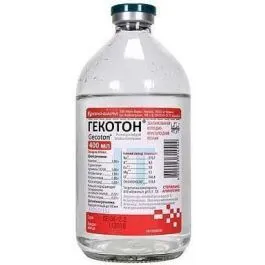
Table of Contents
INSTRUCTIONS FOR MEDICAL USE OF THE MEDICINAL PRODUCT GECOTON® (GECOTON®)
Composition:
Active substances: 100 ml of solution contains hydroxyethyl starch 130/04 5.0 g, xylitol 5.0 g, sodium lactate solution (calculated as sodium lactate) 1.5 g, sodium chloride 0.8 g, potassium chloride 0.03 g, calcium chloride dihydrate (calculated as calcium chloride) 0.02 g, magnesium chloride hexahydrate (calculated as magnesium chloride) 0.01 g;
Excipient: water for injections.
Pharmaceutical form. Infusion solution.
Main physicochemical properties: slightly opalescent, colorless or yellowish solution. Average molecular weight of hydroxyethyl starch − 130,000 Daltons, degree of substitution − 0.4. Theoretical osmolarity − 890 mOsm/L, pH − 5.5–7.5. Ion composition of the preparation: Na⁺ − 270.7 mmol/L, K⁺ − 4.0 mmol/L, Ca²⁺ − 1.8 mmol/L, Mg²⁺ − 1.1 mmol/L, Cl⁻ − 146.6 mmol/L, CH₃CH(OH)COO⁻ − 133.8 mmol/L.
Energy value – 200 kcal/L.
Pharmacotherapeutic group. Blood substitutes and plasma protein fractions.
ATC code B05AA.
Pharmacological properties.
Pharmacodynamics.
The active ingredients in the medicinal product are hydroxyethyl starch (HES) 130/0.4, xylitol, and sodium lactate. Gekoton**®** exerts hemodynamic, rheological, anti-shock, detoxifying, and alkalizing effects.
HES is a synthetic colloid derived from amylopectin. Structurally, it is similar to glycogen, which accounts for its good tolerability and low risk of anaphylactic reactions. HES tends to accumulate in cells of the reticuloendothelial system but does not exert toxic effects on the liver, lungs, spleen, or lymph nodes. Intravenous administration of HES restores impaired hemodynamics, improves microcirculation and blood rheological properties (due to reduction in hematocrit), decreases blood viscosity, reduces platelet aggregation, and prevents erythrocyte aggregation. In patients with hypovolemia, administration of HES increases circulating blood volume and improves hemodynamic and cardiac function. When an adequate amount of HES is administered, normal blood volume is maintained for at least 6 hours.
Xylitol, a carbohydrate metabolism product, is a pentitol that directly enters the pentose phosphate cycle of metabolism. Unlike fructose and sorbitol, xylitol does not cause a reduction in hepatic adenine nucleotides (ATP, ADP, AMP). It is safe for administration to patients with fructose sensitivity or deficiency of the enzyme fructose-1,6-diphosphatase. Xylitol is considered to have greater antiketogenic and nitrogen-sparing effects than glucose and is equally well utilized both pre- and postoperatively. Since xylitol is an energy source with insulin-independent metabolism, exerts antiketogenic and lipotropic effects, it is recommended for use as a parenteral nutrition agent, particularly in patients who have undergone gastrointestinal surgery.
Sodium lactate belongs to slowly-acting alkalizing agents. When administered intravascularly, sodium lactate releases sodium, CO₂, and H₂O, which form sodium bicarbonate, thereby increasing the blood's alkaline reserve. Correction of metabolic acidosis with sodium lactate occurs gradually (as sodium lactate is incorporated into metabolic processes) and does not cause abrupt pH fluctuations. Sodium lactate is considered to have a positive effect on cardiac function, tissue regeneration, and blood respiratory function, exerts a detoxifying effect, promotes increased diuresis, and improves liver and kidney function.
Due to its composition, Gekoton**®** belongs to the group of multi-component colloidal hyperosmolar solutions. After intravenous administration, the drug increases blood osmotic pressure, enhances fluid mobilization from tissues into the vascular bed, restores impaired hemodynamics, improves microcirculation and blood rheological properties, enhances cardiac activity and metabolic processes, and improves hepatic detoxification function.
Pharmacokinetics.
After intravenous administration, HES is continuously hydrolyzed by serum amylase, producing smaller molecules that remain oncologically active until they are excreted by the kidneys.
Xylitol is a five-carbon alcohol; 80% is taken up by the liver and stored as glycogen, while the remainder is metabolized by tissues of other organs (kidneys, heart, pancreas, adrenal glands, brain) and excreted in urine. The maximum rate of xylitol utilization is 0.25 g/kg body weight/hour.
The effect of sodium lactate becomes apparent 20–30 minutes after administration.
Clinical characteristics.
Indications.
Hypovolemia caused by acute blood loss, in cases where the use of crystalloids alone is considered insufficient.
Contraindications.
Hypersensitivity to the active substance or any of the excipients listed in the section "Composition" (including starch allergy), state of hyperhydration, hypervolemia, hyperosmolar coma, hyperlactatemia (lactic acidosis), severe hypocoagulation, hypofibrinogenemia, pronounced thrombocytopenia, hypernatremia, hyperkalemia, hyperchloremia, chronic heart failure, severe coagulation disorders, intracranial hemorrhage, sepsis, burns, period of hemodialysis sessions, detected sensitization to HES. Hekoton**®** must not be administered in cases where fluid infusion is contraindicated (edema, intracranial hemorrhage, hypertensive disease stage III with cardiovascular decompensation, pulmonary edema, severe chronic liver diseases, dehydration state requiring correction of water-electrolyte balance (in this case crystalloids are recommended for fluid replacement)), as well as in patients with renal insufficiency or patients undergoing renal replacement therapy, and in severe coagulopathy. Critical condition of the patient (such patients are usually in intensive care units). Contraindicated in patients with transplanted organs.
Interaction with other medicinal products and other forms of interaction.
| The drug must not be mixed with phosphate- or carbonate-containing solutions. Hekoton® cannot be used as a carrier solution for other drugs. Adding other drugs may lead to physicochemical changes in the solution. Medicinal products that reduce renal function When used concomitantly with aminoglycoside antibiotics, HES may potentiate their nephrotoxicity. Medicinal products causing potassium or sodium retention Since this preparation already contains electrolytes, this fact should be taken into account when using concomitantly medicinal products that may lead to potassium or sodium retention. Cardiac glycosides Elevated calcium levels increase the risk of toxic effects of cardiac glycosides. When using other HES-containing drugs, it should be considered that the total maximum daily dose of HES must not exceed 2 g/kg/day. |
When using other preparations containing xylitol or other carbohydrates (glucose, sorbitol, fructose, etc.), the total daily dose of carbohydrates should not exceed 2 g/kg/day.
Special precautions for use.
Currently, there is a lack of data on the safety of long-term use of HES in patients after surgical procedures and in trauma patients. Before prescribing HES to such patients, the expected benefit should be carefully weighed against the uncertainty regarding long-term safety, and alternative treatment options should be considered. Hydroxyethyl starch solutions should be used only when crystalloids alone are insufficient.
Hydroxyethyl starch preparations are contraindicated in patients with renal impairment, coagulation disorders—especially hemophilia, and diagnosed or suspected von Willebrand disease—as well as in patients undergoing renal replacement therapy (see section "Contraindications").
HES administration must be discontinued immediately upon the first signs of kidney injury. The need for renal replacement therapy has been reported within 90 days following HES infusion. Therefore, renal function must be monitored in patients after HES administration. HES administration should be immediately discontinued at the first signs of coagulopathy. If repeated administration is necessary, coagulation parameters must be closely monitored.
For patients undergoing open-heart surgery with cardiopulmonary bypass, the use of hydroxyethyl starch is not recommended due to the risk of excessive bleeding.
Volume overload due to overdose or excessively rapid infusion must always be avoided, particularly in patients with concomitant cardiac pathology and in elderly patients. Dose selection should be carefully considered, especially in patients with lung, heart, or circulatory disorders.
Serum electrolytes, fluid balance, and renal function should be monitored. Adequate water intake must be ensured. In cases of severe dehydration, water-electrolyte balance should be normalized as a priority.
Severe hemodilution caused by large doses of hydroxyethyl starch solutions should also be avoided during treatment of patients with hypovolemia.
The presence of Hekoton® in the blood may interfere with blood group determination. To correctly determine blood group, a blood sample should be taken before administration of Hekoton®.
To detect early signs of anaphylactoid reactions, the first 10–20 mL of Hekoton® should be administered slowly under continuous medical supervision.
The product must not be used if the solution is cloudy or contains visible particles, or if the vial or container is damaged or previously opened.
Prolonged daily use of HES at medium (500 mL/day) or high (1,000 mL/day) doses may lead to intractable pruritus. Pruritus may begin several weeks after discontinuation of treatment and may persist for months. Administration of the drug may increase blood amylase concentration, which may interfere with the diagnosis of pancreatitis.
The drug should be used with particular caution in patients with impaired liver function or coagulation disorders (except severe forms—see section "Contraindications"). The drug should be administered under monitoring of liver function parameters. Since xylitol has choleretic properties, administration of Hekoton® is not recommended in patients with cholelithiasis.
Administration of the medicinal product in patients with diabetes mellitus should be performed with monitoring of blood glucose levels.
Elderly patients
Careful monitoring of elderly patients, who are more susceptible to heart failure and renal dysfunction, is required during treatment. Dose selection should be carefully adjusted to avoid circulatory and renal complications caused by hypervolemia.
Effect on laboratory tests
After administration of hydroxyethyl starch solutions, alpha-amylase levels may temporarily increase. This should not be interpreted as an indication of pancreatic dysfunction (see section "Adverse reactions").
Administration of Hekoton® may also affect laboratory blood parameters such as blood glucose, protein levels, and erythrocyte sedimentation rate, as well as alter urine test results.
Use during pregnancy or breastfeeding.
There is no clinical experience with the use of this medicinal product during pregnancy or breastfeeding.
Ability to affect reaction speed when operating vehicles or machinery.
The medicinal product is administered exclusively in a hospital setting.
Dosage and Administration
HEC should be administered at the lowest effective dose for the shortest duration possible. Treatment should be accompanied by hemodynamic monitoring and should be discontinued immediately once appropriate hemodynamic parameters are achieved.
The medicinal product is administered intravenously by drip infusion.
Due to the possibility of anaphylactoid reactions, the first 10–20 mL of the solution should be infused slowly at a rate of 20–30 drops per minute under physician supervision.
Dosing recommendations for blood volume replacement.
The risk of circulatory overload due to too rapid administration or excessive dosage should be considered. In patients without risk of cardiovascular or pulmonary complications, a hematocrit value of 30% represents the threshold for administration of colloidal volume expanders.
The daily dose and infusion rate depend on the volume of blood loss, maintenance or restoration of hemodynamics, and the effect of hemodilution.
In emergency situations, the maximum infusion rate may be 10 mL/kg/hour (350–400 mL over 30 minutes). The recommended infusion rate is 5 mL/kg/hour (350–400 mL/hour).
Maximum daily dose (exceeding is permitted only in exceptional cases): 20 mL/kg/day (1400–1600 mL per day). The usual dose administered is 5–10 mL/kg/day (400–800 mL per day).
Duration and extent of therapeutic use are determined by the duration and degree of hypovolemia.
Children.
Experience with the use of this medicinal product in children is lacking.
Overdose.
| High doses of the drug due to dilution effects and circulatory system volume overload may cause prolonged bleeding time, which does not affect platelet function and does not lead to clinically significant bleeding. Attention should be paid to possible decreases in hematocrit and plasma protein concentrations. This may result in impairment of heart and lung function (pulmonary edema). In addition, symptoms of alkalosis, nausea, abdominal distension, diarrhea, and abdominal pain may occur. Treatment. |
In case of overdose, it is necessary to immediately discontinue the infusion and consider the need for diuretics. Symptomatic treatment of the patient should be carried out, and electrolyte levels should be monitored.
Adverse reactions.
Rarely, administration of Hekoton**®** may cause symptoms typical of HES use.
Immune system disorders: anaphylactoid reactions of varying severity (skin reactions, sudden flushing, tachycardia, dizziness, vomiting, fever), which may lead to a drop in arterial pressure and asthmatic conditions (bronchospasm). Severe hypersensitivity reactions accompanied by shock, pulmonary edema, cardiac arrest, and respiratory arrest are very rare. Enlargement of submandibular and parotid salivary glands, as well as flu-like symptoms, headache, and myalgia may occur. If hypersensitivity reactions occur, administration of the drug must be stopped immediately, and emergency measures should be initiated depending on clinical symptoms and severity. Antihistamines and corticosteroids should be administered.
Skin and subcutaneous tissue disorders: prolonged daily use of the drug at medium or high doses may cause persistent pruritus, which is difficult to treat and may last for months. This pruritus may begin several weeks after discontinuation of treatment and persist for months. In such cases, it is recommended to reduce the maximum daily dose to 200 ml.
Renal and urinary disorders: occasionally, lower back pain may occur (administration of the drug should be discontinued; infusion of large volumes of physiological electrolyte solutions should be provided, and frequent monitoring of serum creatinine levels is required); kidney damage.
Laboratory findings: during treatment, blood alpha-amylase levels may increase, which may interfere with the diagnosis of pancreatitis. Levels return to normal within 3–5 days (no diagnostic or therapeutic interventions are required).
Blood and lymphatic system disorders: reduced hematocrit, lower plasma protein concentration. Dilution of coagulation factors, prolonged bleeding time and aPTT (activated partial thromboplastin time), reduced levels of FVIII/von Willebrand factor complex; rapid administration or infusion of a large volume of the drug may cause a sudden increase in circulating blood volume.
Vascular disorders: when high doses are administered, symptoms of increased bleeding tendency (dilution effect) and prolonged blood clotting time may occur. Therefore, maximum recommended doses should not be exceeded.
General disorders and administration site conditions: Hekoton**®** rarely may cause symptoms typical of xylitol side effects: nausea, bloating, diarrhea, abdominal pain.
Hekoton**®**, like other hypertonic and hyperosmolar solutions, may cause irritation of peripheral veins at the infusion site during prolonged administration.
Shelf life. 2 years.
Storage conditions.
Store at temperatures not exceeding 25 °C. Do not freeze. Keep out of reach of children.
Moisture on the inner surface of the bottles is not a contraindication for drug use.
Incompatibility.
The medicinal product must not be mixed with phosphate- or carbonate-containing solutions. Adding other drugs may lead to physicochemical changes in the solution.
When used concomitantly with aminoglycoside antibiotics, HES contained in the formulation may potentiate their nephrotoxicity.
Packaging.
200 ml or 400 ml in a bottle.
Prescription status. Prescription only.
Manufacturer.
LLC "Yuria-Pharm".
Manufacturer's address and location of business activity.
108, Kozbirska St., Cherkasy, 18030, Cherkasy region, Ukraine. Tel.: (044) 281-01-01.