Gekodez®
Ukraine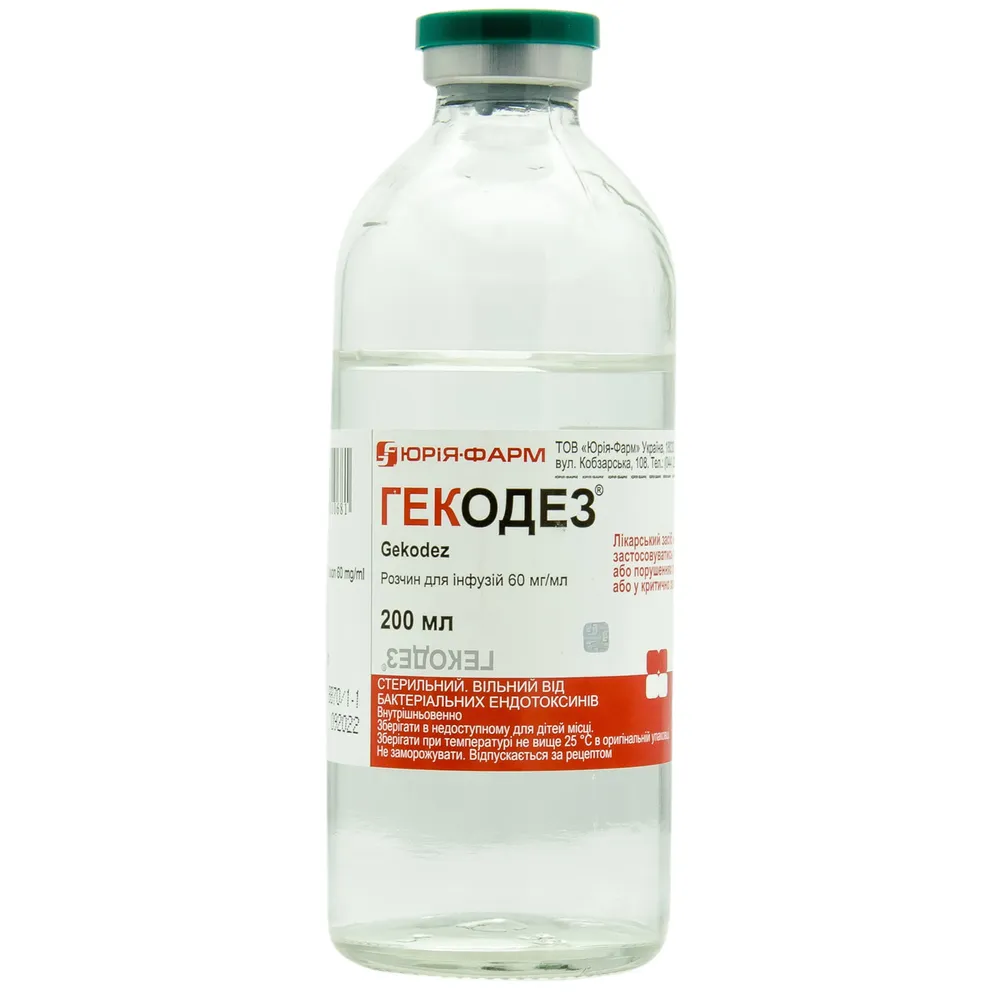
Table of Contents
INSTRUCTIONS FOR MEDICAL USE OF THE MEDICINAL PRODUCT GEKODEZ® (GEKODEZ)
Composition:
Active substance: hydroxyethyl starch;
1 ml of solution contains 60 mg of hydroxyethyl starch with an average molecular weight of 200,000 and average molecular substitution of 0.5 (hydroxyethyl starch (200/0.5));
Excipients: sodium chloride, water for injections.
Pharmaceutical form. Infusion solution.
Main physico-chemical properties: slightly opalescent, colorless or slightly yellowish liquid. pH 4.00–7.00. Theoretical osmolarity – 308 mOsmol/l. Ionic composition: sodium ion – 154.0 mmol/l; chloride ion – 154.0 mmol/l.
Pharmacotherapeutic group. Blood substitutes and perfusion solutions. Hydroxyethylated starch preparations. ATC code B05AA07.
Pharmacological properties.
Hydroxyethyl starch (HES) is derived from amylopectin and is characterized by its molecular weight and degree of substitution. For Haemodex® the average molecular weight of HES is 200,000 Da, and the molar substitution degree is approximately 0.5. Structurally, HES resembles glycogen, which explains its high tolerance and low risk of anaphylactic reactions.
Haemodex® is an iso-oncotic solution, meaning that intravascular plasma volume increases equivalently to the infused volume.
Pharmacodynamics.
The duration of the volume-expanding effect depends primarily on the degree of molar substitution and, to a lesser extent, on the average molecular weight.
Hydroxyethyl starch (HES) undergoes prolonged hydrolysis, resulting in the formation of oncotic active oligo- and polysaccharides of various molecular weights, which are excreted by the kidneys.
Haemodex® may reduce plasma viscosity parameters, including hematocrit. The volume-expanding effect following iso-volemic administration of Haemodex® lasts for at least 6 hours.
Pharmacokinetics.
HES is a mixture of molecules with varying degrees of molar substitution and different molecular weights; both parameters influence the rate of elimination. Small molecules are excreted via glomerular filtration, while larger ones undergo enzymatic hydrolysis by α-amylase and are subsequently excreted by the kidneys. The rate of hydrolysis is lower the higher the degree of substitution of the molecule. Approximately 50% is excreted in urine within 24 hours.
After a single dose of 1000 ml of Haemodex®, plasma clearance is 19 ml/min, and total drug absorption is 58 mg/h/ml. The half-life in blood serum is 12 hours.
Clinical characteristics.
Indications.
Hypovolemia caused by acute blood loss in cases where the use of crystalloids alone is considered insufficient.
Contraindications.
- Hypersensitivity to the active substance or to any other component of the medicinal product;
- Burns;
- Intracranial or cerebral hemorrhage;
- Severe liver function disorders;
- Renal failure or renal replacement therapy;
- Severe coagulopathy;
- Congestive heart failure;
- Pulmonary edema, hyperhydration, hypervolemia;
- Severe hyperkalemia, severe hypernatremia, severe hyperchloremia;
- Dehydration state requiring correction of water-electrolyte balance;
- Contraindicated in patients with transplanted organs;
- Pediatric age;
- First trimester of pregnancy. In the second and third trimesters of pregnancy, the drug should be used only if there are life-threatening indications.
Due to the risk of kidney injury and fatal outcome, the medicinal product is contraindicated in patients with sepsis and critically ill patients.
Special safety precautions.
Do not use the product if the solution is cloudy or contains visible particles, or if the bottle or container is damaged or has been previously opened.
The medicinal product must be used immediately after opening. Under no circumstances should an opened bottle or container be stored for subsequent infusions. Unused portions of the medicinal solution and any materials used must be disposed of in accordance with applicable legislation.
Interaction with other medicinal products and other types of interactions.
To avoid incompatibility, do not mix Hextend® with other drugs.
When administered concomitantly with aminoglycoside antibiotics, hydroxyethyl starch may enhance their nephrotoxicity.
At high doses, volume expansion effects may lead to decreased levels of clotting factors and other plasma proteins, as well as reduced hematocrit.
Special precautions for use
Due to the risk of allergic (anaphylactic/anaphylactoid) reactions, strict monitoring of the patient's condition is required, and the infusion should be administered slowly. To detect potential anaphylactoid reactions as early as possible, the first 10–20 mL of Hextend® should be infused slowly under continuous supervision by medical personnel.
Indications for volume replacement should be carefully evaluated when using HES, and hemodynamic monitoring is required to control volume and dosing.
Volume overload due to overdose or excessively rapid infusion must always be avoided. Dose adjustment should be performed carefully, especially in patients with lung disease or impaired cardiac circulation. Serum electrolytes, fluid balance, and renal function should be monitored. Adequate fluid intake (adequate hydration) should be ensured.
In cases of severe dehydration, the water-electrolyte balance should first be normalized.
HES preparations are contraindicated in patients with renal insufficiency or those receiving renal replacement therapy (see section "Contraindications"). HES administration must be immediately discontinued at the first signs of kidney injury. Cases requiring renal replacement therapy have been reported within 90 days following HES infusion. Therefore, renal function should be monitored in patients for at least 90 days after HES administration.
Particular caution is required when treating patients with impaired liver function (except for severe liver dysfunction, see section "Contraindications") and patients with coagulation disorders, especially hemophilia and diagnosed or suspected von Willebrand disease. In patients with hypovolemia, excessive hemodilution that may occur with high doses of HES solutions should also be avoided. HES administration must be immediately discontinued at the first signs of coagulopathy. When repeated or prolonged use is necessary, coagulation parameters should be closely monitored.
HES preparations are not recommended for patients undergoing open-heart surgery in combination with cardiopulmonary bypass due to the risk of excessive bleeding.
Surgical procedures and trauma
Currently, there are no reliable data on the long-term safety of HES use in patients after surgical interventions or in trauma patients. Before prescribing HES to such patients, the expected benefit should be carefully weighed against the uncertainty regarding long-term safety, and alternative treatment options should be considered.
Elderly patients
Volume overload due to overdose of Hextend® should be avoided, particularly in elderly patients with concomitant cardiac pathology or renal insufficiency. Elderly patients, who are more likely to have heart failure and kidney dysfunction, require careful monitoring during treatment, and dosing should be adjusted accordingly to avoid cardiovascular and renal complications due to hypervolemia.
Effect on laboratory test results
Administration of hydroxyethyl starch may cause elevated serum amylase levels. This effect should not be interpreted as pancreatic dysfunction, but rather as a result of complex formation between hydroxyethyl starch and amylase, leading to delayed renal and non-renal elimination of the complex.
The medicinal product may interfere with the results of clinical and biochemical tests, including blood glucose levels; blood protein levels; erythrocyte sedimentation rate (ESR); biuret test; levels of free fatty acids, cholesterol, and sorbitol dehydrogenase in blood; and urine specific gravity.
The presence of Hextend® in the blood may cause errors in determining the patient's blood group. To correctly determine blood group, the sample must be taken before administration of Hextend®.
With prolonged daily use at medium (500 mL/day) or high (1000 mL/day) doses, pruritus may develop that is difficult to treat. Pruritus may begin several weeks after completion of treatment and may persist for months.
Sodium chloride load
This medicinal product contains:
30.8 mmol (or 708.46 mg) per 200 mL dose of sodium;
38.5 mmol (or 885.58 mg) per 250 mL dose of sodium;
61.6 mmol (or 1416.93 mg) per 400 mL dose of sodium;
77 mmol (or 1771.16 mg) per 500 mL dose of sodium.
Caution is advised when administering to patients on a sodium-controlled diet.
Use during pregnancy or breastfeeding
Pregnancy
There are no clinical data on the use of Hextend® during pregnancy. Animal studies have not revealed any direct or indirect adverse effects on pregnancy, embryonic/fetal development, parturition, or postnatal development. However, in reproductive toxicity studies in animals with similar agents, vaginal bleeding, embryotoxic, and teratogenic effects were observed after repeated dosing in test animals.
The drug is contraindicated in the first trimester of pregnancy. In the second and third trimesters, the drug may be used only if life-saving, when the expected benefit to the mother outweighs the potential risk to the fetus. When using the drug during pregnancy, the possible risk of anaphylactoid reactions, which may lead to fetal brain damage, must be taken seriously.
Breastfeeding
There are no clinical data on the use of Hextend® during breastfeeding. It is unknown whether hydroxyethyl starch is excreted in breast milk. Caution should be exercised when administering the drug to breastfeeding women. The possibility of temporarily discontinuing breastfeeding should be considered.
Ability to affect the reaction rate when driving or operating machinery
No information available. The drug is intended for use in a hospital setting.
Method of Administration and Dosage
The use of HES should be restricted to the initial phase of volume resuscitation, within a maximum time interval of 24 hours.
HES should be administered at the lowest effective doses for the shortest possible duration. Treatment must be accompanied by continuous hemodynamic monitoring and should be discontinued immediately after achieving adequate hemodynamic parameters.
The drug is intended for intravenous administration. The daily dose and infusion rate depend on the volume of blood loss and hemodynamic parameters.
The first 10–20 mL of Hekodez® should be administered slowly, not exceeding 500 mL/hour (corresponding to 0.1 mL/kg/min), under constant physician supervision due to the possibility of anaphylactoid reactions.
The daily dose and infusion rate of the solution depend on the extent of blood loss and the need for maintenance or restoration of hemodynamic parameters.
The maximum daily dose of Hekodez® should not exceed 30 mL/kg body weight, corresponding to 1.8 g HES/kg/day (approximately 2250 mL/day for a patient weighing 75 kg).
The maximum infusion rate depends on the clinical situation. During shock, the recommended infusion rate is up to 20 mL/kg body weight per hour, corresponding to 0.33 mL/kg body weight per minute (1.2 g HES/kg body weight/hour). In critical situations, rapid infusion of 500 mL of solution under pressure is possible. When administering the drug under pressure, especially when using Hekodez® in plastic containers, all air must be removed from the container and the infusion system beforehand to prevent the risk of air embolism.
The duration of therapy depends on the duration and severity of hypovolemia, the hemodynamic response to treatment, and the level of hemodilution.
Children
Data on use in children are limited; therefore, HES-containing drugs are not recommended for use in this patient group.
Overdose
Overdose or excessively rapid administration of the drug may lead to volume overload or hypernatremia, accompanied by peripheral, interstitial, or pulmonary edema and acute heart failure. Excessive chloride administration may result in hyperchloremic metabolic acidosis. If early symptoms of anaphylactic reactions or signs of hypervolemic overload occur, administration of Hekodez® must be stopped immediately, and diuretics should be administered if necessary.
Side effects.
The most common adverse effects are directly related to the main effects of HES solutions and the dose of the drug administered. Hypersensitivity reactions of varying severity may occur, including anaphylactoid reactions (flu-like symptoms (headache, muscle pain, back pain), bradycardia, tachycardia, bronchospasm, non-cardiogenic pulmonary edema), urticaria, hypotension, nausea, vomiting. Increased body temperature, chills, swelling of the lower extremities, enlargement of salivary glands, anaphylactic shock. A possible reduction in coagulation factors due to hemodilution as a result of HES solution administration without concomitant administration of blood components.
Allergic reactions occur quite rarely and are independent of the dose of the administered drug. A known adverse effect after prolonged administration of high doses of hydroxyethyl starch is skin itching.
The frequency of adverse reactions is defined as follows: very common (≥ 1/10), common (from ≥ 1/100 to < 1/10), uncommon (from ≥ 1/1000 to < 1/100), rare (from ≥ 1/10,000 to < 1/1000), very rare (< 1/10,000), frequency not known (assessment not possible with available data).
Blood and lymphatic system
Very common: due to hemodilution, a decrease in hematocrit and plasma protein concentration occurs.
Common (depending on the dose administered): relatively high doses of hydroxyethyl starch cause dilution of coagulation factors and thereby affect blood coagulation. Bleeding time and activated partial thromboplastin time (APTT) may be prolonged, and the concentration of factor VIII/von Willebrand factor (vWF) complex may decrease after administration of high doses of the drug.
Hepatobiliary system
Frequency not known: liver damage.
Skin and subcutaneous tissue
Uncommon: repeated infusions of HES solutions over several days, especially when high cumulative doses are reached, may cause itching that is poorly responsive to treatment. This itching may appear several weeks after the end of starch infusion and may persist for several months.
Results of additional diagnostic tests
Very common: administration of HES leads to an increase in plasma α-amylase concentration, due to formation of an α-amylase-starch complex, which is slowly eliminated via renal and extrarenal pathways. This may be misinterpreted as a biochemical attack of pancreatitis.
Renal and urinary system
Rare: there have been reports of cases of renal area pain. In such cases, infusion should be discontinued, adequate fluid intake should be ensured, and serum creatinine levels should be carefully monitored. In cases of dehydration, administration of the drug may lead to anuria.
Frequency not known: kidney damage.
Immune system
Very rare: anaphylactic/anaphylactoid reactions of varying intensity. Detailed information is provided below.
Anaphylactic/anaphylactoid reactions
After administration of hydroxyethyl starch, anaphylactic/anaphylactoid reactions may occur regardless of the administered dose. Therefore, careful monitoring for anaphylactic/anaphylactoid reactions should be performed in all patients receiving starch infusions. If an anaphylactic/anaphylactoid reaction occurs, infusion should be stopped immediately and standard emergency treatment initiated.
It is not possible to predict, based on testing, in which patients an anaphylactic/anaphylactoid reaction may occur, or the course and severity of such a reaction. Preventive effect of corticosteroid prophylaxis has not been demonstrated.
Shelf life. 2 years.
Storage conditions.
Store at a temperature not exceeding 25 °C in the original packaging. Do not freeze. Keep out of reach of children.
Moisture on the inner surface is not a contraindication for use.
Incompatibility.
Pharmaceutically incompatible with solutions of other medicinal products.
Packaging.
200 ml or 400 ml in bottles.
Prescription category. Prescription only.
Manufacturer.
LLC "Yuria-Pharm".
Manufacturer's address and location of its business activities.
108, Kobzarska Street, Cherkasy, Cherkasy Oblast, 18030, Ukraine. Tel.: (044) 281-01-01.