Gastrogard
Ukraine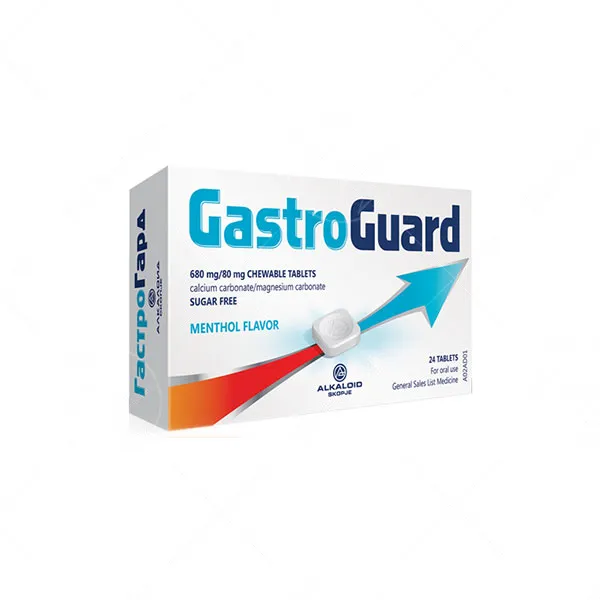
Table of Contents
INSTRUCTIONS FOR MEDICAL USE OF THE MEDICINAL PRODUCT GASTROGARD (GastroGuard®)
Composition:
Active substances: calcium carbonate, heavy magnesium carbonate;
One tablet contains 680 mg of calcium carbonate and 80 mg of heavy magnesium carbonate;
Excipients: colloidal anhydrous silicon dioxide, partially pregelatinized corn starch, copovidone, xylitol, low-substituted hydroxypropylcellulose (LH-11), flavouring agent "Spearmint Flavour SD", flavouring agent "Menthol L flavour spraydried", talc, magnesium stearate.
Pharmaceutical form. Chewable tablets.
Main physicochemical characteristics: white to almost white square, biconvex tablets with rounded corners.
Pharmacotherapeutic group. Antacids. Combined preparations and complex compounds of aluminium, calcium and magnesium. ATC code A02A D01.
Pharmacological properties.
Pharmacodynamics.
This medicinal product is a combination of two antacid agents – calcium carbonate and magnesium carbonate. The mechanism of action of calcium carbonate and magnesium carbonate is local, based on neutralization of gastric acid, and does not depend on systemic absorption.
In the stomach, calcium carbonate and magnesium carbonate react with hydrochloric acid of gastric juice, forming water and soluble mineral salts.
CaCO3 + 2HCl => CaCl2 + H2O + CO2
MgCO3 + 2HCl => MgCl2 + H2O + CO2
Calcium carbonate provides rapid, prolonged, and potent neutralizing effect. This effect is enhanced by the addition of magnesium carbonate, which also has a strong neutralizing action.
In vitro, the total acid-neutralizing capacity of the product amounts to 15.5 mEq H+ (titration to endpoint pH 2.5).
In healthy volunteers, a significant increase in gastric pH above baseline levels was achieved within 1 to 6 minutes after administration of the product.
Pharmacokinetics.
In the stomach, calcium carbonate and magnesium carbonate react with hydrochloric acid of gastric juice, forming water and soluble mineral salts. Calcium and magnesium may be absorbed from these soluble salts. However, the extent of absorption depends on individual patient characteristics and the administered dose. Less than 10% of calcium and 15–20% of magnesium are absorbed.
In healthy individuals, the small amount of absorbed calcium and magnesium is usually rapidly excreted from the body via the kidneys. In case of impaired renal function, plasma concentrations of calcium and magnesium may increase.
Due to the influence of various digestive juices outside the stomach, the soluble salts are converted into insoluble salts in the intestinal tract and subsequently excreted from the body in feces.
Clinical characteristics.
Indications.
For relief of symptoms associated with increased gastric acidity (e.g., heartburn, gastroesophageal reflux) leading to digestive disturbances and dyspepsia.
Contraindications.
Hypersensitivity to any component of the drug (see section "Composition").
Hypercalcemia, hypercalciuria, and/or conditions leading to hypercalcemia, such as sarcoidosis.
Nephrolithiasis due to formation of calcium-containing calculi.
Severe renal insufficiency.
Hypophosphatemia.
Interaction with other medicinal products and other forms of interaction.
Changes in gastric acidity occurring during treatment with antacids may result in reduced rate and extent of absorption of other drugs when administered concomitantly.
Calcium and magnesium salts may also interfere with the absorption of drugs containing phosphates, fluorides, and iron.
Thiazide diuretics reduce urinary excretion of calcium. Due to the increased risk of developing hypercalcemia when thiazide diuretics are used concomitantly, serum calcium levels should be monitored regularly.
It has been established that antacid preparations containing calcium and magnesium may form complexes with certain substances, such as antibiotics (tetracyclines, quinolones), cardiac glycosides (e.g., digoxin), levothyroxine, and eltrombopag, resulting in reduced absorption. This should be taken into account when co-administering such medicinal products.
GastroGard tablets should be taken 4 hours before or 4 hours after taking eltrombopag, and 1–2 hours after taking any other medicinal product.
Special precautions for use.
Prolonged use of the drug should be avoided. The recommended dose should not be exceeded, and if symptoms persist for more than 7 days, additional consultation with a physician is required.
The drug should be prescribed with caution to patients with impaired renal function. If such patients require treatment with this drug, plasma levels of calcium, phosphate, and magnesium should be monitored regularly.
In cases of renal insufficiency, magnesium salts may cause central nervous system depression.
Like other antacids, this medicinal product may mask the presence of gastric malignancy.
Prolonged use of the drug in high doses may lead to the development of adverse reactions such as hypercalcemia, hypermagnesemia, and milk-alkali syndrome, especially in patients with renal insufficiency. The drug should not be taken with large amounts of milk or dairy products.
Prolonged use may increase the risk of kidney stone formation.
Use during pregnancy or breastfeeding.
No increased risk of fetal developmental abnormalities has been observed following administration of calcium carbonate and magnesium carbonate during pregnancy. However, when the drug is used in high doses, for prolonged periods, or in patients with renal insufficiency, the risk of hypercalcemia and/or hypermagnesemia cannot be completely excluded. GastrOgard tablets may be used during pregnancy if taken according to the instructions for medical use, but prolonged use of high doses should be avoided.
GastraGard tablets may be used during breastfeeding if taken according to the instructions for medical use.
It should be noted that during pregnancy and breastfeeding, GastraGard provides a significant intake of calcium in addition to dietary sources. Therefore, pregnant women should limit the use of GastraGard chewable tablets according to the maximum recommended daily dose (see section "Dosage and administration") and avoid concomitant excessive consumption of milk and dairy products. This precaution aims to prevent excessive calcium intake, which may lead to the development of milk-alkali syndrome.
No increased risk of congenital malformations has been observed or is expected following prolonged use of calcium carbonate and magnesium carbonate during pregnancy.
The medicinal product may be used during pregnancy according to approved indications.
The maximum recommended daily dose should not be exceeded, and the drug should not be used for longer than two weeks without medical advice.
To prevent excessive calcium accumulation, pregnant women should avoid simultaneous intake of milk and dairy products.
Lactation.
Calcium and magnesium are excreted in breast milk; however, when therapeutic doses of the drug are used, no effect on newborns/infants during breastfeeding is expected.
Fertility.
There is no known evidence that the drug, when used according to recommendations, may negatively affect human fertility.
Ability to affect reaction speed when driving or operating machinery.
None.
Dosage and administration.
GastraGard tablets are taken orally, chewed or sucked.
Adults and children aged 15 years and older
1 or 2 tablets are chewed or sucked one hour after a main meal or at bedtime, or in case of severe discomfort. The dose may be increased for a short period up to 5 tablets per day. The maximum daily dose of 8 g of calcium should not be exceeded.
Use in renal impairment
See sections "Contraindications" and "Special precautions for use."
Elderly patients
No specific dosage adjustment is required; however, the precautions mentioned in the sections "Contraindications" and "Special precautions for use" should be observed.
Children.
Not recommended for use in children under 15 years of age.
Overdose.
Prolonged use of high doses of calcium carbonate and magnesium carbonate, especially in patients with impaired renal function, may lead to renal failure, hypermagnesemia, hypercalcemia, and alkalosis, which in turn may cause gastrointestinal symptoms (nausea, vomiting, constipation) and muscle weakness. In such cases, the drug should be discontinued and adequate fluid intake ensured. In severe cases of overdose (e.g., milk-alkali syndrome), medical consultation is required, as additional rehydration measures (e.g., infusions) may be necessary.
Adverse Reactions
The data on the adverse reactions listed below are based on spontaneous reports; therefore, the CIOMS III frequency categories are not applicable.
Immune system disorders
Very rarely, hypersensitivity reactions have been reported, manifesting as rash, urticaria, pruritus, angioedema, dyspnea, and anaphylaxis.
Gastrointestinal disorders
Nausea, vomiting, gastric discomfort, constipation, and diarrhea may occur.
Metabolism and nutrition disorders
Prolonged use of high doses of the drug, especially in patients with impaired renal function, may lead to hypermagnesemia, hypercalcemia, and alkalosis, which in turn may cause gastrointestinal symptoms and muscle weakness (see section "Overdose").
Musculoskeletal and connective tissue disorders
Muscle weakness may occur.
Adverse effects observed only in milk-alkali syndrome (see section "Overdose"):
- Gastrointestinal disorders: ageusia;
- General disorders and administration site conditions: calcinosis and asthenia;
- Nervous system disorders: headache;
- Renal and urinary disorders: azotemia.
Reporting of adverse reactions after marketing authorization is of great importance. It allows continuous monitoring of the benefit-risk balance of the medicinal product. Healthcare professionals, pharmacists, patients, and their legal representatives are encouraged to report all suspected adverse reactions and lack of efficacy through the Automated Pharmacovigilance Information System at the following link: https://aisf.dec.gov.ua/.
Shelf life: 3 years.
Storage conditions: No special storage conditions required. Keep out of reach of children.
Packaging: 8 tablets in a blister, 3 blisters per cardboard box.
Dispensing category: Over-the-counter.
Manufacturer: Alkaloid AD Skopje.
Manufacturer's address and place of business:
Boulevard Aleksandar Makedonski 12, Skopje, 1000, North Macedonia.