Gastal peppermint suspension
Ukraine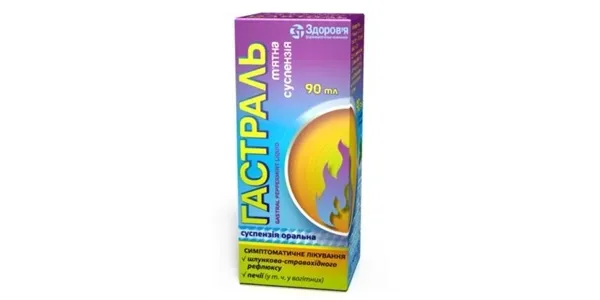
Table of Contents
INSTRUCTIONS FOR MEDICAL USE OF THE MEDICINAL PRODUCT GASTRAL PEPPERMINT SUSPENSION (GASTRAL PEPPERMINT LIQUID)
Composition:
Active substances: sodium alginate, sodium hydrogencarbonate, calcium carbonate;
5 ml of the preparation contains: sodium alginate 250 mg, sodium hydrogencarbonate 133.5 mg, calcium carbonate 80 mg;
Excipients: carbomer, methylparaben (E 218), propylparaben (E 216), sodium saccharin, peppermint oil, sodium hydroxide, purified water.
Pharmaceutical form. Oral suspension.
Main physicochemical properties: viscous, opaque suspension, white to white with yellowish or brownish tint, with a peppermint odor.
Pharmacotherapeutic group. Drugs for treatment of peptic ulcer and gastroesophageal reflux disease. ATC code A02B X13.
Pharmacological properties.
Pharmacodynamics.
After oral administration, GASTRAL PEPPERMINT SUSPENSION rapidly interacts with gastric juice, forming a layer of alginate gel on its surface with a pH close to neutral. This layer quickly and effectively coats the gastric walls (for up to 4 hours), preventing gastroesophageal reflux. In severe cases, this layer may rise into the esophagus instead of gastric contents, thus protecting the esophageal walls.
Pharmacokinetics.
The mechanism of action of the drug is physical and does not depend on absorption into the systemic circulation.
Clinical characteristics.
Indications.
Symptomatic treatment of gastroesophageal reflux, heartburn, including in pregnant women.
Contraindications.
This medicinal product is contraindicated in patients with known or suspected hypersensitivity to the active substances or to any of the excipients, including methylparaben (E 218) and propylparaben (E 216).
Interaction with other medicinal products and other forms of interaction.
At least 2 hours should elapse between the administration of GASTRAL MINT SUSPENSION and the use of other drugs, particularly H2-antihistamines, tetracyclines, digoxin, fluoroquinolones, iron salts, ketoconazole, neuroleptics, thyroxine, penicillamine, beta-blockers (atenolol, metoprolol, propranolol), glucocorticoids, chloroquine, bisphosphonates (diphosphonates), and estramustine.
Special precautions for use
If there is no improvement within 7 days, the clinical picture should be re-evaluated.
The 20 ml of suspension contain 290 mg (12.6 mmol) of sodium, which constitutes 14.5% of the maximum daily sodium intake for adults recommended by the World Health Organization. The maximum daily dose of the medicinal product contains 58% of the maximum daily sodium intake for adults recommended by the World Health Organization.
This medicinal product has a high sodium content (145 mg [6.3 mmol] of sodium in 10 ml of suspension), which should be taken into account in patients on a sodium-restricted diet, such as those with kidney disease or congestive heart failure.
Each 10 ml of the preparation contains 160 mg (1.6 mmol) of calcium carbonate. The medicinal product should be used with caution in patients with hypercalcaemia, nephrocalcinosis, or recurrent calcium-containing kidney stones.
In patients with impaired renal function, serum levels of calcium, potassium, and magnesium should be monitored regularly.
The medicinal product contains methylparaben (E 218) and propylparaben (E 216), which may cause allergic reactions (possibly delayed) (see section "Contraindications").
Use during pregnancy or breastfeeding.
Clinical studies involving more than 500 pregnant women, as well as extensive post-marketing data, indicate that the active substances do not cause developmental abnormalities and have no toxic effect on newborns/infants. The medicinal product may be used during pregnancy if clinically necessary, following consultation with a physician.
Breastfeeding. Studies have shown no adverse effects on newborns/infants who are breastfed by mothers using this medicinal product. The product may be used during breastfeeding following consultation with a physician.
Fertility. Preclinical data indicate that alginate has no negative effect on fertility or reproductive function in test animals or their offspring.
Clinical data do not indicate any effect on human fertility.
Ability to affect reaction speed when driving or operating machinery.
The medicinal product does not impair the ability to drive or operate other complex machinery.
Dosage and Administration.
For adults and children aged 12 years and older, the medicinal product should be administered orally in a dose of 10–20 mL (2–4 teaspoons) after meals and at bedtime. Elderly patients do not require dose adjustment.
For children aged 6 to 12 years: 5–10 mL (1–2 teaspoons) after meals and at bedtime.
If the prescribed dose is a multiple of 10 mL, the product may be used in sachet form.
The medicinal product should not be used for more than 7 days. If symptoms persist or worsen during this period, the patient should consult a physician for diagnostic clarification and adjustment of the treatment regimen.
Patients with impaired liver function do not require dose adjustment.
Renal insufficiency: use with caution in patients on a low-sodium diet (see section "Special Warnings and Precautions for Use").
Children. The medicinal product is not recommended for children under 6 years of age. For children under 12 years of age, the product should be used only as prescribed and under medical supervision.
Overdose.
Symptoms. Symptoms may be mild; some gastrointestinal discomfort may occur. Overdose may manifest as abdominal bloating.
Treatment. In case of overdose, symptomatic treatment should be administered.
Side effects.
Side effects are classified by frequency of occurrence: very common (≥1/10), common (≥1/100 to <1/10), uncommon (≥1/1000 to <1/100), rare (≥1/10,000 to <1/1000), very rare (<1/10,000), and not known (cannot be estimated from the available data).
Immune system disorders: very rare: anaphylactic and anaphylactoid reactions, hypersensitivity reactions such as skin rash, urticaria.
Respiratory, thoracic and mediastinal disorders: very rare: respiratory manifestations such as bronchospasm.
Gastrointestinal disorders: frequency not known: abdominal distension, constipation.
Reporting of side effects. Reporting of side effects after marketing authorization is important. It allows continuous monitoring of the benefit-risk balance of the medicinal product. Healthcare professionals and pharmacists, as well as patients or their legal representatives, are encouraged to report all suspected side effects and lack of efficacy of the medicinal product via the Automated Information System for Pharmacovigilance at the following link: https://aisf.dec.gov.ua.
Shelf life. 2 years.
The shelf life of the product after opening the bottle is no more than 6 months.
Storage conditions. Store in the original packaging at a temperature not exceeding 25 °C.
Do not store in a refrigerator and do not freeze.
Keep out of reach and sight of children.
Packaging. 90 ml or 180 ml in a bottle per carton; 10 ml in sachets, 20 sachets per carton.
Availability. Over-the-counter (without prescription).
Manufacturer. Limited Liability Company "Pharmaceutical Company "Zdorovya".
Manufacturer's address and place of business.
22 Shevchenka Street, Kharkiv, Kharkiv Oblast, 61013, Ukraine.