Gamanorm
Ukraine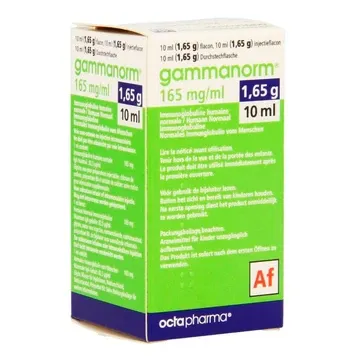
Table of Contents
INSTRUCTION FOR MEDICAL USE OF THE MEDICINAL PRODUCT GAMMANORM (GAMMANORM®)
Composition:
Active substance: human normal immunoglobulin;
1 ml of the injection solution contains 165 mg of human normal immunoglobulin;
corresponds to total protein content containing > 95% IgG;
distribution of IgG subclasses (approximate values): IgG1 – 59%, IgG2 – 36%, IgG3 – 4.9%,
IgG4 – 0.5%. Maximum IgA content – 82.5 μg/ml;
Excipients: glycine, sodium chloride, sodium acetate, polysorbate 80, water for injections.
Pharmaceutical form. Injection solution.
Main physicochemical properties: liquid preparation, clear or slightly opalescent, colorless or pale yellow, or light brown; slight cloudiness or a small amount of solid particles may form during storage.
Pharmacotherapeutic group. Normal human immunoglobulin for extravascular administration. ATC code J06BA01.
Pharmacological properties.
Pharmacodynamics.
Normal human immunoglobulin contains predominantly immunoglobulin G (IgG) with a broad spectrum of antibodies against infectious disease agents.
Normal human immunoglobulin contains IgG – antibodies present in the blood of a normal donor population. Normal human immunoglobulin is typically derived from pools of plasma from at least 1,000 donors. It contains IgG subclasses distributed proportionally to their natural distribution in human blood plasma. Appropriate doses of Gamanorm can restore pathologically low levels of immunoglobulin G to normal values.
Clinical trials
In the study program, patients with primary immunodeficiency syndromes were treated with Gamanorm. Each patient received treatment during two consecutive three-month periods according to a predefined sequence based on a crossover design (syringe then pump, or pump then syringe), without any washout period. Thus, the total duration of treatment within the study was 6 months for each patient.
The average monthly dose administered was 502.1 mg/kg body weight when delivered via pump and 475.0 mg/kg body weight when administered via syringe. Stable trough IgG levels with a mean concentration of 9.7 g/L were achieved during sequential treatment using the pump, while the mean IgG concentration was 9.4 g/L when patients were treated using a syringe. Patients received a mean total number of Gamanorm injections – 12.4 over the 3-month treatment period during sequential pump administration, and 34.8 injections over the 3-month treatment period when Gamanorm was administered via syringe.
Paediatric patients
There are no special or additional warnings or precautions for paediatric patients.
Pharmacokinetics.
After subcutaneous administration of Gamanorm, peak serum levels in the recipient are reached within 4–6 days.
Clinical trial data indicate that trough levels of Gamanorm can be maintained with a weekly dose of 100 mg/kg.
After intramuscular administration, normal human immunoglobulin becomes bioavailable in the recipient's circulation within 2–3 days.
IgG and IgG complexes are degraded in cells of the reticuloendothelial system.
Paediatric patients
There are no special or additional warnings or precautions for paediatric patients.
Clinical characteristics.
Indications.
Indications for subcutaneous administration.
Replacement therapy in adults, children and adolescents (from birth to 18 years of age) in the following conditions:
- Primary immunodeficiency syndromes with impaired antibody production.
- Hypogammaglobulinaemia or recurrent bacterial infections in patients with chronic lymphocytic leukaemia with severe secondary hypogammaglobulinaemia and recurrent infections, in whom prophylactic antibiotics have proven ineffective or are contraindicated.
- Hypogammaglobulinaemia and recurrent bacterial infections in patients with multiple myeloma.
- Hypogammaglobulinaemia in patients before and after allogeneic haematopoietic stem cell transplantation.
Contraindications.
Hypersensitivity to any of the components of the medicinal product.
Hamanorm must not be administered intravenously.
Hamanorm must not be administered intramuscularly in cases of severe thrombocytopenia and other haemostatic disorders.
Interaction with other medicinal products and other forms of interaction.
Live attenuated viral vaccines
Administration of immunoglobulin may result in reduced efficacy of live attenuated viral vaccines for a period of at least 6 weeks to 3 months against infectious diseases such as measles, rubella, mumps and varicella.
An interval of 3 months should be observed after administration of this product before vaccination with live attenuated viral vaccines. For measles, this effect may persist for up to 1 year. Therefore, antibody status should be checked in patients receiving measles vaccine.
Paediatric patients
No specific or additional interactions have been observed in paediatric patients.
Special precautions for use.
If GamanoRM has been accidentally administered intravascularly, patients may develop shock.
The recommended infusion rate specified in the section "Method of administration and dosage" must be strictly followed. Patients must be carefully monitored and closely observed for possible adverse reactions during administration of the drug.
Some adverse reactions may occur more frequently in patients receiving normal human immunoglobulin for the first time, or rarely when switching from replacement therapies to normal human immunoglobulin, or in patients who have had a prolonged interval since their previous injection.
Many potential complications can be avoided by ensuring:
- slow administration of the drug at the beginning of therapy (see section "Method of administration and dosage");
- careful monitoring of patients for symptoms throughout the entire period of drug administration. In particular, patients who have not previously been treated with normal human immunoglobulin, patients switching from replacement therapies, or patients who have had a prolonged interval since the previous injection should be under medical supervision during the first administration and for the first hour after the first infusion, to allow timely detection of possible adverse symptoms (reactions).
All other patients should remain under supervision for at least 20 minutes after administration.
In case of an adverse reaction, the infusion rate should be either reduced or the infusion stopped. The necessary treatment depends on the nature and severity of the adverse reaction.
In case of shock, standard medical treatment for shock should be initiated.
Hypersensitivity
Rarely, allergic reactions may occur, particularly in IgA-deficient patients with anti-IgA antibodies. Treatment of patients with such reactions should be carried out very cautiously. Patients with anti-IgA antibodies, for whom IgG therapy administered subcutaneously remains the only possible treatment option, should receive GamanoRM under strict medical supervision.
Occasionally, normal human immunoglobulin may cause a drop in blood pressure with anaphylactic reaction, even in patients who have previously received treatment with normal human immunoglobulin.
Thromboembolism
Arterial and venous thromboembolic complications, including myocardial infarction, stroke, deep vein thrombosis, and pulmonary embolism, have been associated with the use of immunoglobulins. Caution should be exercised in patients with pre-existing risk factors for thrombotic complications (such as advanced age, hypertension, diabetes, vascular diseases, history of thromboembolic events, acquired or inherited thrombophilic disorders, prolonged periods of immobilization, severe hypovolemia, or conditions increasing blood viscosity). Patients should be informed about the early symptoms of thromboembolic complications, such as difficulty breathing, pain and swelling of limbs, focal neurological symptoms, and chest pain, and advised to seek immediate medical attention if any of these occur. Patients should have adequate hydration prior to administration of immunoglobulins.
Aseptic Meningitis Syndrome (AMS)
Aseptic meningitis syndrome has been reported during treatment with subcutaneously administered immunoglobulins; symptoms usually appear within several hours to 2 days after treatment. Discontinuation of immunoglobulin therapy may result in remission of AMS within several days without residual effects.
Patients should be informed about early symptoms, including severe headache, nuchal rigidity, drowsiness, fever, photophobia, nausea, and vomiting.
Interference with serological testing
After administration of immunoglobulin, a temporary increase in various passively transferred antibodies in the patient's blood may lead to false-positive results in serological testing.
Passive transfer of antibodies against erythrocyte antigens, such as A, B, D, may affect certain serological tests, e.g., the Coombs test.
Transmissible agents
Standard measures to prevent infections resulting from medicinal products derived from human blood or plasma include donor selection, screening of individual donor blood and plasma pools for specific infection markers, and implementation of effective manufacturing steps for virus inactivation/removal. Nevertheless, when medicinal products derived from human blood or plasma are administered, the possibility of transmitting infections cannot be completely excluded. This also applies to unknown or emerging viruses and other pathogenic microorganisms.
The measures taken are considered effective against enveloped viruses such as human immunodeficiency virus (HIV), hepatitis B virus (HBV), and hepatitis C virus (HCV).
The measures taken may be less effective against non-enveloped viruses such as hepatitis A virus (HAV) and parvovirus B19.
There is reassuring clinical experience regarding the lack of transmission of hepatitis A or parvovirus B19 with immunoglobulins, and it is assumed that the antibody content contributes significantly to viral safety.
It is strongly recommended that the name and batch number of the GamanoRM product be recorded each time it is administered to a patient, to allow traceability between the patient's condition and the administration of a specific batch.
GamanoRM does not protect against hepatitis A.
This medicinal product contains 4.35 mmol (or 100 mg) of sodium per dose (40 mL). This should be taken into account by patients on a controlled low-sodium diet.
1 vial of 10 mL contains 1650 mg of normal human immunoglobulin.
1 vial of 20 mL contains 3300 mg of normal human immunoglob inflamm.
Paediatric patients
The aforementioned warnings and precautions apply to both adults and paediatric patients.
Special handling and disposal precautions:
The medicinal product should be at room temperature or body temperature before administration.
The solution should be clear or slightly opalescent, colourless, pale yellow, or light brown.
Do not use solutions that are cloudy or contain sediment.
Any unused medicinal product or waste material must be disposed of in accordance with national regulations.
Instructions for use
Remove the protective cap from the vial and disinfect the rubber stopper with alcohol.
To draw up GamanoRM, use a sterile syringe and needle or a drug transfer device (e.g., Minispike® or Medimop® vial adapter).
Introduce air into the vial equivalent to the volume of GamanoRM to be withdrawn.
Then draw up GamanoRM from the vial.
If multiple vials are required to obtain the desired amount of GamanoRM, repeat this step.
When using an infusion pump
Follow the manufacturer's instructions for pump preparation (filling). To ensure that no air remains in the intravenous infusion system, fill the system/needle with GamanoRM.
Disinfect the injection site(s) (e.g., lower abdomen, thigh) with an antiseptic solution.
Pinch the skin between two fingers and insert the needle into the subcutaneous tissue as shown and taught by the physician.
GamanoRM must not be administered intravascularly. To check whether a blood vessel has been accidentally punctured, gently pull back the syringe plunger and observe whether blood enters the system. If blood is seen, withdraw and dispose of the needle and infusion system. Repeat the filling and injection steps using a new needle, infusion system, and a new injection site.
Secure the needle with sterile gauze or a transparent dressing.
Administration of GamanoRM using an infusion pump
Follow the manufacturer's instructions for pump use.
In infants and children, the injection site may be changed after administering 5 – 15 mL of the product.
In adults, the injection site may be changed according to personal preference. The maximum volume to be administered at one injection site should not exceed 25 mL during the first 10 infusions. Subsequently, the volume per injection site may be gradually increased up to 35 mL if the product is well tolerated.
Multiple injection sites may be used simultaneously. Injection sites should be at least 5 cm apart from each other.
Administration of GamanoRM using a syringe
A butterfly-type catheter may be used to facilitate faster administration. Depending on the system used, the procedure may vary slightly.
Only one injection site should be used at a time. It may be necessary to administer the daily dose at more than one injection site.
Note: When starting to press the plunger, subcutaneous immunoglobulin is viscous and will resist pressure.
The injection rate should be chosen according to patient comfort. The recommended maximum injection rate is approximately 1 – 2 mL/minute. It is advisable not to rush: the injection should not be painful. Some injection sites tolerate larger volumes than others. If necessary, change to a new injection site.
In infants and children, the maximum volume per injection site should not exceed 5 – 15 mL.
In adults, the maximum volume per injection site should not exceed 25 mL.
Dosage is determined by the physician according to individual patient needs, and the prescribed dosage must always be strictly followed.
Remove the peel-off label from the GamanoRM vial and use it to complete the patient diary.
Use during pregnancy or breastfeeding.
Pregnancy
The safety of this medicinal product during pregnancy in humans has not been established in controlled clinical trials; therefore, GamanoRM should be prescribed with caution to pregnant women and women who are breastfeeding. Clinical experience with immunoglobulins suggests that harmful effects on pregnancy, the fetus, or the newborn are not expected.
Breastfeeding
Immunoglobulins are excreted in breast milk and may contribute to protecting the newborn from pathogens entering through the mucous membranes.
Fertility
Clinical experience indicates that immunoglobulins are not expected to have a harmful effect on fertility.
Ability to affect reaction speed when driving or operating machinery.
The ability to drive or operate machinery may be impaired due to certain adverse reactions associated with the use of GamanoRM. Patients experiencing adverse reactions during treatment should wait until these symptoms resolve before driving or operating machinery.
Method of administration and dosage.
Replacement therapy should be initiated and supervised by a physician experienced in treating immunodeficiency.
Administration
The dose and dosing regimen depend on the indication.
Replacement therapy
The medicinal product should be administered subcutaneously.
Individual dose adjustment may be required for each patient depending on pharmacokinetic and clinical response. The dosing regimens below should be used as guidance.
The dosing regimen for subcutaneous administration should aim to achieve a stable minimum IgG level (measured before the next administration) of at least 5–6 g/L and maintain levels within the age-specific reference range for serum immunoglobulin. A loading dose of at least 0.2–0.5 g/kg may be required. This may need to be divided over several days, with a maximum daily dose of 0.1–0.15 g/kg.
After achieving stable IgG levels, maintenance doses should be administered at regular intervals (approximately once a week) to achieve a cumulative monthly dose of 0.4–0.8 g/kg. Each single dose should be administered at different anatomical sites.
Minimum IgG levels should be measured and evaluated together with the frequency of infections. To reduce the incidence of infections, the dose may need to be increased, aiming for higher minimum IgG levels.
Paediatric patients
Doses for children and adolescents (from birth to 18 years of age) do not differ from adult doses, as doses for each indication are calculated based on body weight and adjusted according to clinical response as indicated for replacement therapy.
Method of administration
GamanoRM should be administered subcutaneously.
Subcutaneous infusions for home treatment are initiated and supervised by a physician experienced in managing home-treated patients. The patient must be informed about how to use the syringe pump, how to perform the administration procedure, how to maintain a treatment diary, how to recognize serious adverse reactions, and what actions to take if they occur.
Infusion pump for subcutaneous infusions
GamanoRM can be administered in the abdomen, thigh, upper arm, or lateral thigh. It is recommended to start infusion at a rate of 15 mL/hour/site. If the product is well tolerated, the infusion rate may be gradually increased by 1–2 mL/hour/site up to 25 mL/hour/site in subsequent infusions. The maximum infusion rate, if tolerated, may reach 100 mL/hour for all sites combined.
More than one infusion device may be used simultaneously.
In adults, doses exceeding 30 mL may be divided according to individual patient needs.
The maximum volume to be administered at one infusion site should not exceed 25 mL before the 10th infusion. After the 10th infusion, the maximum volume per infusion site may be gradually increased to 35 mL if the product is well tolerated.
The volume administered at a specific injection site may vary.
In infants and children, the infusion site may be changed after every 5–15 mL administered.
There are no limitations on the number of injection sites.
Syringe for subcutaneous infusions
GamanoRM may be administered using a syringe at a single infusion site.
The recommended maximum infusion rate is approximately 1–2 mL/minute.
The weekly dose may be divided into three administrations given every other day.
For adults, the maximum volume administered per infusion site should not exceed 25 mL of GamanoRM. For children, the maximum volume per infusion site should not exceed 5–15 mL of GamanoRM.
Administration of the daily dose at more than one site may be necessary.
The maximum infusion rate, if well tolerated, may reach 120 mL/hour for all sites combined.
Intramuscular administration
Intramuscular injection should be administered by a physician or nurse.
Children.
Applicable to paediatric patients; see section “Indications”.
Overdose.
Cases of overdose are not known.
Adverse reactions.
Short description of the safety profile.
Adverse reactions such as chills, headache, dizziness, vomiting, allergic reactions, nausea, arthralgia, low blood pressure, and mild back pain may sometimes occur. Rarely, normal human immunoglobulins may cause a sudden drop in blood pressure and, in individual cases, anaphylactic shock, even when the patient has not previously demonstrated hypersensitivity upon prior administration of the drug.
Local reactions at the injection site may frequently occur, such as: swelling, pain, redness, induration, warmth (feeling of heat), itching, hematoma (bruising), and rash.
A table listing adverse reactions is provided below.
The table provides an overview of adverse reactions observed in clinical trials, post-marketing safety studies, and other post-marketing sources. Adverse reactions are classified by MedDRA (Medical Dictionary for Regulatory Activities) system organ class using preferred terms.
The following frequencies of adverse reactions have been observed with the use of the medicinal product Gamanorm:
very common (≥ 1/10); common (≥ 1/100 to < 1/10); uncommon (≥ 1/1,000 to < 1/100); rare (≥ 1/10,000 to < 1/1,000); very rare (< 1/10,000); not known (cannot be estimated from available data).
For spontaneously reported post-marketing adverse reactions, the frequency is classified as not known.
| MedDRA system organ class |
Adverse reaction |
Frequency |
| Immune system disorders |
hypersensitivity anaphylactic shock |
uncommon very rare |
| Nervous system disorders |
aseptic meningitis# dizziness tremor headache |
unknown common uncommon common |
| Vascular disorders |
thromboembolic complications# pallor hypotension |
very rare uncommon rare |
| Respiratory, thoracic and mediastinal disorders |
bronchospasm dyspnea cough |
uncommon uncommon unknown |
| Gastrointestinal disorders |
abdominal pain diarrhea nausea vomiting |
uncommon uncommon common common |
| Skin and subcutaneous tissue disorders |
urticaria rash pruritus |
unknown unknown unknown |
| Musculoskeletal and connective tissue disorders |
back pain myalgia arthralgia |
unknown common very rare |
| General disorders and administration site reactions |
fever chills fatigue injection site reaction malaise hyperemia asthenia feeling of warmth feeling of cold influenza-like illness facial swelling |
very rare very rare common very common uncommon unknown uncommon uncommon uncommon unknown unknown |
See also section "Special precautions for use".
For safety information regarding transmissible infections, see section "Special precautions for use".
Paediatric population
The frequency, type and severity of adverse reactions in children are the same as in adults.
Suspected adverse reactions reporting
Reporting of suspected adverse reactions after marketing authorization is important. It allows continuous monitoring of the benefit-risk balance of the medicinal product. Please report any suspected adverse reactions.
Shelf life. 3 years. After first opening of the vial, the medicinal product should be used immediately.
Storage conditions.
Store at 2 to 8 ºC. Do not freeze.
Keep out of the reach of children.
Store the vial in the original cardboard packaging.
During the shelf life, the product can be stored below 25 ºC for up to 1 month without returning it to refrigerated storage. The product must be discarded if not used after this period.
Incompatibilities.
In the absence of compatibility studies, this medicinal product should not be mixed with other medicinal products.
Packaging.
10 ml or 20 ml of solution for injection in a vial.
1 vial in a cardboard box.
Prescription status.
Prescription only.
Manufacturer.
Octapharma AB.
Manufacturer's address. Lars Forssells gata 23, Stockholm, 11275, Sweden.