Gamalate b6
Ukraine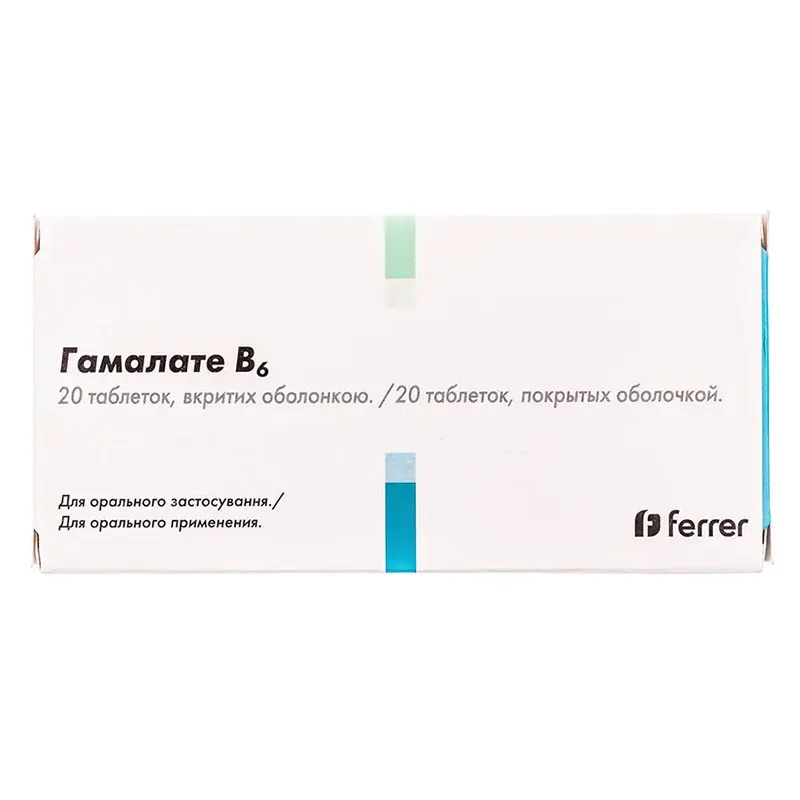
Table of Contents
INSTRUCTIONS FOR MEDICAL USE OF THE MEDICINAL PRODUCT GAMALATE B6 (GAMALATE B6)
Composition:
Active ingredients: 1 coated tablet contains magnesium glutamate hydrobromide (anhydrous) (MGH) 75 mg; γ-aminobutyric acid (GABA) 75 mg; γ-amino-β-oxybutyric acid (GABOB) 37 mg; vitamin B6 (pyridoxine hydrochloride) 37 mg.
Excipients: colloidal anhydrous silicon dioxide, povidone, sodium starch glycolate (type A), magnesium stearate, talc, corn starch; coating: titanium dioxide (E 171), acacia, light magnesium carbonate, talc, acrylic copolymer, propylene glycol, sugar syrup, indigocarmine (E 132), carnauba wax.
Pharmaceutical form. Coated tablets.
Main physicochemical properties: sugar-coated tablets, blue in color.
Pharmacotherapeutic group. Psychostimulants and nootropics.
ATC code: N06B X.
Pharmacological Properties
Pharmacodynamics
Gamalate B6 contains a combination of active substances: gamma-aminobutyric acid (GABA), gamma-amino-beta-hydroxybutyric acid, vitamin B6 (pyridoxine hydrochloride), which are natural components of brain tissue, and magnesium glutamate hydrobromide (MGHB). The medicinal product exerts a neuroregulatory effect on processes in the brain, producing a mild sedative and cerebrotonic effect.
Gamma-aminobutyric acid (GABA) is formed in the brain through decarboxylation of glutamic acid. This reaction is catalyzed by the enzyme glutamate decarboxylase (GDC) and the coenzyme – vitamin B6. As a result of this reaction, gamma-amino-beta-hydroxybutyric acid (GABOB) is formed. GABOB exerts an anticonvulsant effect mediated via a cholinergic mechanism and improves memory and learning ability.
In addition, GABA can be converted back into its precursor (glutamic acid) through a transamination mechanism catalyzed by the enzyme GABA-alpha-ketoglutarate transaminase (GABA-T), with vitamin B6 again acting as a coenzyme. Through this transamination mechanism, GABA participates in cerebral oxygenation.
GABA → glutamic acid → aspartic acid, forming in the brain a substrate for the Krebs cycle.
Thus, the level of GABA in the central nervous system depends on the balance between the activities of glutamate decarboxylase and GABA-T.
When brain function is impaired, a deficiency in inhibition occurs, associated with reduced levels of GABA – the primary inhibitory neurotransmitter. Administration of Gamalate B6 provides exogenous supply of GABA to the nervous system, and the resulting elevated GABA levels produce the following effects:
- Performs a neurotransmitter function and suppresses excitation processes;
- Participates in the transport and utilization of glucose in the brain;
- Participates in cellular respiration and oxidative phosphorylation;
- Promotes the incorporation of specific amino acids (leucine, alanine, phenylalanine) into proteins;
- Participates in the regulation of protein synthesis in the brain.
MGHB contains glutamic acid and a magnesium-bromine compound in chelate form. Due to this structure, MGHB acts as a partial (partial) agonist of L-glutamate, resulting in reduced stimulation and a mild sedative effect. This distinguishes it from tranquilizers (benzodiazepines, barbiturates), which have direct inhibitory action associated with a high incidence of adverse effects, which are not characteristic of MGHB. Studies have demonstrated the anticonvulsant activity of MGHB, as well as a positive effect in sleep disorders, neurovegetative changes, and behavioral disorders in children. The calming effect of MGHB is not associated with reduced attention or concentration.
Pharmacokinetics
Gamalate B6 contains four components, three of which are physiological substances (GABA, GABOB, and vitamin B6). Classical pharmacokinetic studies are therefore not feasible due to the difficulty in quantitatively distinguishing exogenous from endogenous components. The number of components in this medicinal product also precludes analysis using radiolabeled substances due to the high radiological burden.
Clinical characteristics.
Indications. For adults as an adjunctive agent in functional asthenia with manifestations of:
- emotional lability;
- impaired concentration and memory;
- depression and asthenia;
- low adaptability.
Contraindications. Hypersensitivity to any component of the drug.
Due to the presence of γ-aminobutyric acid, the drug is contraindicated in acute renal failure.
Due to the presence of pyridoxine hydrochloride, the drug is contraindicated in peptic ulcer of the stomach and duodenum in the exacerbation phase (due to the possible increase in gastric juice acidity).
Interaction with other medicinal products and other forms of interaction. When used concomitantly with benzodiazepine drugs (tranquilizers, anticonvulsants) as well as with sedatives (barbiturates), mutual potentiation of effect may occur. When used in combination with benzodiazepine drugs, each medicinal substance should be administered at the lowest or medium effective doses. Pyridoxine hydrochloride is incompatible with drugs containing levodopa, since simultaneous administration enhances peripheral decarboxylation of levodopa, thereby reducing its antiparkinsonian effect.
Special precautions for use
The formulation contains sugar syrup, which should be taken into account in patients with diabetes mellitus. The drug should not be administered to patients with rare hereditary fructose, glucose or galactose intolerance, malabsorption syndrome, or sucrase-isomaltase deficiency.
This medicinal product contains less than 1 mmol (23 mg)/dose of sodium. Caution is advised when administering to patients on a controlled sodium diet.
May cause symptoms resembling those observed after alcohol consumption due to the presence of propylene glycol in the formulation.
Use during pregnancy or breastfeeding. This medicinal product should be used during pregnancy or breastfeeding only under medical supervision and after careful consideration of the benefit-risk ratio.
Vitamin B6 is excreted into breast milk. High concentrations of vitamin B6 may suppress lactation.
Ability to affect reaction speed when driving or operating machinery. In individual cases, certain adverse reactions affecting the central nervous system may influence the ability to drive or operate complex machinery.
Dosage and Administration
For adults, take orally 2 tablets 2–3 times a day.
The duration of treatment depends on the patient's condition and the course of the disease, and ranges from 1 to 6 months (individually determined by a physician).
Children. In pediatric practice, the drug should be used in the form of an oral solution.
Overdose. The drug has low toxicity; therefore, intoxication is not expected.
Side effects.
When used in high doses, dyspeptic disorders are possible, which disappear upon dose adjustment. Allergic reactions cannot be excluded.
Gastrointestinal side effects: nausea, vomiting. The active ingredient pyridoxine hydrochloride may increase gastric juice acidity.
Shelf life. 5 years.
Storage conditions. Keep out of reach of children.
Store at a temperature not exceeding 30 °C.
Packaging. 10 coated tablets in a blister. 2 or 6 blisters per pack.
Prescription status. Prescription only.
Manufacturer. Ferrer Internacional, S.A., Spain.
Manufacturer's name and address of business location.
Legal address:
Gran Vía Carlos III, 94, 08028 Barcelona, Spain.
Place of manufacture:
s/Joan Busqueta, 1-9, 08173 Sant Cugat del Vallès (Barcelona), Spain.